hit counter

Clomipramine Improved Alzheimer’s Mouse Memory by Blocking Itch in 45 Days

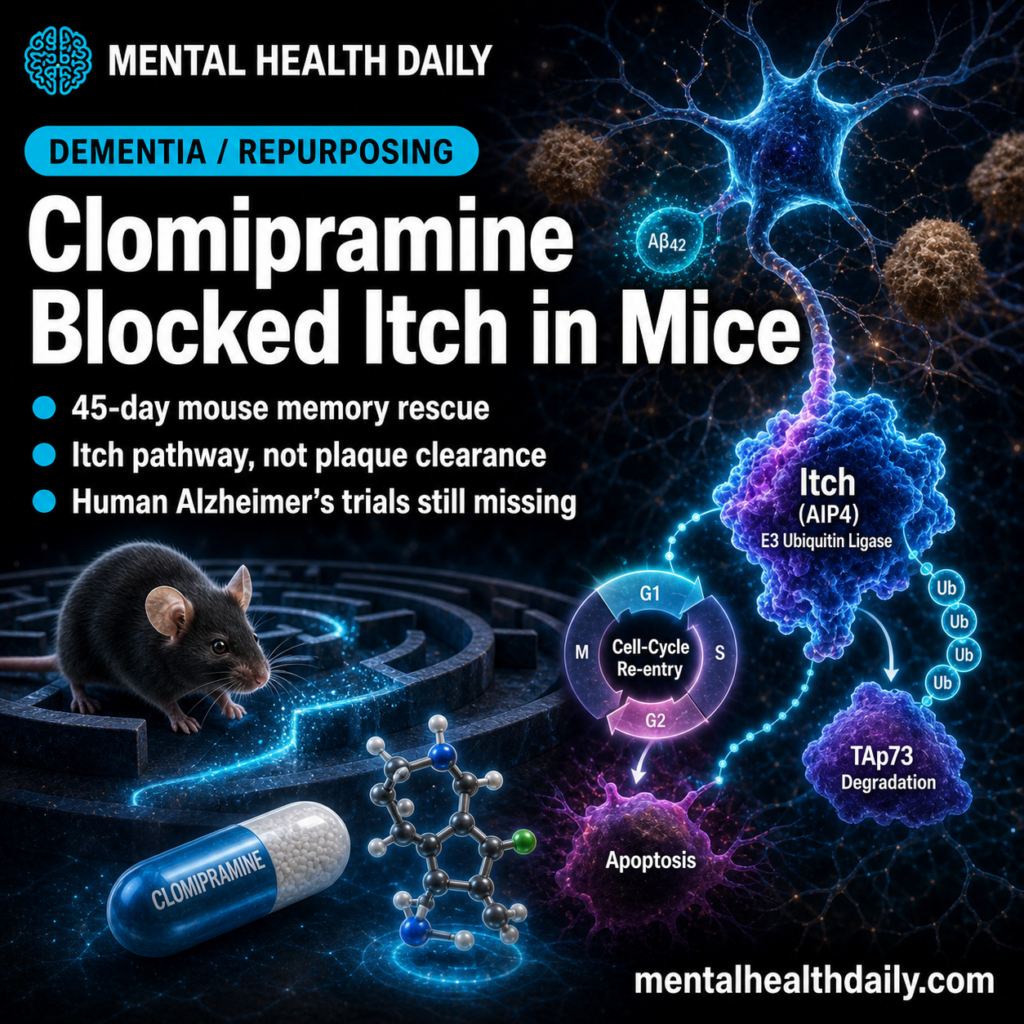
Editorial card showing clomipramine, Itch signaling, and Alzheimer's mouse-memory rescue with a molecular neuroscience background.

A 2026 iScience study found that 45 days of clomipramine improved spatial, working, and reference memory in female APP/PS1 Alzheimer’s-model mice, apparently by blocking the E3 ubiquitin ligase Itch rather than by clearing amyloid plaques.1 Research Highlights 45-day clomipramine signal: 6-month female APP/PS1 mice received 25 mg/kg clomipramine every other day for 45 days, then …

Read more

Statins and Dementia Risk: No Long-Term Signal in 322,358 Patients

Statins do not look like a dementia-prevention drug, but they do not look like a dementia hazard either. In 322,358 Kaiser Permanente Northern California patients followed for an average of 11.8 years, dementia diagnoses rose right after statins were started, then flattened: after the first year, the hazard ratio for Alzheimer’s disease and related dementias …

Read more

Alzheimer’s RVI-AD MRI Score Predicted Dementia Conversion With 0.70 AUC

A 2026 Molecular Psychiatry study found that RVI-AD, a structural-MRI score measuring how closely a person’s brain anatomy matches an Alzheimer’s disease pattern, predicted mild-cognitive-impairment conversion to dementia most strongly over the next 3 years: OR 2.16, 95% CI 1.81-2.57, p < 2e-16, AUC 0.70.1 Research Highlights Short-term conversion signal: in 965 ADNI participants with …

Read more

Lecanemab Clears Amyloid via Microglia and Fc Receptors

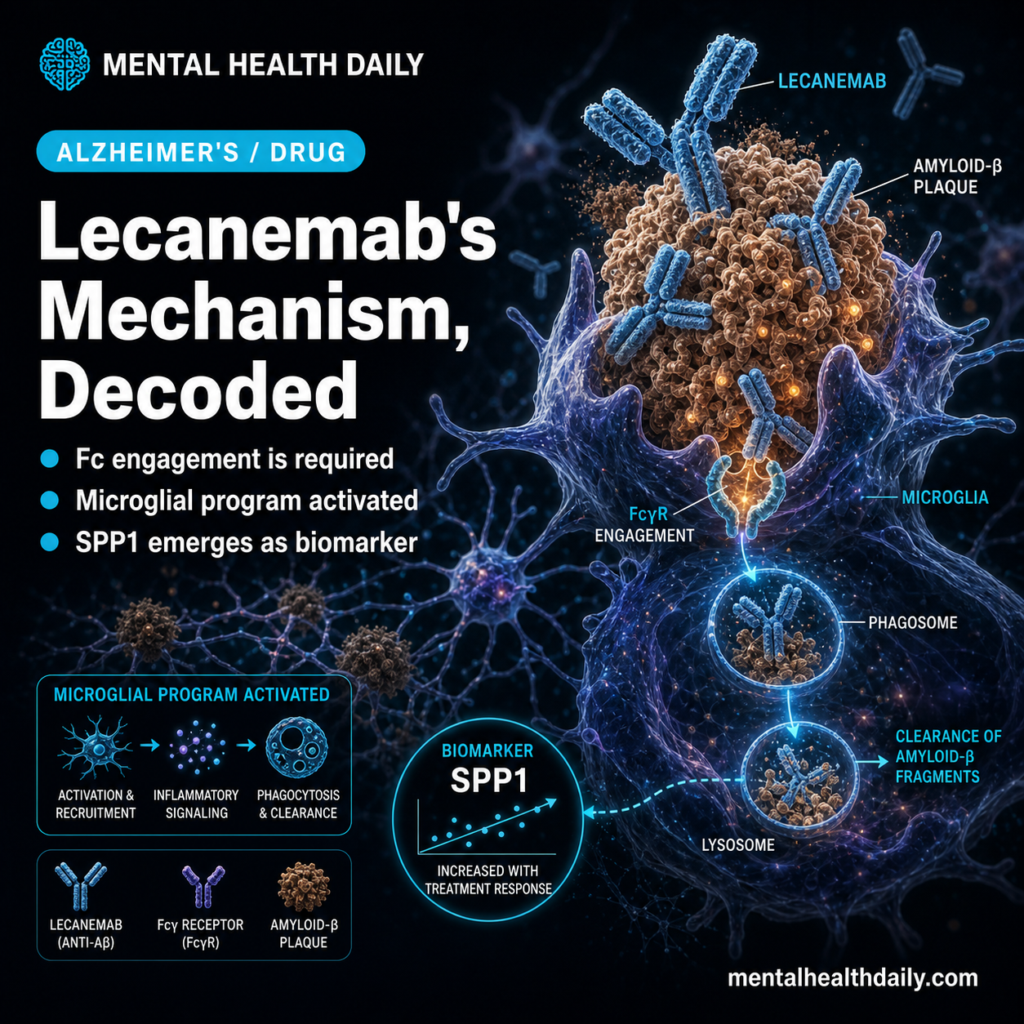
Photoreal illustration of microglia clustering around an amyloid plaque, conveying immune-mediated clearance mechanism.

A 2026 Nature Neuroscience study found that lecanemab cleared amyloid in a humanized-microglia Alzheimer’s disease model only when microglia and the antibody’s intact Fc fragment were both present: X-34 plaque area differed across IgG1, lecanemab, and Fc-silenced LALA-PG groups (P = 0.0003), 82E1 plaque area differed across groups (P < 0.0001), and microglia-deficient mice showed …

Read more

Total-Body Tau PET Links Brain-Organ Coupling to Alzheimer’s Cognition

Photoreal illustration of brain with cardiac and respiratory rhythm overlays, conveying brain-body coupling and AD pathology.

A 2026 total-body tau-PET study of 28 people with Alzheimer’s disease and 23 biomarker-negative controls found stronger brain-organ network connectivity in Alzheimer’s disease than in biomarker-negative controls: 35 altered connections, including 21 brain-body edges, plus AD-only links between brain-organ coupling, cortical tau burden, MRI-derived glymphatic markers, and cognition.1 The result is best read as a …

Read more

Plasma p-tau217 Blood Test Predicts Alzheimer’s Risk 1.5x Stronger in APOE-e4

Photoreal illustration representing a blood biomarker test for Alzheimer's disease with imagery of blood vials, neurons, and APOE genetic motifs.

Until recently, Alzheimer’s pathology could only be confirmed in living patients via PET imaging or lumbar puncture. Plasma p-tau217 changed that calculus — but how to interpret a positive result depends substantially on APOE genotype.1 Research Highlights Plasma p-tau217 is a blood biomarker that rises years before Alzheimer’s symptoms. The 2024 Alzheimer’s Association revised criteria …

Read more