hit counter

Plasma p-tau217 Blood Test Predicts Alzheimer’s Risk 1.5x Stronger in APOE-e4
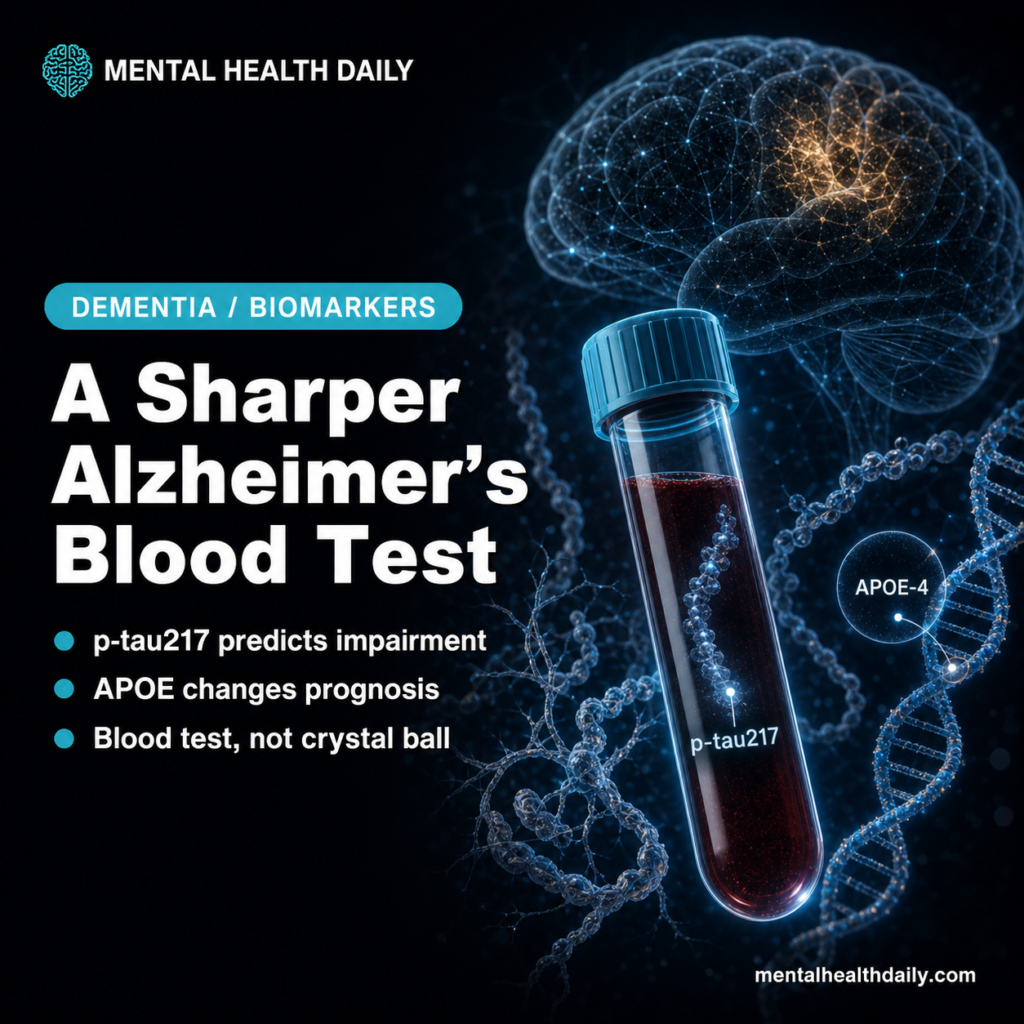
Photoreal illustration representing a blood biomarker test for Alzheimer's disease with imagery of blood vials, neurons, and APOE genetic motifs.

Until recently, Alzheimer’s pathology could only be confirmed in living patients via PET imaging or lumbar puncture. Plasma p-tau217 changed that calculus — but how to interpret a positive result depends substantially on APOE genotype.1 Research Highlights Plasma p-tau217 is a blood biomarker that rises years before Alzheimer’s symptoms. The 2024 Alzheimer’s Association revised criteria …

Read more

Repetitive TMS for Alzheimer’s Disease Alters Brain Waves & Enhances Cognition (2024 Study)

Repetitive transcranial magnetic stimulation (rTMS) is making waves in the field of Alzheimer’s disease (AD) research, offering a glimmer of hope for enhancing cognitive functions in patients. By targeting specific brain regions, rTMS has shown promising results in modulating neural activity and improving cognitive scores. This innovative therapy, coupled with real-time monitoring through electroencephalography (EEG), …

Read more

Berberine for Alzheimer’s Disease Treatment: Mechanisms & Efficacy (2023 Review)

In the quest for more effective treatments for Alzheimer’s Disease (AD), berberine, a bioactive compound derived from traditional Chinese medicine, has emerged as a promising candidate. Recent preclinical studies have showcased its potential to combat the debilitating effects of AD, with evidence pointing towards its ability to improve cognitive functions, reduce hallmark AD pathologies such …

Read more

Ultra-Processed Foods (UPF) Linked to Increased Alzheimer’s Disease Risk (2023 Review)

In the modern dietary landscape, ultra-processed foods (UPFs) have become a staple in many diets, celebrated for their convenience and palatability. However, emerging research reveals a concerning association between UPF consumption and increased risk of Alzheimer’s disease (AD), a leading cause of dementia. Highlights: Strong Link: Recent systematic reviews indicate a strong link between high …

Read more

Caffeine to Prevent Alzheimer’s Disease via Adenosine A2A Receptors? (2023 Review)

Alzheimer’s Disease (AD), a prevalent form of dementia, poses significant challenges for individuals and healthcare systems worldwide. Current treatments primarily offer symptomatic relief without altering the disease’s progression. However, emerging research suggests that caffeine, a widely consumed psychoactive substance, may have neuroprotective properties against AD. Highlights: Alzheimer’s Disease is the most common form of dementia, …

Read more

Olibanum Gum Ineffective for Mild-to-Moderate Alzheimers Disease (2023 Study)

Alzheimer’s disease (AD) is a neurodegenerative disorder characterized by cognitive decline, significantly impacting the elderly. A recent clinical trial investigated the memory-improving potential of Olibanum, a traditional herbal remedy, in AD patients. Highlights: Alzheimer’s disease is a leading cause of dementia, characterized by memory loss and cognitive impairment. Olibanum, also known as Frankincense, has a …

Read more