
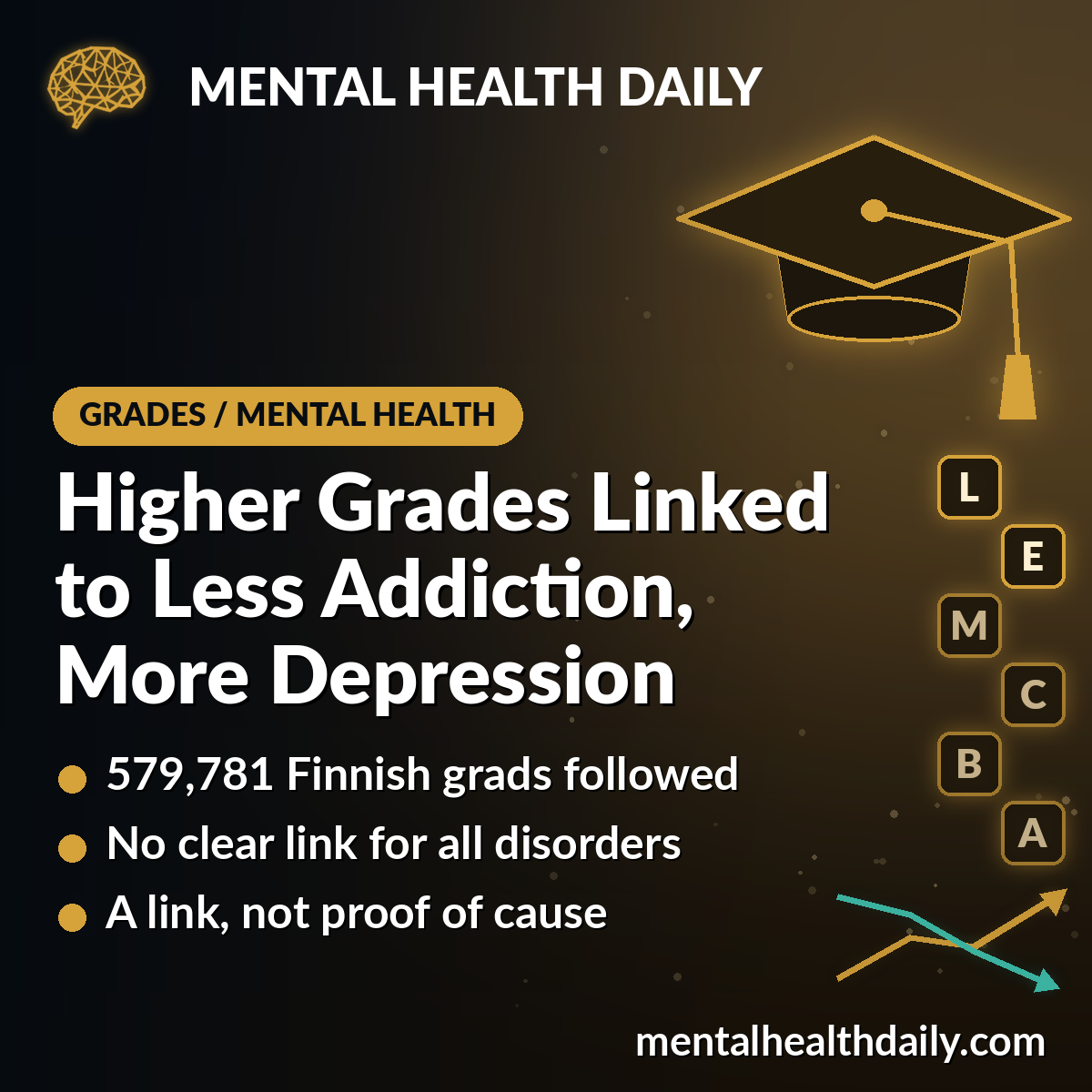
Do good grades protect young people’s mental health? In a study of 579,781 Finnish high school graduates, the answer depended on the disorder. Higher grades on Finland’s final school exams were linked to a lower risk of substance use disorders but a higher risk of depression, anxiety, eating disorders, and personality disorders.1
Looking at all disorders together, grades showed no consistent link with being diagnosed with a mental disorder. Rates of some disorders rose with grades while others fell.
Research Highlights
- Opposite links by disorder: among students with average ninth-grade grades, those who finished high school with an E average (second-highest grade) had a 19% lower rate of substance use disorders than C students (hazard ratio 0.81) and a 25% higher rate of depression (hazard ratio 1.25).1
- Largest increases: the same comparison gave hazard ratios of 1.51 for eating disorders and 1.37 for personality disorders.1
- No overall pattern: across the whole cohort, final grades had no consistent link with being diagnosed with any mental disorder, including in the comparison between siblings.1
- Family factors explain part of it: when siblings were compared with each other, the substance use link held, the depression link held in weaker form, and the anxiety link almost disappeared.1
- Big grade changes stood out: students who went from top ninth-grade grades to the lowest final grades had about 8 times the rate of schizophrenia spectrum disorders, and big improvements were linked to bipolar disorder.1
How the Finnish Study Worked
Christian Hakulinen and colleagues at the University of Helsinki linked national registers covering everyone born in Finland from 1980 to 2001 who graduated from general upper secondary school, the academic high school track, between 1999 and 2021.1
- Grades: the average of each student’s matriculation exams, national tests taken at the end of high school. Grades run from L (highest) through E, M, C, B, to A (lowest passing grade). C, the most common average, was the comparison group.
- Diagnoses: the first recorded mental disorder in hospital, specialist, or primary care records, from graduation (ages 18 to 20) through 2023.
- Starting point: anyone already diagnosed with a given disorder before graduation was left out of that disorder’s analysis.
- Adjustments: sex, birth year, where people lived, parents’ education and income, parents’ mental health history, and in later models, grades at the end of ninth grade.
Over 7.1 million person-years of follow-up, 215,678 people (37.2%) received a mental disorder diagnosis.1 The registers cover hospital and specialist care, plus primary care since 2011, so the count includes a wide range of diagnoses.
Better Grades Were Linked to Less Substance Use but More Depression
The study reports results as hazard ratios. A hazard ratio compares how often a new diagnosis shows up over time in one group versus another. A value of 1 means the same rate as the C students; 1.25 means a 25% higher rate; 0.81 means a 19% lower rate. These are relative differences, not the chance that any one student develops a disorder.
The clearest numbers come from students whose ninth-grade grades were near average. Comparing those who ended high school with an E average against those with a C average:1
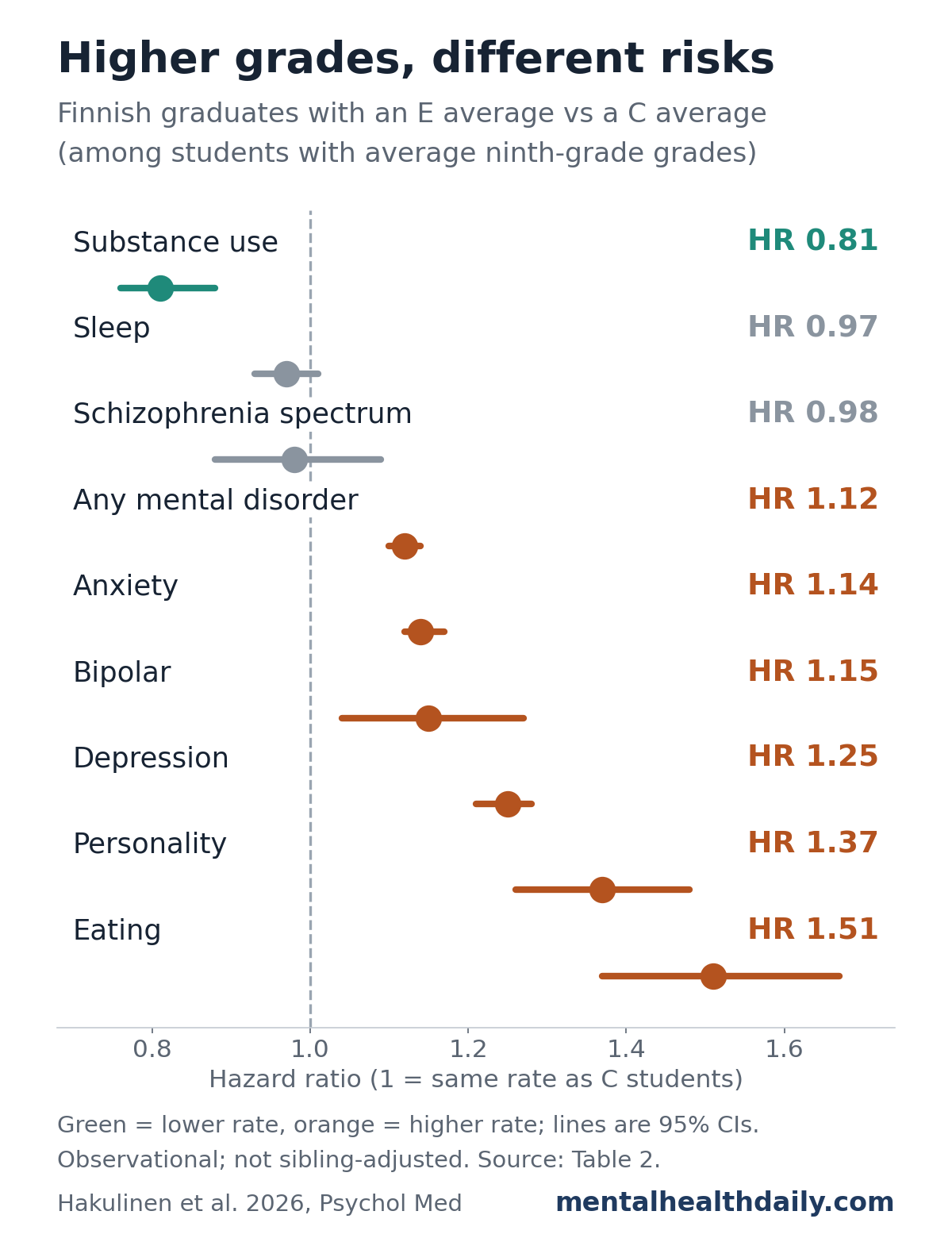
The gradient kept going at the top. In the same group, students with an L average, the highest grade, had a hazard ratio of 1.40 for depression, 1.73 for personality disorders, and 2.49 for eating disorders. At the bottom, an A average came with a 41% higher rate of substance use disorders (hazard ratio 1.41) and a 16% lower rate of depression (hazard ratio 0.84).1
Across the full cohort, without grouping by ninth-grade grades, final grades showed no consistent link with any mental disorder overall. The picture changed when students were compared with others who had similar ninth-grade grades: then higher final grades went with a modestly higher overall rate, such as the 1.12 in the chart. That broad category mixes disorders whose rates rose with grades and disorders whose rates fell.1
What the Sibling Comparison Changed
Families shape both school performance and mental health through shared genes, home life, money, and expectations. To handle this, the researchers ran a sibling comparison: they compared brothers and sisters from the same family who earned different grades. That removes the influence of anything siblings share, such as their parents, their upbringing, and part of their genes.
- Substance use: higher grades were still linked to lower risk within families.
- Depression: the link with higher grades was broadly consistent across all models, though weaker in the sibling analysis.
- Schizophrenia spectrum: above-average grades were linked to lower risk within families.
- Anxiety: the link almost completely disappeared.
- Eating and personality disorders: the links were partly (eating) or mostly (personality) weakened.
So for several disorders, part of what looks like a grades effect comes from family background.1 Full siblings share only about half their genes, so the sibling design cannot rule out genetic differences between them.
Big Grade Changes Before Schizophrenia and Bipolar Disorder
The team also looked at students whose grades moved a lot between ninth grade and the end of high school:1
- Sharp drops: among students with top ninth-grade grades, finishing high school with an A average was linked to a much higher rate of schizophrenia spectrum disorders (hazard ratio 8.28, 95% CI 3.06 to 22.42). The interval is wide because few people fell into this group.
- Big improvements: among students with low ninth-grade grades, finishing with an E average was linked to higher rates of bipolar disorder (hazard ratio 2.56), eating disorders (2.68), and personality disorders (2.01).
The authors point out that these changes may be early signs of illness rather than causes. Early thinking problems and social withdrawal can begin before schizophrenia is diagnosed and could pull grades down. For bipolar disorder, high energy and drive during hypomanic periods could push grades up before a diagnosis.1
How This Fits With Earlier Studies of Ninth-Grade Grades
Studies of grades at around age 15 or 16 mostly found the opposite for depression:
- Finland, ninth grade: in over 1 million Finns born from 1980 to 2000, better ninth-grade grades were linked to lower risk of every mental disorder except eating disorders. The strongest link was with substance use.2
- Finland, 1987 birth cohort: in 50,508 people, a higher ninth-grade average was linked to lower risk of psychosis, bipolar disorder, and depression, with poor physical education grades showing the strongest link.3
- Sweden, age 16: in 713,876 students, excellent grades were linked to nearly 4 times the risk of later bipolar disorder compared with average grades (hazard ratio 3.79). Students with the poorest grades also had a higher risk.4
The substance use and eating disorder results in the new study are consistent with this earlier work. The depression and anxiety results are not. One difference is who gets measured: final exams include only students on the academic track who reached graduation without an existing diagnosis — a narrower group than all ninth graders.
The authors suggest personality traits may help explain the split. High grades partly reflect conscientiousness, which is linked to better mental health, and perfectionism, which is linked to depression, anxiety, and especially eating disorders.1 The study did not measure these traits.
Limits of the Study
- Observational design. The study shows links, not causes. It does not show that studying hard or earning high grades leads to depression.
- Modest effects. The authors describe many of the links as modest and say grades are unlikely to work as a standalone screening tool for individual students.
- Diagnoses, not symptoms. Registers capture people who sought and received care, so differences in help-seeking could affect the numbers.
- Narrow group. Only academic-track graduates were included, and anyone diagnosed before graduation was excluded from that analysis.
- Finland only. Education and health care are free and widely available there, which may not match other countries.
What It Means for Students and Parents
High grades are not a sign that a teenager is safe from mental health problems, and low grades are not a reliable warning sign on their own. The study points instead to specific patterns worth noticing: strong students can still develop depression, anxiety, or eating disorders, and a sudden, large change in grades can sometimes come before a serious illness. Anyone worried about a young person’s mood, eating, substance use, or behavior should talk with a doctor or mental health professional, whatever their report card says.
References
- Hakulinen C, Gutvilig M, Niemi R, et al. Association between school achievement in upper secondary education and subsequent risk of mental disorders: a population-based cohort study. Psychological Medicine. 2026;56:e301. doi:10.1017/S0033291726105637
- Weckström T, Elovainio M, Pulkki-Råback L, et al. School achievement in adolescence and the risk of mental disorders in early adulthood: a Finnish nationwide register study. Molecular Psychiatry. 2023;28:3104–3110. doi:10.1038/s41380-023-02081-4
- Gyllenberg D, Ristikari T, Kelleher I, et al. School performance and later diagnoses of nonaffective psychoses, bipolar disorder, and depression. Acta Psychiatrica Scandinavica. 2022;146(5):420–429. doi:10.1111/acps.13481
- MacCabe JH, Lambe MP, Cnattingius S, et al. Excellent school performance at age 16 and risk of adult bipolar disorder: national cohort study. British Journal of Psychiatry. 2010;196(2):109–115. doi:10.1192/bjp.bp.108.060368