
In a small randomized trial of 29 people with nerve pain after a spinal cord injury, 2 weeks of daily motor cortex rTMS lowered pain more than sham stimulation. Depression and anxiety scores also fell in the active group, but those drops did not beat sham.1
Research Highlights
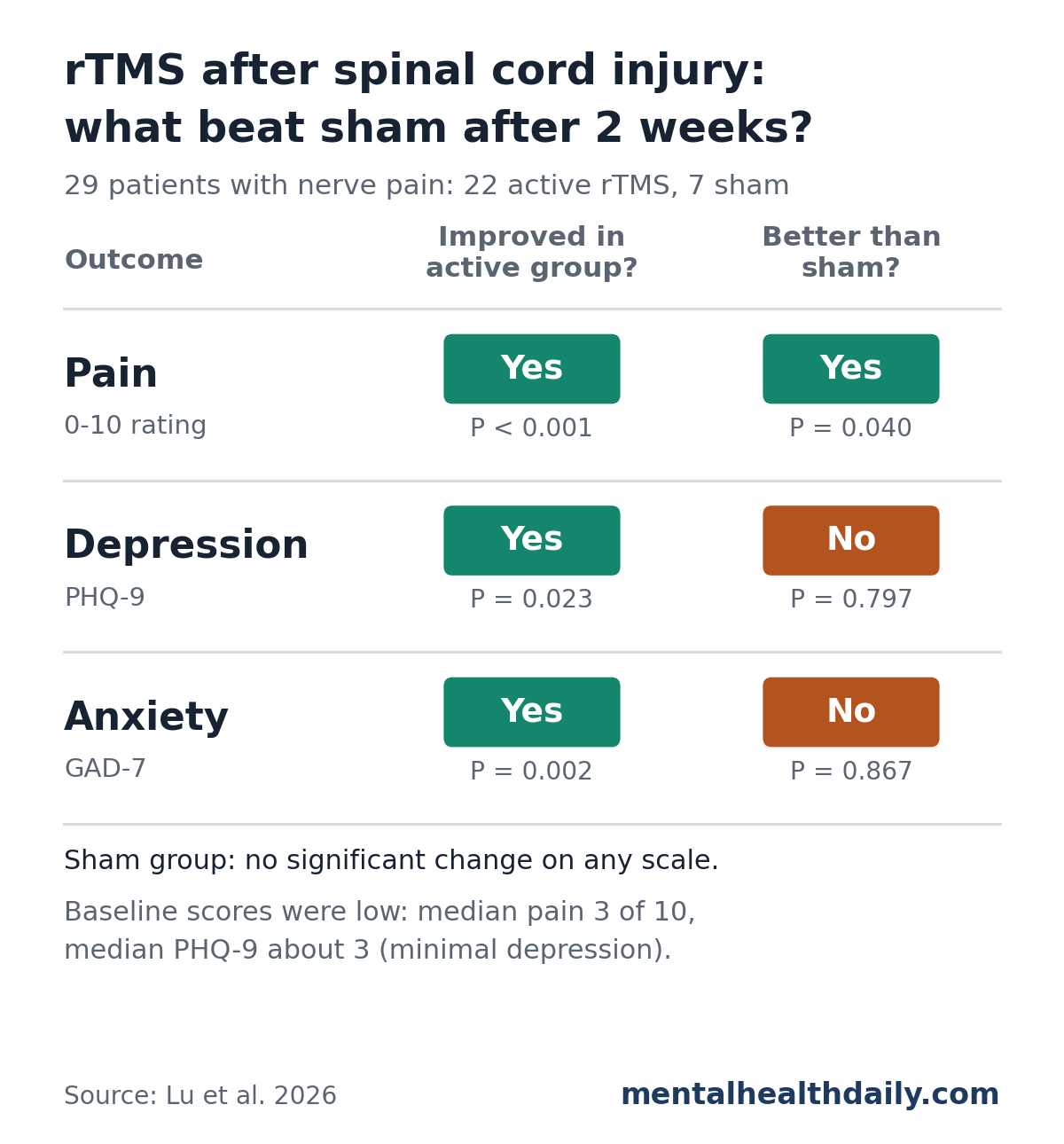
- Pain beat sham: after adjusting for baseline scores, pain ratings were lower with active rTMS than with sham at the end of 2 weeks (P = 0.040).1
- Depression and anxiety did not beat sham: both fell within the active group (P = 0.023 and P = 0.002), but the between-group comparisons were far from significant (P = 0.797 and P = 0.867).1
- Small sham group: 22 people got active rTMS and only 7 got sham, a 3:1 split chosen to spare patients from sham treatment.1
- Brain inhibition shifted: a paired-pulse TMS measure of motor cortex inhibition changed in the active group, and bigger pain drops went with bigger shifts (r = −0.571).1
- Short and mild: starting pain was a median 3 out of 10, depression scores were mostly in the minimal range, and nothing was measured after the 2-week course ended.1
What the Spinal Cord Injury rTMS Trial Tested
Neuropathic pain is pain caused by damage to the nervous system itself, often felt as burning, shooting, or electric sensations. It affects roughly 40% to 70% of people with a spinal cord injury, and common drugs such as pregabalin and gabapentin often give only partial relief.1
Repetitive transcranial magnetic stimulation (rTMS) uses a magnetic coil held against the scalp to deliver rapid pulses that change activity in the cortex underneath. High-frequency pulses (5 Hz or faster) tend to make the targeted area more excitable.
European guidelines rate high-frequency rTMS over the primary motor cortex (M1), the strip of brain that sends movement commands, as definitely effective for neuropathic pain when it targets the side opposite the pain.2 Pain after spinal cord injury is often on both sides of the body, so there is no obvious side to pick.
Lu et al. at Xijing Hospital in Xi’an, China, ran a double-blind, sham-controlled trial in hospitalized patients within a year of their injury. Everyone received the same rehabilitation program and kept their pain medications unchanged.1
- Active rTMS (22 people): 10 Hz pulses over the left M1 hand area, 1,200 pulses per session at 80% of the resting motor threshold (the lowest strength that makes the hand twitch), once a day for 2 weeks.
- Sham rTMS (7 people): identical settings and sound, but with the coil turned on its edge so no effective magnetic pulse reached the brain.
- Who: 25 men and 4 women, median age about 38 to 41, mostly with thoracic injuries; 18 had complete injuries.
- Outcomes: pain on a 0–10 rating scale (the primary outcome), depression on the PHQ-9 (a 9-item questionnaire scored 0–27), and anxiety on the GAD-7 (a 7-item questionnaire scored 0–21), measured before and after the 2 weeks.
Patients and outcome assessors did not know who got real stimulation. The researchers did not report asking patients to guess their group, so how well the blinding held is unknown.1
rTMS Lowered Spinal Cord Injury Pain More Than Sham
All 29 patients finished the 2-week course. At the start, the groups did not differ significantly on any measure, and median pain was 3 out of 10 in both.1
After treatment, pain dropped clearly within the active group (P < 0.001) and did not change significantly with sham. The key test compared the groups after adjusting for starting scores: active rTMS came out ahead (F = 4.662, P = 0.040).1
That test’s effect size was a partial eta-squared of 0.152, meaning treatment group explained about 15% of the remaining variation in pain scores. The 95% confidence interval ran from 0.004 to 1.000, which the researchers describe as wide and uncertain.1
Depression and Anxiety Fell With rTMS but Did Not Beat Sham
The paper’s title says rTMS eased “comorbid depression,” and the active group did improve: PHQ-9 scores fell (P = 0.023) and GAD-7 anxiety scores fell (P = 0.002).1
Against sham, though, there was essentially no difference. The baseline-adjusted comparison gave P = 0.797 for depression and P = 0.867 for anxiety, with effect sizes near zero (partial eta-squared 0.003 and 0.001).1
Low starting scores: median PHQ-9 was 3.5 in the active group and 3 in the sham group, below the usual cutoff of 5 for even mild depression. Most patients were not depressed to begin with, which leaves little room to show a difference.1
Pain and mood moved together: people with more pain at baseline had higher PHQ-9 scores (r = 0.392), and people whose pain dropped more also tended to see bigger PHQ-9 drops (r = 0.436).1 Mood may have eased partly because pain did, but a correlation like this cannot show which came first.
Motor Cortex Inhibition Changed With Pain Relief
To look for a brain mechanism, the researchers used paired-pulse TMS: two quick magnetic pulses over the motor cortex, with the size of the resulting hand-muscle twitch showing how much the first pulse dampened or boosted the second.1
- SICI (short-interval intracortical inhibition): pulses 2.5 ms apart. It reflects inhibition through GABA-A receptors, the brain’s main braking system. A higher SICI value means weaker inhibition.
- ICF (intracortical facilitation): pulses 12 ms apart. It reflects excitatory signaling through NMDA glutamate receptors. A higher value means stronger facilitation.
Both values rose within the active group (P < 0.001 for each), meaning less inhibition and more facilitation, while sham showed no significant change. Neither beat sham in the adjusted comparison: SICI just missed (P = 0.055) and ICF did not (P = 0.109).1
SICI tracked pain. At baseline, people with more pain had lower SICI values, or stronger inhibition (r = −0.458). After treatment, bigger pain drops went with bigger rises in SICI (r = −0.571, P = 0.004).1
The researchers propose that spinal cord injury pain may involve too much inhibition in M1, and that rTMS helps by easing it. Mouse studies they cite point the same way.1
Earlier human data point the other way. A 2006 study in 22 patients with one-sided neuropathic hand pain from various causes found reduced inhibition in the motor cortex on the pain side, and 10 Hz rTMS increased that inhibition in step with pain relief.3
Lu et al. suggest the difference may come from the cause of the pain, since their sample had spinal cord injury only.1
Limitations of This rTMS Spinal Cord Injury Trial
Evidence strength: this is one small, single-center randomized trial. It supports a short-term pain benefit over sham; it does not show that rTMS treats depression or anxiety after spinal cord injury.
- 7-person sham group: the researchers acknowledge this limits precision and power for every between-group comparison.
- Mild symptoms: median pain was 3 out of 10 and depression was mostly minimal, so the results may not apply to people with severe pain or clinical depression.
- No follow-up: outcomes were measured only at the end of the 2 weeks, so how long any benefit lasts is unknown.
- No safety data: the paper does not report side effects or adverse events.
- Early recovery period: everyone was within a year of injury and in active rehabilitation, which can change pain and mood on its own; the sham arm controls for this only partly given its size.
- Indirect brain measures: SICI and ICF reflect GABA and glutamate activity indirectly, and the pain links are correlations.
- Narrow sample: 1 hospital in China, mostly men, left M1 only.
What This Means for People With Spinal Cord Injury Pain
The trial adds a small piece of sham-controlled evidence that motor cortex rTMS can lower nerve pain in the first year after a spinal cord injury, in line with guideline support for M1 rTMS in neuropathic pain more broadly.2
- Pain is the outcome with support here. Depression and anxiety gains in the active arm were not larger than with sham.
- Not tested as a depression treatment. Standard rTMS for depression targets a different area, the left dorsolateral prefrontal cortex; this trial did not test that.2
- Larger trials are needed. The researchers call for bigger studies with follow-up to confirm the effect and test whether SICI could predict who responds.
References
- Lu Y, Zhao K, Liu X, et al. Motor cortex rTMS alleviates pain and comorbid depression after spinal cord injury with a correlate in M1 intracortical inhibition. Journal of Pain Research. 2026;19:627677. doi:10.2147/JPR.S627677
- Lefaucheur JP, Aleman A, Baeken C, et al. Evidence-based guidelines on the therapeutic use of repetitive transcranial magnetic stimulation (rTMS): an update (2014–2018). Clinical Neurophysiology. 2020;131(2):474–528. doi:10.1016/j.clinph.2019.11.002
- Lefaucheur JP, Drouot X, Ménard-Lefaucheur I, Keravel Y, Nguyen JP. Motor cortex rTMS restores defective intracortical inhibition in chronic neuropathic pain. Neurology. 2006;67(9):1568–1574. doi:10.1212/01.wnl.0000242731.10074.3c