Alzheimer's Blood Markers Linked to Brain Thinning Only in More-Educated Women
In 53 South Korean women with memory decline, higher Alzheimer's blood markers were linked to a thinner cortex only in those with 7+ years of schooling.
Read article Mental Health DailyResearch. Evidence. Perspective.
Published research on dementia.
In 53 South Korean women with memory decline, higher Alzheimer's blood markers were linked to a thinner cortex only in those with 7+ years of schooling.
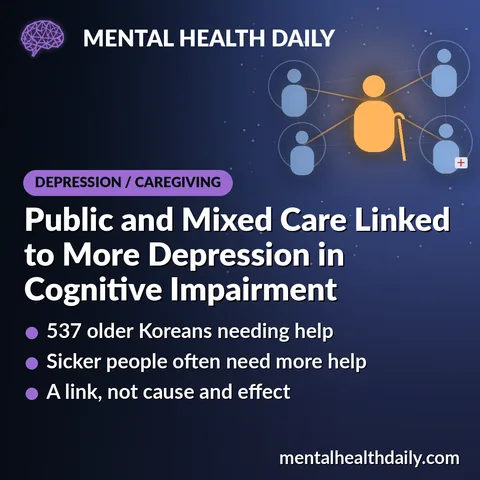
Read articleOlder South Koreans with cognitive impairment had higher depression scores when their care came mainly from public caregivers or a mixed group of helpers rather than their adult children. A …
Read articleA 2026 meta-analysis of 11 reports from small randomized trials found that virtual reality (VR) training modestly improved thinking-test scores in people with Alzheimer’s dementia (standardi…
Read articleA nationwide Finnish registry study found that 2 severe infection categories still predicted dementia after adjustment for 27 noninfectious comorbid diseases.1 Cystitis and bacterial infecti…
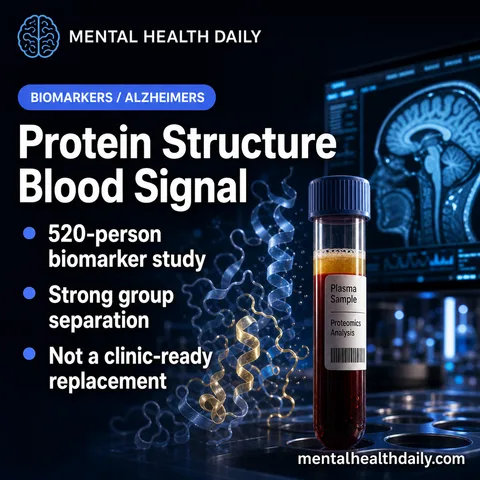
Read articleA 2026 Nature Aging study involving 520 participants found that plasma protein-structure signatures classified healthy control, mild cognitive impairment, and Alzheimer’s disease groups with…
Read articleDaytime agitation in dementia fluctuates day-to-day, and a 2026 explanatory study from Liu et al. used contactless under-mattress sensors in 55 long-term-care residents and an external 17-pe…
Read articleIn APP/PS1 Alzheimer's model mice, deleting PTP1B or treating with the allosteric inhibitor DPM-1003 improved memory behavior, lowered amyloid burden, and pushed microglia toward SYK-driven …
Read article