
Autistic children with low iron were about twice as likely to have clinically significant emotional and behavior problems as those with normal iron, in a study of 173 children newly diagnosed with autism at a hospital in India.1
Research Highlights
- Low iron was common: 42% of the children had iron deficiency, either without anemia (19.7%) or with anemia (22.5%).1
- About 3 times the odds: both iron-deficient groups had roughly 3-fold adjusted odds of emotional (internalizing) and behavior (externalizing) problems, compared with children with normal iron.1
- Iron stores mattered, not anemia: higher ferritin (the body’s stored iron) went with fewer problems, while hemoglobin showed no consistent link.1
- Behavior links held up better than emotional ones: the anemia–emotional problems link did not survive a strict correction for multiple tests.1
- Cause is unproven: the study was a single snapshot, and no trial has shown that iron supplements improve behavior in autistic children.12
Who Was Studied and How Iron Was Measured
The study, published in Frontiers in Psychiatry in September 2026, enrolled children aged 2 to 18 who had just been diagnosed with autism at the Child Development and Guidance Clinic of a teaching hospital in Pune, India, between October 2023 and March 2025.1
Most were young boys. The median age was 4 years, 80% were male, and two-thirds had mothers with a university degree. Children who had taken iron in the previous 3 months were excluded.1
Each child had 2 blood tests:
- Ferritin: a protein that reflects how much iron the body has stored. Low ferritin (under 12 µg/L before age 5, under 15 µg/L after) meant iron deficiency, using World Health Organization cutoffs.
- Hemoglobin: the oxygen-carrying protein in red blood cells. Low ferritin plus low hemoglobin meant iron-deficiency anemia; low ferritin with normal hemoglobin meant iron deficiency without anemia.
Parents filled out the Child Behavior Checklist (CBCL), a widely used questionnaire, before they saw their child’s lab results. A score above the clinical cutoff counted as a significant problem in 1 of 2 areas:
- Internalizing (emotional) problems: anxiety, withdrawal, and similar inward difficulties
- Externalizing (behavior) problems: aggression, hyperactivity, and similar outward difficulties
How Often Low Iron Went With Emotional and Behavior Problems
Of the 173 children analyzed, 100 had normal iron, 34 had iron deficiency without anemia, and 39 had iron-deficiency anemia. Overall, 40% had significant emotional problems and 36% had significant behavior problems.1
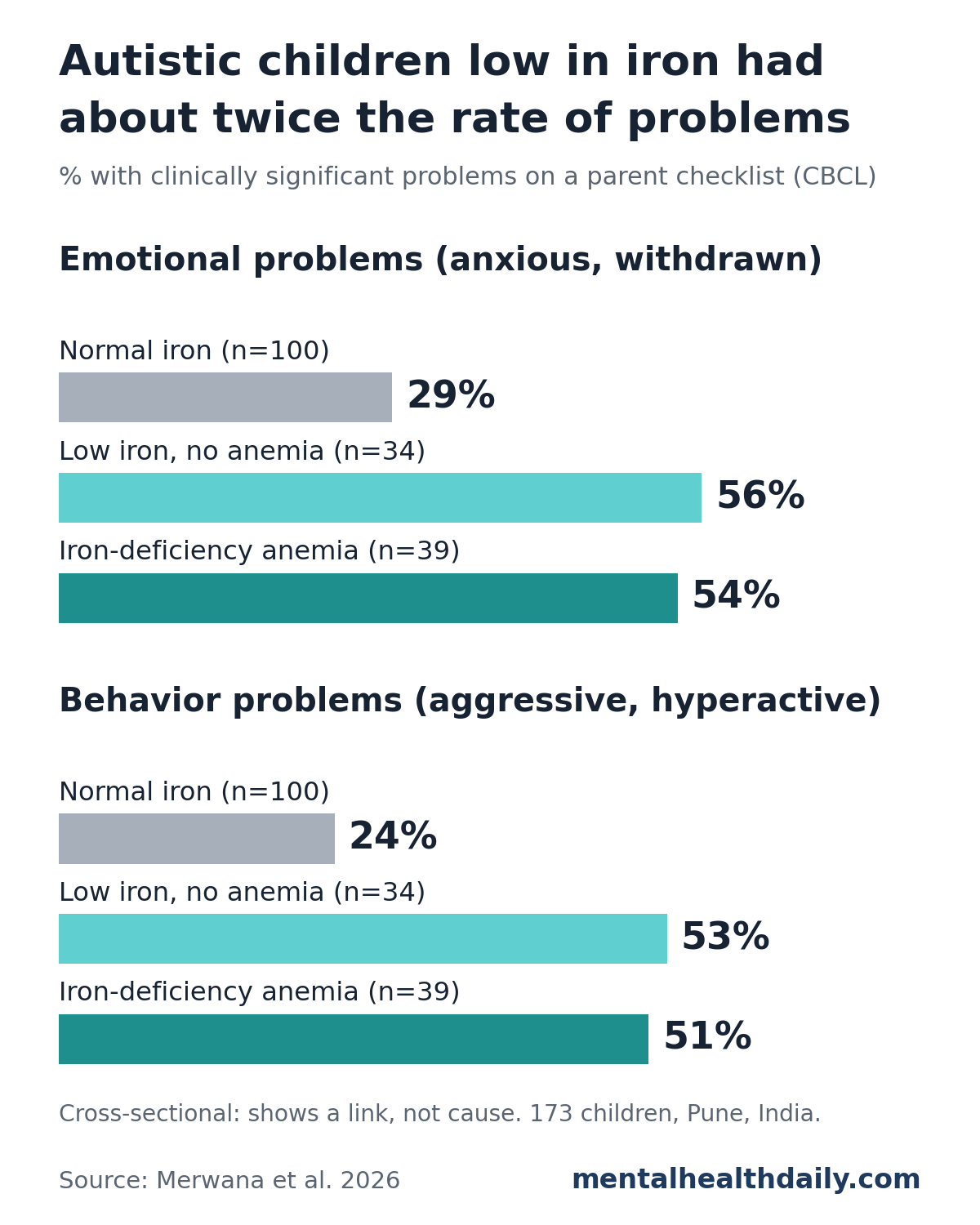
After adjusting for age, sex, mother’s education, and family type, the adjusted odds ratios (how much higher the odds were than in children with normal iron) were:1
- Emotional problems: 3.03 for iron deficiency without anemia and 2.73 for iron-deficiency anemia
- Behavior problems: 3.71 for iron deficiency without anemia and 3.24 for iron-deficiency anemia
In plain percentages, problems were 25 to 29 percentage points more common in the iron-deficient groups.1
Iron Stores Mattered More Than Anemia
Children with low iron and normal hemoglobin had about the same rate of problems as children with iron-deficiency anemia. That pattern points to stored iron, rather than anemia itself, as the measure that tracked with behavior.1
The continuous blood measures said the same thing:
- Ferritin: moving from the 25th to the 75th percentile (9.2 to 21.4 µg/L) was linked to about 77% lower odds of emotional problems and 70% lower odds of behavior problems (odds ratios 0.23 and 0.30).
- Hemoglobin: no consistent link with either outcome.
For emotional problems, the ferritin link was strongest at the very lowest levels and faded as ferritin rose toward 20 to 30 µg/L. For behavior problems, it was fairly steady across the range.1 The authors note that the exact shape of these curves changed with the statistical model, so the overall direction is more reliable than the details.
Behavior Links Were Stronger Than the Emotional Ones
The team tested 6 main comparisons and applied a Bonferroni correction, a strict adjustment that lowers the chance of false positives from running many tests. Five of the 6 still held.1
- Held up well: both iron-deficient groups with behavior problems
- Borderline: iron deficiency without anemia with emotional problems survived only narrowly
- Did not hold: iron-deficiency anemia with emotional problems
A second analysis built for small groups (Firth regression) left both emotional-problem links short of the corrected threshold. A stricter CBCL cutoff also left the emotional-problem link uncertain. The behavior-problem findings were the more consistent result.1
Why Iron Could Matter for the Brain
Iron helps the enzymes that make dopamine and serotonin, and the brain needs it to build myelin, the fatty insulation around nerve fibers. Long-term studies of typically developing children have linked early iron deficiency to behavior difficulties years later.1
Autistic children may be at extra risk of low iron. Picky eating, sensory aversions to certain foods, and gut problems can all limit how much iron a child takes in and absorbs. In this Indian sample, iron deficiency was far more common than in a US autism study the authors cite, where only 8% had low ferritin.1
That eating link cuts both ways. A child with more behavior difficulties may also eat a narrower diet, which would lower iron. A single snapshot cannot tell which came first.1
What Iron Supplement Trials Have Found So Far
Randomized evidence on iron in autism is thin. The trial the authors discuss was small and aimed at sleep. In it, 20 children with low-normal ferritin took ferrous sulfate or a placebo for 3 months.2
- Iron did not improve the main insomnia measures.
- Daytime behavior did not differ between groups.
- The children did not have confirmed iron deficiency, so the trial does not answer whether correcting a real deficiency helps.
A closer parallel comes from ADHD. In a randomized trial in Thailand, children with ADHD and iron deficiency who took ferrous fumarate alongside methylphenidate for 12 weeks had larger parent-rated improvements in ADHD symptoms than those taking a placebo with methylphenidate. Teacher ratings did not differ.3
Limitations
- Snapshot design: iron and behavior were measured at the same time, so the study shows a link and cannot show cause.
- Missing factors: diet, gut symptoms, other nutrient deficiencies, autism severity, and developmental level were not measured. Any of these could affect both iron and behavior.
- No inflammation test: ferritin rises during infection or inflammation, and without that test some children may have been misclassified.
- Small groups: 34 and 39 children in the iron-deficient groups, below the planned 58 each, which made the estimates imprecise.
- One clinic: mostly young boys from families with highly educated mothers, in a country where about two-thirds of young children have anemia. Results may differ elsewhere.
- Parent ratings: the CBCL is parent-reported, although parents completed it before seeing lab results.
What This Means for Families and Clinicians
Iron deficiency was common in these newly diagnosed autistic children, and it was linked to more behavior problems. The authors suggest that iron screening could be considered as part of the first autism evaluation, especially where childhood anemia is common.1
Whether treating low iron improves behavior in autism has not been tested. Iron supplements can cause harm in excess, so testing and dosing belong with a pediatrician rather than a store shelf.
References
- Merwana JU, Kalrao VR, Chaudhry R, Srivastava L. Association of iron deficiency and iron-deficiency anemia with behavioral problems in children with autism: a cross-sectional study. Frontiers in Psychiatry. 2026;17:1900958. doi:10.3389/fpsyt.2026.1900958
- Reynolds AM, Connolly HV, Katz T, et al. Randomized, placebo-controlled trial of ferrous sulfate to treat insomnia in children with autism spectrum disorders. Pediatric Neurology. 2020;104:30–39. doi:10.1016/j.pediatrneurol.2019.07.015 (PubMed)
- Pongpitakdamrong A, Chirdkiatgumchai V, Ruangdaraganon N, et al. Effect of iron supplementation in children with attention-deficit/hyperactivity disorder and iron deficiency: a randomized controlled trial. Journal of Developmental & Behavioral Pediatrics. 2022;43(2):80–86. doi:10.1097/DBP.0000000000000993