
A quick autism score pulled from a standard psychosis interview barely matched self-reported autism traits in young people at high risk for psychosis, and scores fell over time. Researchers followed 214 teens and young adults in Italy for 2 years.1
Research Highlights
- Consistent inside: the 8 items of the PANSS Autism Severity Score (PAUSS) hung together well (Cronbach’s α = 0.849).1
- Almost no agreement with an autism questionnaire: sorting people as high or low on the PAUSS and on the Autism-spectrum Quotient (AQ) gave a Cohen’s κ of 0.022, far below the 0.600 the researchers set for good agreement.1
- Scores fell over time: the median PAUSS dropped from 18.5 at the start to 13 after 1 year and 12 after 2 years, which fits a symptom measure better than a stable trait.1
- Imperfect yardstick: the AQ is a self-report screen, not an autism diagnosis, and no one in the study had a clinician autism assessment.1
- Journal and design: an exploratory psychometric study in European Archives of Psychiatry and Clinical Neuroscience (2026), drawn from one early-intervention service in Parma.1
What the PAUSS Is and Why Psychosis Clinics Use It
The Positive and Negative Syndrome Scale (PANSS) is a 30-item clinician interview that rates psychosis symptoms, from hallucinations to flat emotion. It is one of the most widely used symptom ratings in psychosis care and research.
The PANSS Autism Severity Score (PAUSS) reuses 8 of those items to estimate autistic features without a separate autism assessment. Kästner et al. built it in 2015 from a schizophrenia sample of 1,156 people and tested it in 165 adults with autism, where it correlated substantially with the Autism Diagnostic Observation Schedule (ADOS), a standard clinician autism assessment.2
The 8 items were picked to cover the 3 core autism areas of the older DSM-IV-TR manual (social interaction, communication, and repetitive behavior):
- Negative-symptom items: blunted affect, poor rapport, social withdrawal, difficulty with abstract thinking, lack of flow in conversation, stereotyped thinking
- General items: mannerisms and posturing, preoccupation
Its appeal is speed: no extra interview and little extra training. It has since spread from schizophrenia to first-episode psychosis and to people at clinical high risk.1
Autism and the Clinical High-Risk State Overlap
Clinical high risk for psychosis (CHR-P) describes young people with milder or brief psychosis-like symptoms, or a family risk plus falling function, who have not had a full psychotic episode. A 2022 meta-analysis of 4 studies found that 11.6% of people in this group had an autism diagnosis.3
Telling the two apart is hard. Social withdrawal, odd conversation, rigid thinking, and flat expression can come from autism, from early psychosis, or from both. Pelizza et al. set out to test whether the PAUSS separates them in this group, which no study had checked.1
How the Parma Study Tested the PAUSS
- Who: 214 help-seeking 16- to 25-year-olds meeting CHR-P criteria, recruited 2016 to 2022 through the Parma At-Risk Mental States program; 110 (51.4%) were male, with a mean age of 19.3
- Excluded: anyone with a past psychotic episode, past antipsychotic treatment, or known intellectual disability
- Measures: the PANSS interview and the AQ at entry and yearly for 2 years
- Comparator: the Autism-spectrum Quotient (AQ), a 50-item self-report questionnaire on autistic traits; a score above 25 suggested autism-spectrum traits
- PAUSS split: the sample median of 18.5, following an earlier Japanese study, because no PAUSS cut-off exists for this group; the original cut-off of above 30 was set in people with full psychosis
Two statistics carry most of the story. Cohen’s kappa (κ) measures how often two tools put the same person in the same box beyond chance; 0 means chance-level agreement and 1 means perfect. Spearman’s rho (ρ) measures how well people keep their rank from one time point to the next.1
PAUSS Scores Barely Matched Self-Reported Autism Traits
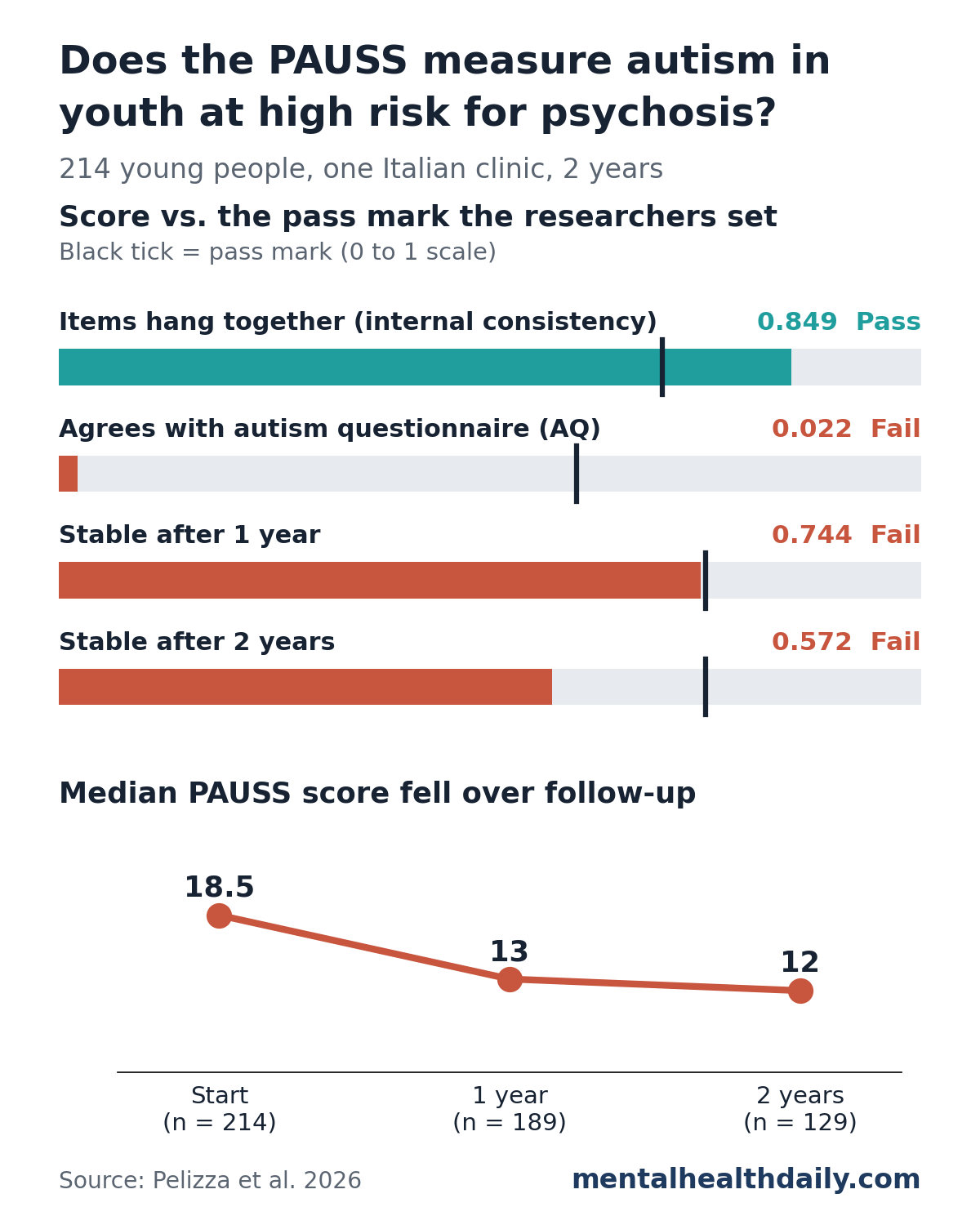
Internal consistency was good: Cronbach’s α was 0.849 (95% CI 0.814 to 0.870), above the 0.700 threshold. Two items fit poorly with the rest, mannerisms and posturing (item-total r = 0.152) and preoccupation (r = 0.384).1
Agreement with the AQ was where the score fell apart:
- Classification agreement: κ = 0.022 (95% CI 0.002 to 0.043), close to chance
- Total-score correlation: ρ = 0.168, not statistically significant after correction (p = 0.057)
- Single items: only blunted affect correlated with the AQ (ρ = 0.262); mannerisms showed essentially no link (ρ = −0.011)
- Prediction: the PAUSS picked out people with AQ scores above 25 with an area under the curve of 0.602, below the 0.700 threshold for acceptable accuracy
The best PAUSS cut-off for matching the AQ was above 33, far higher than the median of 18.5. That value was chosen and tested in the same sample, so it is a starting point for future work rather than a usable threshold.1
PAUSS Scores Fell Over 2 Years of Follow-Up
Autistic traits are expected to be fairly stable. PAUSS scores were not. The median fell from 18.5 at the start (214 people) to 13 at 1 year (189 people) and 12 at 2 years (129 people), and each drop was statistically significant.1
- Rank stability: ρ = 0.744 from start to 1 year and 0.572 from start to 2 years, both under the researchers’ 0.750 bar
- Staying above the median: κ = 0.592 at 1 year and 0.421 at 2 years, both under 0.600
The PAUSS also tracked psychosis symptoms closely. It correlated at ρ = 0.894 with the PANSS negative-symptom score and ρ = 0.799 with the disorganized-symptom score, which is expected given the shared items.1
A 2025 Japanese study pointed in a somewhat different direction. Among 59 people at high risk or with first-episode psychosis, autistic symptoms on the PAUSS improved over 1 year, yet the gap between high- and low-scoring groups persisted while other symptom differences faded. Komatsu et al. concluded that autistic symptoms in these groups have both passing and lasting parts.4
Why the Autism Questionnaire Comparison Has Limits
The weakest link may be the yardstick. The AQ is a self-report screen, and people with autism can find it hard to rate themselves. In the original PAUSS study, the AQ performed at chance level in predicting autism against the ADOS, while the PAUSS did well.2
So poor agreement with the AQ does not prove the PAUSS captures nothing autism-related. The researchers’ own reading is that the score cannot tell autistic features apart from co-occurring psychosis-risk symptoms in this group.1
Other limits bear on the findings:
- No autism diagnosis: no participant had an ADOS or a DSM-5 autism assessment, and there was no autism-only comparison group
- Relative cut-off: the median split marks people with relatively higher scores, not people with clinically meaningful autistic features
- Dropout: 85 of 214 people left the service by 2 years, and those who left may have differed in ways linked to autism traits
- Real change: participants were in active care, so symptoms and function genuinely changed over the yearly gaps; short-term test-retest stability was not measured
- One site: all participants came from a single Italian service, and the exploratory design had no preset hypotheses
What This Means for Autism Screening in Psychosis-Risk Clinics
In this group of young people at high risk for psychosis, PAUSS scores behaved more like a reading of current negative and disorganized symptoms than a stable autism trait score.1
- For clinicians: a high PAUSS is a reason to look closer, not an autism finding; the researchers say it should never replace clinical judgment and proper tools such as the ADOS
- For researchers: studies that label high-risk youth as “autistic” by PAUSS alone may be sorting them by symptom severity
- For families: if autism is a question for a young person in a psychosis-risk service, ask about a dedicated autism assessment
The next step is a head-to-head test of the PAUSS against clinician autism assessments in several high-risk services, ideally with shorter retest intervals.1
References
- Pelizza L, Picone TF, Leuci E, et al. Psychometric properties of the PANSS autism severity score (PAUSS) in young peoples at clinical high risk for psychosis: does it really measure autistic features? European Archives of Psychiatry and Clinical Neuroscience. 2026. doi:10.1007/s00406-026-02374-z
- Kästner A, Begemann M, Michel TM, et al. Autism beyond diagnostic categories: characterization of autistic phenotypes in schizophrenia. BMC Psychiatry. 2015;15:115. doi:10.1186/s12888-015-0494-x
- Vaquerizo-Serrano J, Salazar de Pablo G, Singh J, Santosh P. Autism spectrum disorder and clinical high risk for psychosis: a systematic review and meta-analysis. Journal of Autism and Developmental Disorders. 2022;52(4):1568–1586. doi:10.1007/s10803-021-05046-0
- Komatsu H, Sato Y, Tomimoto K, et al. Persistent differences in autistic symptom severity after one year in individuals at clinical high risk of psychosis and with first-episode psychosis. Journal of Psychiatric Research. 2025;188:176–182. doi:10.1016/j.jpsychires.2025.05.068