
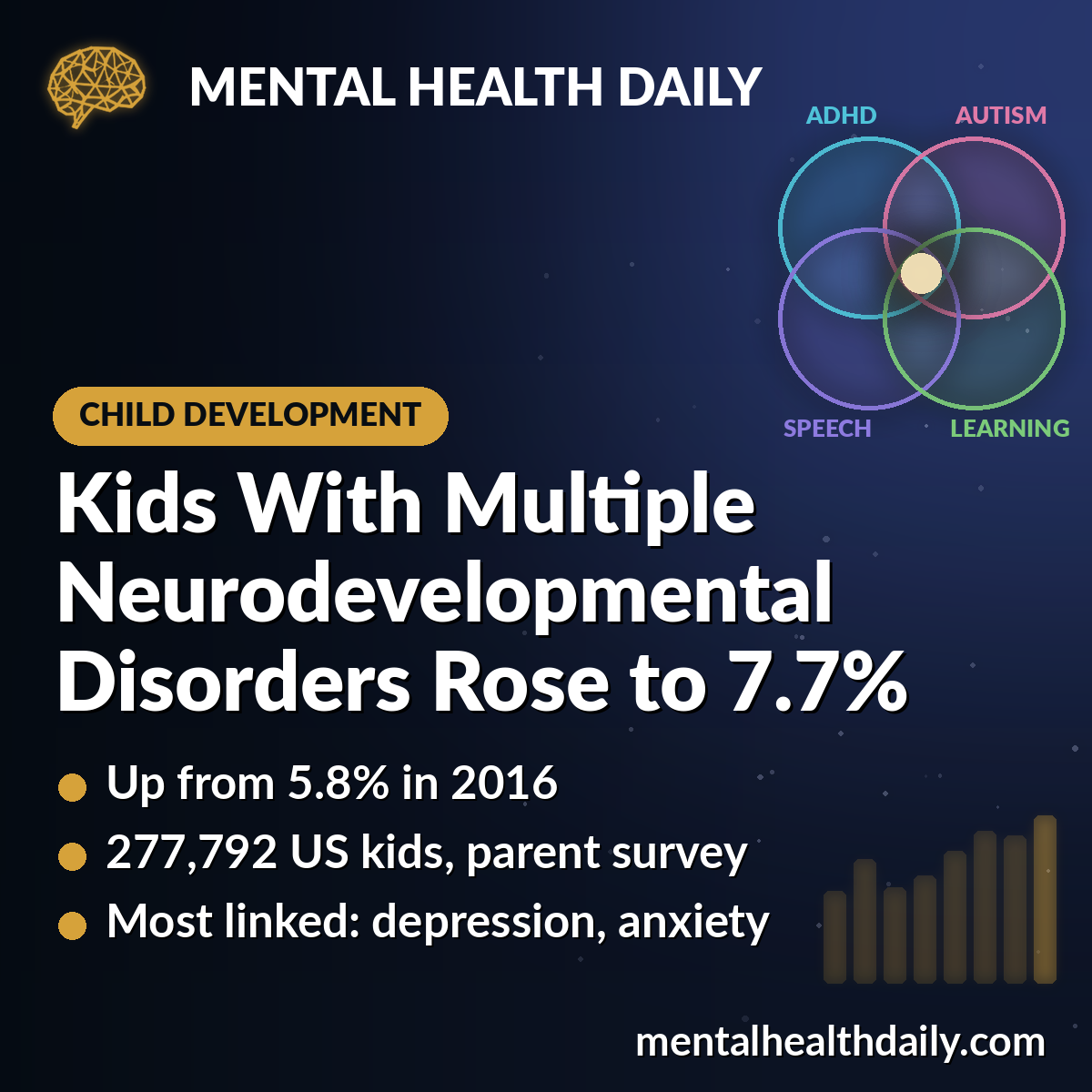
Among US children ages 3 to 17, the share with two or more neurodevelopmental disorders, such as ADHD, autism, or a learning disability, rose from 5.8% in 2016 to 7.7% in 2023, based on a national parent survey.1 Depression or anxiety was the factor most strongly linked to having several of these conditions at once.
Research Highlights
- Large national sample: 277,792 children from the National Survey of Children’s Health, 2016 to 2023, analyzed in a cross-sectional study published in Frontiers in Public Health in September 2026.1
- Rising trend: prevalence climbed from 5.8% to 7.7%, and the increase held after adjusting for family and health factors (2023 vs. 2016 adjusted odds ratio 1.38).1
- Depression or anxiety: 26.7% of children with depression or anxiety had multiple neurodevelopmental disorders, compared with 4.5% of children without them.1
- Boys: 8.9% of boys vs. 4.3% of girls had two or more conditions.1
- Linked, not causal: all factors were measured at the same time, so the study cannot say what came first.1
What Counts as Multiple Neurodevelopmental Disorders
Neurodevelopmental disorders (NDDs) are conditions rooted in how the brain develops, and they usually show up in childhood. They often overlap: a child with ADHD may also have a learning disability or autism.
The researchers counted a child as having multiple NDDs when a parent or caregiver reported at least 2 current conditions from this list:1
- ADHD (attention-deficit/hyperactivity disorder)
- Autism spectrum disorder
- Learning disability
- Speech or other language disorder
- Intellectual disability
- Cerebral palsy
- Tourette syndrome
For each condition, the parent had to say a doctor, other health care provider, or (for learning, speech, and intellectual disabilities) an educator had told them the child had it, and that the child still had it.1
Prevalence Rose From 5.8% to 7.7% in Eight Years
The National Survey of Children’s Health is a yearly US survey of parents, run with federal support and weighted to represent children living in households nationwide. The team pooled 8 years of it.1
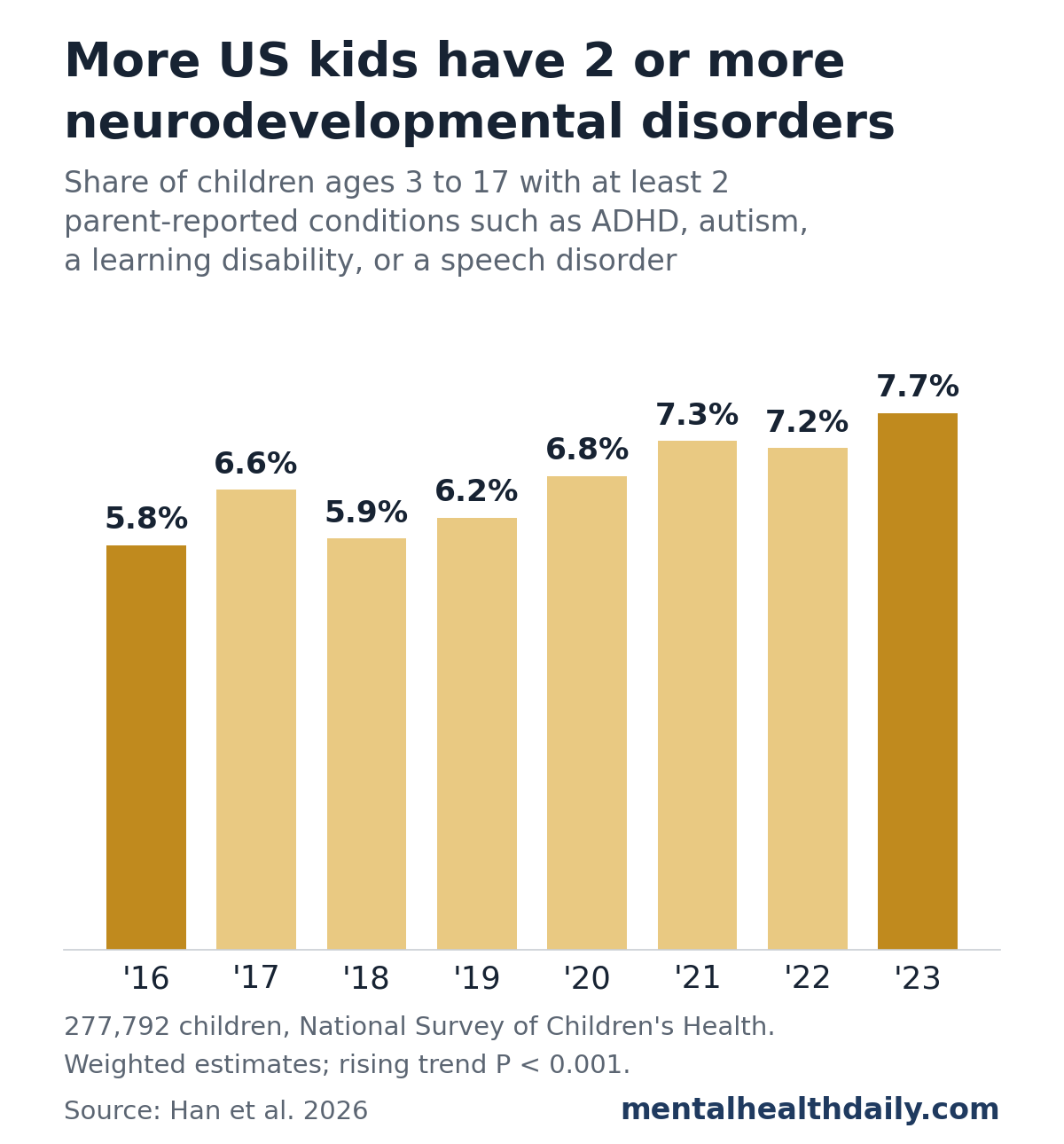
The rise was statistically significant (P for trend < 0.001). After adjusting for age, sex, health, and household factors, children surveyed in 2023 still had 38% higher odds of multiple NDDs than children surveyed in 2016.1
A stricter definition showed the same pattern. The share of children with 3 or more conditions grew from 2.2% to 3.4% over the same years.1
Why the rise? The authors point to broader diagnostic criteria, more screening, and greater awareness among parents, teachers, and doctors. They also note the faster climb after 2020 may reflect the COVID-19 pandemic’s effects on children. A survey like this cannot tell a true increase apart from better detection.1
An earlier analysis from the same senior author, using a broader list of 12 developmental disabilities, found the same upward trend: 9.8% in 2016 to 11.5% in 2022, with higher prevalence during the pandemic than before it.2
Depression and Anxiety Were the Strongest Link
Children whose parents reported current depression or anxiety had more than 5 times the odds of multiple NDDs after adjustment (adjusted odds ratio, or aOR, 5.53).1 An odds ratio above 1 means the condition was more common in that group.
Which came first is unclear. Most earlier research has looked the other way: how ADHD, autism, and related conditions affect anxiety and depression. The authors also mention symptom overlap and the fact that children who see clinicians more often get more diagnoses of every kind.1
Other health factors linked to higher odds of multiple NDDs:1
- Fair or poor general health: aOR 2.82 (32.3% of these children had multiple NDDs, vs. 6.2% of children in good health)
- Heart condition: aOR 1.93
- Underweight: aOR 1.30, which the authors suggest may reflect feeding difficulties common in children with NDDs
- Allergies: aOR 1.17
- Seeing a specialist in the past year: aOR 2.13
Asthma, diabetes, and obesity were not linked after adjustment.1
Boys, Family Stress, and Insurance
Sex. Girls had 60% lower odds than boys (aOR 0.40), which the authors describe as about 2.5-fold higher odds for boys. Part of this may be biology, and part may be that girls are diagnosed less often.1
Family adversity. All 6 adverse childhood experiences in the survey, such as parental divorce or a parent serving time in jail or prison, went with higher raw prevalence. After adjustment, only one stayed significant: living with someone who had a mental illness, was suicidal, or was severely depressed (aOR 1.39).1
Race and ethnicity. Non-Hispanic Black children had the highest prevalence (8.7%) and Asian children the lowest (2.9%). After adjustment, Hispanic and non-Hispanic Black children had about 20% higher odds than non-Hispanic White children.1
Household factors after adjustment:1
- Public insurance: aOR 1.78; children with both public and private coverage had an aOR of 2.77
- Other family structures: aOR 1.22 for family structures other than two married, two unmarried, or single parents
- A college-educated household: aOR 0.87
- Spanish spoken at home: aOR 0.44 (other non-English languages, aOR 0.48)
Lower-income families had higher raw prevalence (8.9% vs. 5.1%), but income was not significant once other factors were included.1
The authors caution that the lower odds in non-English-speaking or more educated families likely reflect differences in diagnosis and access to assessment, not fewer affected children.1
Which Conditions Tend to Pair Up
This paper did not break results down by combination. A companion analysis of the same 2016 to 2023 survey data, covering 272,598 children, found a national prevalence of 8.1%. ADHD with a learning disability was the most common pairing, at 18.2% of all multiple-NDD combinations.3
Limitations
- Cross-sectional design. Everything was measured at one point, so no factor can be called a cause, and the study cannot say which came first.
- Parent-reported diagnoses. Conditions were not checked against medical records.
- Detection vs. true change. The rise may reflect more screening and awareness rather than more children affected.
- Health care use as a factor. Children who see more doctors get more diagnoses, which can inflate links to visits and other conditions.
- Survey limits. Response rates were 35.8% to 43.1%, children in institutions were not included, and severity was not measured. Missing answers were kept as an “unknown” category, which may bias some estimates, such as weight.
What This Means for Families
About 1 in 13 US children had two or more of these conditions in 2023, based on parent reports. The authors argue that care organized around one diagnosis at a time can miss this overlap.1
The strong link with depression and anxiety is a reminder that a child with ADHD, autism, or a learning disability may also need attention for mood and worry. The authors call for coordinated care across pediatrics, mental health, and specialty services, plus family-centered support and better access for disadvantaged and non-English-speaking families.1
References
- Han L, Han P, Ding J, Yang L, Xu Z, Long J, Davidson PM, Lin J. Prevalence of and factors associated with multiple neurodevelopmental disorders among children and adolescents: a nationwide cross-sectional study. Frontiers in Public Health. 2026;14:1875185. doi:10.3389/fpubh.2026.1875185
- Lin J, Xu X, Li C, Kendrick T, He WQ. Multiple developmental disabilities among American children: prevalence and secular trends 2016–2022. Public Health. 2024;237:22–29. doi:10.1016/j.puhe.2024.08.027
- Lin J, Yang L, Li Y, Kidd M. Geographic patterns in the prevalence of multiple neurodevelopmental disorders among children and adolescents in the United States: a cross-sectional study. Journal of Public Health (Oxford). 2026;48(3):670–679. doi:10.1093/pubmed/fdag052 (PubMed)