
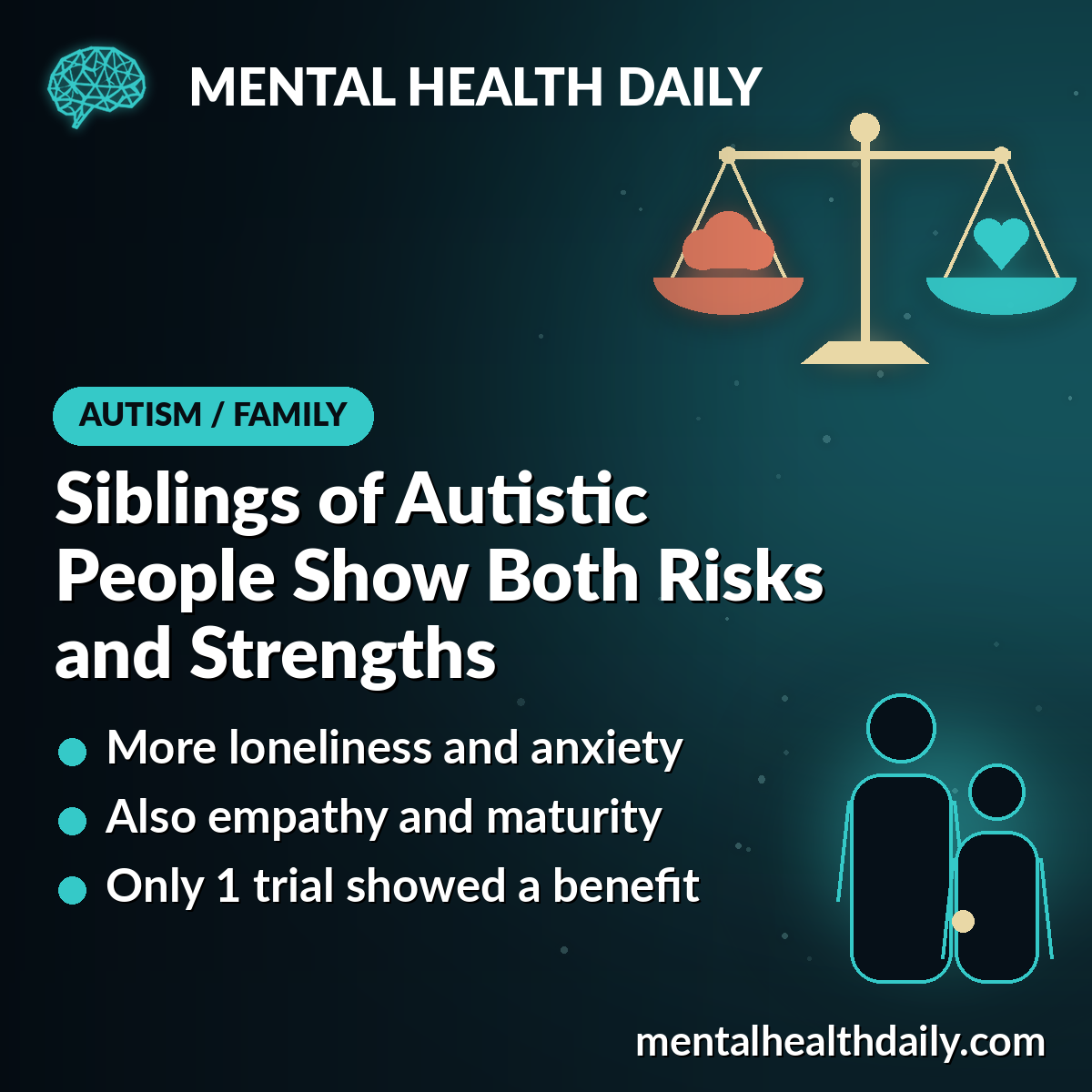
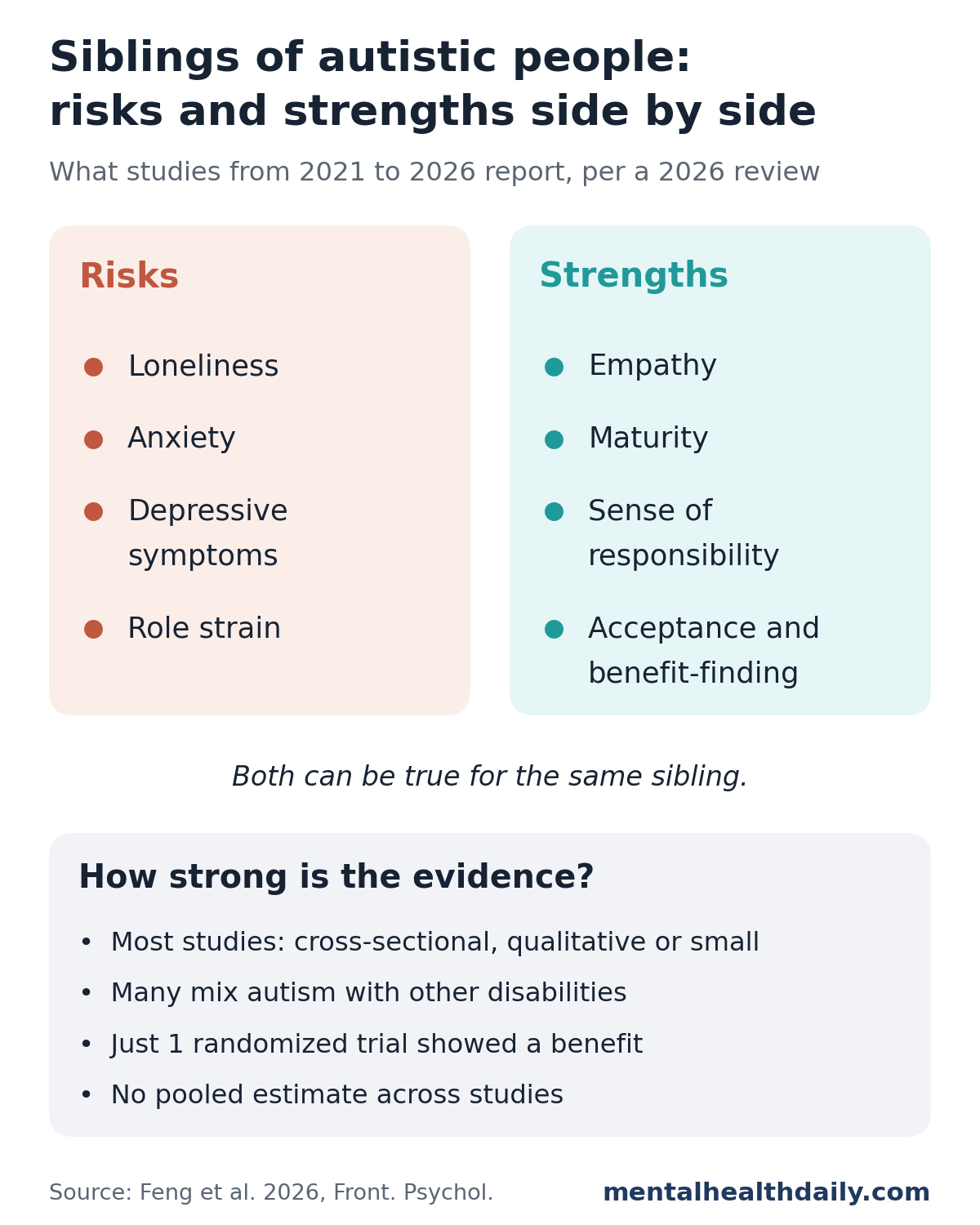
Brothers and sisters of autistic people report more loneliness, anxiety and depressive symptoms than their peers in many studies, and many also describe real empathy, maturity and acceptance. A 2026 review of research on non-autistic siblings, from early childhood to adulthood, finds both pictures hold at once and that the evidence behind each is still thin.1
Research Highlights
- Risks and strengths coexist: studies from January 2021 to March 2026 describe loneliness, anxiety, depressive symptoms and role strain alongside empathy, maturity, responsibility, acceptance and benefit-finding.1
- Family context counts: the autistic child’s behavioral and emotional difficulties, parents’ own mental health, family communication and social support are all linked to how siblings fare.1
- Some “sibling risk” may run in families: higher diagnosis rates in siblings can reflect family traits, not just the stress of growing up together, and current designs cannot separate the two.1
- 1 trial demonstrated a relationship benefit: a 10-week sibling support group improved the sibling relationship. Other programs are workable and well liked, but their benefits are untested.13
- Weak evidence base: most studies are cross-sectional, qualitative or small, and many mix autism with other disabilities.1
What the Review Covered
Yaqi Feng and colleagues at the Second Hospital of Gansu Province in China searched PubMed, PsycINFO and Web of Science for studies published from January 2021 to March 2026, then added older landmark papers. The review appeared in Frontiers in Psychology as a mini review.1
It is a narrative review: the authors summarized and interpreted studies rather than pooling their numbers. They did not rate study quality, chose papers purposively, and used only English-language sources. They describe the result as an “interpretive map” of a fast-moving field.1
The authors use identity-first language (“autistic person”) and “non-autistic siblings.” They avoid “unaffected siblings” and “typically developing siblings,” partly because some siblings have neurodevelopmental traits or diagnoses of their own.1
Where Siblings Struggle
In studies that compare siblings with control groups at one point in time, siblings of autistic children report higher loneliness, social dissatisfaction, anxiety and depressive symptoms.1 Other challenges siblings and families describe:
- Role strain: older siblings, especially sisters, more often take on caregiving, with the stress and role confusion that can bring
- School: limited personal time and disrupted sleep can affect schoolwork, and some siblings end up explaining their brother’s or sister’s needs to school staff
- Home life: restricted family activities, worries about the future, and conflict at home are the main challenges siblings raise with parents, in a study of families with a range of chronic conditions
A nationwide register study found that siblings of autistic people were more likely to later receive diagnoses of developmental delay, speech and language disorders, ADHD, anxiety disorders and disruptive behavior disorders than controls.1
The review flags a catch. Siblings share genes and family environment with their autistic brother or sister, so higher diagnosis rates may partly reflect traits that run in families rather than the stress of growing up together. Register data cannot tell these apart, and the authors say reading them as proof of caregiving burden overstates what the design shows.1
Findings on suicide-related outcomes come from small cross-sectional studies that either combined autistic people with their siblings or mixed autism with other conditions. The authors call them hypothesis-generating, not estimates of how common these outcomes are.1 Anyone in the US having thoughts of suicide can call or text 988, the Suicide and Crisis Lifeline.
Where Siblings Do Well
Many siblings describe unusual empathy, patience and a sense of responsibility. Some see themselves as protectors whose relationship with their sibling shaped their identity and even their career, and families describe staying close through shared routines.1
The review points to a few processes behind resilience:
- Acceptance: how fully a sibling accepts their brother or sister shapes the bond and willingness to help in the future. In emerging adults, optimism and feelings toward the sibling predicted acceptance, in a sample that combined autism and Down syndrome.
- Meaning-making and benefit-finding: finding something valuable in the experience
- Handling mixed feelings: holding warmth, loyalty, worry and frustration at the same time
These are self-reported experiences rather than measured outcomes, and they sit alongside the distress described above rather than canceling it out.1
Why Studies Disagree
Siblings in similar situations end up in very different places, and the review lists several factors linked to that spread. Nearly all come from cross-sectional and often parent-reported data, so they describe associations, not causes.1
- The autistic child’s difficulties: aggression and other externalizing behavior, plus anxiety, are linked to more sibling conflict. In a mixed chronic-condition sample, condition severity mattered more for sibling mental health than the diagnosis itself.
- Parents’ mental health: mothers’ anxiety and depressive symptoms are linked to siblings’ depressive symptoms, and parents’ perceived stigma is linked to siblings’ internalizing problems.
- Family communication: siblings describe dedicated time with parents and age-appropriate explanations of autism as protective.
- Social support: feeling supported, especially by family, is linked to less loneliness and higher life satisfaction.
- Gender, culture and religion: in 465 emerging-adult siblings, brothers reported more stress than sisters, and stress was highest among siblings of autistic people in more traditional communities. That study also included siblings of people with Down syndrome and cerebral palsy.
The sibling relationship itself varies widely. One study sorted the relationships of autistic youth into positive, negative and low-involvement groups, and 64.5% were low-involvement. Positive relationships clustered with better family and peer functioning.1
Study design adds to the disagreement. Many studies sample siblings of people with intellectual disability, Down syndrome or a mix of chronic conditions, so their results may not carry over to autism. Most focus on school-age children and teenagers, and very little is known about preschool or adult siblings.1
How This Fits With Earlier Research
An earlier meta-analysis of 69 independent samples, published in 2019, found that siblings of autistic people had somewhat poorer outcomes than comparison groups overall, with a small average difference (g = −0.26, a standardized effect size where 0.2 is usually considered small).2
- Worse in: internalizing problems, psychological functioning, beliefs about disability, social functioning and the sibling relationship; anxiety (g = −0.25) and depression (g = −0.36) symptoms stood out
- No difference in: overall adjustment, attention and hyperactivity, externalizing behavior, coping or family functioning
That mix of small gaps in some areas and none in others is consistent with the 2026 review’s picture of a varied group rather than a uniformly struggling one.12
What Sibling Support Programs Have Shown
The review separates 5 levels of evidence for programs: feasibility, acceptability, social validity (whether families find the goals and methods worthwhile), early efficacy, and established effectiveness. Most sibling programs have reached only the first 3.1
- Support groups: the most common approach, combining information about autism, emotional expression, stress-management skills and peer support. In the randomized trial of relationship quality, siblings who attended a 10-week autism-focused support group showed better relationship quality and interactions with their autistic sibling than siblings in an attention-only control group.3 It has a short follow-up and has not been replicated.1
- Virtual resilience group for teens: a randomized pilot showed good feasibility and positive trends in stress management, but it was not designed to test whether the program works.1
- Play-based sibling training: siblings learn to act as play partners, which increased sibling-started interaction and shared play in single-case studies. Those designs cannot estimate average effects.1
Early-intervention research in infant siblings of autistic children is a separate field. It targets the baby’s own development, not the sibling role, and the review keeps it apart.1
5 Debates the Review Highlights
- Mixed feelings are normal. Love, irritation, worry and embarrassment toward a brother or sister are part of sibling life generally. Questionnaires built to detect distress can flag them as problems without normal sibling comparisons.
- Growth should not be romanticized. Reported maturity may be real development, a way of making sense of things, or a socially expected answer, and current studies cannot tell these apart. Treating growth as a payoff could become an excuse to offer less support.
- Responsibility is not always positive. What looks like early maturity can be parentification, where a child’s own needs come second to family caregiving.
- Future caregiving should be a choice. Siblings are often assumed to become future caregivers. The authors say programs should treat limited involvement, or none, as a legitimate option.
- Some risk may run in families. Separating shared genetics from life experience needs designs this field has rarely used, such as tracking siblings’ own traits over time or comparing siblings of children with non-inherited conditions.
Culture adds another layer. The authors note that most research comes from Western, individualistic settings, and that ideas like burden, resilience and quality of life may not mean the same thing across cultures.1
What It Means for Families
The authors’ recommendations vary in how much evidence backs them:1
- Notice siblings: routine attention to siblings’ wellbeing during existing family visits, with a fuller check when warning signs appear. No study has tested a sibling screening program, so they do not recommend universal screening.
- Explain and listen: siblings consistently value age-appropriate information about autism and a way to express their feelings.
- Keep responsibilities fair: parents can be supported to talk openly, validate siblings’ feelings, and keep caregiving proportionate, acknowledged and voluntary, especially for older sisters.
- Treat programs as promising: support groups and sibling skills training are workable and well received, but should be offered as promising rather than proven until larger trials report.
Limitations
- Narrative, not systematic: no study-quality rating, purposive selection, English only
- Weak underlying studies: mostly cross-sectional, qualitative or small, often relying on parent report
- Mixed samples: many key findings come from siblings of people with intellectual disability, Down syndrome or other chronic conditions
- Narrow age range: preschool and adult siblings are understudied
- No pooled numbers: the review does not estimate how large any risk or benefit is
The authors conclude that the useful question is no longer whether sibling adaptation is good or bad, but which siblings, in which families and cultures, benefit from which kinds of support, and how much of the reported risk comes from being a sibling at all.1
References
- Feng Y, Zhang J, Zhang R. Psychosocial adaptation of siblings of autistic individuals: current evidence, controversies, and future directions. Frontiers in Psychology. 2026;17:1858545. doi:10.3389/fpsyg.2026.1858545
- Shivers CM, Jackson JB, McGregor CM. Functioning among typically developing siblings of individuals with autism spectrum disorder: a meta-analysis. Clinical Child and Family Psychology Review. 2019;22(2):172–196. doi:10.1007/s10567-018-0269-2
- Zucker A, Chang Y, Maharaj R, et al. Quality of the sibling relationship when one sibling has autism spectrum disorder: a randomized controlled trial of a sibling support group. Autism. 2022;26(5):1137–1152. doi:10.1177/13623613211042135