
Autistic children and young adults who used telehealth had about the same yearly out-of-pocket medical costs as those who didn’t, according to a 2026 analysis of a US national health survey covering 189 people ages 1 to 21.1
Insurance and other health conditions were much more closely linked to what families paid.
Research Highlights
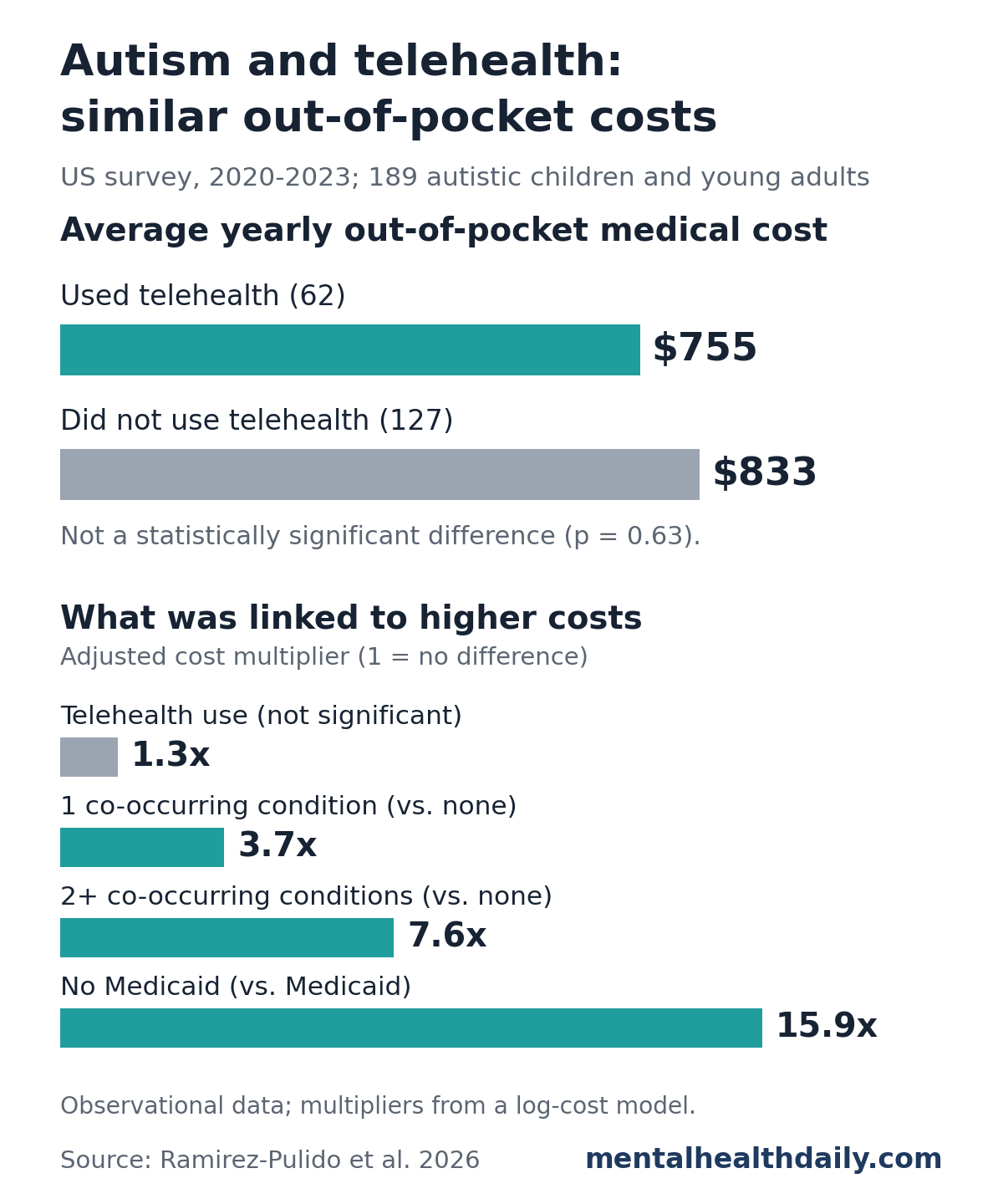
- Similar costs: telehealth users averaged $755 a year in out-of-pocket medical costs, compared with $833 for nonusers, a difference that was not statistically significant.1
- No cost link after adjustment: telehealth use was not significantly linked to out-of-pocket costs once income, insurance, age and health conditions were taken into account.1
- Medicaid had the strongest cost link: children without Medicaid had estimated out-of-pocket costs about 16-fold higher than children with Medicaid.1
- More conditions, higher costs: having 2 or more common co-occurring conditions, such as ADHD or anxiety, was linked to costs about 7.6 times higher than having none.1
- Fewer Black children used telehealth: only 3 of 24 Black children used it, and their adjusted odds of use were much lower than for non-Hispanic White children.1
How Researchers Studied Telehealth and Autism Costs
Gonzalo Ramirez-Pulido and colleagues at the University of Houston and the Humana Integrated Health System Sciences Institute analyzed 4 years (2020 to 2023) of the Medical Expenditure Panel Survey (MEPS).1
MEPS is a large, nationally representative US survey run by the federal Agency for Healthcare Research and Quality. Families report their health conditions, medical visits, insurance and medical spending, and MEPS started asking about telehealth visits in 2020.
The team included every person ages 1 to 21 whose household reported autism and who answered whether their outpatient visits were by telehealth. That gave 189 children and young adults.
- Telehealth users: 62 (32.8%) had at least one outpatient telehealth visit
- Nonusers: 127 had none
- Insurance: 68.8% had Medicaid
- Income: 60.3% of families earned under 200% of the federal poverty level
- Race and ethnicity: 48.7% Hispanic, 28.6% non-Hispanic White, 12.7% Black
Out-of-pocket costs are what families paid themselves, not what insurers paid. Here they combined outpatient, inpatient, emergency, prescription and home health costs for autism and the 5 most common co-occurring conditions: ADHD, anxiety, sleep disorders, asthma and depression.1
Out-of-Pocket Costs Were Similar With and Without Telehealth
Across the whole group, families paid an average of $807.80 a year out of pocket for these medical costs, adjusted to 2023 dollars.1
- Telehealth users: $755.35 a year
- Nonusers: $833.30 a year
- Difference: not statistically significant (p = 0.63)
The 2 groups also had a similar number of medical visits per year: 34 for telehealth users and 36 for nonusers.
Researchers then adjusted for other differences between the groups, including income, insurance, age, race and ethnicity, and health conditions.
After adjustment, telehealth users’ estimated costs were 1.3 times those of nonusers, a difference that was not statistically significant (95% CI 0.93 to 1.82).1
In short, this study found no sign that telehealth lowered what families paid, and no clear sign that it raised it.
Why didn’t telehealth lower costs? Ramirez-Pulido’s team offers 3 possible explanations:1
- Added visits, not replaced ones. Telehealth may have been used on top of in-person care rather than instead of it.
- Different needs. Children with more severe autism or more complex care may use telehealth more and also need more care overall. The survey had no measure of autism severity.
- Pandemic years. The data cover 2020 to 2023, when telehealth expanded quickly to keep care going during COVID-19.
Earlier research suggests savings depend on what telehealth replaces. A 2020 scoping review found that telehealth cut health system costs when it prevented travel paid for by the health system or replaced expensive specialist follow-up.2
An autism-specific example is a 2016 study of 94 young children with autism or other developmental disabilities. Parents were coached to use applied behavior analysis (ABA) to reduce problem behavior, either in person at home or by telehealth.3
Problem behavior fell by more than 90% on average with every approach. Both telehealth versions cost significantly less to deliver than in-home therapy.3
That study measured the cost of providing one specific treatment. The MEPS analysis measured what families paid in a year for care related to autism and 5 common co-occurring conditions, a much broader number.
Medicaid and Co-occurring Conditions Mattered Far More
The same adjusted model found much stronger links between costs and other factors.1
Insurance. Children without Medicaid had estimated out-of-pocket costs about 16-fold higher than children with Medicaid (95% CI 9.4 to 26.8). Medicaid usually charges families little or nothing for covered care.
Co-occurring conditions. Compared with children who had none of the 5 common conditions:
- 1 condition: costs about 3.7 times higher
- 2 or more conditions: costs about 7.6 times higher
Several other factors were also linked to higher costs:
- Family income: about 1.9 times for middle-income and 3.0 times for high-income families, compared with low-income families
- Age: about 1.9 times for ages 6 to 12 and 2.1 times for ages 13 to 17, compared with ages 1 to 5
- Parents’ education: about 2.2 times when a parent had some college, compared with less than high school
- Single-mother households: about 2.4 times, compared with 2-parent households
Hispanic children had lower estimated costs than non-Hispanic White children, about half as high.1
Researchers suggest that Medicaid explains much of the income pattern. About 2 in 3 families in the sample had Medicaid, while higher-income families may pay for more services themselves.
Which Autistic Children Used Telehealth?
Telehealth users were more likely to have other conditions. Compared with nonusers:1
- ADHD: 59.7% vs. 38.6%
- Anxiety: 33.9% vs. 18.1%
- 2 or more co-occurring conditions: 45.2% vs. 33.1%
- Fair or poor mental health: 37.1% vs. 24.4%
In the adjusted model, these factors were linked to higher odds of using telehealth:
- Ages 6 to 12: 2.53 times the odds of children ages 1 to 5
- 2 or more co-occurring conditions: 1.72 times the odds of children with none
- Fair or poor mental health: 1.43 times the odds of children in good to excellent mental health
Ramirez-Pulido and colleagues note that some autistic children find in-person appointments hard, and a visit from home can feel more predictable and familiar.
Black children were much less likely to use telehealth. Only 3 of 24 Black children in the sample used it. After adjustment, their odds of use were 0.17 times those of non-Hispanic White children (95% CI 0.04 to 0.68).1
That estimate rests on very few children, so its exact size is uncertain. Researchers note that it matches earlier reports of racial gaps in telehealth use during the pandemic.
Children whose parents had some college education were also less likely to use telehealth than children whose parents had not finished high school (odds 0.36 times as high).
Limitations of This Telehealth Cost Study
This was an observational survey analysis, so it shows which factors went together with costs, not what caused them.
- Small sample: 189 people over 4 years, with only 62 telehealth users. In 2023 alone, just 6 people used telehealth, and one person with extremely high costs pushed that year’s telehealth average to $3,905.
- Self-reported data: autism, other conditions and spending all came from household reports, which can be misremembered.
- No severity measure: the survey could not separate children with mild and more severe autism.
- Only family costs: this analysis did not look at what insurers paid, so it cannot say whether telehealth saved the health system money.
- Pandemic period: telehealth use in 2020 to 2023 may not reflect how families use it now.
- Rough multipliers: the cost multipliers come from a log-scale model, so they describe typical costs rather than exact dollar differences, and their confidence intervals are wide.
What This Means for Families of Autistic Kids
- Telehealth may not change your medical bills much. In this national sample, families who used it paid about the same out of pocket as those who didn’t.
- Choose telehealth for fit, not savings. Its main value may be convenience and comfort, especially for children who find clinic visits stressful.
- Insurance matters most. Of all the factors in this study, lacking Medicaid had the strongest link to higher out-of-pocket costs.
- Access is uneven. Black children used telehealth much less often, a gap Ramirez-Pulido and colleagues say needs attention so remote care doesn’t widen existing disparities.
References
- Ramirez-Pulido G, Xu T, Chavez S, Adepoju O. Telemedicine use amongst US children and young adults with autism: utilization, costs and common conditions. Health Services Insights. 2026;19:1–11. doi:10.1177/11786329261487536
- Snoswell CL, Taylor ML, Comans TA, Smith AC, Gray LC, Caffery LJ. Determining if telehealth can reduce health system costs: scoping review. Journal of Medical Internet Research. 2020;22(10):e17298. doi:10.2196/17298
- Lindgren S, Wacker D, Suess A, et al. Telehealth and autism: treating challenging behavior at lower cost. Pediatrics. 2016;137(Suppl 2):S167–S175. doi:10.1542/peds.2015-2851O