
When a video call keeps freezing, psychologists doing a remote autism evaluation miss quick moments like a shared glance or a word echoed back.
In a small Czech pilot using recordings of 10 children, those brief behaviors were often marked “can’t score” when the video froze every few seconds. Overall scoring held up well when freezes were rare.1
Research Highlights
- Fast behaviors were lost first: with a 1-second freeze every 5 or 8 seconds, psychologists could not score a child’s spontaneous attempts to share attention in 12 of 20 clips, vs 2 of 20 when freezes came every 11 or 17 seconds.1
- Echoed words and eye contact suffered too: judging whether a child combined eye contact with gestures failed in 10 vs 1 clips, and spotting words repeated right back failed in 9 vs 1.1
- Overall scores held steady in milder conditions: between the 2 smoothest freeze levels, 8 of 10 children got identical total scores.1
- Suggested connection minimums: Wi-Fi signal stronger than −70 dBm and packet loss below about 0.04%, both described as preliminary.1
How Researchers Tested Autism Assessments Over Choppy Video
Research by a team at Masaryk University, University Hospital Brno and Brno University of Technology in the Czech Republic, published in 2026 in PLOS ONE, asked a practical question: how bad can an internet connection get before a remote autism evaluation stops working?1
Researchers focused on the BOSA (Brief Observation of Symptoms of Autism), a short play-based observation in which a parent leads the activities.
A psychologist watches and rates the child’s behaviors, such as eye contact, gestures and use of words. This study analyzed 25 of those items.
The work had 3 steps:
- Lab tests of Zoom. Researchers linked 2 laptops through an isolated fiber-optic network and used software that dropped tiny fractions of data packets on purpose. Separate Wi-Fi tests measured signal strength around a standard apartment.
- Simulated freezes. From those tests, the team built 4 freeze levels: a 1-second freeze every 5, 8.3, 11.1 or 16.7 seconds. A computer script applied each level to full-HD BOSA recordings of 10 hospitalized children aged 2 to 8, making 40 clips.
- Blind scoring. A group of 4 clinical psychologists scored the clips without knowing the child’s diagnosis or that the video had been altered. Any behavior they couldn’t judge was coded as unscorable.
Of the 10 children, 8 had an autism diagnosis and 2 had a speech delay.1
Which Autism Signs Did Video Freezes Hide Most Often?
In all, 4 BOSA items were unscorable far more often than the rest. Researchers estimated they were 4 to 9 times more likely to go unscored than other items:1
- Spontaneous joint attention: a child pointing or looking to share something interesting with a parent, without being prompted.
- Combining gaze with other behaviors: pairing eye contact with a gesture, sound or facial expression.
- Immediate echolalia: repeating words someone just said.
- Unusual use of words or phrases: repeated stock phrases or odd word choices.
Most of these behaviors last only a moment, so a 1-second freeze can wipe them out.
Did More Frequent Freezes Make Scoring Worse?
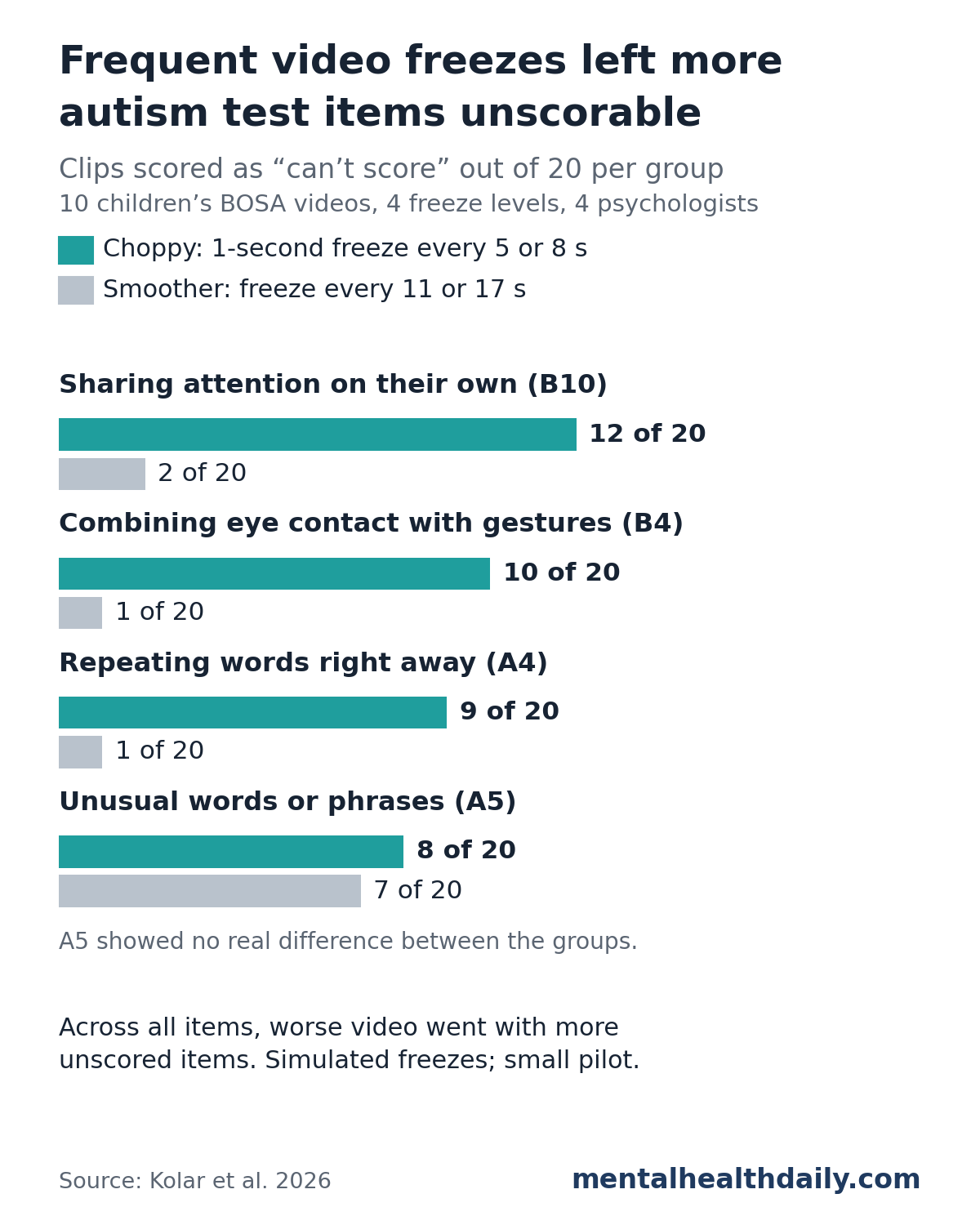
For 3 of those items, yes. Researchers split the clips into a choppy group (a freeze every 5 or 8 seconds) and a smoother group (every 11 or 17 seconds), with 20 clips in each.
Joint attention went unscored in 12 choppy clips vs 2 smoother clips. Combining gaze with gestures went unscored in 10 vs 1, and echolalia in 9 vs 1. All 3 differences were statistically significant.1
Unusual words were the exception: 8 vs 7 clips, no real difference. That item was hard to score regardless of video quality.
Across all items, worse video went with more unscored items (a moderately strong correlation, ρ = −0.58).1
Language items can go blank for another reason.
Under BOSA rules, echolalia and unusual-word items are automatically marked unscorable when a child says fewer than 5 words on their own. So some of these blanks reflect a young or minimally verbal child, not the video.1
The authors note that a single freeze can still erase a short vocalization, so both causes probably overlap. Their advice is to interpret language items carefully in remote sessions, especially for children who speak little.
Did Overall BOSA Scores Hold Up?
Mostly. Researchers also tested each item separately to see whether freeze level predicted whether it got scored. Joint attention, gaze and echolalia leaned that way, but none stayed significant after correcting for testing 21 items at once.1
Comparing the 2 smoothest freeze levels, total BOSA scores agreed closely between different psychologists. In all, 8 of 10 children got the same total, and scores differed by 0.4 points on average.1
That consistency is similar to the same team’s earlier study, where raters using an online BOSA-based protocol agreed with in-person raters 79.8% of the time in 29 children.3
A broader review of 10 studies found telehealth autism diagnosis was 80% to 91% accurate compared with in-person diagnosis.2
But this pilot did not compare the choppier clips with clean, uninterrupted video, so how much the worst conditions shifted final scores is unclear.
What Connection Do Families Need for a Remote Autism Evaluation?
The lab tests gave the authors 2 numbers to check before a session:1
- Wi-Fi signal strength above −70 dBm. Signal strength is measured in negative numbers, so −60 is stronger than −70. In the apartment tests it ranged from −42 dBm near the router to −75 dBm at the farthest point.
- Packet loss below about 0.04%. Packet loss is the share of data that never arrives. Even this tiny amount produced a freeze about every 5 seconds, and above 0.15% the video became unusable.
If a connection falls short, the authors suggest switching to a wired connection, moving closer to the router, or holding the session at a clinic or hub with reliable internet.
During a session, they suggest switching to an in-person evaluation if freezes come more often than about once every 10 seconds, or if more than 2 of the fast-moving items can’t be scored.
Limits of This Telehealth Autism Pilot
The authors call this an exploratory pilot, and the thresholds are first estimates rather than settled cutoffs.
- Small sample: 10 children, 40 clips and 4 psychologists from 1 hospital, so the confidence intervals were wide and smaller effects could be missed.
- Simulated, evenly spaced freezes: real connections drop out in irregular bursts and add pixelation, blurry resolution drops and out-of-sync audio. Real Zoom calls also tend to keep audio going when video stalls, while these clips froze sound and picture together.
- No clean-video comparison: score consistency was checked only between the 2 mildest freeze levels, using different raters rather than the same recording.
- Untested settings: cellular-only connections and delays on the clinician’s side were not studied.
Researchers call for larger studies across several sites, including homes that rely on cellular internet, to confirm or adjust the −70 dBm and 0.04% cutoffs.
References
- Kolar S, Horvath T, Stroupkova L, et al. Telehealth autism evaluation under suboptimal network conditions: technical parameters and clinical implications. PLOS ONE. 2026;21(9):e0357146. doi:10.1371/journal.pone.0357146
- Stavropoulos KK-M, Bolourian Y, Blacher J. A scoping review of telehealth diagnosis of autism spectrum disorder. PLOS ONE. 2022;17(2):e0263062. doi:10.1371/journal.pone.0263062
- Stroupková L, Vyhnalová M, Kolář S, et al. Use of telehealth in autism spectrum disorder assessment in children: evaluation of an online diagnostic protocol including the Brief Observation of Symptoms of Autism. Journal of Autism and Developmental Disorders. 2024. doi:10.1007/s10803-024-06524-x