
Autistic children and teens often face a chain of gaps in care, from slow recognition and long waits for assessment to thin support after diagnosis and a weak handoff to adult services. A 2026 narrative review of 62 recent sources found that families end up filling those gaps themselves.1
Research Highlights
- Problems build up across stages: the review traced delays and dropped handoffs at each step, from first concerns to referral, diagnosis, school support and the move to adult care, drawing on 62 sources published from 2020 to early 2026.1
- Diagnosis often doesn’t lead to support: families frequently leave assessments with recommendations but little practical help turning them into therapy, school services or next steps.1
- Parents become care coordinators: when referrals stall and services don’t talk to each other, caregivers take on the work, with costs to their jobs, finances and mental health.1
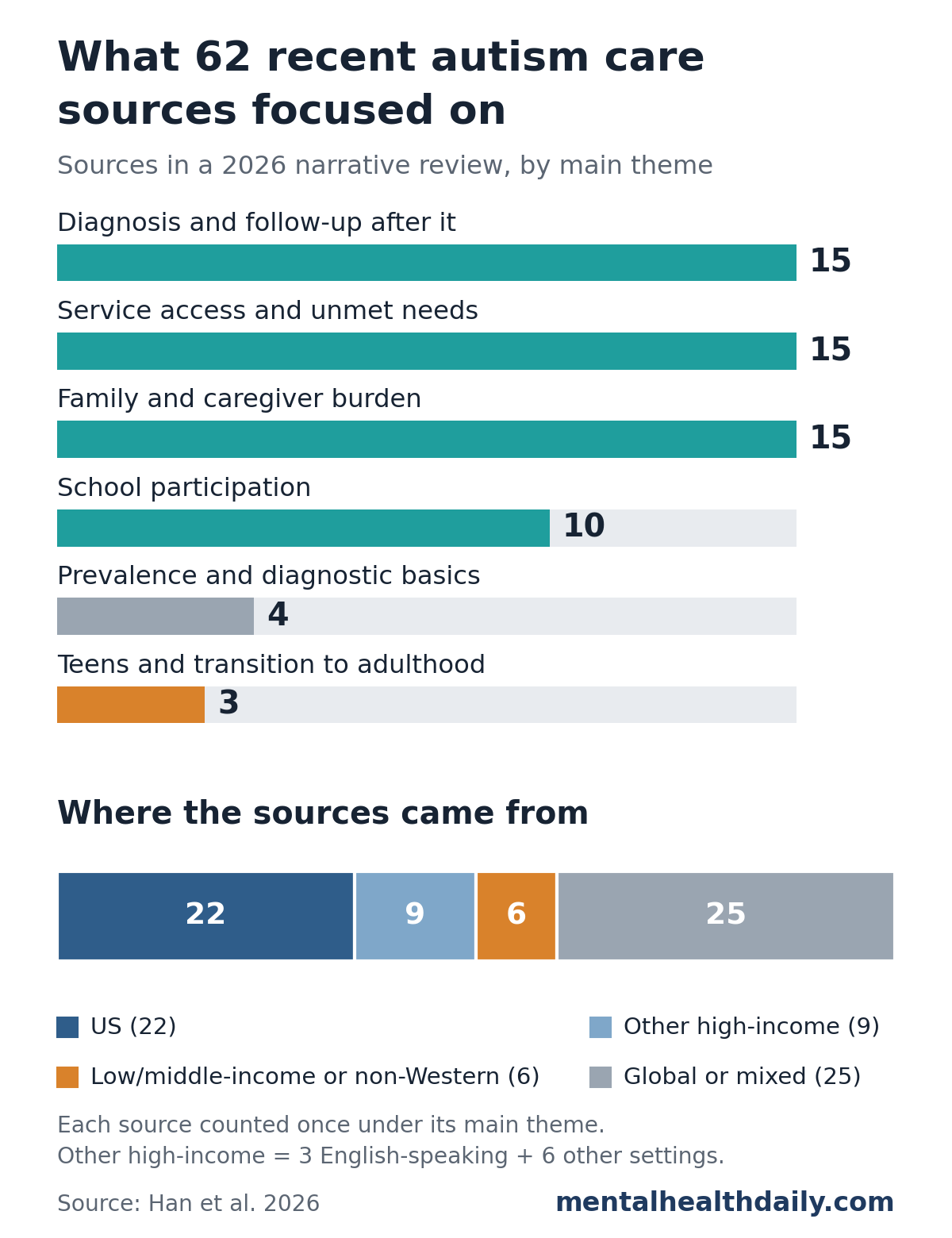
- Transition to adult care is the thinnest area: only 3 of the 62 sources focused on it, and a 2025 survey found that just 53.3% of autistic teens and young adults had completed the move to adult health care.12
- A synthesis, not new data: the review is narrative rather than systematic, with no pooled numbers and no formal quality rating of the studies it drew on.1
What the Autism Care Pathway Review Covered
Han et al., a team in Nanjing, China, set out to connect research lines that are usually studied separately. A care pathway is the route a child and family travel from first concern through referral, diagnostic assessment, follow-up support, school services and, eventually, adult care.1
The scale of need is large. US surveillance data cited in the review estimated that about 1 in 31 children aged 8 had been identified with autism in 2022, and the Global Burden of Disease Study 2021 estimated that about 1 in 127 people worldwide are autistic.1
The authors searched PubMed for studies published from January 2020 to March 2026, which returned 1,330 records, and added guidelines, surveillance reports and studies found in reference lists. The final synthesis drew on 62 sources:
- 32 quantitative, survey or service-access studies
- 16 systematic, scoping and other reviews
- 8 qualitative or caregiver-perspective studies
- 6 surveillance reports, diagnostic references and policy or conceptual papers
The review deliberately left out biology, genetics and medication. Its focus is how health care, schools and family support systems shape everyday life for autistic children and teens.1
Where Delays Start: Recognition and Referral
First concerns usually surface outside specialist clinics. Parents may notice delayed speech, less back-and-forth social play, unusual reactions to sounds or textures, or distress at changes in routine. Teachers may see classroom distress or difficulty with peers as social demands grow.1
So the route to referral depends heavily on nonspecialists whose training and access to support vary widely. Studies in the review linked delayed diagnosis to:
- Race and ethnicity
- Language barriers and limited access to interpreters
- Low income, rural location, insurance rules and a shortage of trained providers
- Presentations that don’t match common expectations of autism, including in girls and young women
Some children are not diagnosed until school age or adolescence. Clinic reports cited in the review found that a meaningful minority received a first autism diagnosis after age 7, often alongside language or anxiety disorders and without earlier parental concern about autism specifically.1
Long Waits for Diagnosis and Thin Support Afterward
The review did not pool wait times, and the underlying studies rarely report them in a comparable way. Instead, it described a pathway that is “frequently prolonged, fragmented, and difficult for families to navigate.” Families may bounce between primary care, community services, school referrals and specialist centers before reaching a full assessment.1
The main causes of delay it identified:
- Long waiting lists for specialist assessment
- Regional shortages of developmental specialists; one US analysis found areas with few pediatricians but relatively high estimated rates of neurodevelopmental conditions
- Unclear responsibility for who makes the referral and who follows up
The period after diagnosis is often just as hard. A quality-improvement project cited in the review found that many children diagnosed during the COVID-19 pandemic did not receive all recommended services, and developmental follow-up was inconsistent. In the authors’ words, diagnosis can function “as an administrative endpoint rather than a coordinated entry point into support.”1
Family navigation programs, in which a trained navigator helps families find and coordinate services, are one response. A 2025 scoping review cited by Han et al. found that navigation can speed the move from a positive screen to diagnosis and from diagnosis to intervention, while also supporting caregivers.1
Service Access Barriers Families Report
Across countries, families described the same set of barriers: waiting times, cost, workforce shortages, poor communication between services, and not knowing what services exist or how to get them. The review gives examples from very different systems.1
- Italy: carers often relied on a mix of public and privately paid services, with heavy time commitments and significant direct costs
- Saudi Arabia: parental satisfaction with services varied, which suggests that having services available doesn’t guarantee they are useful
- South Africa: caregivers described long delays for school places and autism services, and the financial and emotional “costs of waiting”
- United States: use of telehealth for developmental assessments differed by the family’s preferred language
Unmet need, in this view, is more than missing therapy hours. It includes confusing information, long travel, inconsistent follow-up and services that don’t fit what the family needs. A system can look active on paper and still feel out of reach to the families using it.1
How Fragmented Care Adds to Family Burden
Caregivers notice early concerns, arrange evaluations, manage appointments, coordinate with schools and carry out strategies at home. When referrals are delayed or recommendations are unclear, they become what the review calls “default case managers.”1
Studies in the review linked this work to:
- Mental health strain: women caregivers reported greater burden and psychological distress than men in one study
- Lost work and leisure: a scoping review and an interview study found that parenting an autistic child often restricted caregivers’ employment, leisure and community involvement
- Financial strain and stigma: qualitative work from Ghana and elsewhere described money pressures, social exclusion and emotional distress
The authors argue that caregiver burden is also a measure of how well services work. Their phrase for the risk is that “family-centered care should not become family-managed care.” They recommend building psychoeducation, navigation help, peer support and caregiver mental health support into routine care rather than offering it only when families ask.1
School as a Main Source of Support and of Unmet Need
School is where communication demands, peer relationships, sensory load and academic expectations all meet. The studies reviewed increasingly measure participation (how fully a child takes part in school life) rather than attendance or grades alone.1
One study found that a more difficult physical school environment went along with lower participation for autistic youth. That points to things a school can change, such as noise, layout and routines, rather than placing the problem only in the child.1
Schools also carry much of the transition planning in the US. In a population-based study of 322 adolescents with autism at 3 US surveillance sites, 92% had an individualized education program (IEP, a formal special education plan) that included a transition plan, but only 41% had a goal for where they would live after high school.3
The Transition to Adult Services Is the Weakest Link
Adolescence brings new demands: more independence, more complex mental health needs, planning for college or work, and a move from pediatric to adult health care. School-based supports wind down just as adult systems become stricter about eligibility.1
A 2025 pilot survey of 180 autistic adolescents and young adults aged 14 to 25 in rural and urban US areas gives a sense of the gap. Only 53.3% reported having completed the transition to adult health care, at an average age of about 18, and only 40 had discussed the transition with their doctors.2
Han et al. call transition “a particularly underdeveloped area” of research. Their own evidence base reflects it: only 3 of their 62 sources, or 4.8%, focused mainly on adolescence and the move to adulthood.1
How Strong the Evidence Is
The review pulls together a lot of consistent findings, but it is an interpretive summary rather than a measurement. The main limits, most of which the authors state themselves:
- Narrative, not systematic. There was no meta-analysis, no pooled estimate and no formal grading of evidence.
- One screener. The first author screened the studies alone, and no risk-of-bias tool was applied.
- Mixed study types. Surveys, interviews, reviews and surveillance reports answer different questions and can’t be weighed equally.
- Mostly high-income settings. 22 sources were US-based and only 6 came from low- and middle-income or non-Western settings; all were in English.
- Barriers, not solutions. Most underlying studies describe problems; few compare service models or follow families over years.
- Pandemic timing. Much of the literature comes from 2020 onward, so some barriers were made worse, or more visible, by COVID-19 disruptions.
Where the review’s claims could be checked against the original studies, as with transition planning, the primary data back them up.23
What Could Improve Autism Care for Children and Teens
The authors’ recommendations follow from the pathway view:
- Treat diagnosis as an entry point. Every assessment should connect families to services, school planning and follow-up.
- Fund coordination, not just more appointments. Family navigators, interpreters, outreach and targeted financial help may matter as much as added diagnostic slots.
- Link health care and schools. Clinical recommendations need to be written in a form schools can act on.
- Start transition planning early. Health care, school and adult services should plan the handoff together instead of leaving it to the last year of pediatric care.
- Test what works. Future studies should compare service models over time rather than only documenting barriers.
For parents in the middle of this process, the review’s message is that much of the difficulty comes from how systems are built, not from anything the family is doing wrong. Asking a pediatrician, school or local autism organization about navigation or care coordination support is a reasonable first step.
References
- Han X, Weng L, Xu H. Care pathways, service access, and psychosocial support needs in children and adolescents with autism spectrum disorder: a narrative review. Frontiers in Public Health. 2026;14:1840171. doi:10.3389/fpubh.2026.1840171
- Zhang E, Snyder M, Alduraidi W, et al. Health care transition for autistic adolescents and young adults: a pilot rural and urban comparison survey study. Autism. 2025;29:1403–1414. doi:10.1177/13623613241304495
- Hughes MM, Kirby AV, Davis J, et al. Individualized education programs and transition planning for adolescents with autism. Pediatrics. 2023;152(1):e2022060199. doi:10.1542/peds.2022-060199