hit counter

ABCD: Childhood Poverty Raised Risk; Inhibitory Control Split Resilience
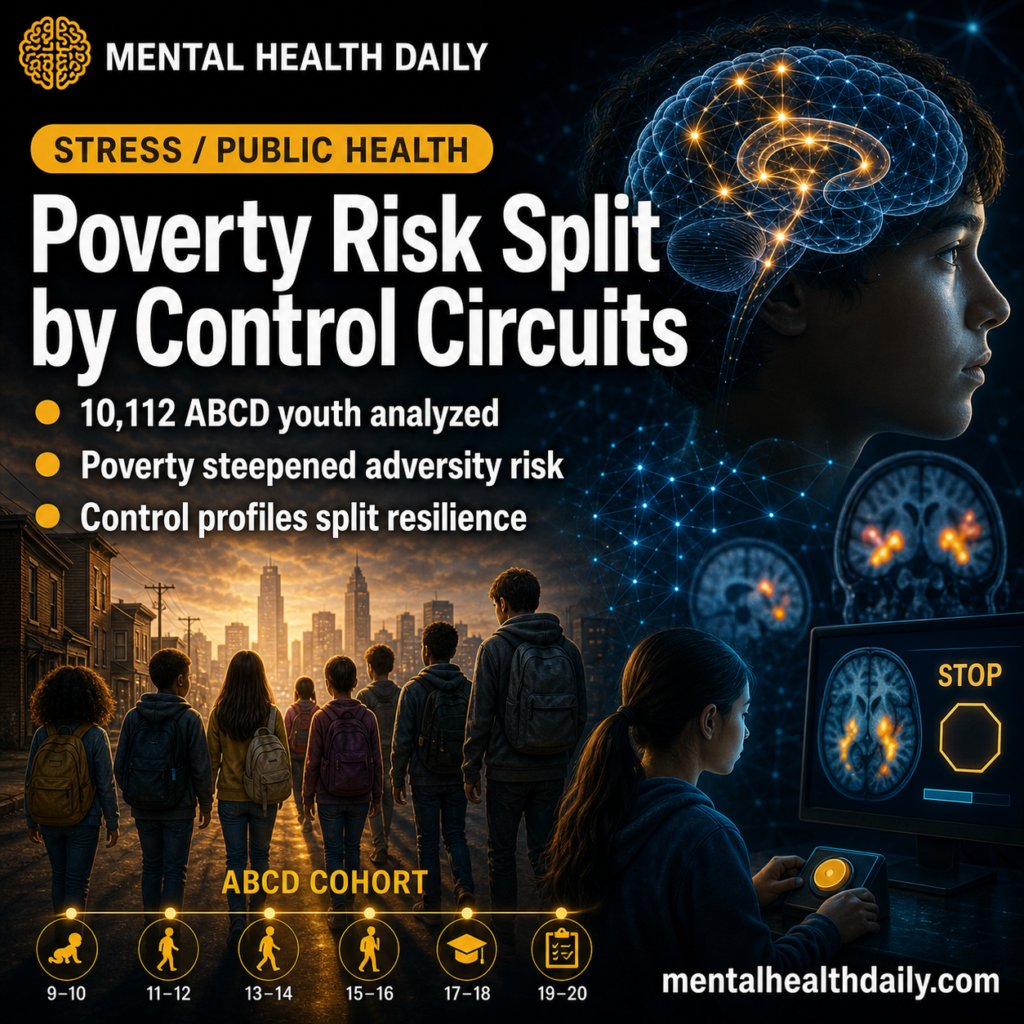
MHD featured image for childhood poverty, inhibitory control, and resilience in ABCD youth.

A 2026 ABCD cohort preprint involving 10,112 youth found that childhood poverty strengthened the link between cumulative early-life adversity and later behavioral problems; among poverty-exposed youth, inhibitory-control fMRI profiles split children into higher-vulnerability and buffered pathways. Research Highlights Poverty steepened adversity risk: In 10,112 ABCD youth, childhood poverty amplified the baseline early-life-adversity-to-CBCL Total Problems slope …

Read more

Group fMRI Misread Cognitive Control in 4,423 Youth

MHD featured image for group fMRI and individual cognitive-control brain signals.

A 2026 ABCD stop-signal fMRI study found that group-level cognitive-control brain signals often failed to describe within-person brain dynamics: across 16 comparisons, between-person and within-person associations diverged, and several reversed direction.1 The practical warning is narrow but sharp: a brain pattern that separates people in a group may be the wrong map for explaining how …

Read more

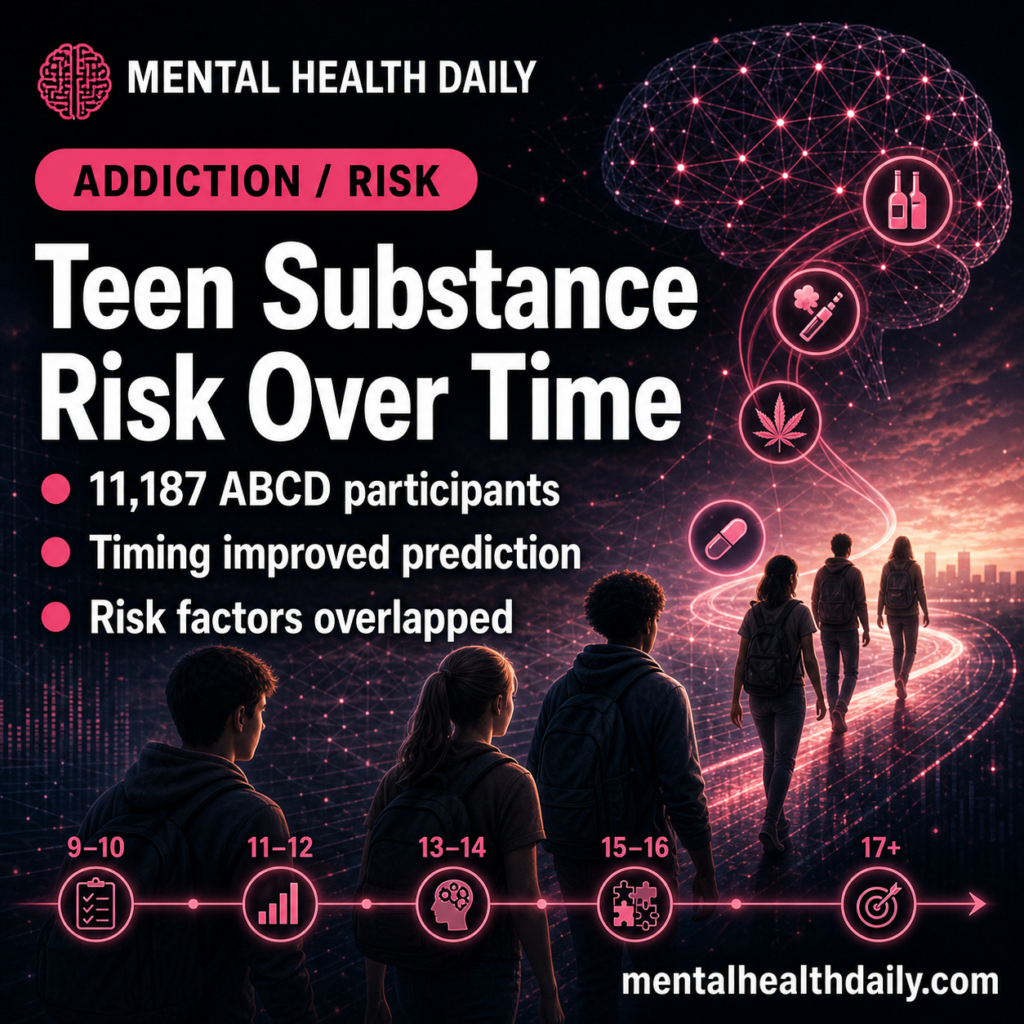
Teen Substance Use Prediction: Dynamic ABCD Models Improved AUROC

Editorial card showing adolescent substance-use risk pathways over time, with dynamic prediction outperforming baseline-only models.

A 2026 ABCD Study preprint found that teen substance-use initiation prediction improved more when models included changing risk over time than when they simply switched from logistic regression to multi-task learning.1 Dynamic models raised AUROC by 0.044 to 0.062 in multi-task learning and by 0.050 to 0.084 in logistic regression, which makes timing the main …

Read more

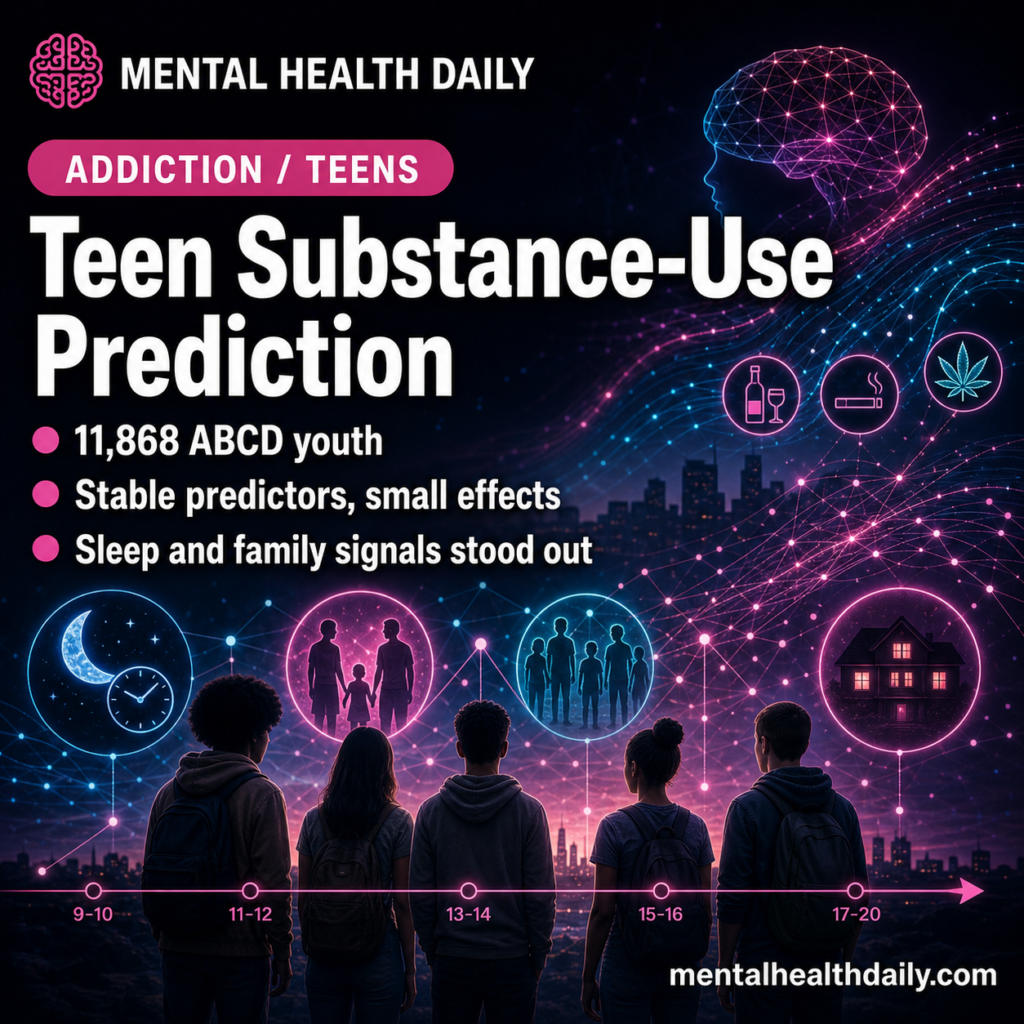
Teen Substance-Use Prediction in ABCD: Stable Signals, Small Effects

MHD featured image for teen substance-use prediction in the ABCD Study.

A 2026 ABCD Study preprint involving 11,868 youth found stable time-ordered predictors of teen substance-use initiation, but the adjusted effects were small: most estimates ranged from −0.01 to 0.02 initiation-probability points per 1-SD predictor increase. Research Highlights Large ABCD panel: Wei et al. analyzed 11,868 youth with repeated observations and interval-level initiation outcomes for alcohol, …

Read more

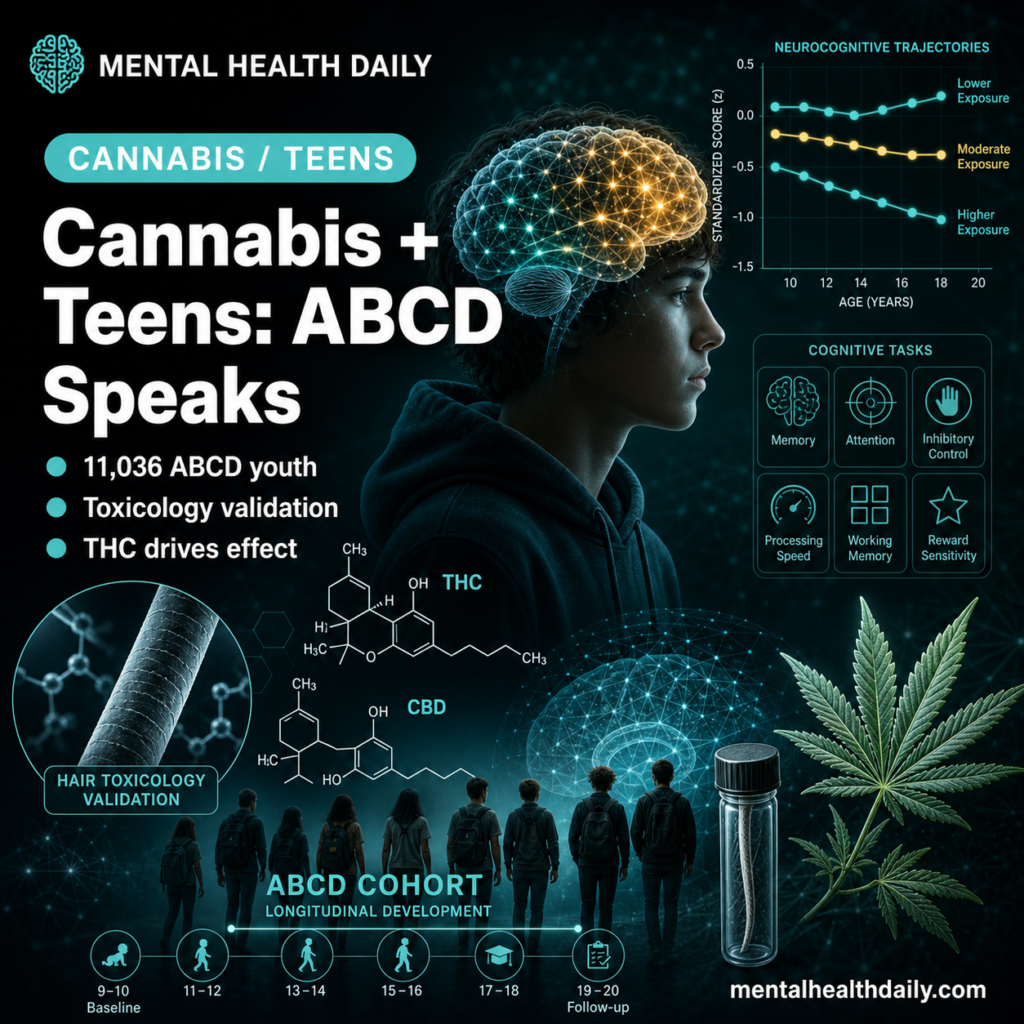
Teenage Cannabis Use vs. Cognition and Brain Development: THC vs. CBD (Toxicology Data)

Photoreal illustration of an adolescent brain with overlay of cannabis molecules and cognitive metrics, conveying developmental neurocognitive impact.

Studies of adolescent cannabis effects on cognition have been limited by self-report and confounding. A 2026 longitudinal study by Wade and colleagues uses the Adolescent Brain Cognitive Development (ABCD) cohort with both self-report and biological toxicology, separating THC and CBD effects on developing cognition.1 Research Highlights Adolescence is a critical window for cognitive maturation, with …

Read more