hit counter

Resting Brain Connectivity Predicts Fear Extinction Learning
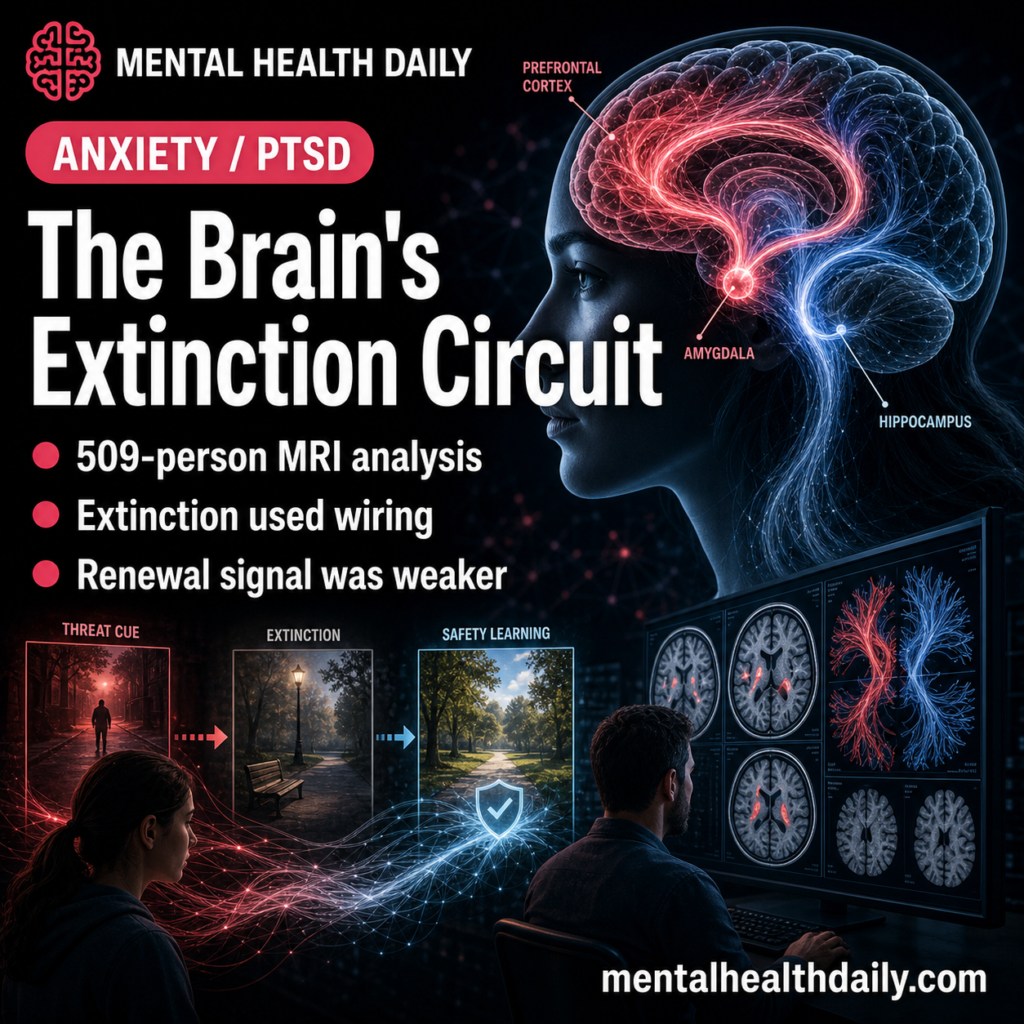
Photoreal illustration of brain network connections in the fear-extinction circuitry, with imagery linking amygdala and prefrontal regions.

A 2026 multimodal MRI analysis of 509 healthy adults found that fear acquisition, extinction learning, and renewal were not predicted by one generic “fear circuit” score: functional connectivity predicted acquisition, structural connectivity predicted extinction, and effective connectivity was the only renewal signal.1 The extinction result is the clinically interesting piece because exposure therapy depends on …

Read more

Psychedelic Hallucinations May Reflect Wake-Time Memory Replay

Photoreal illustration of a brain shifting between perception and generative imagery under psychedelic influence.

A 2026 eLife computational study modeled classical psychedelics by increasing a network state variable from alpha = 0 to alpha = 1, shifting perception from bottom-up sensory inference toward top-down generative replay. The result is a useful but still unproven oneirogen model: hallucinations look less like random noise and more like wake-time replay of a …

Read more

EEG Alpha Density Decreased in Children, Increased in Adults

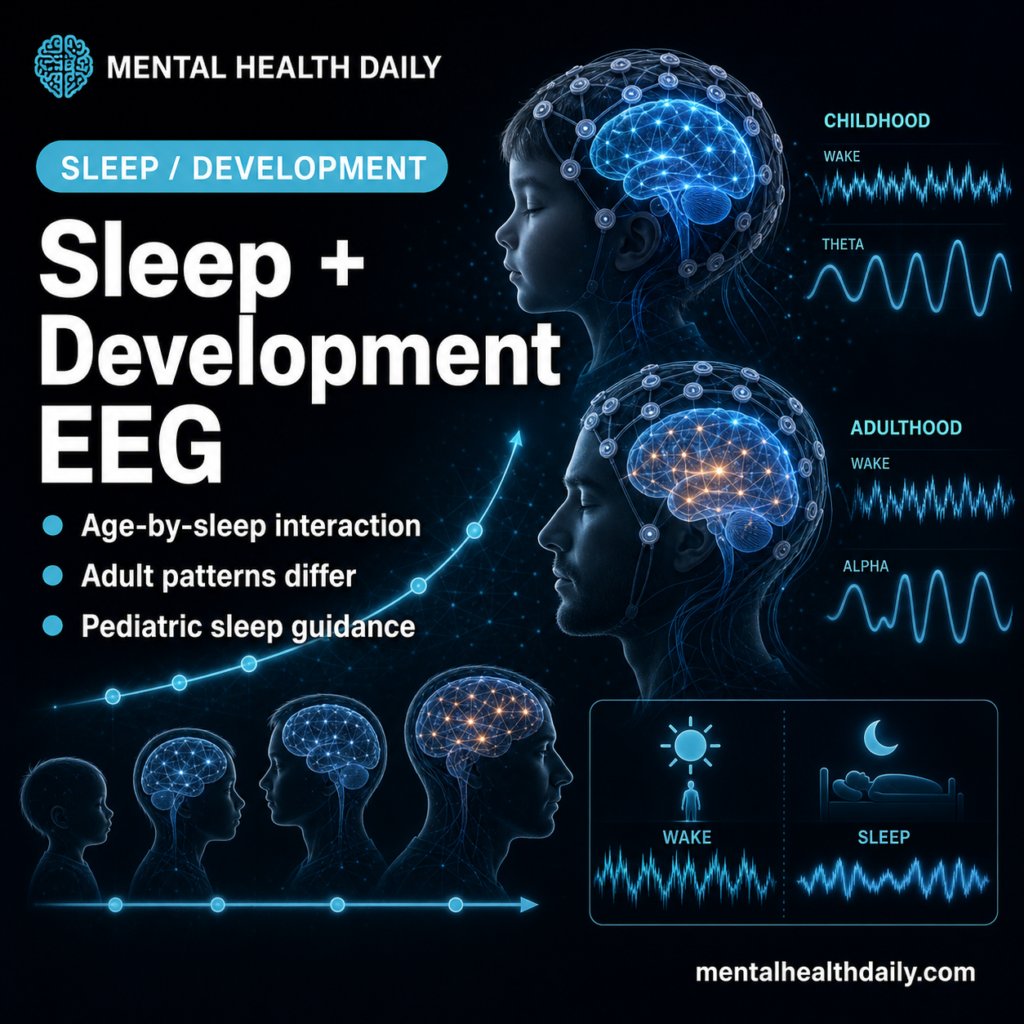
Photoreal illustration of children and adults with overlay of EEG brain rhythms, conveying developmental differences in sleep effects on brain activity.

A 2026 eNeuro analysis of 163 people ages 3.5–24.7 found that wake EEG amplitude behaved like a sleep-pressure marker, but wake alpha-density changed in opposite directions across development: it decreased overnight in children and increased overnight in adolescents and adults.1 Research Highlights Alpha density flipped by age: In 163 participants ages 3.5–24.7, oscillation density showed …

Read more

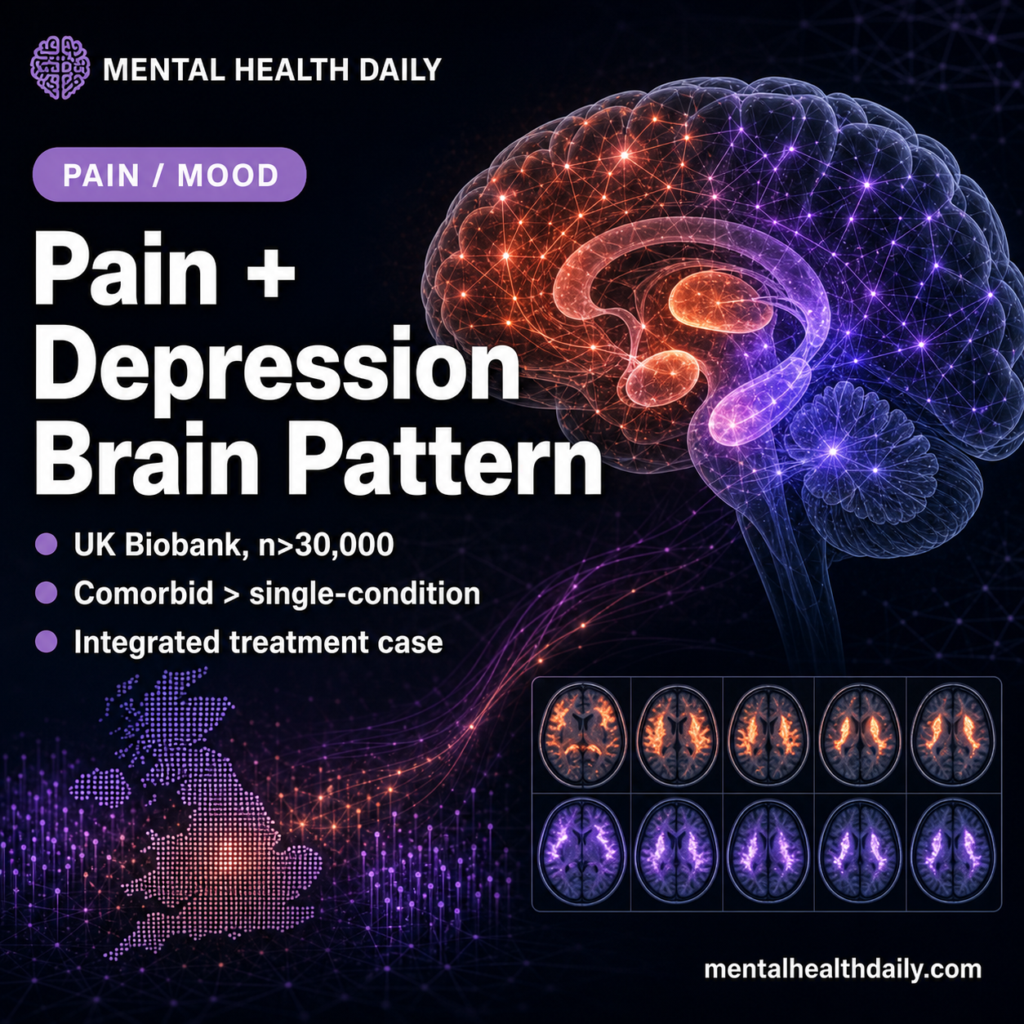
Chronic Pain Plus Depression Alters Brain Structure

Photoreal illustration of brain regions affected by overlapping pain and depression networks, conveying comorbid neural signature.

A 2026 UK Biobank MRI preprint involving 71,214 adults found that chronic pain plus current depression had a structural brain profile that was more than chronic pain plus depression pasted together. The 1,377-person comorbid group showed widespread lower cortical volume, lower bilateral thalamic and hippocampal volume, lower left accumbens volume, and broad white-matter microstructure differences …

Read more

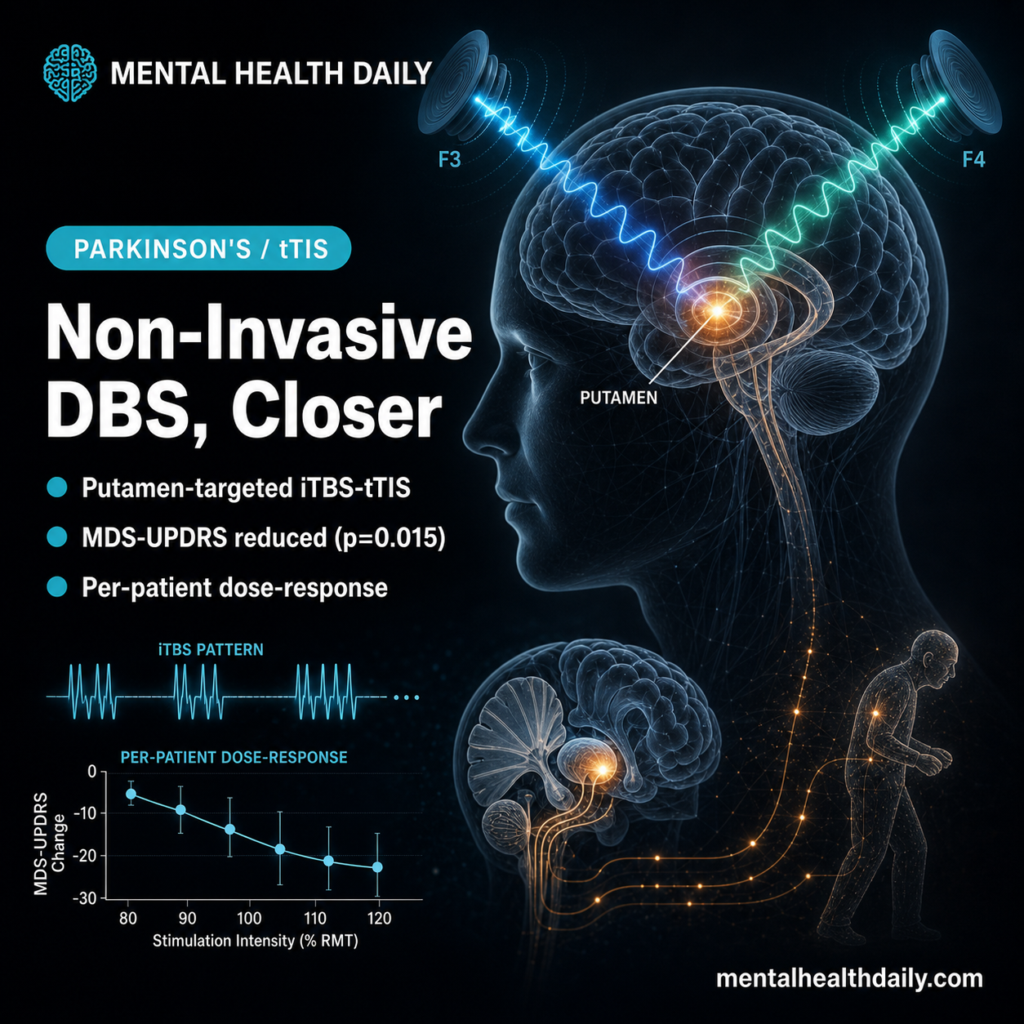
Transcranial Temporal Interference Stimulation (tTIS) May Improve Parkinson’s Motor Symptoms

Photoreal illustration of two interfering electric fields converging at deep brain regions, conveying non-invasive deep stimulation in Parkinson's.

Deep brain stimulation works for Parkinson’s, but it requires implanted electrodes. A 2026 randomized crossover trial by Stalter and colleagues tested whether transcranial temporal interference stimulation — a non-invasive technique designed to reach deep targets without exciting overlying cortex — can move the needle on motor symptoms when aimed at the putamen.1 Research Highlights Transcranial …

Read more

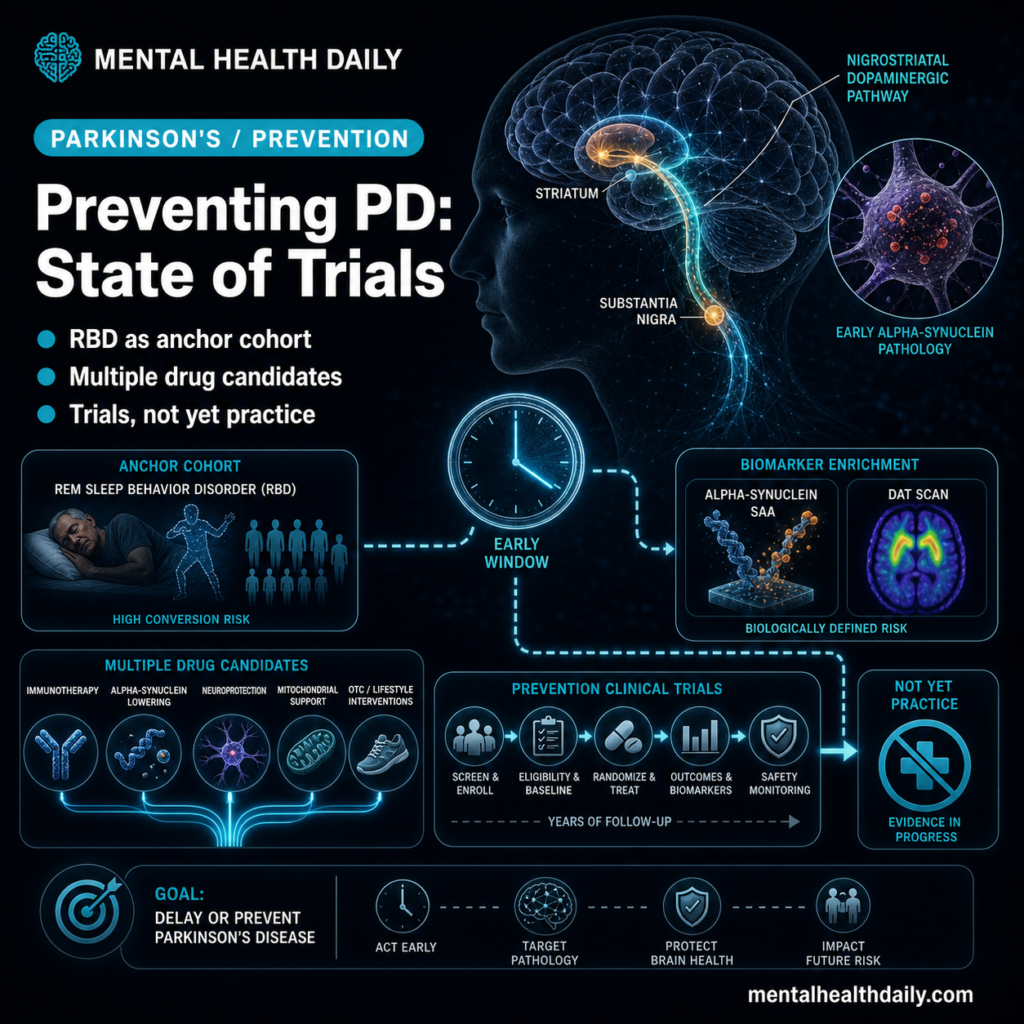
Parkinson’s Disease Prevention: Prodromal Symptoms, RBD, Early Intervention Trials

Photoreal illustration of a brain with prodromal pathology and a clock indicating early-window intervention opportunity for Parkinson's prevention.

Parkinson’s disease has a years-to-decades prodromal stage where motor symptoms haven’t yet emerged but pathology is accumulating. A 2026 review by Schaeffer et al. synthesizes the case for (and limits of) intervening during this window — with implications for high-risk individuals weighing whether to enter preventive trials.1 Research Highlights Prodromal Parkinson’s disease is the period …

Read more

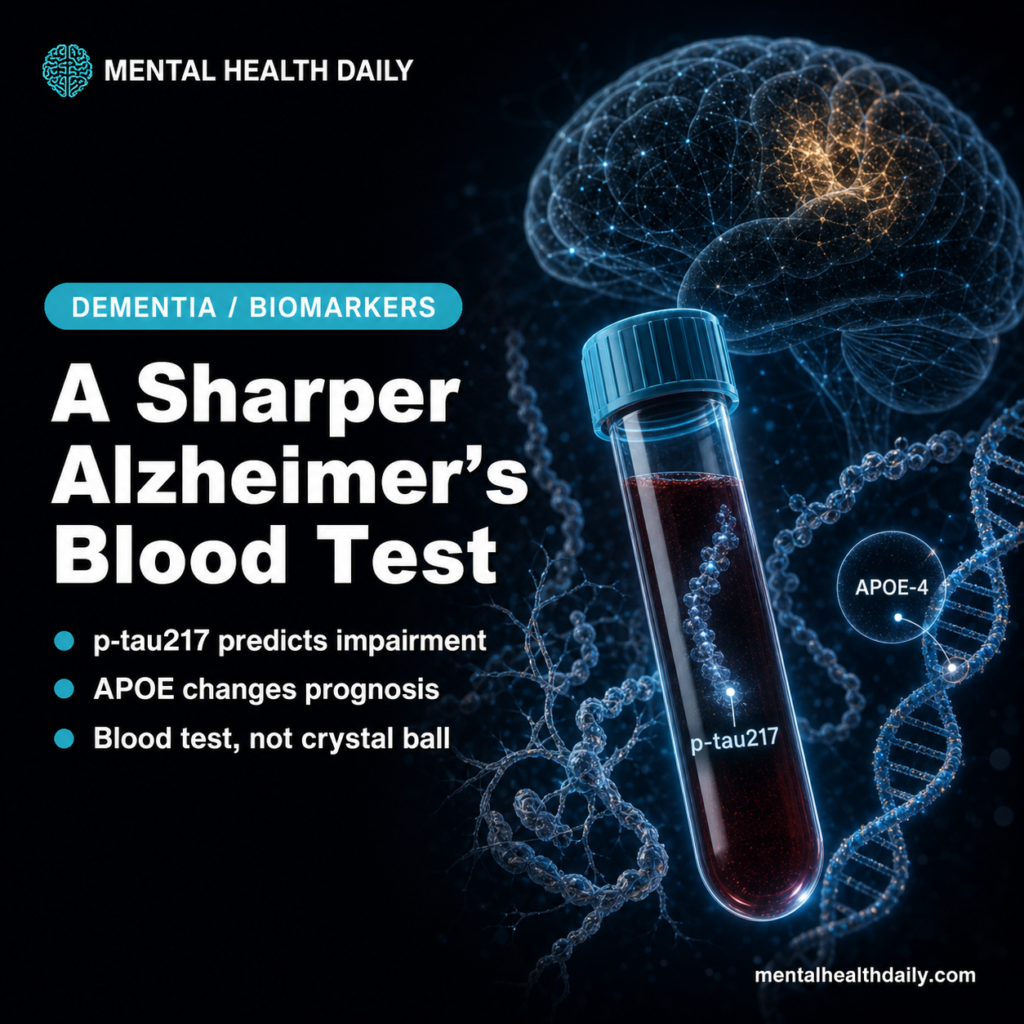
Plasma p-tau217 Blood Test Predicts Alzheimer’s Risk 1.5x Stronger in APOE-e4

Photoreal illustration representing a blood biomarker test for Alzheimer's disease with imagery of blood vials, neurons, and APOE genetic motifs.

Until recently, Alzheimer’s pathology could only be confirmed in living patients via PET imaging or lumbar puncture. Plasma p-tau217 changed that calculus — but how to interpret a positive result depends substantially on APOE genotype.1 Research Highlights Plasma p-tau217 is a blood biomarker that rises years before Alzheimer’s symptoms. The 2024 Alzheimer’s Association revised criteria …

Read more