
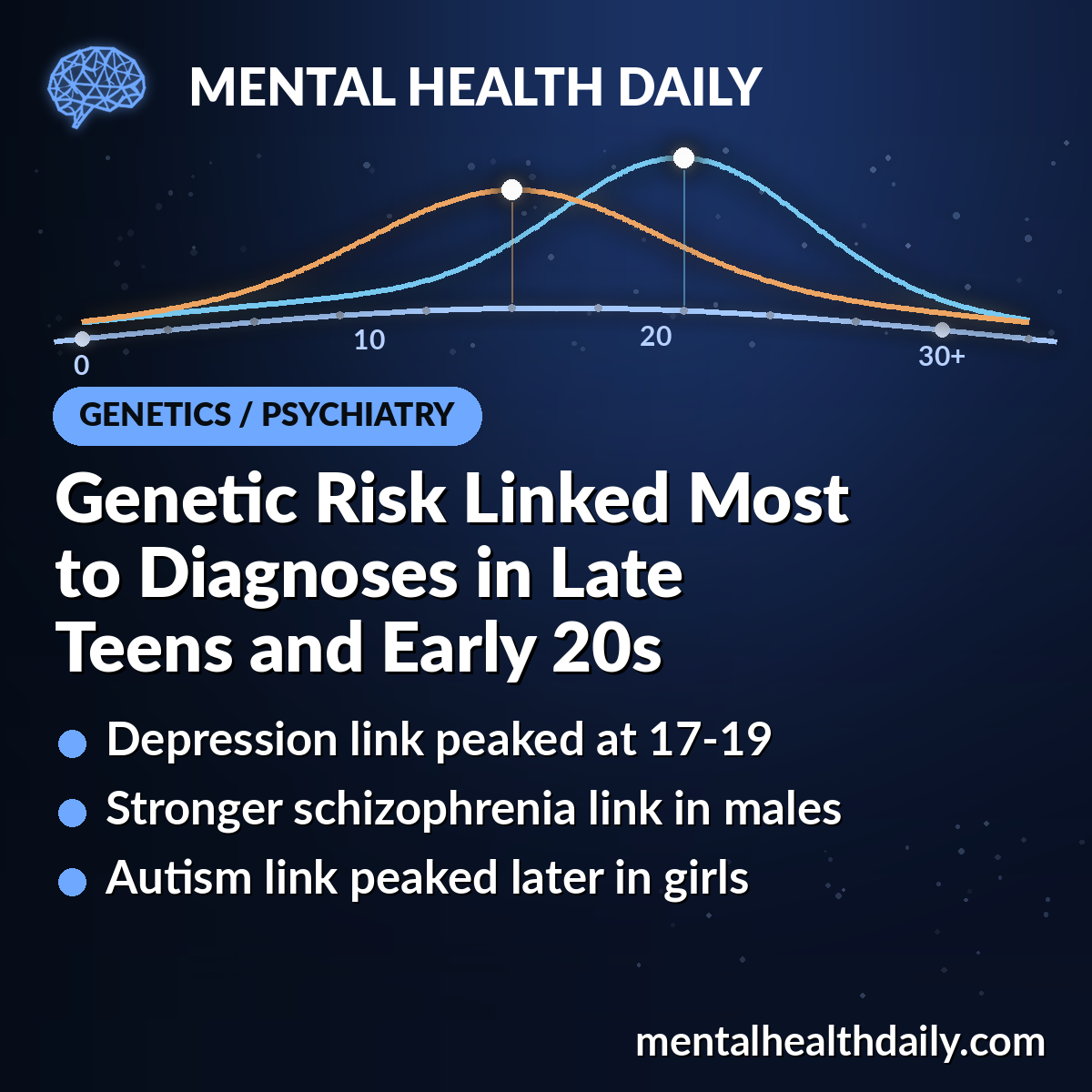
Inherited genetic risk for depression, schizophrenia, and bipolar disorder was most strongly linked to diagnoses made in the late teens and early 20s, according to a 2026 Danish study of about 120,000 people.1 The timing differed by gender, especially for schizophrenia and autism.
Research Highlights
- Depression peaked at ages 17–19: each 1-standard-deviation (SD) rise in the depression polygenic score was linked to a 56% higher rate of first depression diagnosis in males (hazard ratio 1.56) and 48% in females (1.48) at those ages.1
- Schizophrenia link was stronger in males: the schizophrenia score peaked at ages 20–22 in males (hazard ratio 1.71) and at 17–19 in females (1.29).1
- Autism link peaked later in girls: in males the autism score was most strongly linked to diagnosis at ages 4–9; in females the peak came at ages 13–18.1
- ADHD link grew with age: the ADHD score was most strongly linked to ADHD first diagnosed at ages 25–27, in both males and females.1
- Group patterns, not personal predictions: the analysis was exploratory, used age at hospital diagnosis rather than age at first symptoms, and was limited to people born in Denmark who passed a genetic-ancestry filter.1
What a Polygenic Score Measures
Most psychiatric conditions are influenced by thousands of common gene variants, each with a tiny effect. A polygenic score (also called a polygenic risk score) adds up how many of those risk variants a person carries, weighted by how strongly each one was linked to the disorder in earlier large genetic studies.
The result is a single number that ranks people by inherited risk relative to others in the same population. Common variants collectively account for roughly 10% of variation in risk for depression and autism, and about 20% for ADHD, schizophrenia, and bipolar disorder.
Those are population heritability estimates; an individual polygenic score captures only part of that contribution.1
Results here are reported as hazard ratios per 1 SD of the score. A hazard ratio of 1.56 means that at a given age, people whose score was 1 SD higher were diagnosed at a rate 56% higher than people at the average score. A value of 1.0 would mean no link.
How the Danish iPSYCH Study Tracked Genetic Risk by Age and Gender
Maseras et al. used iPSYCH2015, a Danish research sample built from newborn blood spots stored for everyone born in Denmark from 1981 to 2008. It includes people later diagnosed in a Danish hospital with a major psychiatric disorder, plus a random comparison group drawn from the whole birth population.1
- Cases: 30,905 with major depressive disorder, 12,703 with schizophrenia spectrum disorders, 3,169 with bipolar disorder, 25,167 with ADHD, and 15,677 with autism
- Comparison group: 52,765 randomly sampled people, about 2% of the birth cohort
- Analyzed sample: 119,941 people after genotyping, quality control, and an ancestry filter
- Follow-up: first hospital diagnosis between 1994 and 2015, tracked from age 10 for depression, schizophrenia, and bipolar disorder, and from age 1 for autism and ADHD
- Analysis: Cox models (a standard way to compare diagnosis rates over time) split follow-up into 3-year age bands, analyzed males and females separately, and adjusted for birth year and genetic ancestry
Diagnosis ages ranged from 10 to 35 for depression, schizophrenia, and bipolar disorder (average 20), and from 1 to 35 for autism and ADHD (average 12). Females made up 67% of depression cases, 61% of bipolar cases, 46% of schizophrenia cases, about 30% of ADHD cases, and about 25% of autism cases.1
Depression and Schizophrenia Genetic Risk Peaked in the Late Teens and Early 20s
Every polygenic score was linked to higher risk of every disorder at every age. For depression, schizophrenia, and bipolar disorder, though, the links were strongest between about ages 17 and 22 and weakened toward age 35.1
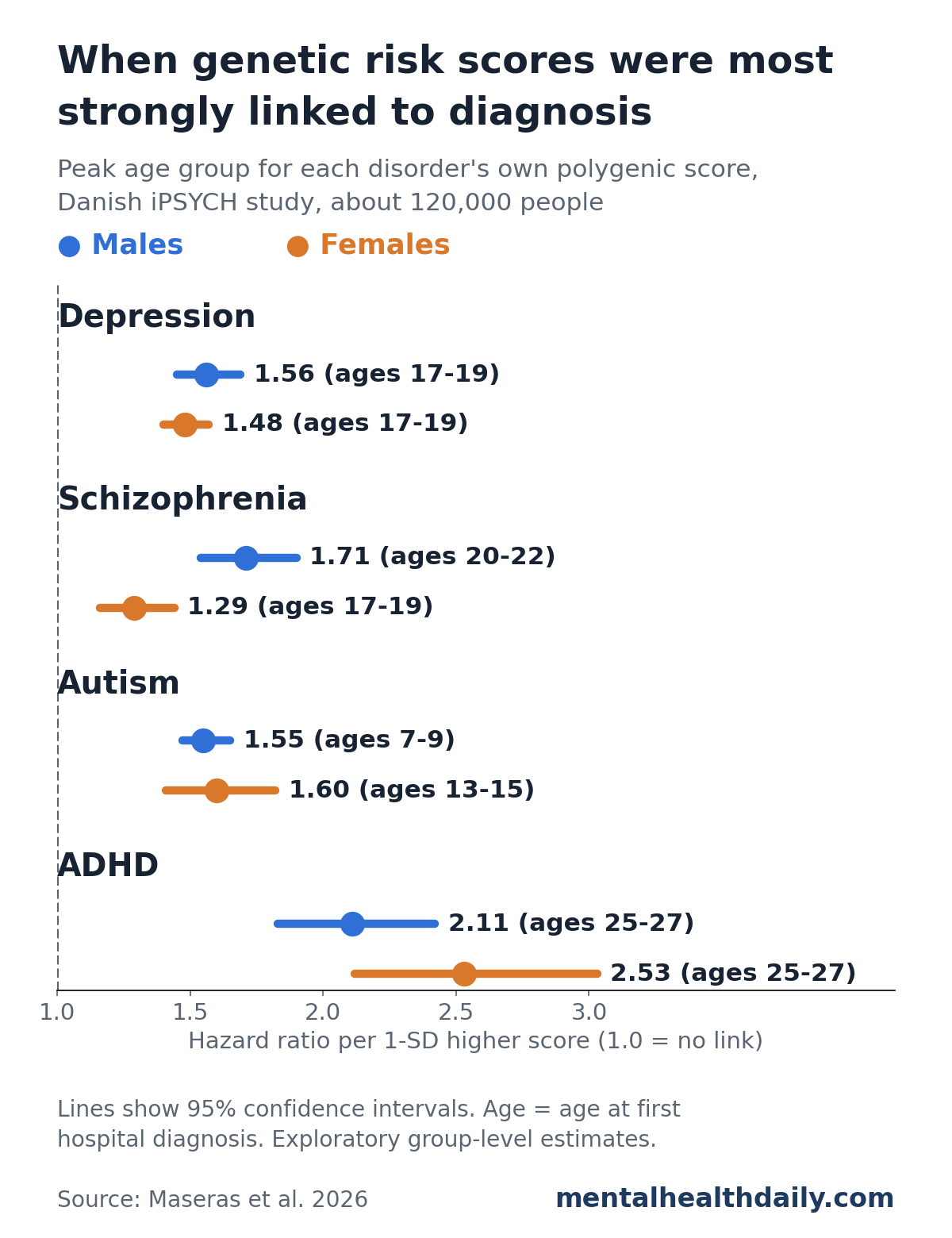
Depression: the depression score peaked at ages 17–19 in both groups — hazard ratio 1.56 (95% CI 1.45–1.69) in males and 1.48 (1.40–1.57) in females. Across all ages combined, the figure was only 1.25–1.28.1
Links at ages 11–13 were weaker. The researchers suggest this reflects small numbers and the possibility that childhood depression is driven more by trauma and other non-genetic factors.1
Schizophrenia: the gender difference was marked. In males, the schizophrenia score peaked at ages 20–22 (hazard ratio 1.71; 95% CI 1.54–1.90) and ranged from 1.15 to 1.71 across age bands. In females it peaked earlier, at 17–19 (1.29; 1.16–1.44), and stayed within a narrow 1.11–1.29, with most age-specific estimates not statistically significant.1
Bipolar disorder: the peak came at older ages than for depression, in line with bipolar disorder’s usually later diagnosis.1
Autism and ADHD Genetic Links Peaked Later in Girls
For the 2 childhood-onset conditions, males showed stronger genetic links before the average age of diagnosis, and females showed stronger links after it.1
- Autism in males: hazard ratio 1.51 (95% CI 1.44–1.61) at ages 4–6 and 1.55 (1.47–1.65) at ages 7–9, declining after that.
- Autism in females: hazard ratio 1.60 (1.41–1.82) at ages 13–15 and 1.57 (1.37–1.80) at ages 16–18.
- ADHD in both genders: the link rose with age, reaching 2.11 (1.83–2.42) in males and 2.53 (2.12–3.03) in females at ages 25–27.
The later female autism peak fits 2 explanations the researchers raise. One is a female protective effect: girls may need a heavier genetic load before autism becomes apparent. The other is diagnostic delay, since diagnostic criteria may be biased toward how autism shows up in boys.1
For ADHD, girls and women often have subtler symptoms, along with anxiety or depression, which can push diagnosis later.1
Depression Genetic Risk Was Linked to All 5 Disorders
The depression polygenic score stood out across the board. It was linked to diagnoses of schizophrenia, autism, and ADHD as well as depression.1
- Females with schizophrenia: the depression score was more strongly linked to diagnosis than the schizophrenia score itself. Women with schizophrenia more often have prominent mood symptoms, and current schizophrenia scores may capture male-typical risk better.1
- Later-diagnosed ADHD: the depression score’s link to ADHD grew stronger with age in both genders.1
- Autism and ADHD: despite known shared genetics, the researchers found little cross-link between the autism and ADHD scores in this analysis.1
Other Studies Also Link Higher Genetic Load to Earlier Diagnosis
These results fit a broader pattern in psychiatric genetics.
- Earlier depression onset: a UK Biobank analysis of 94,154 people found that gene variants linked to earlier depression onset also tended to raise risk of depression and other psychiatric disorders (genetic correlation −0.49 between onset age and depression risk).2
- Late-diagnosed ADHD: an earlier iPSYCH study comparing 14,878 childhood, 1,473 persistent, and 6,961 late-diagnosed ADHD cases found that late-diagnosed ADHD shared more genetic overlap with depression, while childhood ADHD overlapped more with autism and hyperactivity.3
- Female protective effect in autism: siblings of autistic girls were more likely to be diagnosed with autism than siblings of autistic boys, and mothers carried more common inherited autism risk than fathers.4
The new analysis adds age-by-gender detail across 5 disorders in one population sample, which earlier studies mostly lacked.1
Limitations of This Polygenic Score Analysis
The overall patterns are consistent, but several design features limit how far individual numbers can be pushed.
- Exploratory, many comparisons: the researchers estimated dozens of age, gender, and disorder combinations without a prespecified significance threshold or multiple-testing correction. They advise reading overall patterns rather than single significant estimates.1
- Diagnosis is not onset: age at first hospital diagnosis stands in for age at onset. Later diagnoses in girls may reflect delayed detection or access to care rather than later biology.1
- Hospital cases only: people treated only in primary care are missing, which may tilt the sample toward more severe illness. Follow-up also stopped at age 35.1
- Score quality varies: polygenic scores inherit biases from the studies used to build them, including gender imbalance. The autism and ADHD scores were trained on data that included iPSYCH itself.1
- Model-dependent gender gaps: without age bands, the schizophrenia score looked more strongly linked in females; with age bands, it was generally stronger in males across ages.1
- Ancestry: the sample was Danish and filtered for genetic ancestry, so results may not carry over to other populations.
What Polygenic Risk Scores Can and Cannot Tell You
A hazard ratio around 1.5 per SD describes a shift in average rates across tens of thousands of people. It does not tell any one person whether, or when, they will be diagnosed, and the study did not test individual prediction.
- For researchers: genetic studies of psychiatric disorders should account for age at diagnosis and gender, since mixing them can blur or hide real signals.
- For families: the late teens and early 20s are when depression and schizophrenia are often first diagnosed, and this is also when their genetic links were strongest.
- For girls with possible autism or ADHD: later diagnosis is common, and the researchers tie the later genetic peak in females partly to delayed recognition.
References
- Maseras GT, Chen D, Albiñana C, et al. Gender-specific associations between polygenic scores and age-specific risk of psychiatric disorders. British Journal of Psychiatry. 2026:1–8. doi:10.1192/bjp.2026.10759
- Harder A, Nguyen TD, Pasman JA, et al. Genetics of age-at-onset in major depression. Translational Psychiatry. 2022;12:124. doi:10.1038/s41398-022-01888-z
- Rajagopal VM, Duan J, Vilar-Ribó L, et al. Differences in the genetic architecture of common and rare variants in childhood, persistent and late-diagnosed attention-deficit hyperactivity disorder. Nature Genetics. 2022;54:1117–1124. doi:10.1038/s41588-022-01143-7
- Wigdor EM, Weiner DJ, Grove J, et al. The female protective effect against autism spectrum disorder. Cell Genomics. 2022;2(6):100134. doi:10.1016/j.xgen.2022.100134