
A single low dose of amisulpride, a drug thought to boost dopamine signaling at low doses, led to higher blood flow in the brain’s main reward hub than placebo. The randomized trial scanned 111 young adults, 57 with unmedicated depression and 54 without.1
Research Highlights
- Higher ventral striatum blood flow: people given 100 mg of amisulpride had relative ventral striatum perfusion of 127.7% of the gray-matter average vs 122.4% on placebo (p = 0.031), in both the depression and healthy groups.1
- Only that region moved: 9 other reward-network regions, including the caudate, putamen, insula, and ventral tegmental area, showed no significant change.1
- Design: double-blind, placebo-controlled, single dose, published in Neuropsychopharmacology (2026); 120 people completed the study and 111 had usable scans.1
- Anhedonia link, in healthy volunteers only: among healthy people on amisulpride, higher anhedonia scores went with higher ventral striatum blood flow (r = 0.59). The link was absent in the depression group.1
- A brain probe, not a treatment test: the study measured acute brain effects of one dose and did not test whether amisulpride relieves depression.1
Why Researchers Gave a Dopamine Drug to People With Depression
Anhedonia, the loss of interest or pleasure in things that used to feel rewarding, affects most people with major depressive disorder (MDD). Standard antidepressants often do not treat it well, and reward-processing problems predict a poorer response to treatment.1
Anhedonia is linked to problems in the brain’s reward network and to impaired dopamine signaling.1 The ventral striatum, a structure deep in the brain that includes the nucleus accumbens, sits at the center of that network.
Amisulpride blocks dopamine D2 and D3 receptors. At high doses (400 mg and up) it works as an antipsychotic. At low doses (200 mg or less) it has antidepressant effects. The leading explanation is that low doses mainly block the “brake” receptors on dopamine neurons, which lets them release more dopamine.1
That makes a low dose a handy tool: a short, controlled nudge to dopamine signaling that researchers can watch in the scanner.
How the Amisulpride Brain Blood Flow Study Worked
The team, based in Berlin, recruited adults aged 18 to 45. The depression group had a current MDD diagnosis of mild to moderate severity and had taken no antidepressants or other prescribed medication for at least 14 days.1
Participants were randomly assigned to one dose of 100 mg amisulpride or a matching placebo, creating 4 analyzed groups:
- Depression + amisulpride: 27 people
- Depression + placebo: 30 people
- Healthy + amisulpride: 25 people
- Healthy + placebo: 29 people
About 3.5 to 4 hours after the pill, timed to the drug’s second blood-level peak, each person had an hour-long MRI session. Nine of the 120 completers were dropped because of poor scan quality, 4 of them for heavy head motion.1
Blood flow was measured with arterial spin labeling (ASL), an MRI method that magnetically tags blood flowing into the brain and needs no injected tracer. Busier brain regions generally draw more blood, so perfusion serves as an indirect gauge of activity.
The main outcome was relative blood flow in the ventral striatum: flow in that region expressed as a percentage of average flow across the brain’s gray matter.1
Ventral Striatum Blood Flow Was About 5 Points Higher With Amisulpride
People who took amisulpride had ventral striatum blood flow of 127.72% of the gray-matter average, compared with 122.39% on placebo. That difference was statistically significant (F(1,107) = 4.78, p = 0.031).1
The effect was modest. Treatment explained about 4% of the variation in ventral striatum blood flow (η² = 0.043).
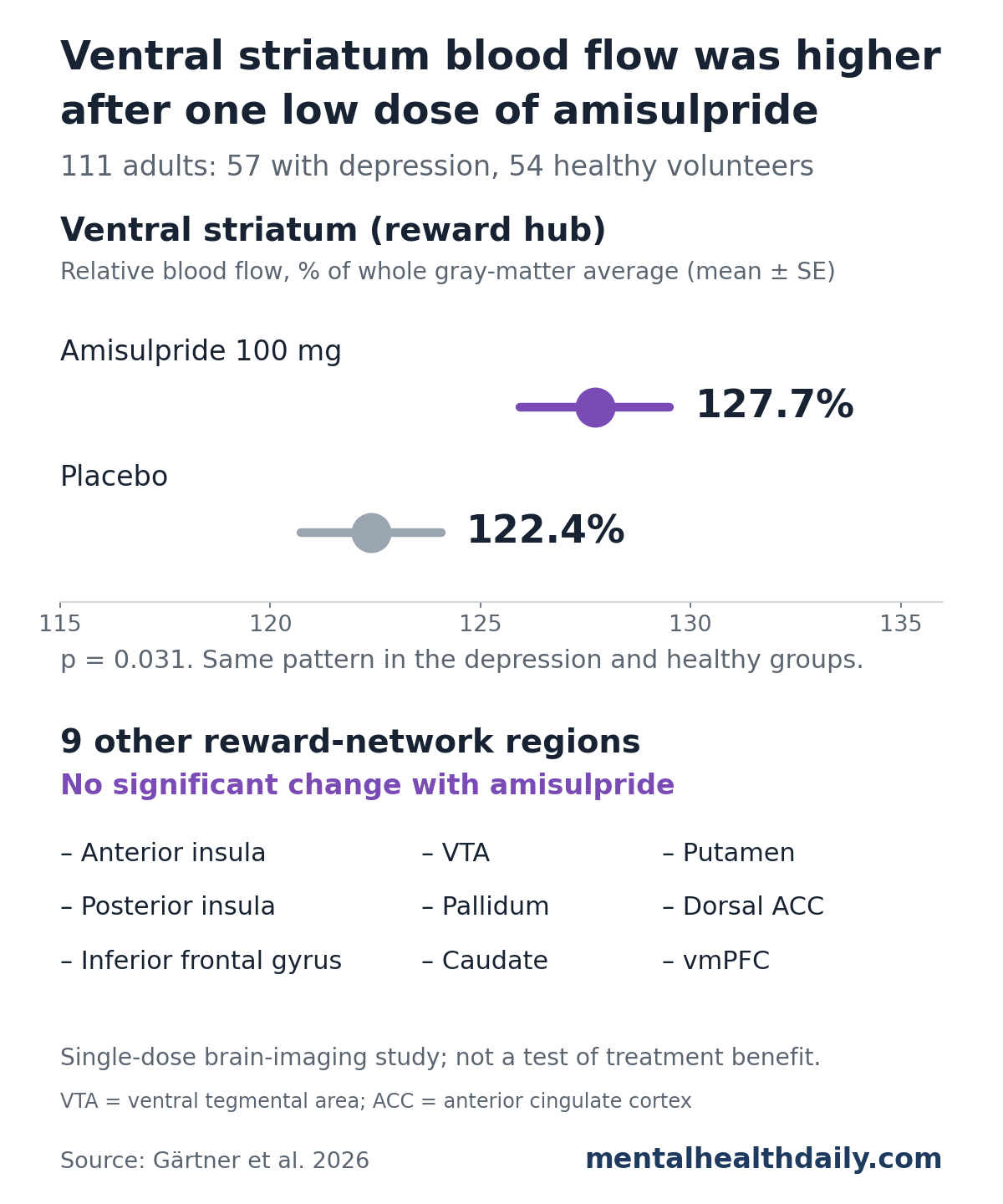
The effect showed up in both groups. There was no significant difference between the depression and healthy groups and no sign that the drug worked differently in one of them.1
The effect was specific. The researchers also checked 9 other reward-network regions:
- anterior and posterior insula
- inferior frontal gyrus
- ventral tegmental area (VTA), where many dopamine neurons live
- pallidum, caudate, and putamen
- dorsal anterior cingulate cortex and ventromedial prefrontal cortex
None showed a significant effect of amisulpride. Blood flow was also not linked to how much amisulpride was in each person’s blood, which the authors read as evidence against a general effect on blood vessels.1
What the Anhedonia and Frontal Operculum Results Showed
These analyses were exploratory and not corrected for multiple comparisons, so they are leads to follow up rather than firm findings.1
- Anhedonia and the ventral striatum: in healthy volunteers on amisulpride, more anhedonia went with higher ventral striatum blood flow (r = 0.59, p = 0.002). The link was not present in the depression group or in anyone on placebo.
- A frontal region stood out in depression: a whole-brain search found higher blood flow in the right frontal operculum, a region next to the insula, in depressed vs healthy people on placebo (Cohen’s d = 1.07). That gap disappeared between the two amisulpride groups.
- Symptoms tracked that region on placebo only: on placebo, operculum blood flow correlated with anhedonia (r = 0.47) and with self-rated depression on the Beck Depression Inventory (r = 0.47). On amisulpride, both correlations were close to zero.
The authors suggest people with weaker reward processing might show a bigger dopamine response, but they stress that one dose cannot say anything about antidepressant benefit.1
How This Fits With Earlier Amisulpride Studies
The result is consistent with earlier work on low-dose amisulpride and the striatum.
- Reward-task fMRI in depression: in 46 unmedicated depressed adults and 43 healthy controls, a single 50-mg dose increased striatal responses to monetary rewards and strengthened connections between the nucleus accumbens and the midcingulate cortex in the depressed group. It did not improve reward learning.2
- Resting blood flow in healthy men: a crossover ASL study in 20 healthy men at steady-state dosing found broad drops in cortical blood flow, especially in the prefrontal lobes, while basal ganglia blood flow rose slightly.3
- Clinical trials: a meta-analysis of 11 randomized trials (2,065 patients, mostly with dysthymia) found amisulpride 50 mg a day reduced depressive symptoms more than placebo (standardized mean difference −0.70), with effects similar to SSRIs.4
The new study adds a larger sample and a direct depression-vs-healthy comparison. It found the striatal increase after one lower dose, without the cortical drops seen after a week of dosing.1
Limitations
- One dose, not treatment. Antidepressant effects of amisulpride appear with repeated dosing. This study captured only the acute brain response.1
- Blood flow is not dopamine. Dopamine release was not measured directly. ASL tracks blood flow, which several brain chemicals can influence.
- One scan per person. Because each participant was scanned once, the study compares groups. It cannot say whether amisulpride raised blood flow or placebo lowered it.
- Mild depression, young adults. Most patients had mild depression and all were 18 to 45 and unmedicated. The authors think this may explain why patients and controls did not differ in striatal blood flow.
- Timing. Scans came about 4 hours after dosing, as blood levels were falling. An earlier scan might have picked up other regions.
- Industry funding. Boehringer Ingelheim funded the study, and several authors are employees or consultants.1
On safety, 26 participants reported 34 adverse events across the drug and placebo groups. None were serious, most were mild and brief, and headache was the most common.1
What It Means
This is good evidence that a single low dose of amisulpride leads to higher blood flow in the ventral striatum, but not in the other reward regions checked, in both depressed and healthy adults. It supports the idea that low-dose amisulpride acts on reward circuitry through dopamine.
It is not evidence that amisulpride treats depression or anhedonia. That question needs trials with repeated dosing and symptom outcomes, not a single-dose brain scan.
References
- Gärtner M, Meiering MS, Weigner D, et al. Investigating the effect of increased dopamine signaling on cerebral blood flow in Major Depressive Disorder: a double-blind randomized placebo-controlled study. Neuropsychopharmacology. 2026;51:1808–1815. doi:10.1038/s41386-026-02471-6
- Admon R, Kaiser RH, Dillon DG, et al. Dopaminergic enhancement of striatal response to reward in major depression. American Journal of Psychiatry. 2017;174(4):378–386. doi:10.1176/appi.ajp.2016.16010111
- Viviani R, Graf H, Wiegers M, Abler B. Effects of amisulpride on human resting cerebral perfusion. Psychopharmacology. 2013;229(1):95–103. doi:10.1007/s00213-013-3091-z
- Zangani C, Giordano B, Stein HC, et al. Efficacy of amisulpride for depressive symptoms in individuals with mental disorders: a systematic review and meta-analysis. Human Psychopharmacology: Clinical and Experimental. 2021;36(6):e2801. doi:10.1002/hup.2801