
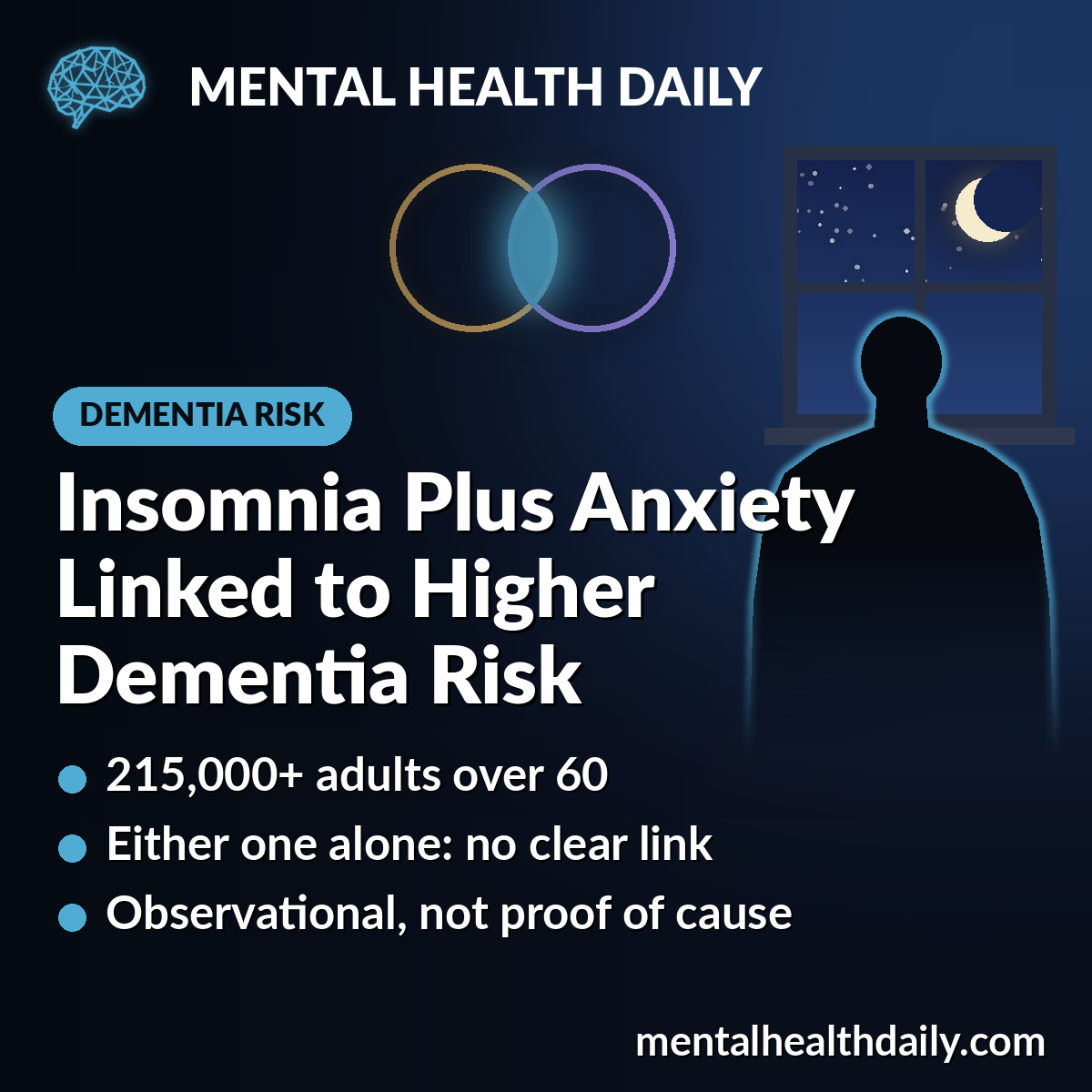
Older adults who had both insomnia and anxiety were more likely to have cognitive impairment and to develop dementia, according to a 2026 study of more than 215,000 people in China and the UK.1 Insomnia alone or anxiety alone was not linked to either outcome.
Research Highlights
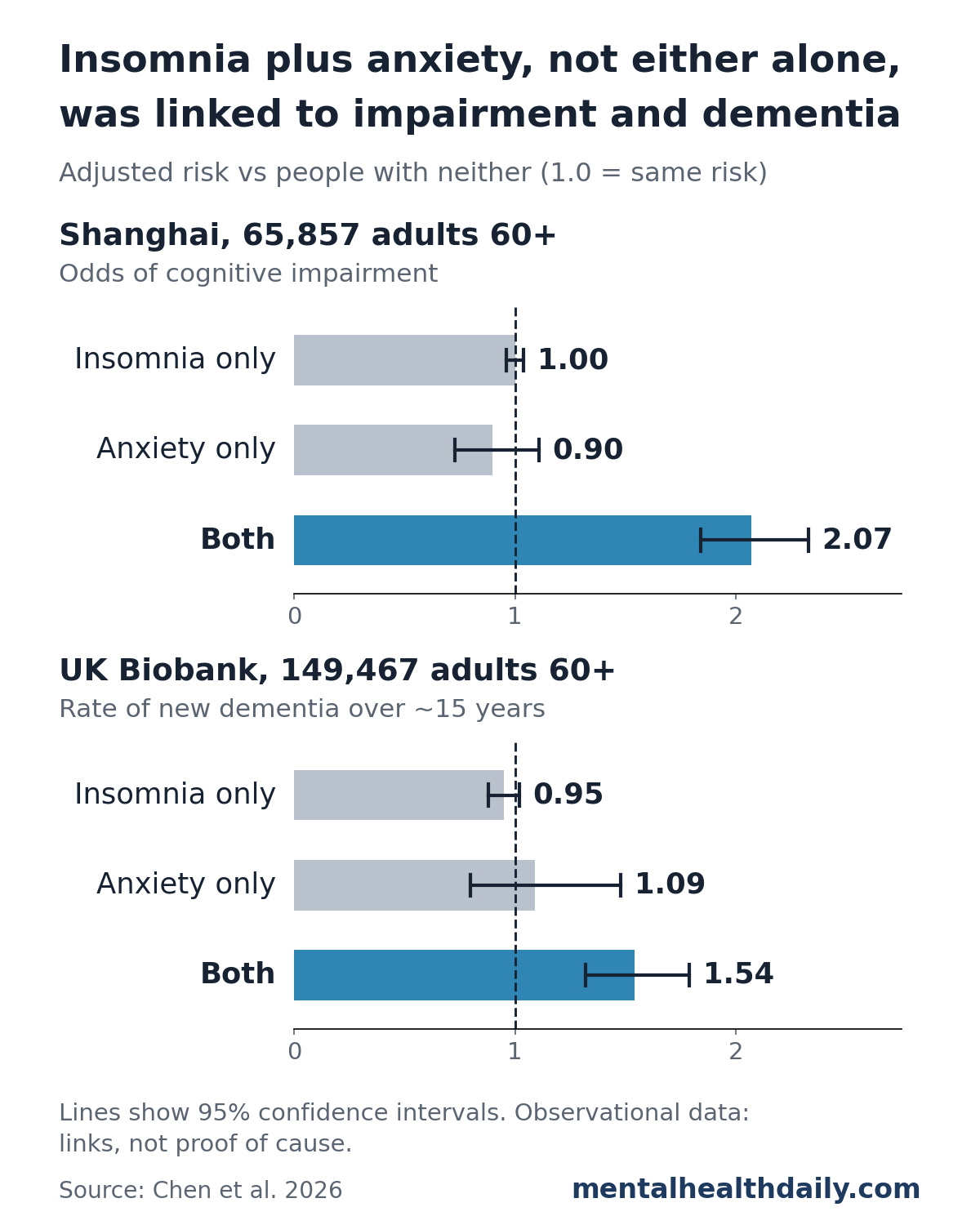
- About double the odds of cognitive impairment: in 65,857 Shanghai adults aged 60 and older, people with both conditions had an adjusted odds ratio of 2.07 (95% CI 1.84–2.33) vs people with neither.1
- Higher rate of new dementia: in 149,467 UK Biobank participants followed for up to about 15 years, the combination was linked to a 54% higher dementia rate (HR 1.54, 95% CI 1.32–1.79).1
- Neither condition alone stood out: after adjustment, insomnia alone and anxiety alone sat close to the reference risk in both cohorts.1
- Combined link bigger than the sum: the extra risk with both conditions was larger than what the two separate effects would add up to, a pattern researchers call synergy.1
- Alzheimer’s-related blood marker involved: in a 3,055-person subgroup, blood markers statistically explained about a third of the link with cognitive impairment, mostly through p-tau217.1
How the Insomnia and Anxiety Dementia Study Worked
Chen et al. used 2 separate groups of older adults and published the results in Alzheimer’s & Dementia.1 One group was measured at a single point in time; the other was followed forward for years.
- Shanghai (SHAPE study): 65,857 adults aged 60 and older from 16 communities, assessed between June 2024 and December 2025. Average age was 72.6.
- UK Biobank: 149,467 adults aged 60 and older without dementia at enrollment in 2006–2010, tracked through national health records. Average age was 63.9.
- Biomarker subgroup: 3,055 randomly selected Shanghai participants gave blood for 3 brain-related markers.
Each person was sorted into 1 of 4 groups: neither condition, insomnia only, anxiety only, or both. About 2.4% of the Shanghai sample and 1.9% of the UK sample had both.1
How insomnia and anxiety were measured: in Shanghai, by questionnaire. Insomnia meant a score above 6 on the Athens Insomnia Scale or use of sleep medication, and anxiety meant a score above 4 on the GAD-7, a 7-item anxiety screen. In the UK, both came mainly from diagnosis codes in medical records, with insomnia also including people who reported usually having trouble sleeping.1
The models adjusted for age, sex, education, smoking, alcohol, high blood pressure, diabetes, heart disease, stroke, and depression. UK analyses also adjusted for APOE ε4, the best-known genetic risk factor for Alzheimer’s.1
Insomnia Plus Anxiety Doubled the Odds of Cognitive Impairment in Shanghai
Among Shanghai participants with both conditions, 67.3% had cognitive impairment, compared with 29.4% of those with neither. After adjustment, their odds were about twice as high (OR 2.07).1
People with only one condition looked like the reference group once other factors were accounted for. Insomnia alone had an odds ratio of 1.00, and anxiety alone 0.90, neither statistically significant.1
Severity tracked the link. When the researchers split symptoms into levels, only clinically significant insomnia combined with anxiety was linked to impairment:1
- Clinically significant insomnia + mild anxiety: OR 1.83 (95% CI 1.58–2.10)
- Clinically significant insomnia + moderate-to-severe anxiety: OR 2.67 (95% CI 2.18–3.26)
- Milder (“suspected”) insomnia with any level of anxiety: no significant link
Insomnia Plus Anxiety Was Linked to 54% More New Dementia in the UK
UK Biobank offered the forward-looking test. During follow-up of up to about 15 years, 7.5% of people with both conditions developed dementia vs 2.5% of those with neither.1
After adjustment, the combined group had a hazard ratio of 1.54, meaning dementia was diagnosed at about 1.5 times the rate. Insomnia alone (HR 0.95) and anxiety alone (HR 1.09) were not significantly different from the reference group.1
The pattern appeared for both major dementia types:
- Alzheimer’s disease: HR 1.48 (95% CI 1.15–1.91)
- Vascular dementia (dementia caused by reduced blood flow to the brain): HR 1.89 (95% CI 1.37–2.61)
Results held when the researchers excluded people with depression at the start or anyone diagnosed with dementia in the first 5 years of follow-up, a check against early, undiagnosed dementia driving the link.1
What “Synergistic” Means for Insomnia and Anxiety
Synergy here means the combined link was bigger than the sum of the two parts. If insomnia and anxiety each added a little risk, you would expect the combined risk to equal both pieces added together.
That is not what happened. Each condition alone added roughly nothing, so simple addition predicts a combined ratio near 1.0. The observed ratios were 2.07 in Shanghai and 1.54 in the UK.1
Researchers measured this gap with the relative excess risk due to interaction (RERI), the extra risk left over after adding up the separate effects. It was 1.17 in Shanghai (95% CI 0.87–1.47) and 0.50 in the UK (95% CI 0.11–0.90), both above zero.1
p-Tau217 and GFAP Blood Markers Accounted for Part of the Link
In the 3,055-person blood subgroup, the combined group had higher levels of 2 of 3 markers:1
- p-Tau217 (a form of the tau protein that rises in the blood as Alzheimer’s amyloid builds up in the brain): higher, and the main statistical go-between
- GFAP (glial fibrillary acidic protein, released by activated support cells called astrocytes): higher, with a small but significant contribution
- NfL (neurofilament light, a general marker of nerve-cell damage): no difference
Together, the markers carried about a third of the statistical link (indirect effect 0.35 out of a total 1.10 on the log-odds scale). Neither condition alone was linked to any marker.1
Proposed explanation: the researchers suggest anxiety keeps stress hormones high, which may boost amyloid production, while broken sleep may slow the brain’s overnight clearance of amyloid. That idea fits the p-tau217 result but was not tested directly here.
Earlier Studies of Anxiety and Insomnia Alone
Earlier work has linked each condition to dementia on its own. A 2018 meta-analysis found anxiety was linked to later Alzheimer’s disease (HR 1.53) and vascular dementia (OR 1.88).2
A 2025 meta-analysis of sleep disorders linked insomnia to Alzheimer’s (HR 1.49) and vascular dementia (HR 1.59).3 Neither pooled analysis separated people who had both conditions from people with only one.
Chen et al. note that other studies, with more adjustment or genetic methods, found weak or no links for each condition alone.1 Their results offer one explanation for that mixed record: in these cohorts, the risk sat mostly with people who had both.
Limitations of This Insomnia, Anxiety, and Dementia Study
This was an observational study, so it shows links, not cause and effect. Several features bear directly on the findings:
- Shanghai data were cross-sectional. Sleep, anxiety, blood markers, and cognition were measured at the same time, so early brain changes could be causing the poor sleep and worry rather than the reverse.
- Biomarker results come from one time point. The “go-between” analysis cannot show what came first.
- Heavy overlap with depression. 75.4% of the Shanghai combined group had depression; it was adjusted for but could still blur the picture.
- Medications were not detailed. Sleeping pills and anti-anxiety drugs were not classified, so their effects cannot be ruled out.
- Different definitions in each cohort. Questionnaires in Shanghai and medical-record codes in the UK.
- Small share of all dementia. In the UK cohort, the combination accounted for an estimated 1.87% of dementia cases.
What This Means for Older Adults With Insomnia and Anxiety
People over 60 who have both ongoing insomnia and anxiety appear to be a higher-risk group for later memory and thinking problems. The researchers suggest screening for both together, and closer cognitive check-ups in people who have them.
Both conditions are treatable, with options such as cognitive behavioral therapy for insomnia and for anxiety. This study did not test whether treating them lowers dementia risk; that would take a trial.
References
- Chen Y, Wang Q, Li L, et al. Synergistic association of insomnia and anxiety with cognitive impairment and dementia in older adults. Alzheimer’s & Dementia. 2026;22:e71853. doi:10.1002/alz.71853
- Becker E, Orellana Rios CL, Lahmann C, Rücker G, Bauer J, Boeker M. Anxiety as a risk factor of Alzheimer’s disease and vascular dementia. British Journal of Psychiatry. 2018;213(5):654–660. doi:10.1192/bjp.2018.173
- Ungvari Z, Fekete M, Lehoczki A, et al. Sleep disorders increase the risk of dementia, Alzheimer’s disease, and cognitive decline: a meta-analysis. GeroScience. 2025;47(3):4899–4920. doi:10.1007/s11357-025-01637-2