
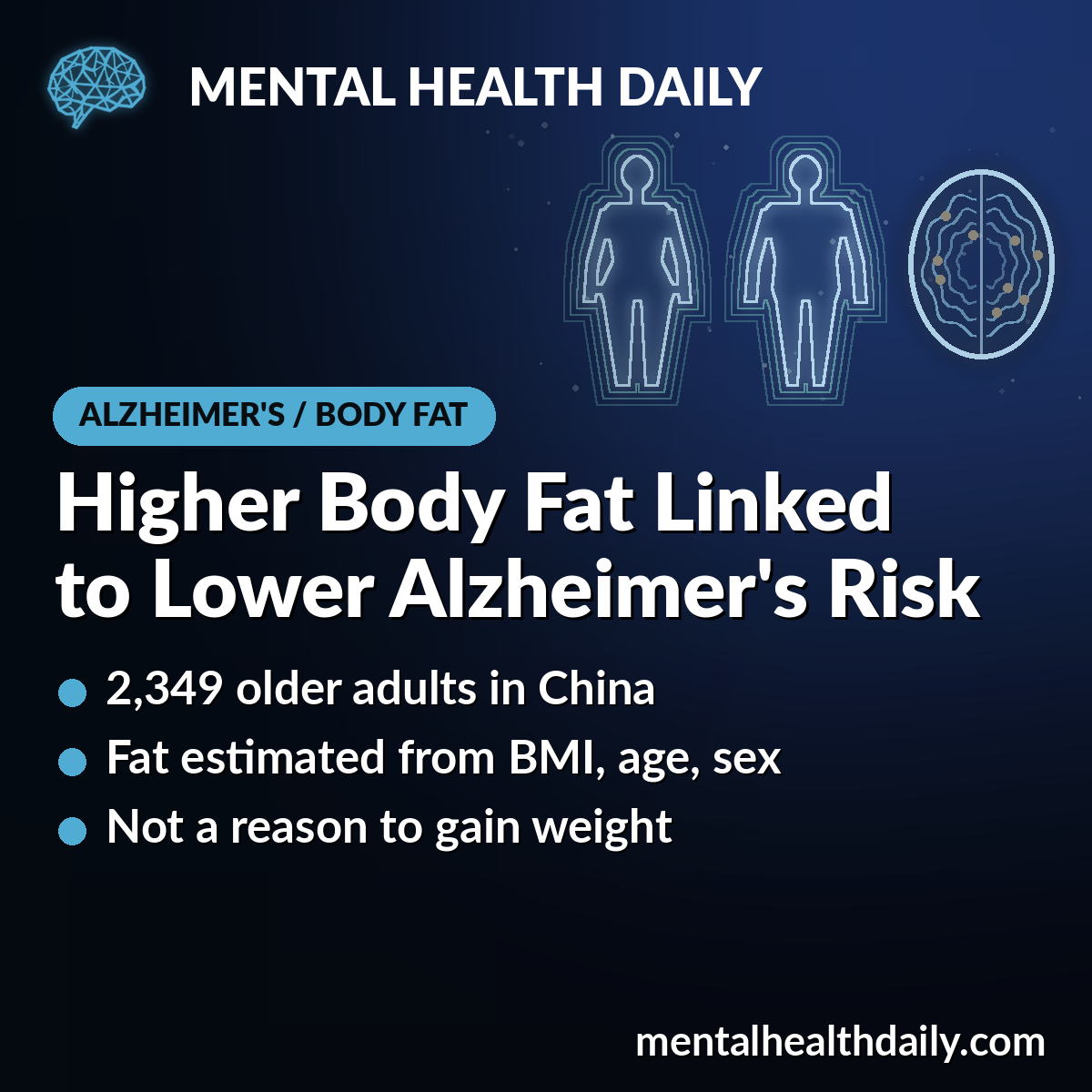
Older adults with more estimated body fat were less likely to develop Alzheimer’s-type memory and thinking problems over about 2 years, in a 2026 study that followed 2,349 dementia-free people in China.1 The link is observational, and the researchers warn against gaining fat to prevent dementia.
Research Highlights
- About half the risk of Alzheimer’s-type MCI: people in the highest quarter of estimated body fat had a hazard ratio of 0.52 (95% CI 0.36–0.76) compared with the lowest quarter.1
- Lower risk of Alzheimer’s-type dementia: 0.59 (0.39–0.89) for the highest vs. lowest quarter, although a model that accounted for other causes of decline gave a less certain 0.68 (0.45–1.03).1
- No clear link with other causes: body fat was not linked to MCI or dementia judged to come from causes other than Alzheimer’s disease.1
- Ages 70 to 74 stood out: in this age group, each 1-point rise in body fat percentage during follow-up was linked to a 20% lower rate of moving from normal cognition to MCI.1
- Sex differences were exploratory: women showed more amyloid-related links and men more tau-related links, but formal tests for sex and age differences were not significant.1
Body Fat Percentage Was Estimated From BMI, Age, and Sex
Zhang et al. used the Hubei Memory and Aging Cohort Study (HMACS), which enrolled community-dwelling older adults across 7 research centers in Hubei Province, China, between 2018 and 2023.1 Everyone included was free of dementia at the start and had at least 1 follow-up visit.
- Who: 2,349 adults (1,070 men and 1,279 women), average age 71.9.
- Follow-up: visits every 1 to 2 years, averaging 2.27 years in total.
- Validation cohort: 1,858 dementia-free participants from the Alzheimer’s Disease Neuroimaging Initiative (ADNI), a mostly North American research study with brain scans and spinal fluid tests.
- Adjusted for: age, education, high blood pressure, and diabetes.
Body mass index (BMI) is weight divided by height squared. It cannot tell fat from muscle, and women carry more fat than men at the same BMI.
The researchers instead used CUN-BAE (Clínica Universidad de Navarra-Body Adiposity Estimator), a formula that turns BMI, age, and sex into an estimated body fat percentage.
CUN-BAE has been checked against DEXA scans (low-dose X-ray scans that measure body composition), but it is still a calculation from BMI, not a direct fat measurement, and it says nothing about where fat sits on the body.1
To get a feel for the numbers: men in the lowest quarter had less than 23.17% estimated body fat and a median BMI of about 20, while men in the highest quarter had more than 28.61% and a median BMI of about 27.
For women, the lowest and highest quarters were split at 35.67% and 40.98%, with median BMIs of about 20 and 28.1
Highest Body Fat Quarter Had About Half the Risk of Alzheimer’s-Type MCI
Mild cognitive impairment (MCI) means measurable problems with memory or thinking that do not yet stop a person from managing daily life. In HMACS, neurologists classified new MCI and dementia as “consistent with Alzheimer’s disease” based on their clinical pattern, such as slow onset and steadily worsening memory or thinking, without biomarker tests.1
A hazard ratio compares how quickly a new diagnosis appears in 2 groups; 1.0 means the same rate, and 0.52 means roughly half the rate. Compared with the lowest body fat quarter, results for the highest quarter were:1
- Alzheimer’s-type MCI: 0.52 (95% CI 0.36–0.76); 46 of 359 people vs. 77 of 323 developed it.
- Alzheimer’s-type dementia: 0.59 (0.39–0.89); 37 of 586 vs. 67 of 587.
- MCI from other causes: 0.95 (0.69–1.30), no clear difference.
- Dementia from other causes: 0.71 (0.37–1.35), no clear difference.
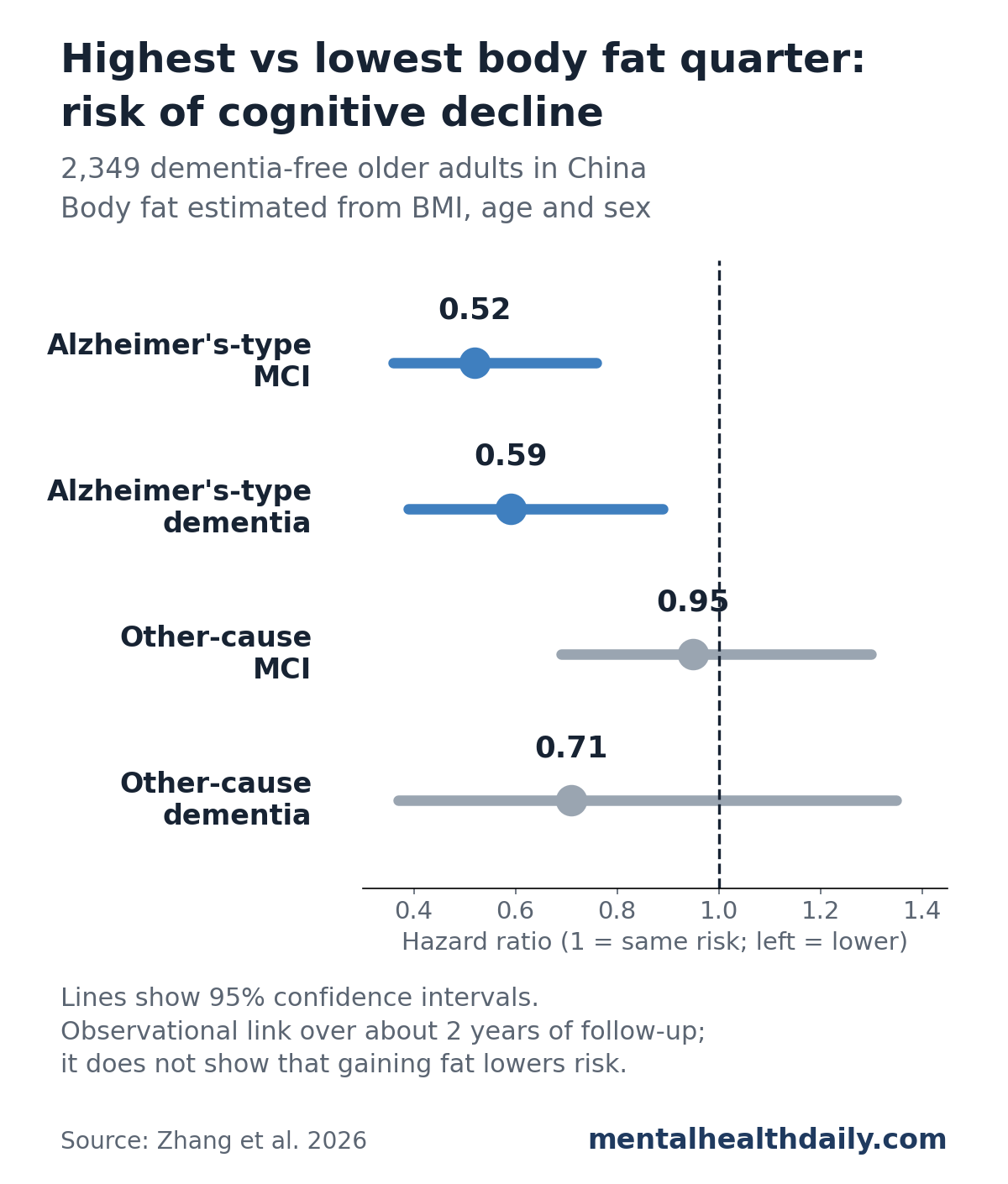
Competing-risk check: some people developed decline from other causes first, which removes them from the Alzheimer’s count. A model that accounted for this gave similar results for MCI (0.56; 0.38–0.83) but a less certain result for dementia (0.68; 0.45–1.03).1
Both sexes: as a continuous measure, each 1-point higher body fat percentage was linked to a 6% lower rate of Alzheimer’s-type MCI in women (0.94; 0.89–0.98) and 9% lower in men (0.91; 0.86–0.96).1
CUN-BAE vs. other measures: for Alzheimer’s-type MCI, estimated body fat gave the most consistent results in both sexes. Waist-to-hip ratio produced unstable estimates, and BMI showed no clear link with all-cause dementia in women (0.97; 0.93–1.01).1
Gaining Body Fat at Ages 70 to 74 Was Linked to Fewer New MCI Cases
The team also tracked whether each person’s estimated body fat went up or down between visits. Among 969 people with normal cognition at the start, each 1-point rise was linked to a 9% lower relative risk of developing MCI (relative risk ratio 0.91; 0.85–0.97).1
Split by age, the link was significant only in people aged 70 to 74: each 1-point rise went with a 20% lower rate of moving from normal cognition to MCI (hazard ratio 0.80; 0.67–0.97). Estimates for ages 65 to 69 (0.95) and 75 and older (0.97) were close to no difference.1
For people who already had MCI at the start, changes in body fat were not linked to recovering or progressing to dementia.1
Women and Men Showed Different Alzheimer’s Biomarker Patterns
Alzheimer’s disease is marked by 2 proteins building up in the brain: amyloid, which forms plaques between nerve cells, and tau, which forms tangles inside them. Blood tests such as p-tau217 (a form of tau that leaks into blood as the disease develops) and PET brain scans can track both.
- Women in HMACS: higher estimated body fat was linked to lower blood p-tau217. Above about 37.6% body fat, it was also linked to higher blood amyloid-beta 42, a pattern usually seen with less amyloid in the brain.1
- Both sexes in ADNI: each 1-point higher body fat percentage was linked to 9% lower odds in men (odds ratio 0.91; 0.87–0.96) and 7% lower odds in women (0.93; 0.89–0.97) of testing positive for both amyloid and tau.1
- Amyloid PET: higher body fat was linked to less amyloid across many brain regions, with larger effects in women.1
- Tau PET: a link with less tau showed up only in men with MCI, mainly those already amyloid positive.1
The researchers describe this as an amyloid-related pattern in women and a tau-related pattern in men. Formal tests of whether the links differed by sex or age were all nonsignificant, so the sex split is a hypothesis to test, not an established difference.1
Weight Loss Before Dementia Could Explain Part of the Link
The finding fits the “obesity paradox”: excess weight in midlife raises later dementia risk,1 and the 2024 Lancet Commission lists obesity among 14 modifiable risk factors linked to nearly half of dementia cases.2 In older age, the pattern often flips.
One reason is that people often lose weight in the years before dementia is diagnosed, so lower body fat in late life may partly be an early sign of disease rather than a cause.
In the Framingham Heart Study, which followed 2,045 adults for about 4 decades, people whose BMI rose in early midlife and then declined had 3.84 times the dementia risk of those whose BMI did not decline (95% CI 1.39–10.60).3
Limitations of this body fat and Alzheimer’s study:
- Observational design: the study shows associations, not that body fat protects the brain.
- Short follow-up: with about 2 years in HMACS, weight loss from early, undiagnosed disease is hard to rule out.
- Estimated fat: CUN-BAE is calculated from BMI, so it cannot separate fat from muscle directly or show belly fat.
- Clinical diagnoses: HMACS labeled cases as Alzheimer’s-type by symptoms, without biomarker confirmation.
- No death data: deaths could not be modeled, and people with higher body fat who reached older age may be unusually healthy survivors.
- Exploratory subgroups: sex and age interaction tests were nonsignificant, and many biomarker analyses were exploratory.
What This Means for Weight in Older Adults
The researchers state plainly that their results do not support increasing body fat to prevent dementia, and that obesity’s heart and metabolic risks still apply.1 Their practical point is narrower: weight loss should not be a blanket goal for every older adult.
- Unplanned weight loss deserves attention: in older adults, it can come before memory problems and is worth raising with a doctor.1,3
- Weight decisions are individual: the researchers say they should weigh overall health, other conditions, and personal risk, not cognition alone.
- A screening idea, not a treatment: the team suggests estimated body fat could help flag higher-risk groups, which would need testing in other populations.
References
- Zhang J, Liu D, Yang Y, et al. Mapping sex-specific associations of adiposity with age-related cognitive decline and multimodal Alzheimer’s pathology. Alzheimer’s & Dementia. 2026;22:e71848. doi:10.1002/alz.71848
- Livingston G, Huntley J, Liu KY, et al. Dementia prevention, intervention, and care: 2024 report of the Lancet standing Commission. The Lancet. 2024;404:572–628. doi:10.1016/S0140-6736(24)01296-0
- Li J, Liu C, Ang TFA, Au R. BMI decline patterns and relation to dementia risk across four decades of follow-up in the Framingham Study. Alzheimer’s & Dementia. 2023;19:2520–2527. doi:10.1002/alz.12839