hit counter

PTSD Trauma Memories Are Encoded in Hippocampal Semantic Maps

Photoreal illustration of the hippocampus with semantic encoding pathways highlighted, representing trauma memory processing in PTSD.

A 2026 fMRI study of 79 women with interpersonal-violence-related PTSD found that the hippocampus does encode the meaning of autobiographical trauma narratives, t(140) = 4.05, p < 0.001, even though average hippocampal encoding did not rise for trauma vs. neutral memories. Research Highlights Hippocampal semantic encoding was significant: Cisler et al. analyzed 3,928 narrative sentences …

Read more

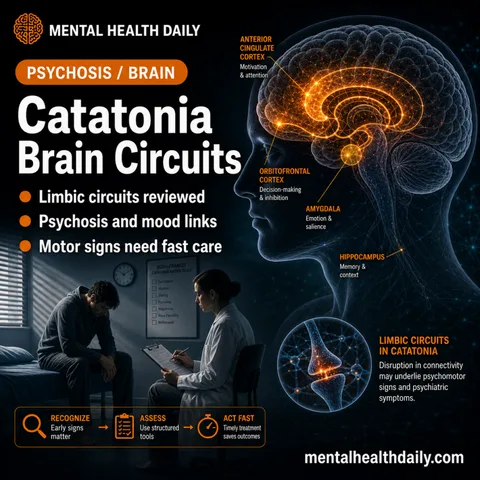
Catatonia Linked to Lower Left Paracingulate Sulcus Rate (28% vs 53%)

Photoreal illustration of a brain with the anterior cingulate cortex highlighted, representing transdiagnostic structural markers of catatonia.

A 2026 hospital MRI study found that the left paracingulate sulcus was present in 31 of 109 catatonia patients (28%) vs. 171 of 323 psychiatric controls without catatonia (53%), a left-hemisphere group effect that survived adjustment for age, sex, scanner, brain volume, benzodiazepines, and antipsychotics.1 Research Highlights Left PCS signal: left paracingulate sulcus (PCS) presence …

Read more

Negative Emotionality Reduces Frontal Midline Theta in 106 Recruits

Photoreal illustration of frontal-midline brain activity overlaid on a stylized portrait, conveying personality-brain link in cognitive control.

A 2026 EEG study of 106 Army National Guard recruits found that higher negative emotionality predicted poorer Go/No-Go discrimination (β = −.234, 95% CI −.392 to −.076) and lower frontal midline theta (β = −.149, 95% CI −.290 to −.001). The key result was not a vague personality-brain link: frontal midline theta, not occipital alpha, …

Read more

Teen Anxiety and Anhedonia Split Reward-Uncertainty fMRI

Photoreal illustration of adolescent brain regions with overlapping reward and default-mode network glow, conveying uncertainty processing.

A 2026 fMRI study of 84 medication-free adolescents found that reward uncertainty had its own phase-specific brain pattern: anxiety, depression, and anhedonia separated across different task phases and brain systems.1 The clearest clinical split was narrow but useful: anxiety tracked blunted striatum/thalamus activation during uncertain non-reward expectancy, while depression and anhedonia tracked higher visual/default-network activation …

Read more

fMRI Biotypes Predicted tDCS Anxiety Response in Older Adults

Photoreal illustration of a clinician fitting a tDCS device on an older adult, with brain network biotype overlays.

A 2026 BETA analysis of 199 older adults found that resting-state fMRI could separate 4 anxiety-related tDCS response patterns, but the result was narrower than “brain scan predicts treatment”: only the Robust tDCS Responder subtype showed a statistically reliable Active vs. Sham anxiety advantage across all participants.1 Research Highlights Only 1 subtype cleared the Active …

Read more

Resting Brain Connectivity Predicts Fear Extinction Learning

Photoreal illustration of brain network connections in the fear-extinction circuitry, with imagery linking amygdala and prefrontal regions.

A 2026 multimodal MRI analysis of 509 healthy adults found that fear acquisition, extinction learning, and renewal were not predicted by one generic “fear circuit” score: functional connectivity predicted acquisition, structural connectivity predicted extinction, and effective connectivity was the only renewal signal.1 The extinction result is the clinically interesting piece because exposure therapy depends on …

Read more

Psychedelic Hallucinations May Reflect Wake-Time Memory Replay

Photoreal illustration of a brain shifting between perception and generative imagery under psychedelic influence.

A 2026 eLife computational study modeled classical psychedelics by increasing a network state variable from alpha = 0 to alpha = 1, shifting perception from bottom-up sensory inference toward top-down generative replay. The result is a useful but still unproven oneirogen model: hallucinations look less like random noise and more like wake-time replay of a …

Read more