
Older adults who were targeted by soft political repression in East Germany reported more depression, anxiety, and trauma symptoms than matched controls, over 30 years after the repression. They also had higher blood levels of interleukin-6, a marker of inflammation.1
Research Highlights
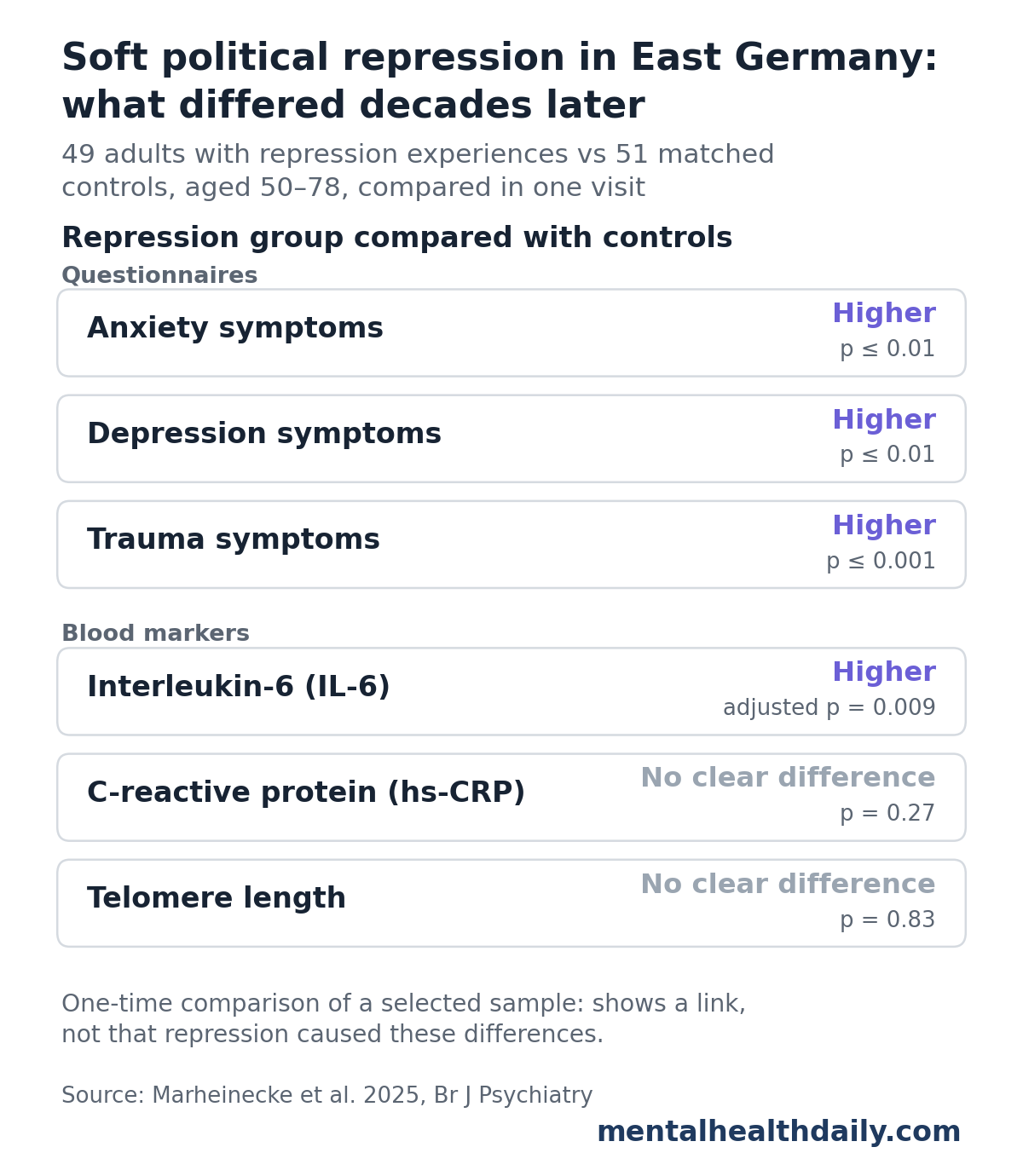
- More distress: 49 adults with repression experiences scored higher than 51 matched controls on depression, anxiety, and trauma symptoms (combined test p < 0.001).1
- Higher interleukin-6: the repression group had higher IL-6 after adjusting for age, gender, and body mass index (β = 0.33, adjusted p = 0.009).1
- No difference in CRP or telomeres: C-reactive protein (p = 0.274) and telomere length (p = 0.829), a marker of cellular aging, did not differ between groups.1
- Social support and telomeres: within the repression group only, people with more social support had longer telomeres (p = 0.032), 1 of 9 interaction tests that reached significance.1
- Design: a one-time comparison of volunteers in Thuringia and Saxony, aged 50 to 78, published in the British Journal of Psychiatry in December 2025. It shows a link, not cause and effect.1
What Soft Political Repression Meant in East Germany
Soft political repression means pressure on people seen as opponents that stops short of arrest, prison, or violence. The German Democratic Republic (GDR, or East Germany, 1949–1990) used it widely against emigration applicants, artists, church groups, and youth subcultures.1
In German this approach is often called Zersetzung, roughly “decomposition.” Common tactics included:1
- Surveillance: planned monitoring and wiretapping
- Interrogation summons: being called in for questioning
- Denunciation: being reported to the authorities by others
- Engineered setbacks: harassment or provoked failures at school, work, or in social life
The goal was to wear down a person’s psychological and social footing through anxiety, isolation, and confusion. These experiences usually do not meet the DSM-5 definition of a traumatic event, so the researchers treated soft repression as an extreme form of chronic psychosocial stress: long-running pressure marked by uncontrollability, social threat, and uncertainty.1
Who Took Part in the East German Repression Study
Ruth Marheinecke et al., at Jena University Hospital and the University of California, San Francisco, recruited 100 people who grew up in the GDR. Data were collected between June 2022 and June 2024, and the hypotheses were preregistered.1
- Repression group: 49 adults who had experienced at least 2 state-organized soft repression tactics
- Control group: 51 adults who lived in the GDR but reported no personal repression, matched for age, gender, and GDR origin
- Age: 50 to 78; mean about 66 in the repression group and 65 in the control group
- Excluded: anyone ever held as a political prisoner, people with acute mental illness, and people taking antidepressants or steroids
- Measures: questionnaires on depression (BDI-II), trait anxiety (STAI), and trauma symptoms (Harvard Trauma Questionnaire), plus a blood draw
Not everyone completed every part. Questionnaire data were available for 44 people in the repression group and 49 controls, and usable blood samples for 40 and 42.1
Higher Distress and Interleukin-6 in the Repression Group
People in the repression group scored higher on all 3 distress measures. The combined test was clear (Wilks’ Λ = 0.82, F(3,85) = 6.40, p < 0.001), and each measure differed on its own: anxiety and depression at p ≤ 0.01, and trauma symptoms at p ≤ 0.001.1
The blood results were more selective. The researchers measured 3 markers:
- Interleukin-6 (IL-6): a signaling protein released by immune cells that drives inflammation. Chronic stress has been linked to higher levels.
- High-sensitivity C-reactive protein (hs-CRP): a protein the liver makes in response to IL-6 and other inflammatory signals. It is the inflammation test most doctors order.
- Telomere length: telomeres are protective caps on the ends of chromosomes that shorten with age. Shorter telomeres in white blood cells are used as a marker of cellular aging.
Only IL-6 differed. After adjusting for age, gender, and body mass index (BMI), the repression group had higher IL-6 (β = 0.33, adjusted p = 0.009). Group membership explained about 13% of the variation left after the other factors (partial η² = 0.13).1
BMI was a bigger factor than repression. Higher BMI predicted higher IL-6 (partial η² = 0.30) and was the only significant predictor of hs-CRP. Older age and male gender predicted shorter telomeres, as expected.1
Resilience was lower too. The repression group averaged 5.45 on the Resilience Scale vs 5.83 for controls (p = 0.009). Perceived social support (22.7 vs 23.9) and socioeconomic status did not differ.1
Why IL-6 Rose but CRP and Telomeres Did Not
The researchers expected all 3 blood markers to shift, so the hypothesis was only partly confirmed. They point out that in depression research, IL-6 has been more consistently linked to symptoms and stress than CRP.1
Large-scale data fit that split. In up to 144,890 UK Biobank participants, Ye et al. found that measured CRP tracked with depression and anxiety symptoms. Genetic analyses, however, suggested that higher IL-6 activity raised the risk of depressive symptoms, while genetically higher CRP was linked to lower risk.3
Finding no difference in CRP and telomeres in a sample this small is weak evidence that those markers are unaffected. Blood data came from only 82 people, and the study’s size was originally set for a different outcome (cortisol reactivity).1
Social Support and Telomere Length
Within the repression group, people who reported more social support had longer telomeres (β = 0.02, p = 0.032, partial η² = 0.07). No such link appeared in the control group. Resilience and socioeconomic status made no difference to any biomarker result.1
The researchers read this as social support possibly buffering cellular aging after repression. Treat it as a lead: it was 1 significant result among 9 interaction tests, and the researchers call these models likely underpowered.1
Across the general population, social support does not seem to predict telomere length. A meta-analysis of 17 studies by Montoya and Uchino found no significant association (Zr = 0.010, 95% CI −0.028 to 0.047).4 Whether support matters more for people under chronic strain is still an open question.
Limits of This East German Repression Study
Evidence strength: this is a cross-sectional study of a small, self-selected sample. It can show that repression experiences go along with more distress and higher IL-6. It cannot show that repression caused them.
- One point in time: there are no measurements from before or during the repression.
- Recall: repression experiences were self-reported more than 30 years later, which can blur or reshape memories.
- Blurry groups: everyone in the GDR lived under general state repression, and experiences within the repression group varied widely.
- Healthier-than-typical sample: people with acute mental illness, antidepressant users, and former political prisoners were excluded. During screening, 12 potential repression-group participants were excluded for psychological instability vs 1 control.
- Other differences: more people in the repression group had a household income under €1,500 a month (13 of 49 vs 6 of 51) or were divorced (12 vs 6), and the 2 groups were recruited in different ways.
The exclusions likely made the group differences smaller. The researchers say their sample may reflect particularly resilient people, so the real impact of soft repression could be greater.1
A companion paper from the same 100-person cohort supports that concern. Only 29 repression-group participants vs 46 controls completed a laboratory stress test. Repression-group members who declined had more distress, anxiety, depression, and trauma symptoms, while those who completed it looked similar to controls.2
That same test found higher self-reported stress in the repression group, but no difference in cortisol, heart rate, or heart rate variability.2
What the Findings Mean for People Affected by Repression
- Distress can last decades: the psychological results agree with earlier German clinical studies that found high rates of mood and anxiety disorders in people targeted by soft repression.1
- Inflammation is one possible pathway: higher IL-6 fits the broader link between chronic stress and inflammation, though this study cannot show direction.
- Recognition in health care: the researchers note that people affected by soft repression often struggle to be taken seriously or to get appropriate health care.1
- Still in use elsewhere: the researchers cite similar tactics documented in Hong Kong, Zimbabwe, and Colombia, but the health findings here come only from former GDR residents.1
Larger studies that follow people over time, and that include those too distressed to join a lab study, are needed to confirm the IL-6 link and test whether social support protects against cellular aging.
References
- Marheinecke R, Blasberg J, Lin J, Opel N, Spitzer C, Strauss B, Epel E, Engert V. Long-term consequences of soft political repression on psychological well-being, systemic inflammation and cellular ageing. British Journal of Psychiatry. Published online December 16, 2025. doi:10.1192/bjp.2025.10493
- Marheinecke R, Ramirez L, Opel N, Spitzer C, Strauß B, Engert V. Long-term psychobiological stress responses following soft political repression. Scientific Reports. 2026;16:24306. doi:10.1038/s41598-026-65049-8
- Ye Z, Kappelmann N, Moser S, Davey Smith G, Burgess S, Jones PB, Khandaker GM. Role of inflammation in depression and anxiety: tests for disorder specificity, linearity and potential causality of association in the UK Biobank. eClinicalMedicine. 2021;38:100992. doi:10.1016/j.eclinm.2021.100992
- Montoya M, Uchino BN. Social support and telomere length: a meta-analysis. Journal of Behavioral Medicine. 2023;46:556–565. doi:10.1007/s10865-022-00389-0