
Two weeks after a single dose of psilocybin, people with major depression had lower levels of two brain chemicals, galanin and noradrenaline, in their spinal fluid than people given a niacin placebo. In the same Swedish trial, a larger drop in galanin went with a larger drop in depression scores (r = 0.58, p = 0.0024).1
This is a small, exploratory look inside a 35-person randomized trial, and only 25 participants gave spinal fluid both times. It points to a specific brainstem system worth testing, not a validated depression test.
Research Highlights
- Galanin tracked mood improvement: across participants with paired spinal fluid samples, change in galanin correlated with change in MADRS depression score at r = 0.58 (p = 0.0024), the strongest link of any marker.1
- Two co-released chemicals fell together: compared with niacin, psilocybin lowered spinal fluid galanin and noradrenaline. Noradrenaline was the only monoamine that changed.1
- Expected inflammation and BDNF effects did not appear: four cytokines (IL-1β, IL-6, TNF-α, IFN-γ), BDNF, and the blood cell protein p11 showed no significant change.1
- Small subset, many markers: paired spinal fluid came from 14 psilocybin and 11 niacin participants, and roughly 100 spinal fluid markers were tested.1
The Swedish Psilocybin Trial Behind the Samples
The parent study, run at Karolinska Institutet and the Northern Stockholm Psychiatric Clinic, randomized 35 adults with moderate to severe recurrent major depression to one of two arms:2
- Psilocybin arm (17 people): a single 25-mg oral dose.
- Niacin arm (18 people): 100 mg of niacin, a vitamin that causes flushing and tingling, used as an active placebo so the pill would not feel like nothing.
Both groups got a preparation session, a supported dosing session, and three integration sessions over 17 days. On the MADRS (Montgomery–Åsberg Depression Rating Scale, 0 to 60, clinician-rated), psilocybin beat niacin by 7.27 points on day 8 (95% CI −12.89 to −1.65) and by 11.03 points on day 15. The gap held through day 42 but was no longer significant at 1 year. Two psilocybin participants had persistent, severe anxiety that needed medical attention.2
That is a smaller trial than the 233-person dose study of psilocybin in treatment-resistant depression, where MADRS scores fell 12.0 points with 25 mg vs 5.4 with 1 mg at week 3.5 The clinical result is consistent with other randomized psilocybin trials. What makes the Swedish trial unusual is what the team collected alongside the ratings.
What Was Measured in Spinal Fluid and Blood
Cerebrospinal fluid (CSF) is the clear fluid that bathes the brain and spinal cord. It is collected by lumbar puncture, a needle placed between vertebrae in the lower back. CSF sits much closer to brain chemistry than blood does, which is why a trial would ask volunteers to go through it twice.
Samples were taken 1 to 2 days before dosing and again about 14 days later.1 The team looked at:
- In CSF: monoamine neurotransmitters (such as serotonin, noradrenaline, and adrenaline) and their breakdown products, four inflammatory cytokines, BDNF (a growth factor linked to brain plasticity), and the Olink Target 96 Metabolism protein panel.
- In blood: p11, a protein in white blood cells that earlier work linked to response to the antidepressant citalopram.
Blood pairs were available for 17 people per arm. CSF pairs were available for only 14 psilocybin and 11 niacin participants, and only people with both samples were analyzed. In the CSF subset, the psilocybin group was younger on average (38.2 vs 47.2 years), with similar starting MADRS scores (25.5 vs 25.8).1
Psilocybin Lowered CSF Galanin and Noradrenaline
Adjusting for each person’s starting level, the psilocybin group ended up with lower CSF galanin and lower CSF noradrenaline than the niacin group. Two other proteins also shifted: sclerostin (SOST) was lower and clusterin-like protein 1 (CLUL1) was higher.1 The authors describe the galanin drop as the most robust finding, seen both within the psilocybin group and against niacin.
The brief shows these group differences only as dots on a plot, without printed means or confidence intervals. Read from that figure, the effect sizes are moderate to large (Cohen’s d roughly 0.5 to 1), and the p-values fall between about 0.01 and 0.04.
Why galanin and noradrenaline belong together
Galanin is a small neuropeptide made in the same neurons as noradrenaline in the locus coeruleus, a brainstem cluster that drives arousal and the stress response. The two are released together. Galanin acts as a brake: it dampens the firing of monoamine neurons, and stress increases it.1
Post-mortem studies connect this system to depression. In brain tissue from people with major depression who died by suicide, the galanin system was altered at the level of gene transcripts, DNA methylation, and the peptide itself, with galanin most concentrated in the locus coeruleus.3 The source authors read those data as more galanin signaling in depression, which a psilocybin-driven drop would reverse.
There is a wrinkle the authors point out themselves. If galanin is a brake on noradrenaline, lowering galanin should raise noradrenaline, yet both fell. They offer two explanations: psilocybin’s action on 5-HT2A serotonin receptors can directly quiet the locus coeruleus, or both drops reflect that region settling down from the overactivity seen in depression.1
Bigger Galanin Drops Went With Bigger Mood Gains
The team then asked whether each marker’s change from baseline tracked the change in MADRS score. Five did:1
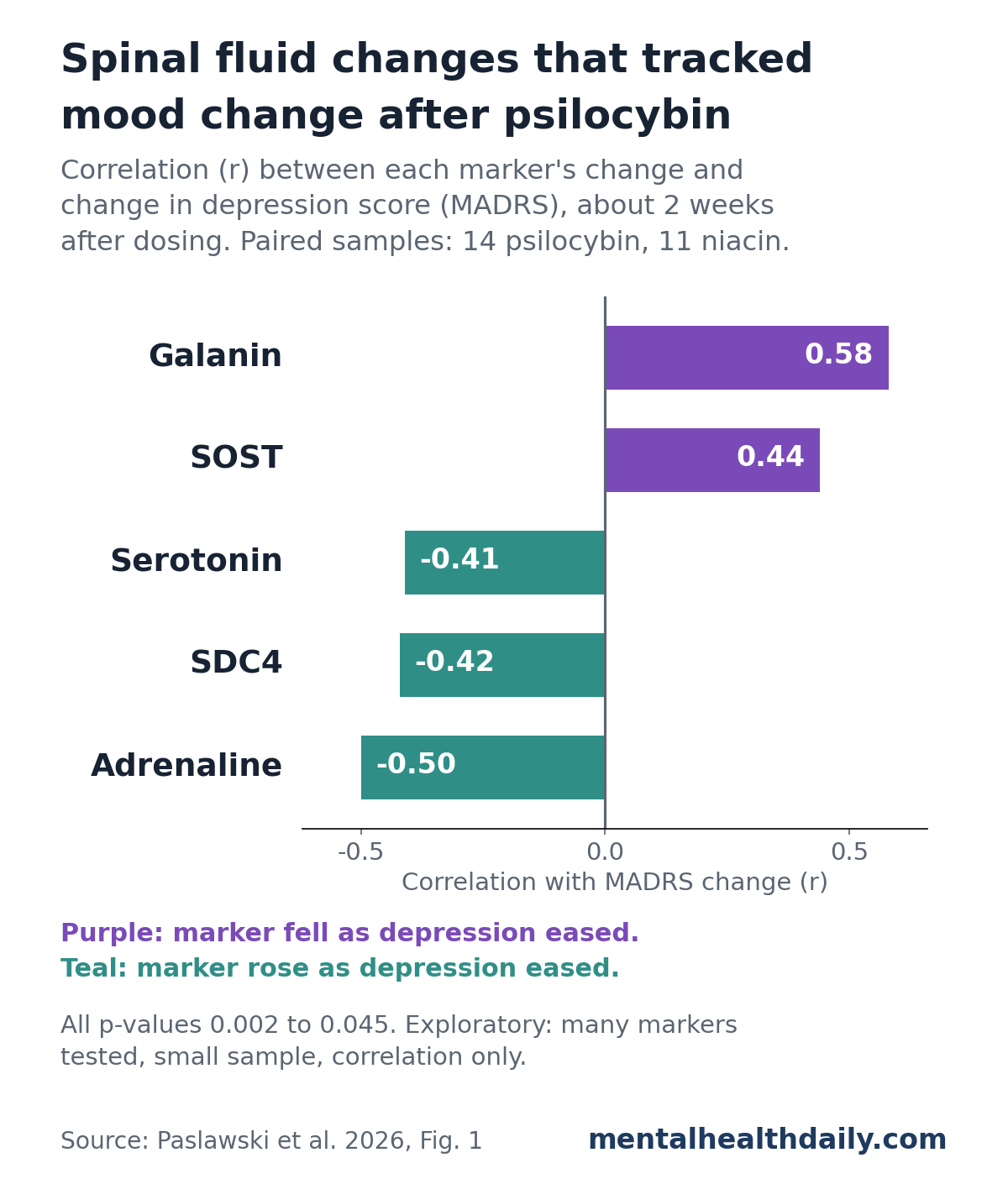
- Galanin: r = 0.58, p = 0.0024
- Adrenaline: r = −0.50, p = 0.0108
- Syndecan-4 (SDC4): r = −0.42, p = 0.0153
- Sclerostin (SOST): r = 0.44, p = 0.0264
- Serotonin: r = −0.41, p = 0.0453
A positive r here means the marker fell as depression scores fell. So people whose galanin dropped most tended to improve most. Adrenaline, serotonin, and SDC4 moved the other way: they rose in people who improved.
The brief does not say whether these correlations were run within the psilocybin group or across both arms. Each scatter plot shows about 25 points, which matches the full CSF sample. If the arms were pooled, part of each correlation simply reflects that the psilocybin group improved more and also had lower galanin.
What Did Not Change: Inflammation, BDNF, and p11
Several leading theories of how psilocybin works did not show up in this sample.1
- Cytokines: no significant change in CSF IL-1β, IL-6, TNF-α, or IFN-γ.
- BDNF: CSF proBDNF and BDNF varied widely and did not change significantly.
- p11: no difference in blood white cells or their subtypes.
The cytokine result differs from a placebo-controlled study in healthy volunteers, where psilocybin lowered blood TNF-α within hours and IL-6 and C-reactive protein a week later, and bigger IL-6 and CRP drops went with more lasting mood benefits.4 That study measured blood rather than CSF, in people without depression, and sampled earlier. The Swedish authors suggest their 2-week sampling may simply have missed a faster immune effect.1
How Much Weight the Galanin Finding Can Carry
The authors call reduced CSF galanin a novel biomarker of antidepressant effect that needs validation in larger groups. That is the right frame. Several features of the design limit what it shows:
- Small CSF sample: 14 vs 11 people. The authors note the study may have been underpowered for modest effects.
- Many markers, borderline p-values: about 100 CSF markers were compared, and the significant ones sit near p = 0.01 to 0.04 with no correction for multiple testing reported. Some hits could be chance.
- Correlation, not mechanism: galanin tracking mood does not show that lowering galanin causes improvement. No mediation analysis was reported.
- One time point: a single sample about 2 weeks after dosing can miss earlier or later changes.
- Unbalanced subset: the CSF groups differed by about 9 years in average age.
- No exact group values in the brief: between-group differences for galanin and noradrenaline appear only as plot positions, with details in an online supplement.
Even with those limits, the result is specific and testable. It names one brainstem system, one pair of co-released chemicals, and one fluid, and it fits independent post-mortem evidence that galanin signaling is disturbed in depression.3 A larger trial with repeated CSF sampling is the obvious next test.
Practical Takeaways
- There is no galanin test for depression. This is a research finding from spinal fluid, not a blood test, and it has not been validated.
- The clinical result comes from the parent trial. Psilocybin with support reduced depression scores more than niacin for about 6 weeks in 35 people; it is not an FDA-approved treatment for depression in the United States.
- The locus coeruleus is a lead worth following. The finding shifts attention from serotonin and inflammation alone toward the brain’s noradrenaline and stress circuitry.
References
- Paslawski W, Doyon D, Ekman CJ, et al. CSF galanin and noradrenaline downregulation by psilocybin therapy in major depressive disorder. Neuropsychopharmacology. 2026;51:1898–1901. doi:10.1038/s41386-026-02490-3
- Yngwe H, Plavén-Sigray P, Ekman CJ, et al. Short-term and late-term effects of psilocybin on symptoms in major depression: a randomized clinical trial. JAMA Network Open. 2026;9:e2612589. doi:10.1001/jamanetworkopen.2026.12589
- Barde S, Rüegg J, Prud’homme J, et al. Alterations in the neuropeptide galanin system in major depressive disorder involve levels of transcripts, methylation, and peptide. Proceedings of the National Academy of Sciences. 2016;113:E8472–E8481. doi:10.1073/pnas.1617824113
- Mason NL, Szabo A, Kuypers KPC, et al. Psilocybin induces acute and persisting alterations in immune status in healthy volunteers: an experimental, placebo-controlled study. Brain, Behavior, and Immunity. 2023;114:299–310. doi:10.1016/j.bbi.2023.09.004
- Goodwin GM, Aaronson ST, Alvarez O, et al. Single-dose psilocybin for a treatment-resistant episode of major depression. New England Journal of Medicine. 2022;387:1637–1648. doi:10.1056/NEJMoa2206443