
A 2026 study of postmortem brain tissue from 20 people with opioid use disorder and 20 non-users flagged 18 candidate gene variants and 174 genes with changed activity, led by immune and inflammation genes.1 The variants are leads for DNA testing, and half of them are common in the general population.
Research Highlights
- 18 candidate variants in 16 genes: 17 changed a single protein building block and 1 cut a protein short. Each was detected in all 20 OUD samples and none of the 20 comparison samples.1
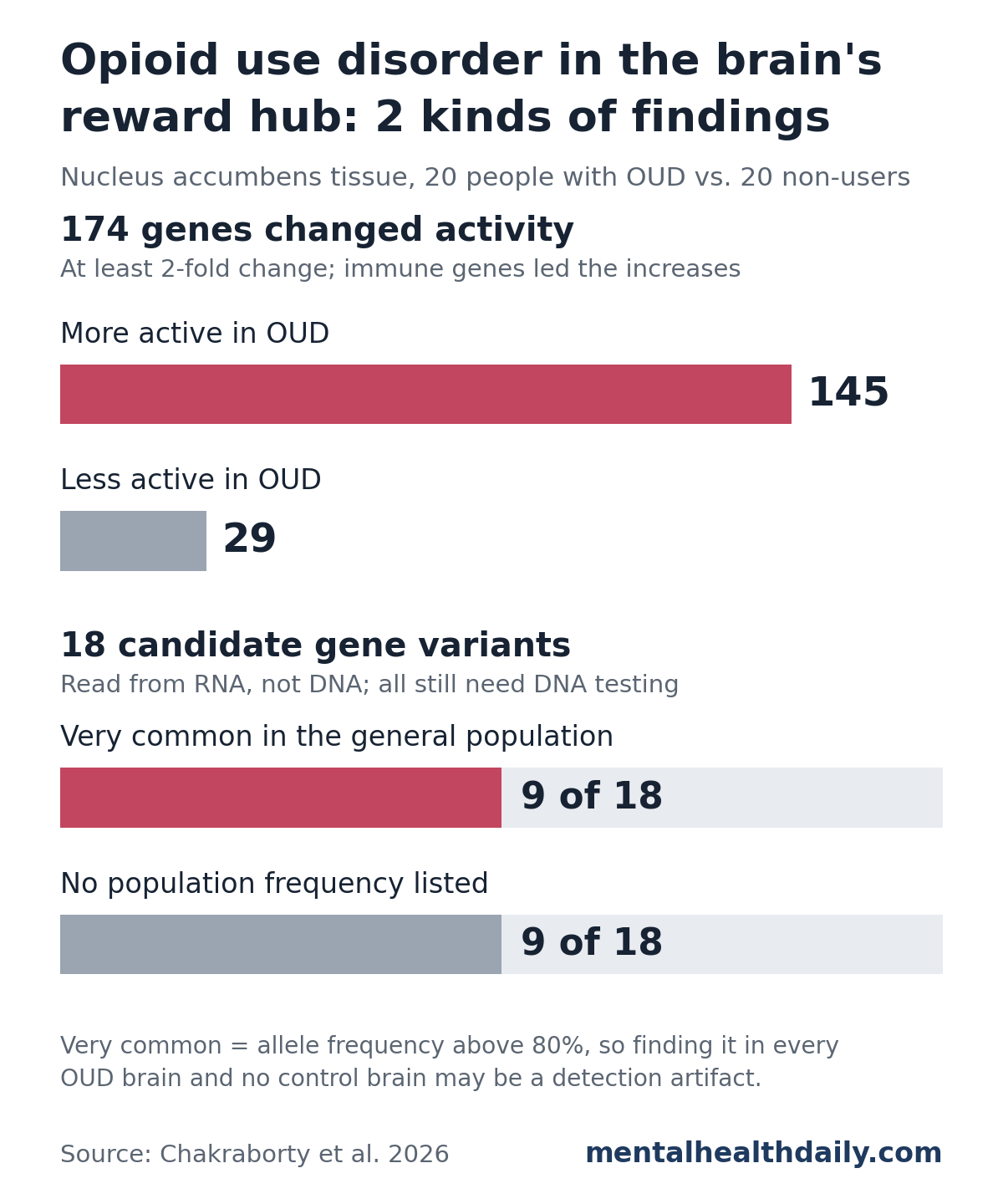
- Half are common variants: 9 of the 18 have population frequencies above 80%, so their clean split between groups may reflect what RNA sequencing could detect rather than real genetic differences.1
- Immune genes stood out: 145 genes were more active and 29 less active in OUD tissue, with immune and inflammation pathways enriched among the increases.1
- Consistent with earlier work: the original analysis of the same brains also found a neuroinflammation signature.2
- Genes are not a crystal ball: OUD is about 50% heritable, yet 15 candidate variants from an FDA-approved risk algorithm explained only 0.40% of OUD risk in a study of over 450,000 veterans.34
What Researchers Analyzed in the Nucleus Accumbens
Opioid use disorder (OUD) is a chronic condition in which opioid use continues despite serious harm, driven by craving, tolerance, and withdrawal. It can involve prescription painkillers such as oxycodone, heroin, or synthetic opioids such as fentanyl.
Chakraborty et al. at the University of Nebraska Medical Center focused on the nucleus accumbens, a small region deep in the brain that helps assign value to rewards. Drugs that release dopamine there can turn ordinary reward learning into habit and cue-driven craving.1
The team reanalyzed public RNA sequencing data, a method that reads the messenger RNA in a tissue sample to show which genes are switched on and how strongly. The data came from an earlier University of Pittsburgh study.2
- Brains: 20 people who met OUD criteria when they died (5 to 18 years since diagnosis) and 20 people who did not use opioids
- Matching: 10 men and 10 women per group; average age 46.9 (OUD) vs. 47.3 years (non-users)
- Exclusions: other major psychiatric or neurological disorders, significant head injury, and signs of neurodegenerative disease
- Tissue quality: similar between groups for time from death to tissue collection, brain acidity, and RNA integrity
The research had 2 parts: reading DNA-level variants out of the RNA sequences, and comparing gene activity between the groups.1
18 Candidate Gene Variants Showed Up in Every OUD Sample
A genetic variant is a spot where a person’s DNA spelling differs from the reference genome. When a gene is active, that spelling difference also shows up in its RNA, so RNA sequencing can pick up variants in genes that are switched on.
The researchers kept only variants found in all 20 OUD samples and in none of the 20 non-user samples. They call this a cohort-concordance filter and say plainly that it picks candidates; it is not a statistical test of association.1
What passed the filter: 18 variants in 16 genes. 17 were missense variants, which swap one amino acid (a protein building block) for another. 1 was a stop-gain variant, which inserts an early “stop” signal so the protein comes out shorter.1
5 of the variant-carrying genes already had some link to addiction-related traits in earlier research, mostly animal studies:1
- FUT9: helps nerve cells stick together and connect; animals lacking it show more anxiety-like behavior
- FMR1: controls protein production at synapses and shapes impulse control; linked to binge eating
- MFN1: fuses mitochondria (the cell’s power plants) and has been linked to reward processing
- RYR3: releases calcium inside neurons, affects their excitability, and has been linked to movement and social behavior
- DAG1: helps build and maintain synapses, especially inhibitory ones
The stop-gain variant: it sits in ZNF117, a zinc-finger protein that binds DNA and helps regulate other genes. The variant cuts the 483-amino-acid protein off at position 428, dropping its last 2 zinc-finger units. Protein-structure modeling with AlphaFold predicted a reshaped protein that keeps about 88% of its sequence.1
Why Half the Variants Are Suspect
9 of the 18 variants, including the ZNF117 stop-gain, have reported population allele frequencies above 80%. That means the variant is the usual version of the gene in most people.1
A variant that common should turn up in many of the 20 non-users too. Its complete absence there more likely reflects what the RNA data could detect. A gene that is less active in one group leaves too few reads to call the variant. The researchers flag this themselves and say DNA sequencing of the same brains is the priority next step.1
Immune Genes Were More Active in OUD Brain Tissue
The second analysis compared gene activity between the groups, counting genes with at least a 2-fold difference. It found 174 such genes: 145 more active in OUD tissue and 29 less active.1
Immune and inflammation genes led the increases. Upregulated genes included IL1B and IL6, which code for inflammatory signaling proteins called cytokines, as well as IL4R and SOCS3. Pathway analysis found immune and inflammatory processes enriched among the upregulated genes.1
The same brains told a similar story in the original 2021 analysis. Seney et al. reported neuroinflammation and synaptic remodeling pathways in both the nucleus accumbens and the dorsolateral prefrontal cortex. They also found more markers of microglia, the brain’s resident immune cells, in OUD tissue.2
Variants and gene activity rarely connected. In a knowledge-base search, the only direct link between a variant-carrying gene and a changed gene was IL6ST, the receptor subunit that IL6 binds to.1
Long non-coding RNAs: these are RNA molecules that do not make proteins but can tune other genes. LINC01554 was more active and LINC00996 less active in OUD tissue. Computer predictions paired them with NPAS4 and GADD45B, 2 genes previously linked to substance use.1
OUD Is About 50% Heritable, but No Single Gene Predicts It
Genes clearly matter in opioid use disorder. A 2022 genome-wide association study (GWAS, a scan of millions of common DNA markers across many people) in the Million Veteran Program included 425,944 people.3
- Heritability: estimated at about 50%
- Risk regions: 14 loci, 12 of them new, including variants in OPRM1 (the gene for the mu-opioid receptor that opioids act on) and FURIN
- Shared genetics: significant genetic correlations with 127 traits, including psychiatric disorders and other substance use traits
That inherited risk is spread across many genes, each adding a small push. A 2025 study tested 15 candidate variants used by a genetic OUD risk algorithm that had received FDA premarketing approval. Among 452,664 veterans with opioid exposure, the 15 variants explained 0.40% of the variation in OUD risk; age and sex alone explained 3.27%.4
A machine learning model built on those variants classified people correctly 52.83% of the time, barely better than a coin flip.4 A list of 18 candidates from 40 brains is far earlier on that path than a validated risk test.
Limitations of This Postmortem RNA Study
This is an exploratory reanalysis that generates hypotheses. The researchers call every result a candidate, and the design limits are substantial:1
- Variants read from RNA, not DNA. Only active genes could be checked, inherited variants cannot be told apart from ones acquired in the tissue, and RNA editing can mimic a DNA change.
- Small sample. 20 brains per group is far too few for a formal variant association test.
- Uneven ancestry. The OUD group was 19 White and 1 Black person, the comparison group 13 White and 7 Black people. Race was adjusted for statistically, but ancestry can shape which variants appear.
- Bulk tissue. Higher immune-gene activity could mean each cell changed or that the tissue simply held more immune cells such as microglia.
- Cause or consequence. These brains came from people who had lived with OUD for 5 years or more. Changes in gene activity could follow long-term opioid exposure rather than create vulnerability.
- Many predictions. Protein structures, pathway links, and RNA pairings all come from computer models without lab confirmation.
What the Findings Mean for Opioid Use Disorder
- The immune signal is the firmer result. It appeared in 2 different analyses of the same brains and fits animal research linking opioids to brain inflammation.12
- The 18 variants are a to-do list. Each needs DNA sequencing, testing in a larger and more diverse group, and lab work in brain cells before it counts as a risk variant.1
- No gene test tells you who will develop OUD. Inherited risk is real but spread thin across many genes, and age and sex predict more than the tested candidate variants.4
- OUD is treatable regardless of genetics. Anyone concerned about their opioid use can talk with a doctor about evidence-based options such as buprenorphine or methadone.
References
- Chakraborty R, Guda C, Veerappa A. Deciphering the impact of genetic variants on vulnerability to Opioid Use Disorder. Frontiers in Cellular Neuroscience. 2026;20:1814602. doi:10.3389/fncel.2026.1814602
- Seney ML, Kim SM, Glausier JR, et al. Transcriptional alterations in dorsolateral prefrontal cortex and nucleus accumbens implicate neuroinflammation and synaptic remodeling in opioid use disorder. Biological Psychiatry. 2021;90(8):550–562. doi:10.1016/j.biopsych.2021.06.007
- Kember RL, Vickers-Smith R, Xu H, et al. Cross-ancestry meta-analysis of opioid use disorder uncovers novel loci with predominant effects in brain regions associated with addiction. Nature Neuroscience. 2022;25:1279–1287. doi:10.1038/s41593-022-01160-z
- Davis CN, et al. Utility of candidate genes from an algorithm designed to predict genetic risk for opioid use disorder. JAMA Network Open. 2025;8(1):e2453913. doi:10.1001/jamanetworkopen.2024.53913