
People who had a bleeding stroke and arrived at the hospital with low levels of prealbumin, a blood protein that drops with inflammation and poor nutrition, were more likely to be depressed 3 months later, according to a 2026 Chinese study involving 446 adults.1
Research Highlights
- Depression was common: 159 of 446 patients (35.7%) met criteria for post-stroke depression 3 months after a spontaneous intracerebral hemorrhage.1
- Lower prealbumin in the depressed group: average admission prealbumin was 223.7 mg/L in people who later developed depression vs. 243.4 mg/L in those who did not (P < 0.001).1
- The link held after adjustment: compared with the lowest quarter of prealbumin, the third and fourth quarters had 59% and 52% lower odds of depression (OR 0.408 and 0.476) after accounting for stroke severity, disability and social factors.1
- Albumin showed no clear link: in the same 440 patients, the slower-moving blood protein albumin was not significantly associated with later depression.1
- A marker, not a cause: the study was retrospective and observational, measured prealbumin once, and did not test whether raising it changes depression risk.1
What Prealbumin Is and Why It Drops After a Brain Bleed
Prealbumin (also called transthyretin) is a protein made mainly by the liver. It carries thyroid hormone and a vitamin A–binding protein through the blood, and its blood level reflects both nutrition and inflammation.1
Prealbumin is also a negative acute-phase protein: when the body is fighting serious inflammation, the liver makes less of it. Its half-life is about 2 days, compared with about 20 days for albumin, so it falls quickly when someone becomes acutely ill or stops eating well.1
A spontaneous intracerebral hemorrhage (sICH) is a bleeding stroke: a blood vessel inside the brain ruptures without an injury, often because of high blood pressure. Several things after the bleed can push prealbumin down at the same time:
- Inflammation: blood breakdown products, swelling around the clot and a leaky blood–brain barrier set off inflammation in the brain and the rest of the body
- Poor intake: many patients eat much less in the first days after a stroke
- Metabolic stress: the body breaks down protein faster during acute illness
Inflammation and poor nutrition have both been linked to depression, which is why the researchers suspected that a low early prealbumin reading might flag people at higher risk of depression months later.1
How the Study Measured Prealbumin and Diagnosed Depression
Luo et al. reviewed records from a neurosurgery department at a large teaching hospital in Luzhou, Sichuan, China, covering patients admitted from January 2022 to December 2023.1
- Patients: 446 adults with a CT-confirmed bleeding stroke, about 72% men, with no history of depression or other serious mental illness
- Prealbumin: the first blood measurement taken within 48 hours of admission
- Depression check: at about 3 months, certified evaluators who did not know the lab results used the 17-item Hamilton Depression Rating Scale (HAMD-17, a clinician-scored interview of depressive symptoms) by phone, video or clinic visit
- Diagnosis: post-stroke depression (PSD) required meeting DSM-5 criteria for depression plus a HAMD-17 score of 8 or higher
- Left out: people who died early, or whose impaired consciousness or aphasia (loss of language ability) made a 3-month interview impossible
The fully adjusted model accounted for age, sex, marital status, body mass index, occupation, insurance type, admission stroke severity (NIHSS score), admission disability (modified Rankin Scale), regular physical activity, alcohol use, diabetes and previous stroke.1
Higher Prealbumin Was Linked to Lower Odds of Depression at 3 Months
People who developed depression started out sicker. At admission, their median stroke severity score was 10 vs. 6, and their median Barthel Index (a 0–100 score of independence in daily activities) was 30 vs. 60.1 They also had lower prealbumin: 223.7 vs. 243.4 mg/L on average.
After adjustment for those differences, prealbumin still went with depression risk. Treated as a continuous number, each 1 mg/L higher was linked to slightly lower odds (adjusted OR 0.995, 95% CI 0.990 to 0.999, P = 0.023). An odds ratio (OR) below 1 means lower odds than the comparison group.1
Splitting patients into 4 roughly equal groups by prealbumin level made the pattern easier to see:
- Lowest quarter (under 203 mg/L): reference group
- Second quarter (203–236 mg/L): OR 0.579 (95% CI 0.312 to 1.073), not statistically significant
- Third quarter (237–272 mg/L): OR 0.408 (0.212 to 0.785)
- Highest quarter (over 272 mg/L): OR 0.476 (0.243 to 0.932)
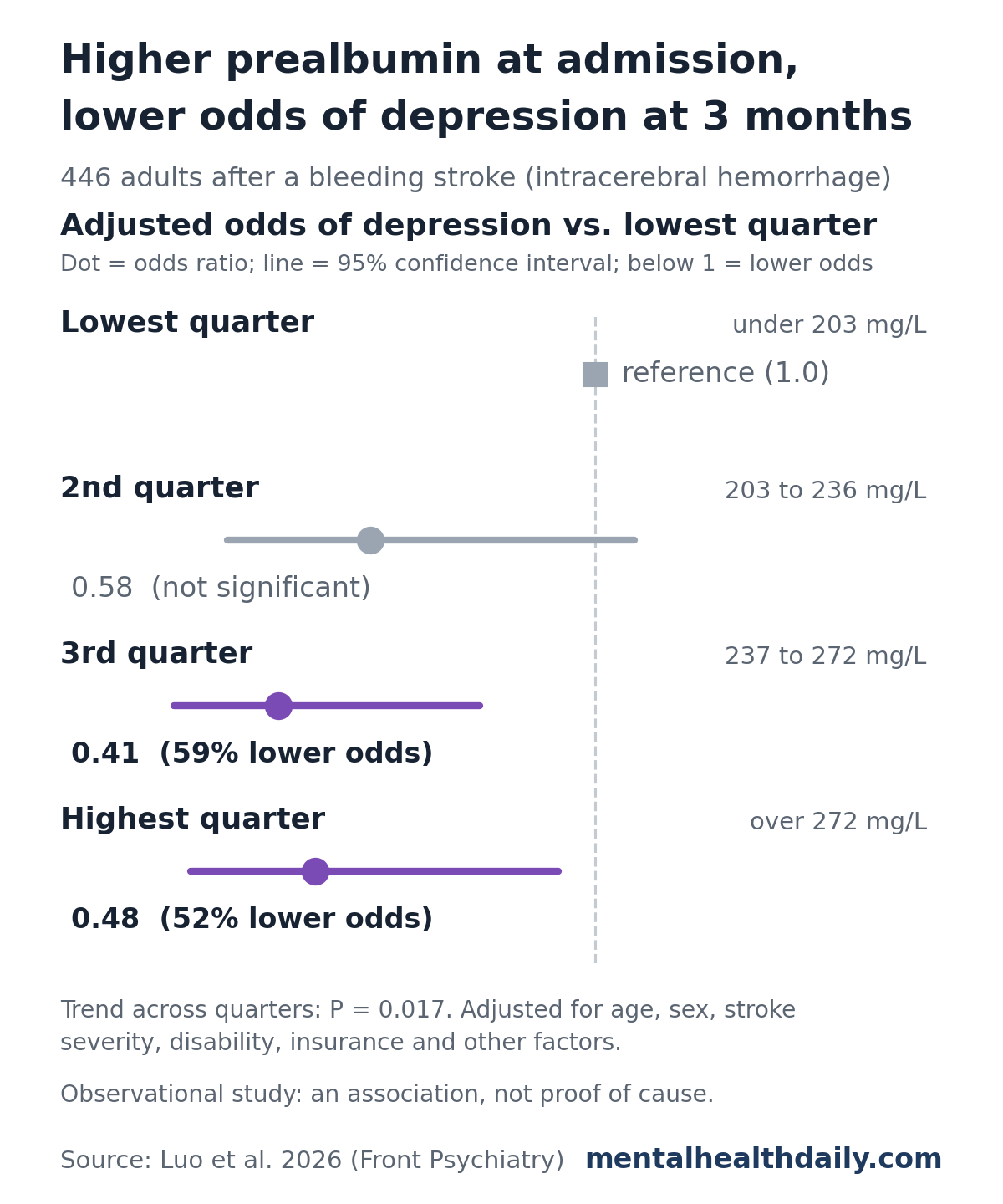
The trend across quarters was significant (P = 0.017). The highest quarter did not do better than the third (P = 0.644 for that comparison), so the data fit an overall inverse link more than a steady dose-response curve.1
Robustness checks: the result held when the researchers additionally adjusted for the size of the blood clot in the 383 patients with volume data (OR 0.994, P = 0.021) and when they dropped 2 patients with incomplete body-size data. Subgroup tests by sex, age, body mass index, insurance and surgery found no significant differences, although several subgroups were small.1
The study reported odds ratios only. It did not report an AUC or any accuracy figure for predicting depression in an individual patient, and the researchers state that prealbumin should not be used on its own as a screening or diagnostic test.1
Prealbumin Was Linked to Depression; Albumin Was Not
Among 440 patients with both measurements, the researchers ran the same fully adjusted model for each protein separately:1
- Prealbumin: OR 0.9951 per 1 mg/L (95% CI 0.9906 to 0.9996, P = 0.035)
- Albumin: OR 0.9672 per 1 g/L (95% CI 0.9162 to 1.0210, P = 0.227)
That pattern fits prealbumin’s shorter half-life: it reflects the last few days of illness and intake, while albumin moves slowly. The researchers did not formally test one protein against the other, so the study does not show that prealbumin is the better marker.
Depression After a Bleeding Stroke Is Common and Starts Early
The 35.7% rate in this cohort sits at the high end of what is seen after stroke overall. A 2023 meta-analysis of 77 studies estimated that 27% of stroke survivors have depression at a given time point; 71% of cases that develop in the first year begin within 3 months, and about half of people depressed in those first 3 months were still depressed later.2
Bleeding strokes may carry a heavier mood burden. A 2021 Chinese study using the same HAMD-17 scale found depression 1 month after stroke in 42.3% of patients with intracerebral hemorrhage vs. 22.9% after ischemic (clot) stroke, with an adjusted OR of 2.65 for hemorrhage.3
The prealbumin finding is also consistent with earlier work. A 2016 study involving 307 patients with acute stroke found depression at 1 month in 93 (30.3%), and admission prealbumin was significantly lower in that group.4 The 2026 study extends the link to bleeding stroke specifically and to a later, 3-month check.
Limitations of This Prealbumin and Post-Stroke Depression Study
This was a single-hospital retrospective cohort, so it can show an association but not that low prealbumin causes depression. Specific limits include:1
- Missing confounders: no inflammation markers such as C-reactive protein or interleukin-6, no Glasgow Coma Scale scores, no measures of social support or loneliness, and no systematic delirium screening
- One blood draw: prealbumin was measured once, and the time from stroke onset to the draw, early treatments and food intake beforehand were not recorded
- Survivors only: people who died or could not be interviewed because of aphasia or impaired consciousness were excluded, so the sickest patients are missing
- Mixed follow-up methods: depression interviews were done by phone, video or in person, and the method was not recorded for each patient
- Small per-unit effect: the odds change per 1 mg/L is tiny, and the quarter-by-quarter pattern was not a smooth gradient
- Odd side findings: reported alcohol use (OR 0.548) and diabetes (OR 0.366, only 8 depressed patients with diabetes) were also linked to lower odds of depression; the researchers caution that these likely reflect crude measurement and confounding, not protection
What This Means for Stroke Patients and Families
- Low prealbumin is a warning sign of a rough recovery, not a depression test. It points to more inflammation, poorer intake or a sicker early course, all of which travel with later mood problems.
- Watch mood in the first 3 months. Depression after stroke is common, usually starts early and is treatable, so new low mood, loss of interest or withdrawal during recovery deserves a conversation with the care team.
- No evidence yet for nutrition as depression prevention. Good nutrition support matters after stroke for many reasons, but this study did not test whether raising prealbumin lowers depression risk.
- Next step: prospective studies with repeated prealbumin measurements, inflammation markers and detailed nutrition and social data, in more than one hospital.
References
- Luo H, Luo Q, Shi X, Xie J, Lei R, Zhou J. Serum prealbumin at admission is associated with post-stroke depression at 3 months in patients with spontaneous intracerebral hemorrhage. Frontiers in Psychiatry. 2026;17:1698928. doi:10.3389/fpsyt.2026.1698928
- Liu L, Xu M, Marshall IJ, Wolfe CD, Wang Y, O’Connell MD. Prevalence and natural history of depression after stroke: a systematic review and meta-analysis of observational studies. PLoS Medicine. 2023;20:e1004200. doi:10.1371/journal.pmed.1004200
- Zeng YY, Cheng HR, Cheng L, et al. Comparison of poststroke depression between acute ischemic and hemorrhagic stroke patients. International Journal of Geriatric Psychiatry. 2021;36:493–499. doi:10.1002/gps.5444
- Wang L, Xu H, Ren W, et al. Low serum prealbumin levels in post-stroke depression. Psychiatry Research. 2016;246:149–153. doi:10.1016/j.psychres.2016.09.021