
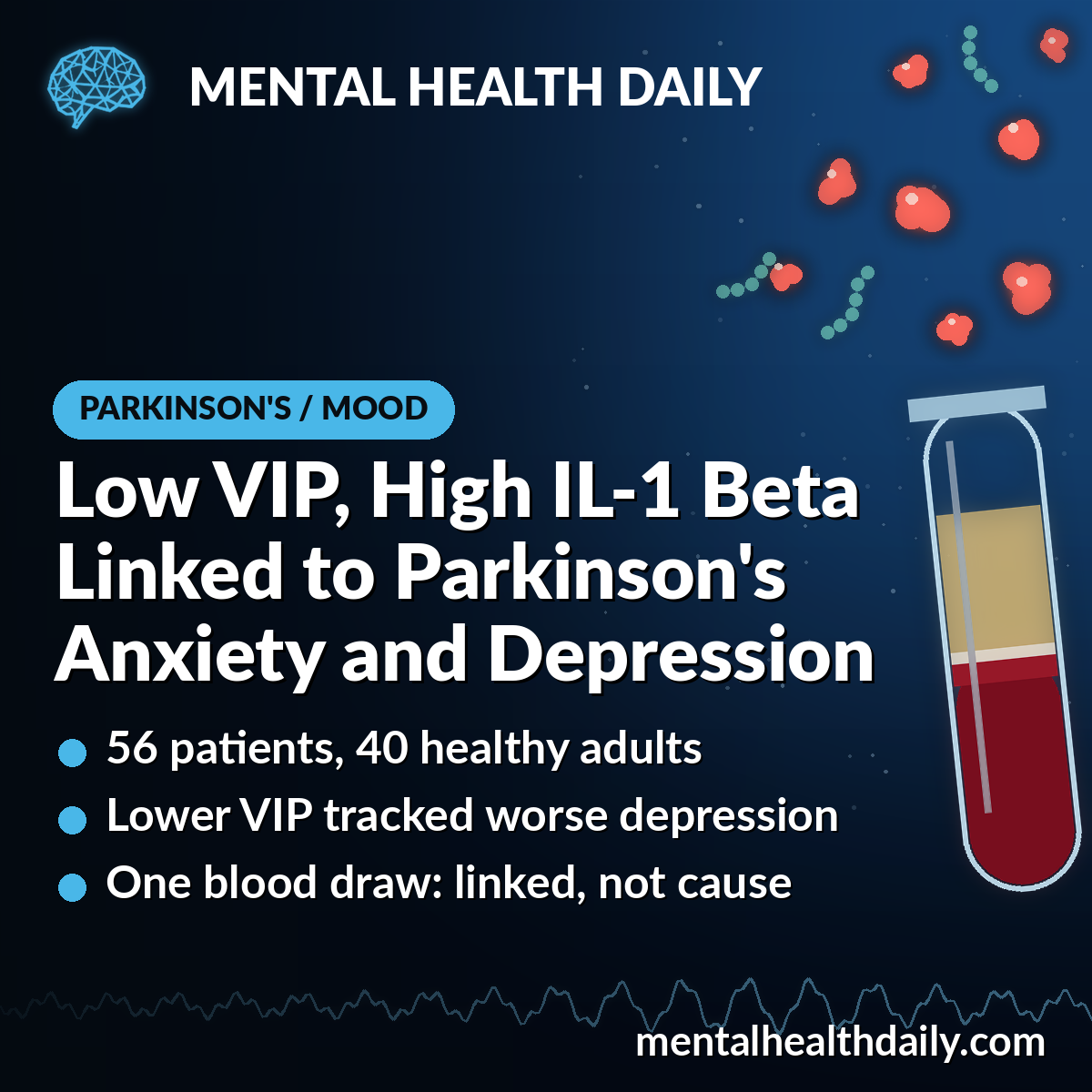
People with Parkinson’s disease who had both anxiety and depression had lower blood levels of a protective peptide called VIP and higher levels of the inflammatory protein IL-1β than patients with neither, in a 2026 study from China.1
Research Highlights
- Lower VIP with anxiety and depression: 135.63 pg/mL in 27 patients with both vs 195.22 pg/mL in 19 patients with neither (p < 0.001).1
- Higher IL-1β: 332.92 vs 223.91 pg/mL in the same comparison (p < 0.001).1
- Strongest link with depression scores: lower VIP went with higher Hamilton depression scores (r = −0.853) and, less strongly, higher anxiety scores (r = −0.559).1
- Preliminary evidence: a single-center, one-time blood draw in 56 patients and 40 healthy controls, with medications not accounted for.1
What VIP and IL-1β Do in the Body
Anxiety and depression are among the most common non-motor symptoms of Parkinson’s disease. They often show up together, can appear before the tremor and stiffness, and weigh heavily on daily life.1
Researchers have long suspected that inflammation is part of the reason. Li et al. focused on blood molecules that sit on opposite sides of that process:
- VIP (vasoactive intestinal peptide): a small signaling protein made by nerve and immune cells. It widens blood vessels, calms immune responses, and helps keep neurons alive. In lab studies it dampens the brain’s immune cells (microglia) and their output of inflammatory molecules.
- IL-1β (interleukin-1 beta): a cytokine, meaning an immune messenger protein, that switches inflammation on. High levels can promote oxidative stress and damage neurons.
- TNF-α (tumor necrosis factor alpha): another inflammatory cytokine, involved in immune-cell activation and cell death signaling.
The idea behind the study was simple: if the balance tips toward less VIP and more inflammatory cytokines, mood symptoms might follow that tilt.1
How the Parkinson’s Blood Study Was Set Up
Researchers at the Second Affiliated Hospital of Henan Medical University in Xinxiang, China, consecutively enrolled 56 people with Parkinson’s disease between October 2020 and June 2022, plus 40 age- and sex-matched healthy adults having routine checkups.1
- Patients: 27 men and 29 women, average age about 62; half were in early stages (Hoehn–Yahr I–II). People with low cognitive test scores or a primary psychiatric disorder were excluded.
- Mood ratings: clinicians used the Hamilton Anxiety Scale (HAMA-14) and Hamilton Depression Rating Scale (HAMD-17). Anxiety meant a HAMA score of 7 or more; depression meant a HAMD score of 8 or more.
- Blood test: a fasting morning sample, with VIP, IL-1β, and TNF-α measured by ELISA, a standard antibody-based lab test.
For the mood comparison, 27 patients met both cutoffs and 19 met neither. Another 10 patients with only anxiety (6) or only depression (4) were left out of that comparison.1
Lower VIP and Higher IL-1β in Patients With Anxiety and Depression
Compared with healthy controls, the whole Parkinson’s group already had lower VIP (160.37 vs 219.86 pg/mL) and higher TNF-α (371.09 vs 293.01) and IL-1β (287.81 vs 217.10).1 Within Parkinson’s, the gap widened further in patients with mood symptoms.
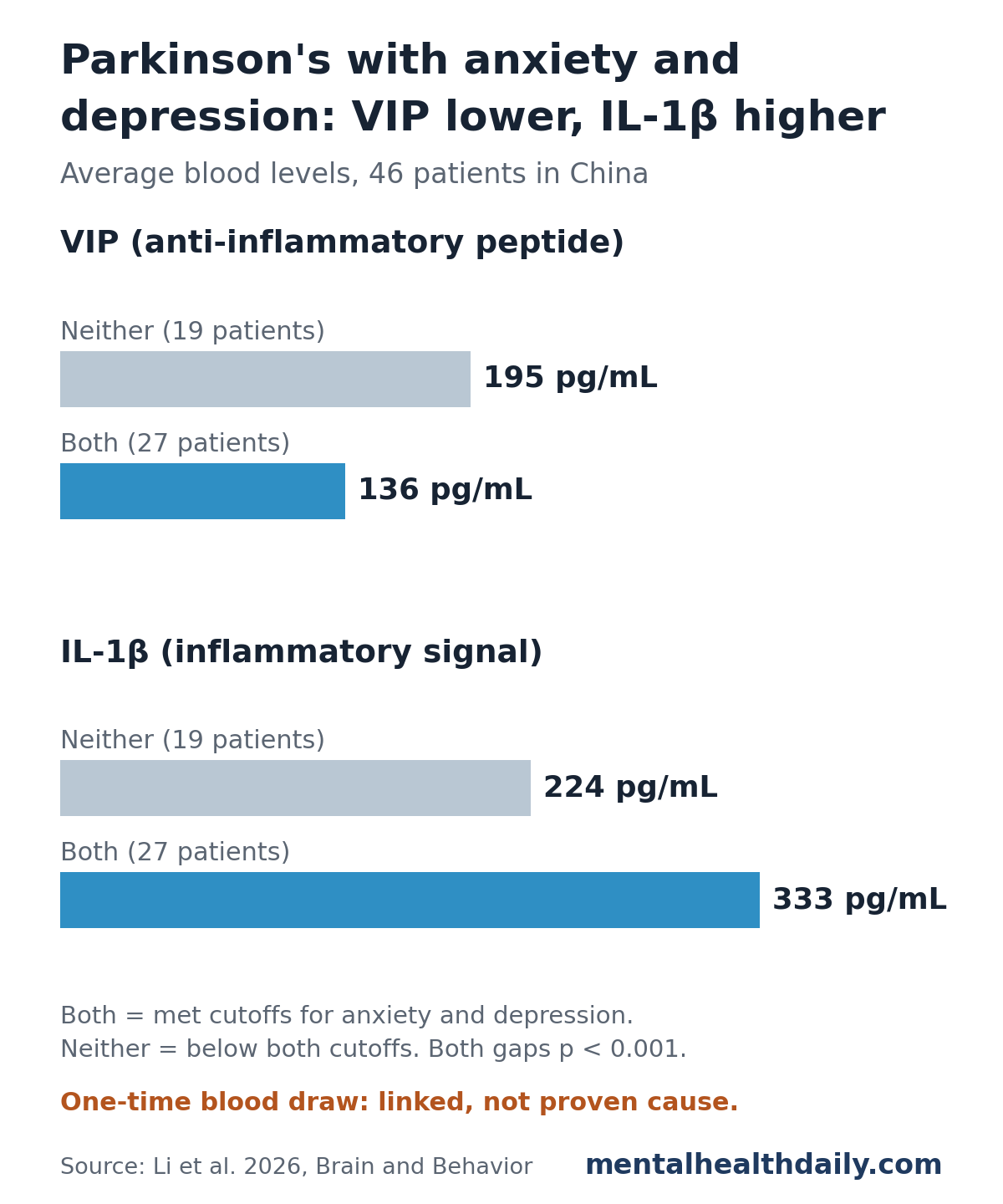
VIP: 135.63 pg/mL in patients with both anxiety and depression vs 195.22 in those with neither, roughly 30% lower.1
IL-1β: 332.92 vs 223.91 pg/mL, roughly 50% higher. TNF-α was also higher (391.60 vs 337.56; p = 0.008).1
Patients in the anxiety-and-depression group did not differ from the others in baseline demographics or routine blood chemistry.1
VIP Tracked Depression Severity Closely
Across the 46 patients in the mood comparison, lower VIP went with worse symptoms on both rating scales. IL-1β moved the other way:1
- VIP and depression: r = −0.853, a very strong inverse correlation.
- VIP and anxiety: r = −0.559.
- IL-1β and anxiety: r = 0.727.
- IL-1β and depression: r = 0.375.
- TNF-α: linked to depression (r = 0.398) but not anxiety.
Median VIP stepped down with each level of depression: 218 pg/mL with none, 169 with mild, 131 with moderate, and 114 with severe. Median IL-1β climbed with anxiety severity, from 151 pg/mL with none to 459 with severe.1
In a statistical model that included all 3 markers, only VIP and IL-1β stayed independently linked to having both anxiety and depression; TNF-α dropped out.1
None of the 3 markers tracked daily-living function or how long patients had had Parkinson’s. IL-1β was higher in middle and late stages than in early disease.1
Could a VIP Blood Test Flag Mood Problems in Parkinson’s?
The researchers tested how well each marker separated the 2 mood groups. VIP did best, with an area under the curve (AUC, a 0.5-to-1 score where 1 means perfect separation) of 0.892. IL-1β reached 0.796 and TNF-α 0.691.1
Those numbers come from the same small sample used to pick the cutoffs, with no second group to check them against. The researchers say the accuracy may be overestimated, and the comparison only involved patients at the 2 extremes, not the in-between cases a clinic would actually see.1
For now, anxiety and depression in Parkinson’s are identified through symptoms and clinical rating scales, not blood tests.
Earlier Studies Point the Same Way on VIP and Inflammation
- Lower VIP in Parkinson’s mood symptoms: a 2021 study of 72 patients and 71 healthy volunteers also found lower serum VIP in Parkinson’s. VIP was lower in patients with anxiety or depression and correlated with mood and cognition symptoms, though far more weakly (r = −0.373).2
- Cytokines and mood in Parkinson’s: a 2012 Swedish study of 86 patients found that higher blood TNF-α and soluble IL-2 receptor went with more severe fatigue, depression, and anxiety symptoms.3
The result is consistent with that earlier work, though the correlations here are much stronger than in the 2021 study. Comparing only patients at the 2 extremes likely makes correlations look larger than they would in a full clinic population.
Limitations of This VIP and IL-1β Study
Evidence strength: a cross-sectional study captures one moment. It can show that low VIP and high IL-1β go along with anxiety and depression, but not which comes first or whether either one drives the symptoms.
- Small groups: 27 and 19 patients, from one hospital, with no advance sample-size calculation.
- Medications not accounted for: levodopa, antidepressants, anti-anxiety drugs, and statins can all affect inflammation, and medication data were incomplete.
- Extreme-groups comparison: the 10 patients with only anxiety or only depression were excluded.
- No validation: the AUC values were never tested in a separate group of patients.
- Reporting gaps: the paper lists an exclusion cutoff of 27 on the MMSE (a short cognitive test), yet reports median scores of 26 in both groups, so who was excluded is not fully clear.
What This Means for People With Parkinson’s
- Mood symptoms are part of Parkinson’s: anxiety and depression are common in the disease and worth raising with a neurologist or mental health clinician.
- Inflammation keeps showing up: this study adds VIP and IL-1β to a growing list of blood markers linked to mood in Parkinson’s.
- Not a test or treatment yet: larger, long-term studies that account for medications would need to confirm these markers before any clinical use.
References
- Li L, Jia X, Shi Y, et al. Serum VIP and IL-1β levels are associated with anxiety and depression in patients with Parkinson’s disease: a cross-sectional study. Brain and Behavior. 2026;16:e71742. doi:10.1002/brb3.71742
- Hu S, Huang S, Ma J, et al. Correlation of decreased serum pituitary adenylate cyclase-activating polypeptide and vasoactive intestinal peptide levels with non-motor symptoms in patients with Parkinson’s disease. Frontiers in Aging Neuroscience. 2021;13:689939. doi:10.3389/fnagi.2021.689939
- Lindqvist D, Kaufman E, Brundin L, et al. Non-motor symptoms in patients with Parkinson’s disease – correlations with inflammatory cytokines in serum. PLoS One. 2012;7(10):e47387. doi:10.1371/journal.pone.0047387