
UK university students who ate more fish-based omega-3 had slightly lower anxiety scores, but the link was not statistically significant once alcohol use was accounted for. Neither type of dietary omega-3 was linked to depression scores in this 50-student survey.1
Research Highlights
- Small survey: 96 students were recruited in 2025 and 50 were analyzed after supplement users, students with a diagnosed mental-health condition, and a few others were excluded.1
- Anxiety link faded with adjustment: each extra 100 mg/day of EPA + DHA from food went with a 0.325-point lower GAD-7 anxiety score (95% CI −0.725 to 0.074; p = 0.108).1
- No consistent dose pattern: on a log scale the estimate flipped direction (+0.166, p = 0.557), and rank correlations were not significant.1
- No depression link: neither EPA + DHA nor plant-based ALA was significantly linked to PHQ-9 depression scores.1
- Trials are mixed too: omega-3 supplements eased anxiety in a meta-analysis of 19 trials, especially in people with clinical diagnoses, while long-term prevention trials found little or no effect.23
How the UK Student Omega-3 Survey Worked
Omega-3 fatty acids are polyunsaturated fats the body cannot make well on its own. The two long-chain forms, EPA (eicosapentaenoic acid) and DHA (docosahexaenoic acid), come mainly from oily fish and seafood. They help build nerve-cell membranes and help regulate inflammatory signaling.
ALA (alpha-linolenic acid) is the plant form found in walnuts, flaxseed and chia, and the body converts only a small share of it into EPA and DHA.1
Mine Mumcu, John Lodge and Hasan Kaan Kavsara of London Metropolitan University and Yeditepe University ran an online survey of UK students between February and May 2025, recruited through social media and campus QR codes. Their main question was whether higher dietary EPA + DHA went with lower anxiety.1
- Omega-3 intake: estimated from a food frequency questionnaire (how often students ate salmon, mackerel, tuna, shrimp, walnuts, chia and similar foods), adapted from a validated omega-3 screener
- Anxiety: the GAD-7, a 7-question screener scored 0 to 21
- Depression: the PHQ-9, a 9-question screener scored 0 to 27
- Adjustments: age, sex, total calories from a single 24-hour food recall, and alcohol use
Researchers excluded anyone taking omega-3 supplements (21 people) so they could study food alone. They also excluded students with a diagnosed anxiety, depressive or bipolar disorder (16 people), aiming for a non-clinical sample.1
Sample: 50 students, average age 25, 70% women, 52% master’s students and 38% nutrition students. Average estimated EPA + DHA intake was about 473 mg/day, and 76% met the 250 mg/day general-health reference value.1
Symptoms: average scores were 6.66 on the GAD-7 and 7.02 on the PHQ-9. Most students (80%) had minimal or mild symptoms on each screener.1
Fish Omega-3 and Anxiety: A Link That Lost Significance
Researchers built 4 regression models, adding one set of adjustments at a time. In the first 3, higher EPA + DHA intake was significantly linked to lower GAD-7 scores, by about 0.36 to 0.39 points per extra 100 mg/day.1
The fully adjusted model, designated as the main analysis, added alcohol use. The estimate shrank to 0.325 points and was no longer statistically significant (p = 0.108).1
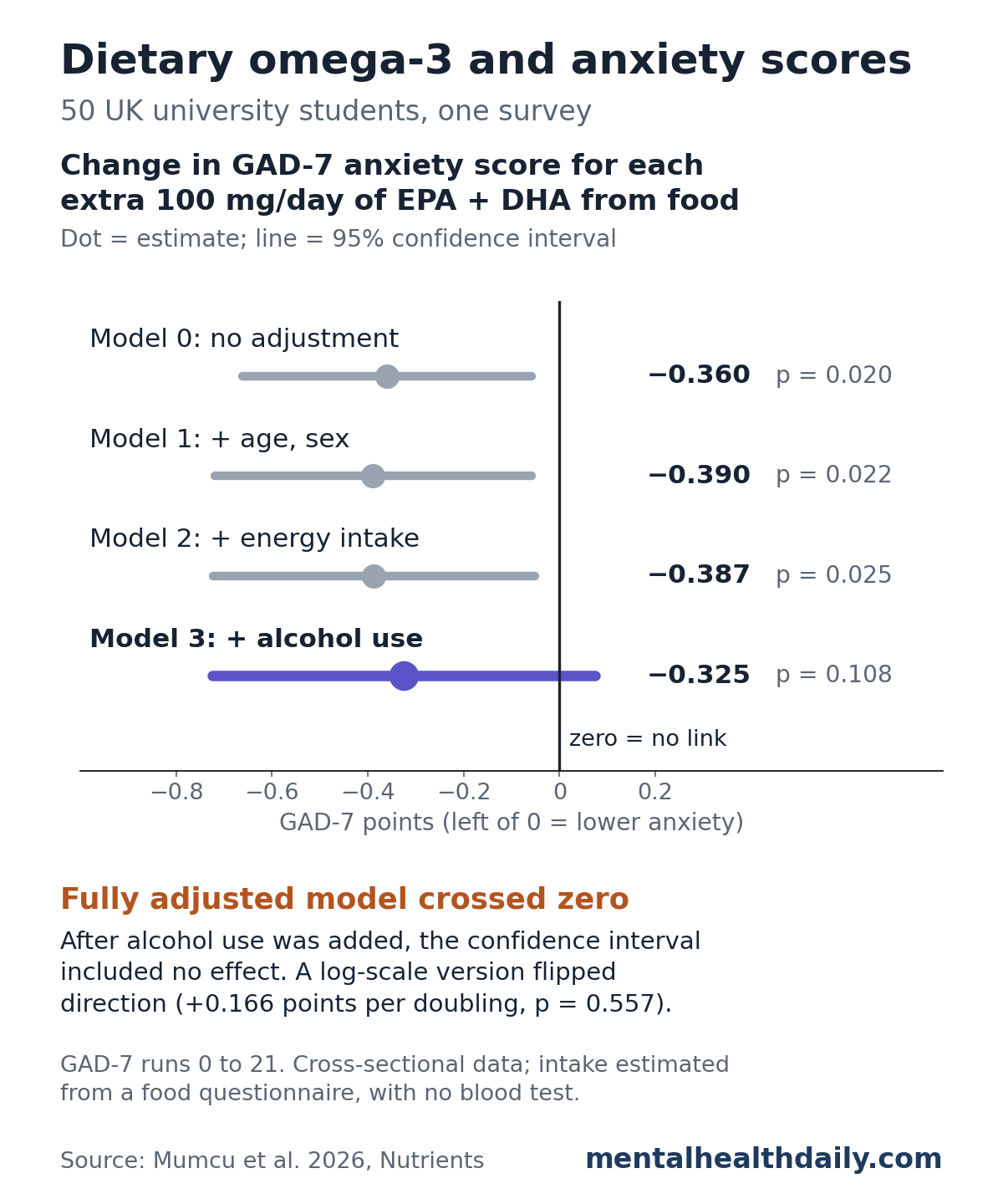
For scale, 0.325 points is small on a 0-to-21 questionnaire, and the 95% confidence interval ran from a 0.725-point drop to a 0.074-point rise.1
Other analyses backed that up. The researchers checked the result several other ways:
- Rank correlation: weak and not significant (rs = −0.169, p = 0.240)
- Log-scaled intake: the coefficient turned positive (+0.166 GAD-7 points per doubling of intake, p = 0.557)
- Dropping influential data points, adding BMI, or excluding intakes above 1,200 mg/day: the estimate stayed inverse but not significant
Because the result changed with how intake was modeled, the researchers concluded the data do not support a dose–response relationship, where more omega-3 reliably goes with less anxiety.1
Sex difference: women scored about 2.9 points higher than men on the GAD-7 in the adjusted model (p = 0.041). The study was not designed to test sex differences, and 70% of the sample was female.1
No Link Between Omega-3 Intake and Depression Scores
All depression and ALA analyses were exploratory. None reached significance, whether intake was treated as a continuous number or split at reference levels: 250 mg/day of EPA + DHA, and 1.6 g/day (men) or 1.1 g/day (women) of ALA.1
Students who met those intake levels had GAD-7 and PHQ-9 scores similar to those who did not. The researchers note these reference values were set for general health, not for preventing anxiety or depression.1
What Omega-3 Trials and Larger Studies Show
Randomized trials of omega-3 supplements, rather than diet surveys, give a mixed picture for anxiety and depression:
- Anxiety treatment: a 2018 meta-analysis of 19 clinical trials found anxiety symptoms improved more with omega-3 supplements than without (Hedges’ g = 0.374, a small-to-moderate effect). Benefits were stronger in people with clinical diagnoses than in those without.2
- Prevention: a review of 31 trials with more than 41,000 participants concluded that long-chain omega-3 supplements probably have little or no effect in preventing depression or anxiety symptoms.3
- Fish in the diet: a meta-analysis of 31 observational studies (255,076 people) linked higher fish intake to a 22% lower risk of depression (relative risk 0.78, pooled from 21 datasets).4
The UK survey is too small to settle where students fit. Its anxiety estimate leaned toward lower scores with more fish omega-3, but the fully adjusted model could not rule out no effect, and a modest depression link like the one in large observational studies would be easy to miss with 50 people.
Limitations of This Omega-3 Student Survey
The researchers called the work exploratory and hypothesis-generating. A single cross-sectional survey can show whether two things go together at one moment, but not which came first or whether one causes the other. The main limits:
- Too small for small effects: with 50 students, the study had 80% power only for fairly strong correlations (about 0.38 or larger)
- Direction unknown: anxiety can change appetite and food choices, so anxious students might eat less fish rather than the reverse
- Selected sample: only 52% of recruits were analyzed, recruitment was by social media and word of mouth, and 38% studied nutrition
- Narrow range: excluding supplement users and students with diagnoses may have narrowed the range of both intake and symptom scores
- Rough intake estimates: self-reported eating, an adapted questionnaire that was not revalidated, US food-composition values, and no blood test of omega-3 levels
- Missing factors: no data on omega-6 intake, overall diet quality, sleep, stress, caffeine or socioeconomic background
The GAD-7 and PHQ-9 measure recent symptoms and are screening tools, not diagnoses. The findings say nothing about whether omega-3 supplements help anyone with an anxiety or depressive disorder.
What the Findings Mean for Students
For students without a diagnosis, this survey offers no clear evidence that eating more fish or plant omega-3 is linked to lower anxiety or depression. The small inverse anxiety signal is worth testing in larger studies with repeated diet records and blood omega-3 measures, as the researchers recommend.1
Oily fish is still recommended for general health. Students with ongoing anxiety or low mood are better served by talking with a doctor or campus counseling service than by changing their diet alone.
References
- Mumcu M, Lodge JK, Kavsara HK. Dietary omega-3 fatty acid intake, anxiety, and depression among university students in the UK: an exploratory cross-sectional study. Nutrients. 2026;18(17):2858. doi:10.3390/nu18172858
- Su KP, Tseng PT, Lin PY, et al. Association of use of omega-3 polyunsaturated fatty acids with changes in severity of anxiety symptoms: a systematic review and meta-analysis. JAMA Network Open. 2018;1(5):e182327. doi:10.1001/jamanetworkopen.2018.2327
- Deane KHO, Jimoh OF, Biswas P, et al. Omega-3 and polyunsaturated fat for prevention of depression and anxiety symptoms: systematic review and meta-analysis of randomised trials. British Journal of Psychiatry. 2021;218(3):135–142. doi:10.1192/bjp.2019.234
- Grosso G, Micek A, Marventano S, et al. Dietary n-3 PUFA, fish consumption and depression: a systematic review and meta-analysis of observational studies. Journal of Affective Disorders. 2016;205:269–281. doi:10.1016/j.jad.2016.08.011