Trauma Reminders Increase Drug Cravings — Negative Affect Is the Link
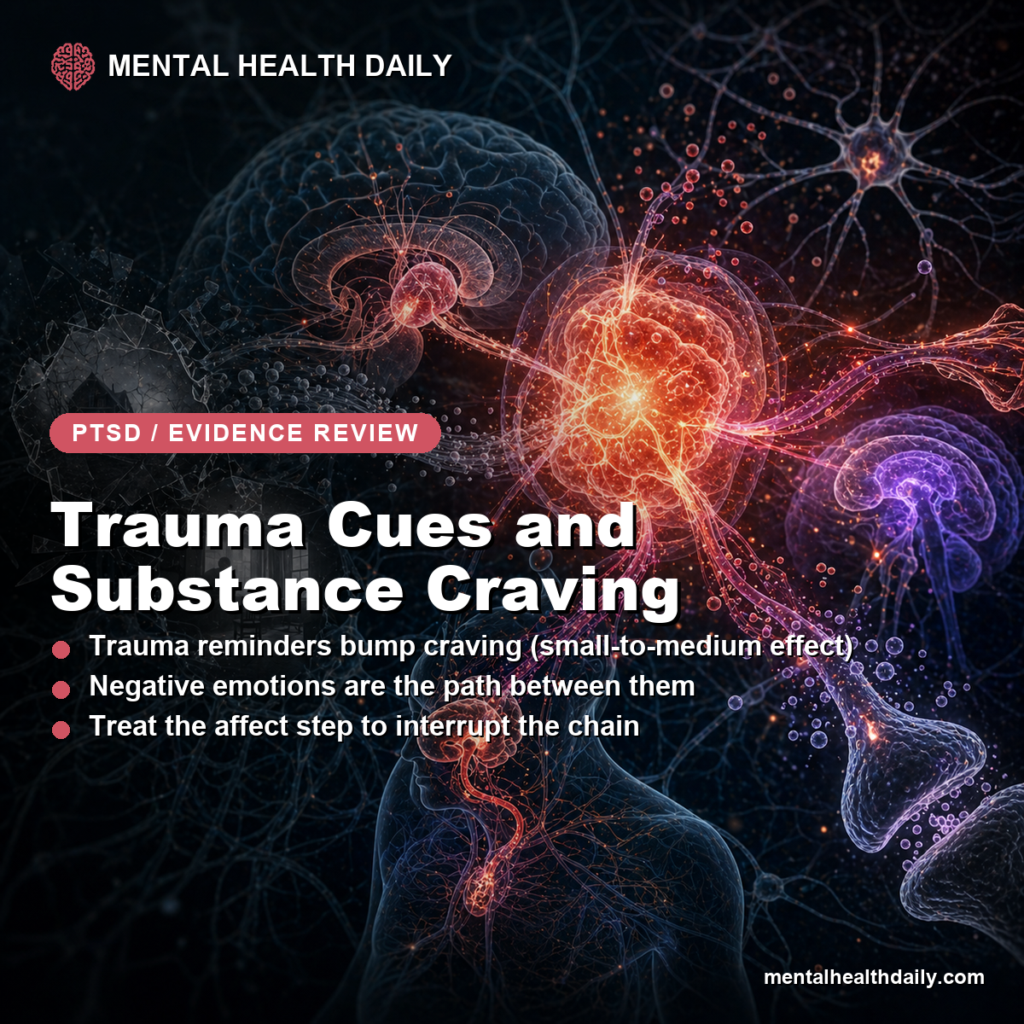
Trauma reminders trigger substance craving — but the path runs through negative emotions, not directly. A 2026 meta-analysis quantifies the link.
Trauma reminders trigger substance craving — but the path runs through negative emotions, not directly. A 2026 meta-analysis quantifies the link.
The complex interplay between reproductive behaviors and psychiatric disorders is an area of interest within the scientific community, revealing how our genetic makeup may influence both our reproductive milestones and mental health. A recent study sheds light on this relationship, focusing on the causal pathways linking reproductive behaviors, such as the age at first sexual …

Recent research has uncovered the potential of minocycline, a tetracycline antibiotic, in modifying fear memory retention. A new study conducted by Yanfang Xia and colleagues, published in Translational Psychiatry, highlights how minocycline could play a role in treating anxiety and stress-related disorders. Highlights: Study Basis: The study was based on Pavlovian fear conditioning as a …

Stellate Ganglion Block (SGB), a medical procedure originally designed for pain management, is emerging as a potential treatment for anxiety disorders. This approach leverages its ability to modulate the sympathetic nervous system, which plays a significant role in anxiety symptoms. Highlights: SGB Procedure & Technicality: SGB involves injecting a local anesthetic near the stellate ganglion …
Lamotrigine is a synthetic phenyltriazine chemical with anticonvulsant and analgesic properties initially sold by GlaxoSmithKline under the brand name Lamictal. It was first approved by the FDA in 1994 for the treatment of partial seizures in adults, and was subsequently approved in 1998 for the management of Lennox-Gastaut syndrome – a severe form of epilepsy …
Effexor (Venlafaxine) is a drug that was introduced in 1993 as a pharmaceutical antidepressant by Wyeth; its marketing rights are now owned by Pfizer. Pharmacodynamically, it functions primarily as a serotonin-norepinephrine reuptake inhibitor (SNRI) and is understood to be the first-ever “dual reuptake inhibitor” approved by the FDA for the treatment of major depressive disorder. …
Many people find recreational horseback riding pleasurable and relaxing. However, many individuals are unaware that there’s a therapeutic form of horseback riding [often integrated with psychotherapy] called “equine assisted therapy.” In recent years equine therapy has garnered attention as a potential intervention for the treatment of PTSD, troubled youth, and even autism spectrum disorders. From …