hit counter

Alzheimer’s PET Imaging Now Gates Anti-Amyloid Therapy Eligibility

MHD featured image for Alzheimer's PET imaging and anti-amyloid therapy eligibility.

A 2026 review in the Japanese Journal of Radiology argued that amyloid PET has moved from an optional Alzheimer’s disease biomarker to a practical eligibility gate for anti-amyloid antibody therapy, while tau PET and FDG-PET answer different questions in the same clinical workflow.1 The key shift is not that every memory complaint needs PET; it …

Read more

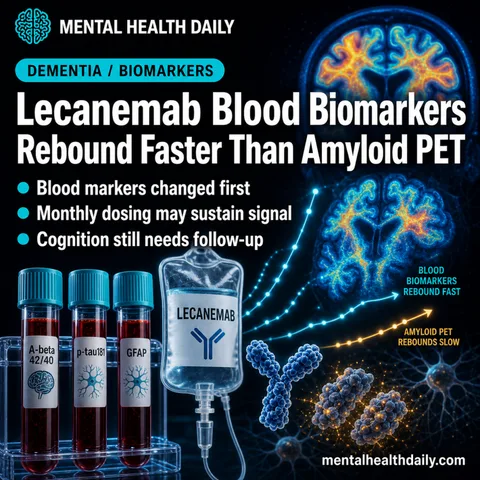
Lecanemab Blood Biomarkers Rebound Faster Than Amyloid PET After Stopping

Editorial card showing lecanemab maintenance dosing and Alzheimer's blood biomarkers with blood vials, amyloid PET imagery, and biomarker trajectory lines.

Lecanemab blood biomarkers may rebound much faster than amyloid PET after treatment stops: a 2026 PK/PD model estimated that half of the Aβ42/40 treatment effect is lost within 0.5 years, compared with 12.1 years for amyloid PET signal.1 Research Highlights 0.5-year rebound for Aβ42/40: Bhagunde et al. estimated that half of the Aβ42/40 treatment effect …

Read more

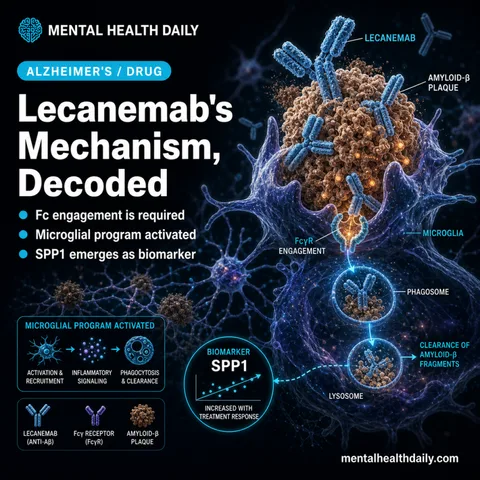
Lecanemab Clears Amyloid via Microglia and Fc Receptors

Photoreal illustration of microglia clustering around an amyloid plaque, conveying immune-mediated clearance mechanism.

A 2026 Nature Neuroscience study found that lecanemab cleared amyloid in a humanized-microglia Alzheimer’s disease model only when microglia and the antibody’s intact Fc fragment were both present: X-34 plaque area differed across IgG1, lecanemab, and Fc-silenced LALA-PG groups (P = 0.0003), 82E1 plaque area differed across groups (P < 0.0001), and microglia-deficient mice showed …

Read more

Plasma p-tau217 Blood Test Predicts Alzheimer’s Risk 1.5x Stronger in APOE-e4

Photoreal illustration representing a blood biomarker test for Alzheimer's disease with imagery of blood vials, neurons, and APOE genetic motifs.

Until recently, Alzheimer’s pathology could only be confirmed in living patients via PET imaging or lumbar puncture. Plasma p-tau217 changed that calculus — but how to interpret a positive result depends substantially on APOE genotype.1 Research Highlights Plasma p-tau217 is a blood biomarker that rises years before Alzheimer’s symptoms. The 2024 Alzheimer’s Association revised criteria …

Read more