hit counter

Anxious Depression fMRI Meta-Analysis Finds Left Temporal Activation

Editorial brain-map card for anxious depression with highlighted limbic and prefrontal regions from an earlier draft framing.

A 2026 fMRI meta-analysis of 11 studies found a narrow anxious-depression signal: 829 anxious-depression patients differed from 681 non-anxious MDD patients in left middle temporal gyrus activation (SDM-Z = 2.046, p = 0.020), while healthy-control contrasts centered on the anterior commissure and right middle frontal gyrus. The calibrated interpretation is not “amygdala and insula hyperactivity …

Read more

Lithium Loading Dose Did Not Clearly Beat Standard Acute-Mania Titration

Photoreal illustration of lithium tablets and blood-level monitoring chart, conveying acute-mania pharmacological strategy.

A 60-patient randomized trial of lithium loading for acute bipolar I mania reported faster serum lithium attainment than standard titration and a larger 14-day Young Mania Rating Scale (YMRS) change score, but the same accepted manuscript says absolute YMRS scores at Days 3, 7, and 14 were not significantly different between the 2 arms when …

Read more

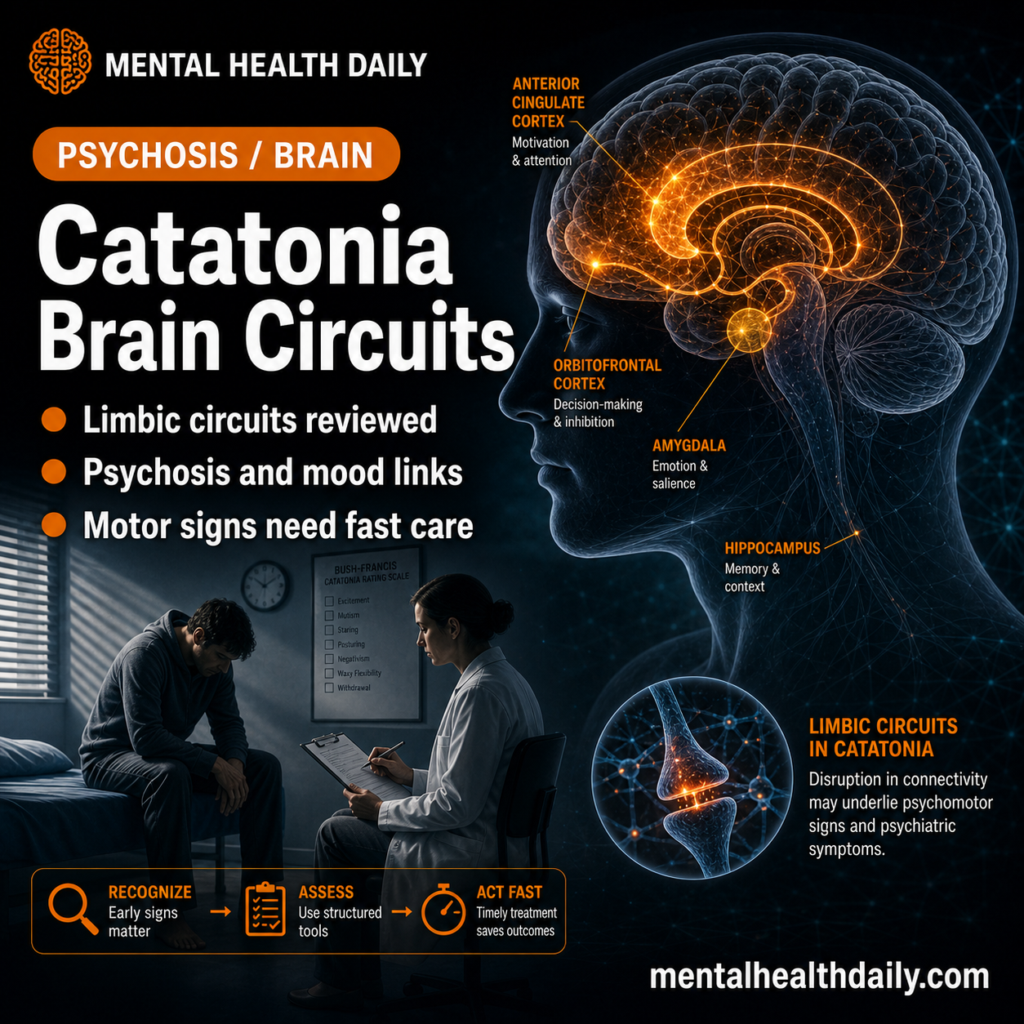
Catatonia Linked to Lower Left Paracingulate Sulcus Rate (28% vs 53%)

Photoreal illustration of a brain with the anterior cingulate cortex highlighted, representing transdiagnostic structural markers of catatonia.

A 2026 hospital MRI study found that the left paracingulate sulcus was present in 31 of 109 catatonia patients (28%) vs. 171 of 323 psychiatric controls without catatonia (53%), a left-hemisphere group effect that survived adjustment for age, sex, scanner, brain volume, benzodiazepines, and antipsychotics.1 Research Highlights Left PCS signal: left paracingulate sulcus (PCS) presence …

Read more

Negative Emotionality Reduces Frontal Midline Theta in 106 Recruits

Photoreal illustration of frontal-midline brain activity overlaid on a stylized portrait, conveying personality-brain link in cognitive control.

A 2026 EEG study of 106 Army National Guard recruits found that higher negative emotionality predicted poorer Go/No-Go discrimination (β = −.234, 95% CI −.392 to −.076) and lower frontal midline theta (β = −.149, 95% CI −.290 to −.001). The key result was not a vague personality-brain link: frontal midline theta, not occipital alpha, …

Read more

Posttraumatic Growth in Farsi Refugees: 61% Explained by 4 Factors

Photoreal illustration of refugees in community setting with imagery of resilience and growth, conveying integrated trauma adaptation.

A 2026 survey of 230 Farsi-speaking refugees in German camps found a hard double signal: 69.1% screened above the RHS-15 threshold for depression, anxiety, and PTSD symptoms, while 4 protective factors explained 61% of posttraumatic-growth variance.1 Research Highlights High distress and growth coexisted: 159 of 230 participants (69.1%) scored ≥12 on the RHS-15 symptom scale, …

Read more

Chronic Pain Plus Depression Alters Brain Structure

Photoreal illustration of brain regions affected by overlapping pain and depression networks, conveying comorbid neural signature.

A 2026 UK Biobank MRI preprint involving 71,214 adults found that chronic pain plus current depression had a structural brain profile that was more than chronic pain plus depression pasted together. The 1,377-person comorbid group showed widespread lower cortical volume, lower bilateral thalamic and hippocampal volume, lower left accumbens volume, and broad white-matter microstructure differences …

Read more

Antidepressant Use in Pakistan (2026): SSRI Prescribing Patterns and Patient-Reported Side Effects

Photoreal illustration of a pharmacist counseling patient on antidepressant medication, conveying global pharmacovigilance.

Most antidepressant pharmacovigilance data come from high-income countries, leaving prescribing patterns and adverse-effect profiles in low- and middle-income countries underdocumented. A 2026 cross-sectional study by Riaz and colleagues describes antidepressant use in Pakistan, with patient-reported adverse effects mapped against prescription patterns.1 Research Highlights Antidepressant use in low- and middle-income countries (LMICs) has grown substantially but …

Read more