
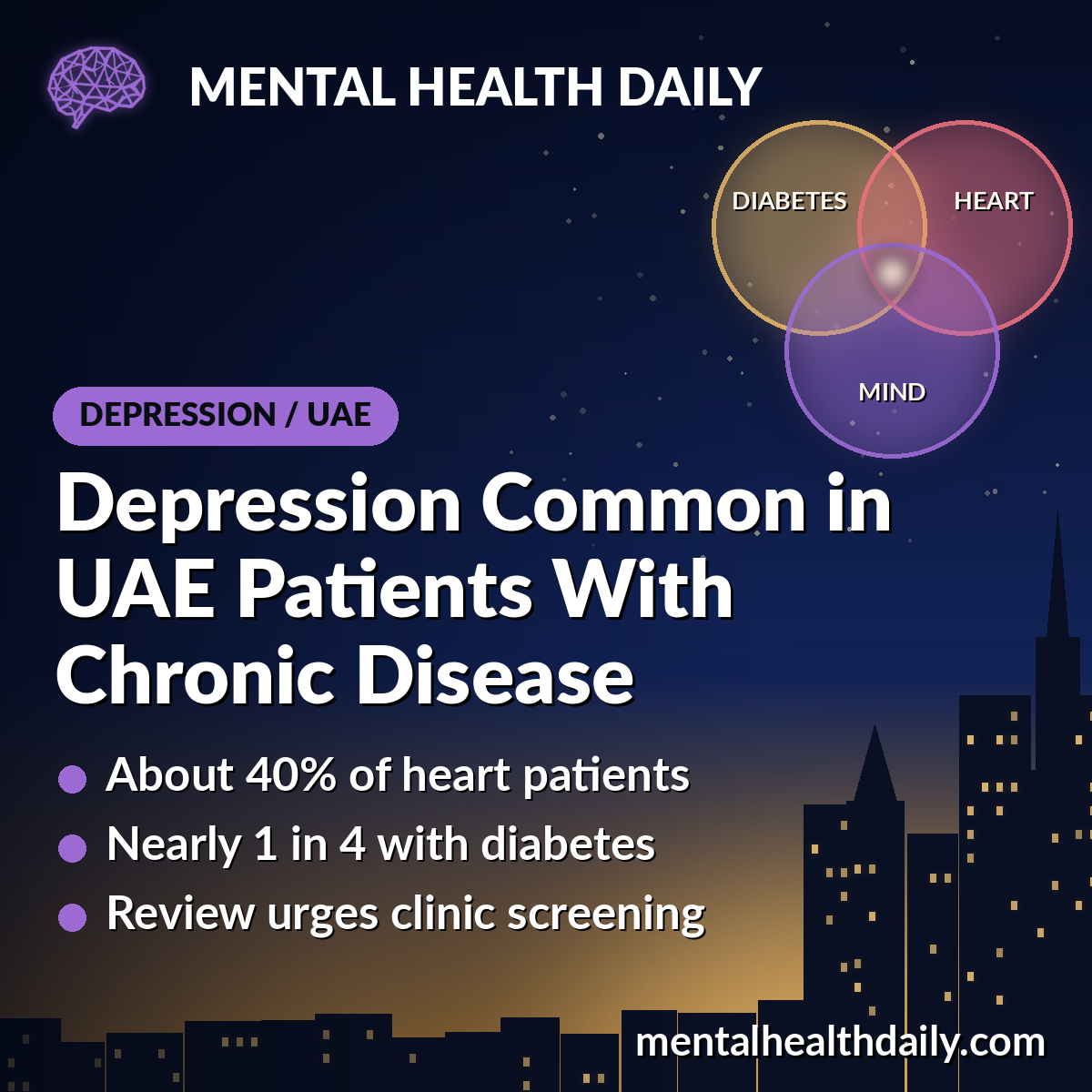
Depression is common among people in the United Arab Emirates who live with diabetes, heart disease and other long-term illnesses, according to a 2026 narrative review of UAE research. The reviewers argue that primary care doctors should screen for it routinely and share care with mental health specialists.1
Research Highlights
- High depression rates with chronic disease: in a UAE primary-care study the review relies on, about 40% of patients with heart disease and 22.7% of those with type 2 diabetes screened positive for depression.1,2
- Consistent with global data: a 2017 meta-analysis found that people with 2 or more chronic conditions were about twice as likely to be depressed as people without multimorbidity.3
- Barriers to care: stigma, limited mental health insurance coverage for expatriates, language and cultural differences, and too few specialists outside the cities.1
- Hidden symptoms: depression and anxiety often show up as pain, fatigue, stomach trouble or poor sleep, so they are easy to miss in a busy clinic.1
- Proposed fix: short questionnaires in primary care, referral pathways to specialists, and pharmacists checking medications, building on Abu Dhabi’s SAKINA network and IFHAS screening program.1
- Evidence type: a narrative review, not a systematic one, so it describes and proposes rather than pooling new data.1
What Multimorbidity Means and Why It Raises Depression Risk
Multimorbidity means living with 2 or more long-term conditions at once, such as type 2 diabetes plus high blood pressure, or heart disease plus kidney disease. The World Health Organization uses this definition, and it is becoming more common worldwide.1
Mental health and chronic physical illness feed into each other. The review notes that depression is 2 to 3 times as common in people with type 2 diabetes as in people without it, and that depression is in turn linked to more heart problems in people with diabetes.1
The reviewers list several shared pathways:1
- Body stress systems: inflammation and changes in the HPA axis (the hypothalamic-pituitary-adrenal axis, the hormone system that controls the stress response)
- Daily life: poor sleep, limited mobility, money worries and the strain of managing several illnesses
- Treatment burden: polypharmacy (taking many medicines at once), side effects and drug interactions
- Behavior: low mood can bring overeating and inactivity, which make blood sugar harder to control
About 40% of UAE Heart Disease Patients Had Depression in One Study
Chronic diseases are a major health burden in the UAE. Non-communicable diseases such as heart disease, cancer and diabetes account for 77% of deaths, according to figures the review cites, and WHO data put cardiovascular disease at 40% of deaths. Obesity, high blood pressure and high blood sugar are common even in young Emirati adults.1
The review’s depression figures come mainly from Alkaabi et al., who surveyed 417 adults with chronic diseases at 7 primary health care centers in Al Ain. Patients completed the PHQ-9 (Patient Health Questionnaire-9), a 9-question depression screening form, and a score of 8 or higher counted as depression.2
- All chronic disease patients: 21.1% screened positive for depression.2
- Heart disease: about 40%, and heart disease remained linked to depression after accounting for other factors.1,2
- Type 2 diabetes: 22.7%.1
- Other patterns: depression was also higher with asthma, and women with chronic kidney disease, heart disease or a longer illness had higher depression levels.1
These numbers come from a screening questionnaire at a single point in time in one city, not from clinical diagnoses or a national sample. They line up with global evidence: Read et al.’s 2017 meta-analysis found that multimorbidity roughly doubles the likelihood of depression.3
Insurance, Language and Stigma Keep Patients From Mental Health Care
Migrant workers from India, Pakistan, Bangladesh and the Philippines make up about 80% of the UAE’s population, the review reports. It notes that studies in this group report high rates of depression, along with diabetes, metabolic syndrome and other chronic illnesses.1
The reviewers describe several barriers that stop people from getting mental health care:1
- Insurance: many expatriates have private policies with limited mental health coverage.
- Language and culture: people from many backgrounds struggle to find culturally suitable services, and the reviewers call for screening tools in patients’ native languages.
- Stigma: fear of judgment, discrimination or harm to the family’s reputation leads people to avoid seeking help.
- Job and money worries: many underserved workers are in informal jobs where losing work or being labeled can be devastating.
- Distance: rural areas have few mental health professionals, and travel to city clinics often depends on family help.
Workforce is another limit. Ministry of Health and Prevention figures from 2021 showed about 17.3 doctors for every 10,000 people, unevenly spread across specialties. A 2024 news report the review cites estimated that a population of 11 million by 2030 would need 1,759 psychiatrists and 3,381 psychiatric beds.1
Depression Often Shows Up as Physical Symptoms in Primary Care
Many patients with depression or anxiety come to the doctor with only physical complaints: pain, tiredness, digestive problems or trouble sleeping. Unless they also mention emotional distress, they may keep getting treated for the physical symptoms while the underlying problem goes unnoticed.1
Primary care doctors face their own obstacles, according to the review: limited training in mental health, short appointments, competing demands, and patients who are reluctant to talk about low mood. Patients with several illnesses also take many medicines, which raises the risk of drug interactions.1
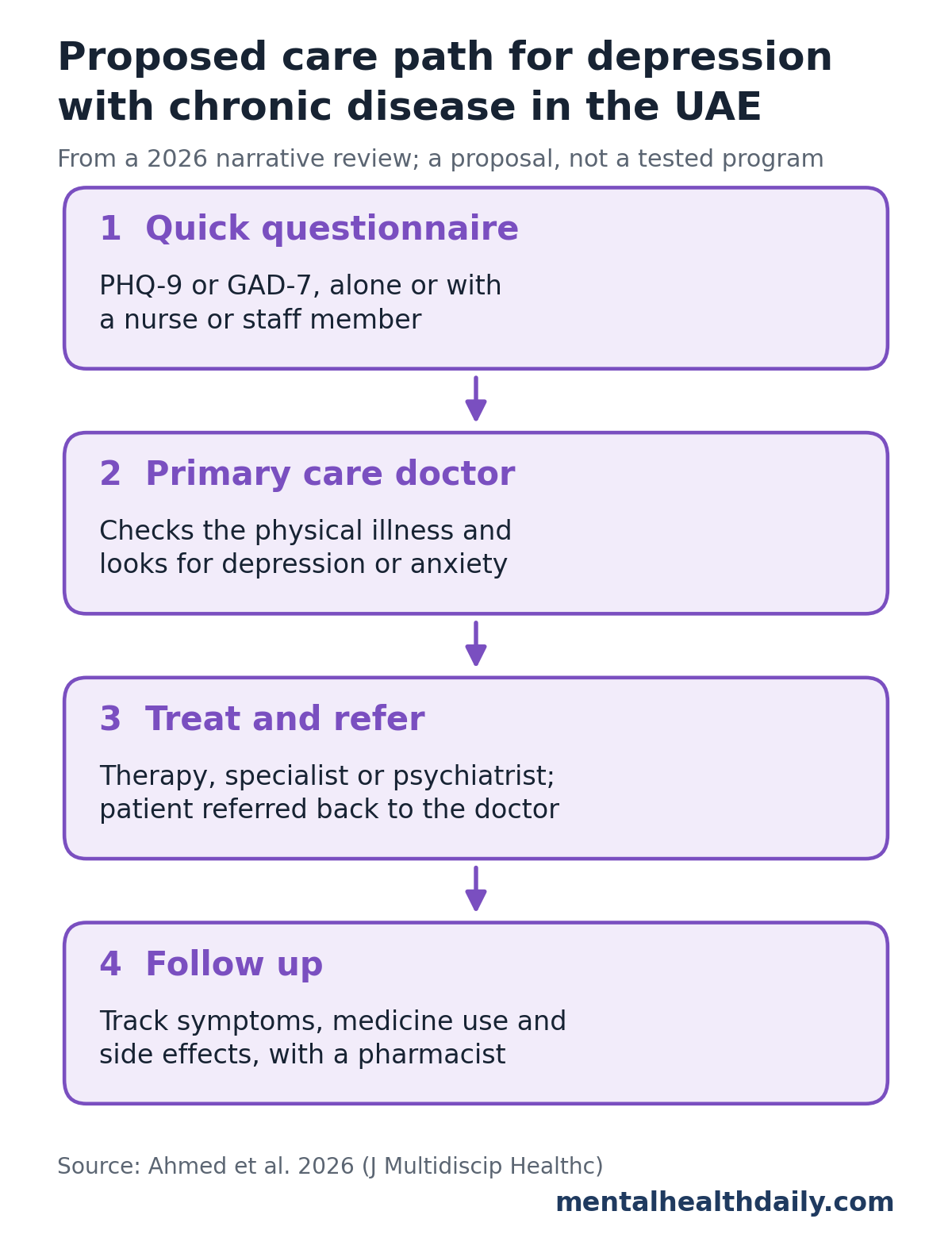
The reviewers recommend basic mental health screening for everyone who visits a clinic, whatever the reason, using short tools such as the PHQ-9 for depression and the GAD-7, a 7-question anxiety form. They also favor measurement-based care: repeating these scales over time and adjusting treatment based on the scores, much as a doctor tracks blood pressure.1
A Team Approach: Collaborative Care Between Doctors, Specialists and Pharmacists
The review’s central proposal is collaborative care. In this model, mental health problems are treated in primary care by a coordinated team: the family doctor works alongside psychiatrists and other mental health staff instead of handing patients off.1
That model has trial support. In 2 Danish randomized trials, Curth et al. compared collaborative care with consultation liaison, where a psychiatrist advises the family doctor as needed. Collaborative care led to larger symptom reductions at 6 months in both the depression trial (389 patients enrolled) and the anxiety trial (302 patients enrolled).4
Both models need ongoing specialist time, which is hard to supply in rural and underserved areas, the review notes.1
The proposed team roles:1
- Primary care doctors: screen, treat the physical illness, start mental health care and refer when needed, supported by continuing education, telehealth and clear referral pathways.
- Specialists: psychiatrists and therapists take complex cases and send patients back to primary care once stable.
- Pharmacists: explain why each medicine matters, check for drug interactions and side effects, and help patients stay on treatment.
- Allied staff: nutritionists, social workers, psychologists and physiotherapists for patients with complex needs.
Simple steps such as appointment reminders sent shortly before a visit also help people keep follow-up appointments, the reviewers add.1
Abu Dhabi’s SAKINA Network and IFHAS Screening Program
The review highlights 2 Abu Dhabi programs that already put parts of this model into practice:1
- SAKINA (Arabic for “tranquility”), launched in May 2024 by PureHealth on the Abu Dhabi Department of Health’s mental health model of care. Primary health care centers screen for depression, anxiety, postpartum depression and dementia using standard questionnaires, with psychiatrists based in satellite clinics in those centers. Integrated clinics in hospitals cover cancer, chronic disease, stroke recovery, women’s health, older adults and children, and a digital platform called PURA offers virtual care.
- IFHAS, the screening program of the Abu Dhabi Public Health Center (ADPHC) for Thiqa insurance holders aged 18 to 75, checks for mental health problems in people attending primary care for chronic conditions such as diabetes, high blood pressure and heart disease.
The reviewers say these programs have reduced stigma and improved early detection and access. The review does not present outcome data to back that up, and its first author is affiliated with SAKINA.1
Limitations of This UAE Multimorbidity Review
- Narrative, not systematic: the authors searched PubMed and Google Scholar by hand, with no formal quality rating of studies and no pooled estimates.
- Thin local data: the main UAE depression figures come from 1 cross-sectional questionnaire study in one city.
- Mixed sources: some figures come from news reports and program websites rather than peer-reviewed research.
- Search limits: only English-language papers were included, some papers were unavailable, and publication bias is possible, as the authors acknowledge.
- Industry ties: Viatris, a drug company, funded the medical writing, and 3 of the 6 authors work for it.
What This Means for Patients With Chronic Diseases in the UAE
Depression is a common part of chronic illness. If you live with diabetes, heart disease or several long-term conditions, persistent low mood, loss of interest, tiredness or poor sleep are worth raising with your doctor, even if the visit is for something else.
Ask about screening. A PHQ-9 or GAD-7 takes a few minutes. In Abu Dhabi, SAKINA and IFHAS already offer this kind of screening in primary care centers; IFHAS is for Thiqa insurance holders aged 18 to 75. People outside that eligibility can ask their clinician about screening.1
Treating mood helps the whole picture. Depression can make it harder to keep up with medicines, diet and exercise, so getting help for it supports care for the physical illness too.1
References
- Ahmed NN, Makhoul S, Hallak O, Cherchali A, Siddiqui U, Purushottamahanti P. Impact of multimorbidity on mental illness in the United Arab Emirates: a review. Journal of Multidisciplinary Healthcare. 2026;19:624773. doi:10.2147/JMDH.S624773
- Alkaabi AJ, Alkous A, Mahmoud K, et al. The prevalence and correlates of depression among patients with chronic diseases in the United Arab Emirates. PLoS One. 2022;17(12):e0278818. doi:10.1371/journal.pone.0278818
- Read JR, Sharpe L, Modini M, Dear BF. Multimorbidity and depression: a systematic review and meta-analysis. Journal of Affective Disorders. 2017;221:36–46. doi:10.1016/j.jad.2017.06.009
- Curth NK, Hjorthøj C, Brinck-Claussen U, et al. The effects of collaborative care versus consultation liaison for anxiety disorders and depression in Denmark: two randomised controlled trials. British Journal of Psychiatry. 2023;223(3):430–437. doi:10.1192/bjp.2023.77