
A self-guided smartphone app based on interpersonal psychotherapy did not change depression scores during pregnancy, but it lowered them after birth. In a randomized trial of 350 pregnant women in Japan expecting their first child, app users scored 1.01 points lower than women in usual care on the 0-to-27 PHQ-9 depression scale about 1 month after delivery.1 Nine in 10 app users rated it as satisfactory.
Most women in the trial had few depressive symptoms to begin with. The app was built to protect mental well-being through pregnancy and early parenthood, so this is a prevention study rather than a test of treatment for perinatal depression.
Research Highlights
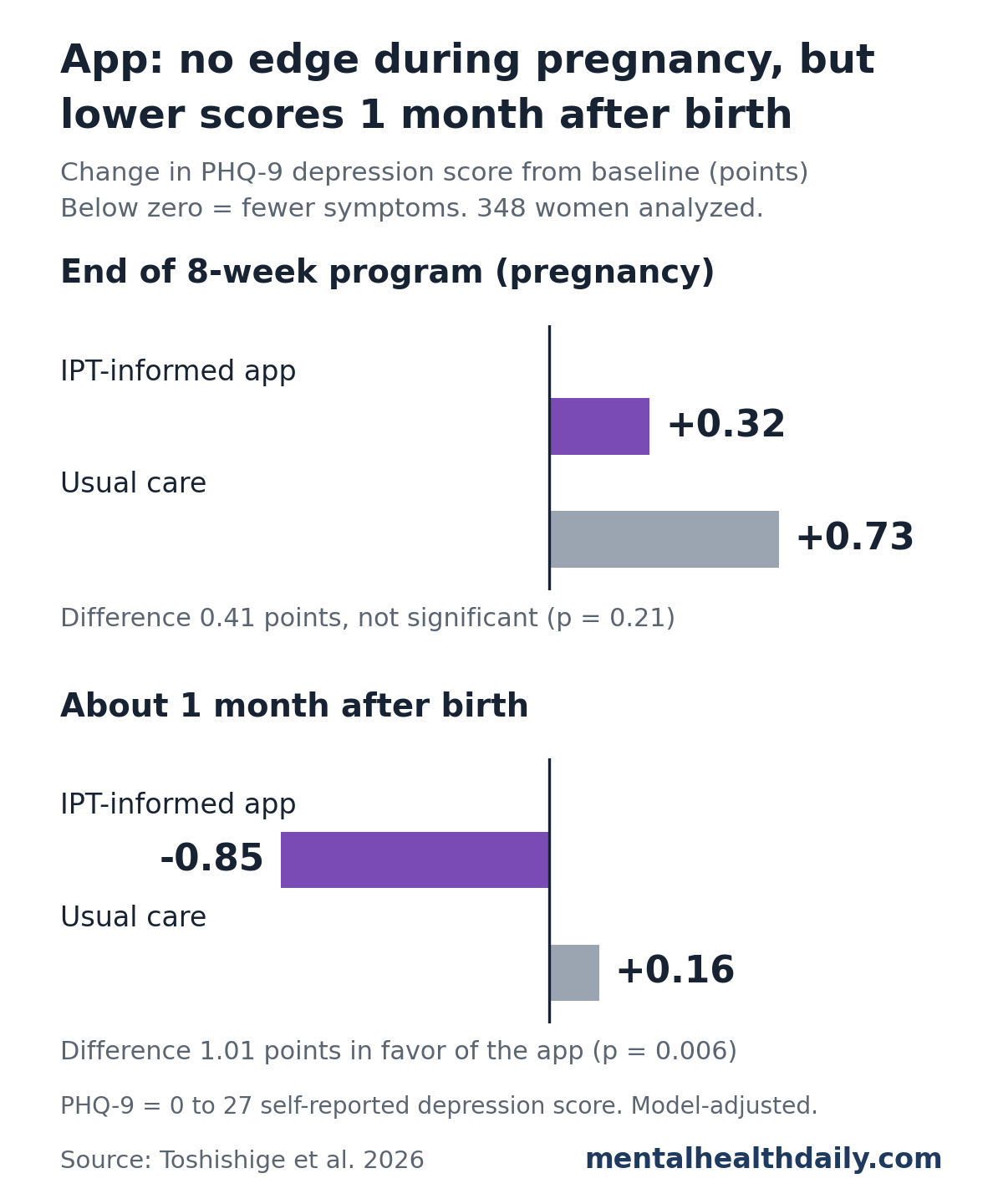
- Lower scores after birth: at about 1 month postpartum, the app group scored 1.01 PHQ-9 points lower than usual care (95% CI 0.29 to 1.73, p = 0.006; standardized mean difference 0.28).1
- No difference during pregnancy: at the end of the 8-week program, the co-primary efficacy outcome, the gap was 0.41 points and not statistically significant (p = 0.214).1
- Women liked it: 157 of 174 app users (90.2%) cleared the prespecified satisfaction threshold, and they finished an average of 7.45 of the 8 weekly lessons.1
- A second depression scale agreed: the Edinburgh Postnatal Depression Scale also showed no clear difference in pregnancy and a 1.51-point advantage for the app after birth.1
- In line with other digital trials: the postpartum effect size matches the pooled estimate for digital perinatal depression programs (0.29).2
What the Interpersonal Therapy App Taught
Interpersonal psychotherapy (IPT) is a structured talk therapy that links mood to what is happening in a person’s close relationships and life roles. It fits pregnancy well, because becoming a parent reshapes roles, shifts the balance with a partner, and changes who a person leans on for support. A meta-analysis of 28 studies found in-person IPT effective for treating and preventing depression in pregnant and postpartum women.3 The catch is access: therapists trained in it are scarce, and appointments are hard to fit around pregnancy and work.
The app, developed with the drug company Shionogi, packaged IPT ideas into a fully self-guided program with no therapist involved:1
- 8 weekly lessons of about 5 to 10 minutes, led by a rule-based chatbot character, unlocking one at a time
- Early lessons mapped the user’s relationships and sources of support and showed how feelings track daily interactions
- Lessons 5 to 7 were tailored to one problem area: the role change of becoming a parent, or a conflict with someone close, usually a partner, with practice in stating expectations more clearly
- Everyday tools: a feelings tracker, a log, short articles, and a built-in Edinburgh Postnatal Depression Scale (EPDS) check with feedback
- A safety function: any answer indicating thoughts of self-harm brought up a banner linking to government hotline and counseling services
Women in the usual care group continued their routine prenatal check-ups without the app. App users could keep using it after the 8 weeks, and 96% opened it at least once more before the postpartum assessment.1
Who Took Part
Researchers recruited nationwide in Japan through online ads and postcards in late 2024. Of 1,179 women screened, 350 were randomized: 176 to the app and 174 to usual care. The analysis included 348 women (175 and 173).1
- Everyone was expecting her first child, aged 18 to 39, in the second trimester (about 21 weeks on average), and living with a partner or spouse
- No minimum depression score was required; average PHQ-9 at the start was about 5, and more than half scored 4 or lower
- Only 10% to 14% scored 10 or higher, the usual cutoff for moderate symptoms
- Excluded: women already in psychiatric care, those taking regular medications, and anyone reporting frequent thoughts of self-harm on screening
No Difference by the End of the 8-Week Program
The trial had two co-primary outcomes at week 8, while women were still pregnant. The first was acceptability, measured with a client satisfaction questionnaire (CSQ-8); the app passed easily, with 90.2% scoring in the upper half against a target of 50%. The second was the change in PHQ-9 score, and there the app did not beat usual care.1
Symptom scores crept up slightly in both groups during pregnancy. After statistical adjustment, PHQ-9 rose 0.32 points with the app and 0.73 points with usual care, a 0.41-point difference (95% CI −0.24 to 1.06). The EPDS showed the same thing: a 0.61-point difference that was not significant (p = 0.093).1
The authors point to a floor effect. When most women start near the bottom of the scale, there is little room to show improvement. The effect they planned for, 1.19 points, was also bigger than what showed up at week 8.
Lower Depression Scores About a Month After Birth
The postpartum check was a prespecified secondary outcome, scheduled 28 days after each woman’s due date (in practice, about 4 to 5 weeks after delivery). By then the groups had separated:1
- PHQ-9: scores fell 0.85 points from baseline with the app and rose 0.16 points with usual care, a 1.01-point difference (p = 0.006, standardized mean difference 0.28)
- EPDS (0 to 30): a 1.51-point difference in favor of the app (95% CI 0.65 to 2.38, p < 0.001, standardized mean difference 0.35)
- Raw averages: 4.17 with the app vs. 5.18 with usual care on the PHQ-9
In absolute terms, that is about 1 point on a 27-point scale, and both groups stayed in the minimal-to-mild range on average. A shift that size is small for any one person; its value would come at the population level, where nudging many people away from the depression threshold adds up.
The authors suggest the interpersonal skills learned in pregnancy got more use once the baby arrived, when role changes and friction with a partner become real. That is plausible and consistent with IPT’s focus, but the trial did not measure it directly.
Benefit was seen among women with some symptoms. In an exploratory analysis of women who started with PHQ-9 scores of 5 or higher, the app group was 1.20 points lower at week 8 (p = 0.031) and 1.63 points lower after birth (p = 0.006). Women who started at 4 or lower showed no clear difference at either point. The trial was not powered for these subgroup comparisons.1
How This Fits With Other Perinatal Research
The postpartum result is consistent with the wider evidence on digital help for new and expecting mothers. A 2024 meta-analysis found that digital interventions for perinatal depression had a small, significant benefit over controls (standardized mean difference 0.29), with results that varied by how and when programs were delivered.2
The closest comparison is a 2023 US randomized trial of a chatbot using CBT and IPT techniques in 192 women enrolled right after delivery. As here, women found the chatbot acceptable, most had low symptoms, and the benefit was clearest among those with at least mild symptoms at the start.4
Prevention is already standard advice. The US Preventive Services Task Force recommends that clinicians provide or refer pregnant and postpartum people at increased risk of perinatal depression to counseling such as CBT or interpersonal therapy.5 A self-guided app could widen that reach, but this trial largely excluded the higher-risk women that recommendation targets.
Limits of the Trial
- Open-label with a no-app control. Women knew their group, all outcomes were self-reported, and usual care had no comparison app. Users were also told the app came from psychiatrists, an obstetrician, and a drug company, which the authors say may have raised expectations.
- The main pregnancy outcome was null. The postpartum benefit is a secondary result, and the effect sizes were calculated after the fact.
- Short follow-up. Postpartum depression often starts within the first 6 months, and this trial stopped at about 1 month.
- A narrow, lower-risk group. Only partnered first-time mothers aged 18 to 39 in Japan; single, adolescent, and older mothers, women with unplanned pregnancies, and women already in psychiatric care were excluded.
- Industry funded. Shionogi funded the trial and co-developed the app, several authors are company employees or co-inventors on a pending patent, and the data are not publicly available.
- One reporting inconsistency. The discussion lists baseline PHQ-9 averages of 2.56 and 2.13, while the results table gives about 5 for both groups; this article uses the table values.
What It Means for Expecting Parents
This is an encouraging result for a low-intensity, self-guided IPT app as a preventive tool for first-time mothers who are doing reasonably well in pregnancy. Women used it heavily and rated it well, and it was followed by modestly lower depression scores after birth. A trial with a comparison app, longer postpartum follow-up, and a more diverse, higher-risk group would show whether the benefit holds up.
The trial does not show that an app treats perinatal depression. Anyone with persistent low mood, loss of interest, or thoughts of self-harm during pregnancy or after birth should talk with a doctor, midwife, or mental health professional. In the US, the 988 Suicide & Crisis Lifeline (call or text 988) and the National Maternal Mental Health Hotline (1-833-852-6262) are available 24 hours a day.
References
- Toshishige Y, Okami T, Chatani N, et al. Acceptability and efficacy of a smartphone intervention informed by interpersonal psychotherapy for perinatal mental health: a randomized controlled trial. Psychological Medicine. 2026;56:e295. doi:10.1017/S0033291726105868
- Anyanwu IS, Jenkins J. Effectiveness of digital health interventions for perinatal depression: a systematic review and meta-analysis. Oxford Open Digital Health. 2024;2:oqae026. doi:10.1093/oodh/oqae026
- Sockol LE. A systematic review and meta-analysis of interpersonal psychotherapy for perinatal women. Journal of Affective Disorders. 2018;232:316–328. doi:10.1016/j.jad.2018.01.018
- Suharwardy S, Ramachandran M, Leonard SA, et al. Feasibility and impact of a mental health chatbot on postpartum mental health: a randomized controlled trial. AJOG Global Reports. 2023;3(3):100165. doi:10.1016/j.xagr.2023.100165
- US Preventive Services Task Force. Interventions to prevent perinatal depression: US Preventive Services Task Force recommendation statement. JAMA. 2019;321(6):580–587. doi:10.1001/jama.2019.0007