
A 2026 randomized trial of a smartphone cognitive behavioral therapy (CBT) app for people with depression and a history of mild traumatic brain injury (TBI, or concussion) found no difference in depression scores between the app and a control app that only taught about concussion and depression. Average scores on the PHQ-9 depression questionnaire fell by 2.0 points in the CBT group and 3.1 points in the control group.1 The report is a medRxiv preprint (posted online without peer review), and only 42 of the 113 people randomized completed the 12-week primary assessment. The one prespecified secondary outcome that favored the CBT app was insomnia.
Research Highlights
- Depression did not differ by app: the prespecified primary outcome (PHQ-9 change at 12 weeks) showed no significant group difference, and both groups improved over time.1
- Insomnia improved more with CBT: Insomnia Severity Index scores fell more in the CBT group at the 16-week follow-up (Cohen’s d = 0.45, p = 0.0064), a result that survived a conservative multiple-comparison correction.1
- Heavy dropout: 40 of 59 people assigned to the CBT app and 31 of 54 assigned to the control app did not complete the primary assessment.1
- Underpowered for depression: post-hoc power to detect a 3-point PHQ-9 difference was 0.24, so a modest benefit could have been missed.1
- A related trial found the same insomnia pattern: an earlier internet insomnia program in service members with TBI reduced insomnia more than sleep education, with no group difference in depression.2
What the CBT App for Depression After Mild TBI Tested
Cognitive behavioral therapy for depression (CBT-D) is a structured talk therapy that works on two loops: doing more rewarding activities (which lifts mood and gives thoughts less to feed on) and spotting and rebalancing negative thoughts. The trial tested ACDC (Mobile Application to Combat Depression and Concussion), an app built on US Department of Veterans Affairs CBT manuals and a CBT program for TBI.1
- Format: 12 weekly lessons of 15 to 20 minutes, plus 1 to 2 hours a week of homework such as scheduling pleasant activities and practicing thought balancing
- Design choices: short lessons to suit the attention and memory problems common after concussion, and video “coaches” played by actors, modeled on real service members and veterans, to build a sense of therapeutic alliance (a working bond between patient and helper)
- Control: an app with the same look and interface that taught about concussion and depression but contained no CBT skills
Participants needed at least mild depression (PHQ-9 of 5 or higher), a self-reported history of mild TBI at least 6 months earlier, and a smartphone. No therapist was involved, and everything happened remotely. The original target was 200 participants, and the study was designed to detect a 3-point PHQ-9 difference. The sponsor stopped the trial when funding ended, before that number was reached. To recruit faster, the team also widened eligibility partway through, first to civilians and then to ages up to 70.1
Depression Scores Fell in Both Groups, With No Difference Between Apps
The prespecified primary outcome was the change in PHQ-9 (a 0-to-27 self-report depression score) from baseline to 12 weeks. From 151 people screened, 113 were randomized: 59 to the CBT app and 54 to the control app. Only 19 and 23 of them, respectively, completed the 12-week assessment.1
- CBT app: PHQ-9 fell 2.0 points on average
- Control app: PHQ-9 fell 3.1 points on average
- Between groups: no significant difference at 12 weeks or at the 16-week follow-up; across both groups, scores fell 2.1 points by the end of treatment and 3.1 points by 16 weeks
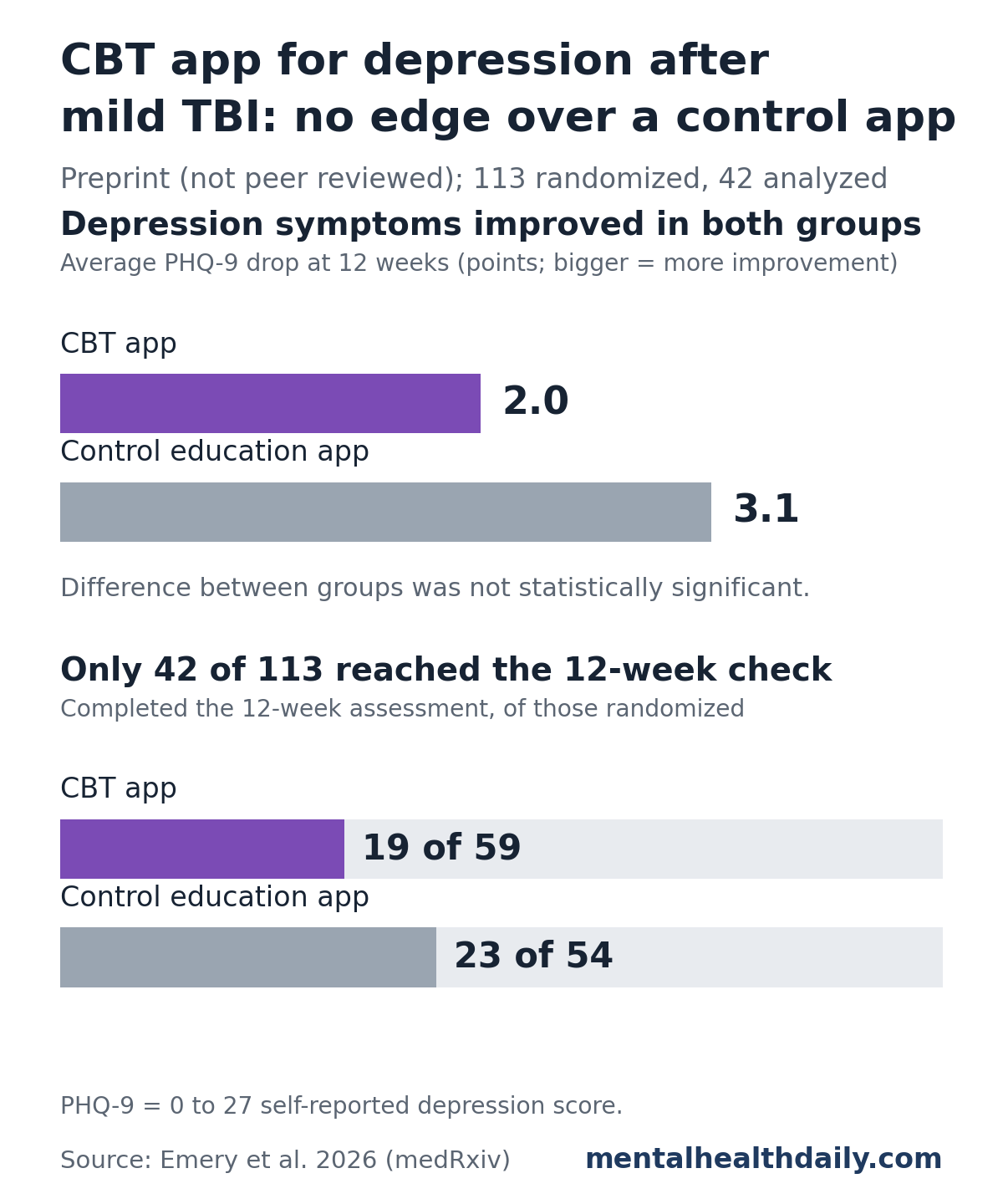
The authors offer 3 explanations for the improvement in both arms: depression naturally waxes and wanes, and people tend to join a treatment study when symptoms are high; the “neutral” education app may have been mildly therapeutic; or neither app helped and taking part in a study did the work.1 With no wait-list group, the trial cannot separate these. A 2025 randomized trial of a mood-tracking smartphone app in 127 adults with TBI, compared with a wait-list, likewise found no benefit for emotional distress (PHQ-9 and anxiety scores) at 6 weeks.3
Low power. Post-hoc, the trial had 0.24 power to detect a 3-point PHQ-9 difference (the target was 90% power for a larger effect). The 2.0 vs. 3.1 result shows no benefit from the CBT app, although a modest benefit could have been missed. The point estimate favored the control app.
Insomnia Improved More With the CBT App at 16 Weeks
The Insomnia Severity Index (ISI) is a 0-to-28 self-report questionnaire where higher scores mean worse insomnia. At the 16-week follow-up (4 weeks after the program ended), ISI scores changed little in the control group and fell into the subthreshold range (below the roughly 11-point cutoff for clinical insomnia) in the CBT group. The group-by-time interaction had Cohen’s d = 0.45 (95% CI 0.12 to 0.96), p = 0.0064, which clears the stricter p < 0.0083 cutoff for the 3 secondary outcomes at 2 time points.1
The ISI result is one of 3 prespecified secondary outcomes and the trial’s primary question was depression, so it is a lead for a follow-up trial rather than a firm conclusion. The other 2 secondary outcomes were less clear:
- PTSD symptoms (PCL-5): improved faster in the CBT group (interaction p = 0.0023 after treatment and p = 0.024 at 16 weeks), but that group started with higher scores and the groups did not differ in absolute scores at either time point
- TBI quality of life: no significant group differences
The insomnia signal has precedent. The same research group ran a separate randomized trial of a fully automated internet-guided CBT program for insomnia (eCBT-I) in service members and veterans with TBI. Among the 50 of 125 randomized participants who finished, ISI fell 6.0 points with eCBT-I vs. 2.3 points with online sleep education (difference −3.5, 95% CI −6.5 to −0.4, Cohen’s d = −0.32, p = 0.03); the groups converged by the 3-month follow-up, and depression scores did not differ between groups.2 That trial, like this one, had heavy loss to follow-up and was stopped when funding ended. This trial cannot show which CBT component, such as regular activity scheduling, affected sleep.
Exploratory Correlations and App Ratings Inside the CBT Group
Within the CBT group only, changes in depression scores moved together with changes in insomnia and PTSD symptoms (r = 0.46 to 0.76), and similar correlations were absent in the control group.1 These correlations were exploratory and uncorrected for multiple comparisons, in about 19 people, so they show who improved on several measures together and say nothing about what caused the improvement.
Participants rated the CBT app higher than the education app on therapeutic alliance (p = 0.0001), engagement (p = 0.002), and overall app rating (p = 0.036). Engagement ratings were still modest, typically around 3 on a 5-point scale, and some users said they expected more interactive features such as an AI chat agent. Higher ratings went with bigger depression improvements in the CBT group (correlation magnitudes 0.53 to 0.66), and the link could run either way: a better experience may help, or people who feel better rate apps higher.1
Evidence Strength: A Small, Preprint Trial With High Attrition
Randomization and a registered primary outcome (ClinicalTrials.gov NCT05147506) make this stronger than an uncontrolled pilot. The limits are substantial:
- Attrition. About 63% of randomized participants did not complete the primary assessment, and missing data were not imputed. Completers may differ from people who left.
- Who dropped out. Self-reported Black or African American and Hispanic or Latino participants were less likely to complete the study, so results say little about these groups.
- Self-reported everything. Mild TBI was self-reported (records and imaging were not required), outcomes were questionnaires rather than clinician ratings, and adherence and homework completion were not measured.
- Shifting population. 9 of the 19 CBT completers were civilians, although the app was designed for service members, and other treatment was not tracked.
- Partial blinding. Participants could not be fully blinded, although only 6 of 19 in the CBT group correctly guessed their arm, which suggests the app did not feel like typical CBT.
- Not peer reviewed. The preprint’s own banner says it should not be used to guide clinical practice, and numbers may change in a reviewed version.
Safety: no serious or unexpected adverse events, deaths, suicide attempts, or psychiatric hospitalizations were reported. Suicidal thoughts on PHQ-9 item 9 were tracked and followed up: 20 reports in 10 people in the CBT group and 24 reports in 8 people in the control group, not significantly different.1
What the Trial Means for Depression Apps After Concussion
- No depression benefit in this trial. The 12-week CBT app did not lower depression more than an education app, and similar null results have appeared for other TBI apps.3 Evidence for in-person CBT for depression after TBI is a separate question.
- Insomnia looks like the easier target. Two trials from the same group show digital CBT shifting sleep scores, so sleep problems after concussion appear to respond to remote treatment even when mood does not.12
- Apps work best as a bridge. The authors frame the app for people without access to a provider, not as a replacement for therapy. Persistent depression, or any thoughts of suicide, after a head injury warrants a clinician.
- Next trials need a wait-list arm and better retention. The authors suggest more frequent short lessons, stronger reminders, and a control that is truly inert.
References
- Emery JB, Matheson L, Shaw OM, et al. Novel cognitive behavioral therapy app for depression in mild traumatic brain injury: a randomized controlled trial. medRxiv (preprint, not peer reviewed). Posted September 27, 2026. doi:10.64898/2026.09.24.26363933
- Malarkey ME, Fu AJ, Mannan N, et al. Internet-guided cognitive behavioral therapy for insomnia among patients with traumatic brain injury: a randomized clinical trial. JAMA Network Open. 2024;7(7):e2420090. doi:10.1001/jamanetworkopen.2024.20090
- Sherer M, Juengst S, Sander AM, et al. Mood Tracker: a randomized controlled trial of a self-monitoring intervention for emotional distress after traumatic brain injury. Journal of Head Trauma Rehabilitation. 2025;40(1):E13–E22. doi:10.1097/HTR.0000000000000945