
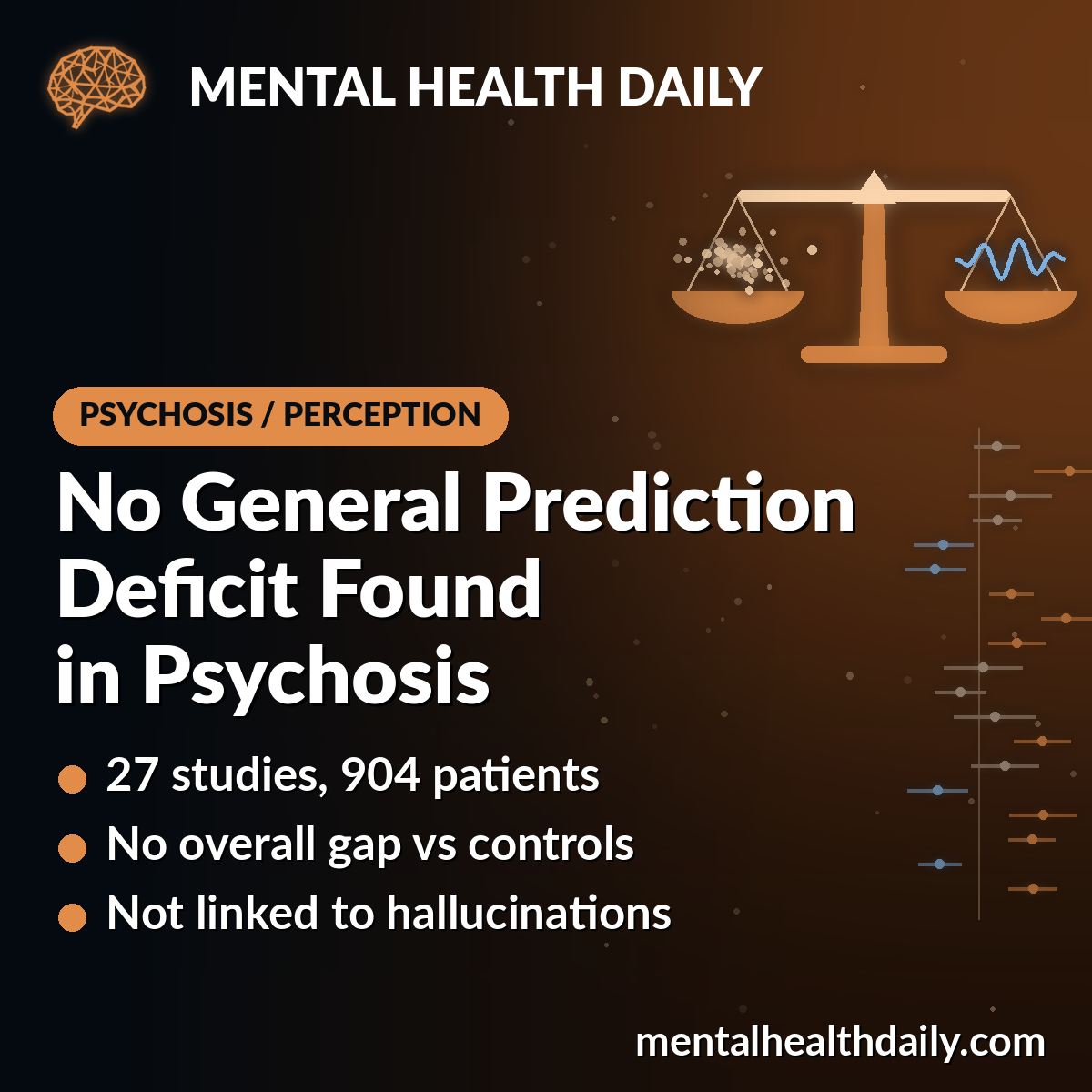
One of the most popular ideas about psychosis says the brain leans too hard, or not hard enough, on its own expectations when it builds a picture of the world. A 2026 meta-analysis of 34 results from 27 studies found no general difference: across perception tasks, people with schizophrenia-spectrum psychosis relied on their expectations about as much as healthy controls did (Hedges’ g = 0.03, 95% CI −0.27 to 0.34).1
Expectation strength was also not linked to how severe people’s hallucinations or delusions were. Individual studies still pointed in both directions, so the finding argues against a single across-the-board shift, not against every version of the theory.
Research Highlights
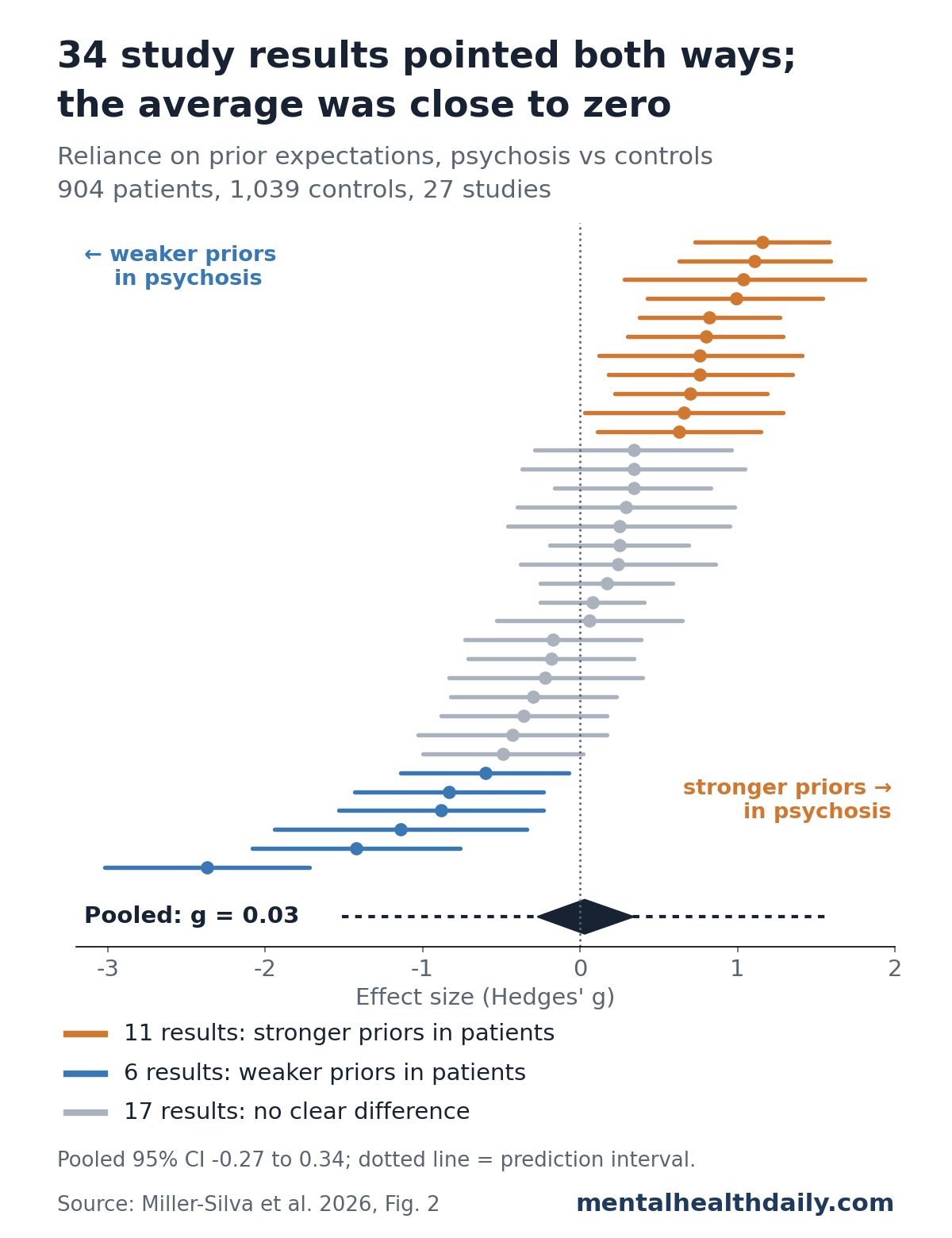
- No overall difference: across 904 patients and 1,039 controls, the pooled effect was g = 0.03 (95% CI −0.27 to 0.34; p = .818), essentially zero.1
- Studies disagreed sharply: in the paper’s forest plot, 11 results showed stronger reliance on expectations in patients, 6 showed weaker reliance, and 17 showed no clear difference.1
- Not linked to symptoms: expectation strength did not track hallucinations (r = 0.04; 370 patients) or delusions (r = −0.16; 183 patients).1
- The “two-level” fix did not work: splitting tasks into low-level perceptual and higher-level cognitive expectations did not explain the disagreement (p = .758).1
- Small studies, varied tasks: only 1 included study had more than 50 patients, and the tasks ranged from hearing voices in noise to judging motion and tilted lines.1
Priors: The Brain’s Best Guess Before the Evidence Arrives
Perception is partly guesswork. Your brain combines what your senses report with what it already expects to find. Those expectations are called priors. They are why a half-heard word in a noisy room usually comes through as the right word, and also why some visual illusions work.
The predictive processing theory of psychosis proposes that this balance is off in people with schizophrenia and related disorders. There are 2 main versions:
- Priors too strong: expectations override the senses, so a person hears a voice that is not there. A 2017 study found that people who hear voices, with or without a psychosis diagnosis, were more likely to “hear” a tone they had learned to expect after it was paired with a checkerboard pattern. Computer modeling of their responses showed they weighted their expectations more heavily than the actual sound.2
- Priors too weak: other studies report the opposite, that people with psychosis lean less on their expectations than controls do.1
A third idea tries to reconcile the 2. Weak low-level (perceptual) priors could trigger compensating strong high-level (cognitive) beliefs, with the weak perceptual priors driving unusual perceptions and the strong cognitive priors driving delusions.1 A 2026 review in Nature Mental Health describes this tension between “top-down” and “bottom-up” accounts and calls for standardized tasks and long-term studies.3
The problem is that most of the evidence comes from single tasks in small samples, and the results conflict. Some studies report stronger priors in psychosis, others weaker, others no difference.1
How the Cambridge Team Pooled the Studies
Chantal Miller-Silva, Graham Murray, and colleagues at the University of Cambridge preregistered their plan and searched 4 databases for studies published from 2005 to October 2024. They screened 2,898 articles and kept 33 studies. Of those, 34 results from 27 studies had the data needed for the main analysis.1
- Who: adults with schizophrenia-spectrum psychosis, including first-episode psychosis, vs healthy controls. People at high risk of psychosis, and psychosis caused by drugs or neurological disease, were excluded.
- Which tasks: only behavioral perception tasks that deliberately created an expectation, for example telling people a voice might be hidden in noise, or repeatedly pairing a sound with an image. Brain-imaging measures, learning and memory tasks, and illusion tasks without a direct expectation manipulation were left out.
- How: each result was converted to Hedges’ g, a standardized difference where 0 means no gap between groups and positive values mean patients relied more on their priors. A three-level model accounted for studies that contributed more than 1 result.
The patients averaged about 35 years old, about 70% were men, and their average PANSS total symptom score was 61. Patients with active and remitted symptoms were combined.1
Result: No Overall Difference in Reliance on Expectations
Pooled across all 34 results, patients and controls did not differ (g = 0.03, 95% CI −0.27 to 0.34; p = .818). The expectation manipulations themselves worked in the individual studies; no overall difference was detected in how much the groups were swayed.1
That average hides a lot of disagreement. Individual results ran from g = −2.37 (much weaker priors in patients) to g = 1.16 (much stronger). About 70% of the variation reflected real differences between studies rather than chance (I² = 70.37%). The prediction interval, the range where a new study’s result would likely fall, ran from −1.51 to 1.58. In plain terms, the next study could find stronger, weaker, or no difference.1
The result held up in several checks. Removing the most extreme study, removing a study rated at high risk of bias, and removing the 2017 conditioning study did not change the conclusion, and there was no clear sign of small-study bias (Egger’s test p = .082).1
Expectations Were Not Linked to Hallucinations or Delusions
A theory of psychosis should explain its symptoms. The team ran separate analyses within patients:1
- Hallucinations: 10 results, 370 patients. Correlation r = 0.04 (95% CI −0.28 to 0.36; p = .780).
- Delusions: 6 results, 183 patients. Correlation r = −0.16 (95% CI −0.51 to 0.19; p = .293).
- Overall positive symptoms: an exploratory check using PANSS positive scores across 22 results and 527 patients found no effect (p = .84).
These symptom analyses rest on fewer studies and mixed rating scales, so they are weaker than the main comparison. Still, none of them points toward the link the theory predicts.
Splitting Priors Into Perceptual and Cognitive Did Not Resolve the Conflict
The team tested the reconciling idea directly. They coded 21 results as testing perceptual priors (automatic, low-level expectations, such as a sound learned to go with a flash) and 13 as testing cognitive priors (explicit beliefs, such as being told a voice is likely). Neither type differed between patients and controls:1
- Perceptual priors: g = −0.01 (95% CI −0.41 to 0.40)
- Cognitive priors: g = 0.08 (95% CI −0.48 to 0.65)
The 2 groups of tasks did not differ from each other either (p = .758). Perceptual priors were not linked to hallucinations, and cognitive priors were not linked to delusions. The authors point out that researchers often disagree on which label a given task deserves, and a 2-level split is likely too crude for what the theory describes as a graded hierarchy.1
What the Finding Leaves Open
The authors say plainly that the result does not rule out a role for altered prediction in psychosis. What it argues against is a general shift that shows up across many kinds of perception. Several leads remain:1
- Voice detection: 3 studies that asked people to detect voices in noise found stronger reliance on expectations in patients. Even there, links to symptoms varied, and it is unclear whether the bias causes hallucinations or follows from having them.
- Uncertainty: group differences may depend on how noisy or ambiguous the sensory signal is. Two motion studies with similar designs found opposite results, and one used an ambiguous stimulus while the other used motion hidden in noise.
- Other kinds of priors: one study found patients over-relied on expectations about how many things they would see, but not about whether 2 signals came from the same source.
- Illness phase and medication: too few studies existed to compare active with remitted illness or to separate medication effects.
The finding also does not mean perception or thinking in psychosis is typical in every respect. It covers one specific question, how much people lean on a deliberately induced expectation, in the kinds of tasks included here.
Limitations
- Very different tasks pooled together: the authors themselves say a single average is likely an inadequate summary for such varied research.
- Small studies: only 1 study included more than 50 patients, and most studies used a single task.
- Wide uncertainty: the confidence interval still allows a small difference in either direction, and the symptom analyses were based on 4 to 8 studies each.
- Measurement: outcomes ranged from reaction times to response bias to model-based measures, and some effects may reflect something other than expectation use, such as a preference for sounds over visual cues.
Why It Matters
Predictive processing has been floated as a basis for cognitive therapies and for digital tools that might flag relapse early. This meta-analysis is a caution against building on a general deficit. A single task showing strong or weak priors in a small group should not be generalized to “psychosis.” The authors call for larger studies that give the same patients several different tasks and follow them across episodes of illness.1
For people living with psychosis, nothing here changes treatment. It does push back on a tidy story often told about psychosis: that hallucinations and delusions come from one simple imbalance between expectation and evidence.
References
- Miller-Silva C, Illingworth BJG, Martey K, Mujirishvili T, de Beer F, Siskind D, Murray GK. No evidence for a generalised predictive processing deficit in psychosis: a meta-analysis. Psychological Medicine. 2026;56:e268. doi:10.1017/S0033291726105455
- Powers AR, Mathys C, Corlett PR. Pavlovian conditioning–induced hallucinations result from overweighting of perceptual priors. Science. 2017;357:596–600. doi:10.1126/science.aan3458
- Goodwin I, Diederen KMJ, Hird EJ, et al. Predictive processing accounts of psychosis: bottom-up or top-down disruptions. Nature Mental Health. 2026;4:60–84. doi:10.1038/s44220-025-00558-5