
A 15-session inhibitory control training game did not lower anxiety, worry, low mood, or rumination in 8- to 11-year-olds at school, compared with a matched control game. Children got better at the game itself, but that skill did not carry over to untrained tests.1
Research Highlights
- The trial: 123 children in Years 4 and 5 at four schools in Queensland, Australia, were randomly assigned to a Go/No-Go training game (62) or a control game without the stopping demand (61). Published in PLOS One in September 2026.1
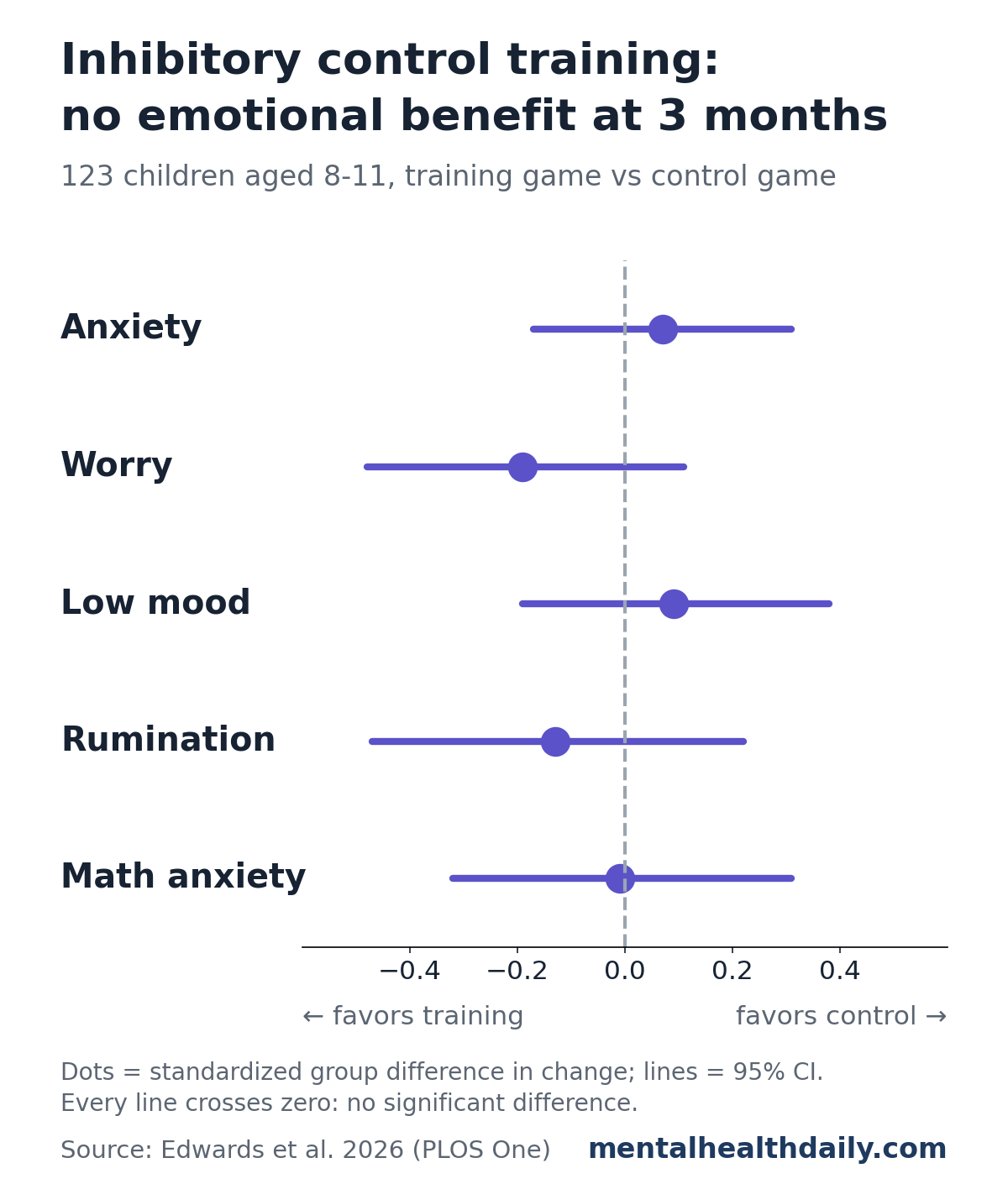
- No emotional benefit: anxiety, worry, low mood, rumination, and math anxiety did not change differently between groups after training or at 1- and 3-month follow-ups.1
- No math benefit: math scores rose in both groups over the school term, with no extra gain from training.1
- An unexpected dip: the training group scored worse than before on several untrained thinking tests, while the control group held steady.1
- Consistent with a larger trial: a 2024 study of 235 children found that response-inhibition training did not change mental health, academic achievement, or brain measures.2
What Inhibitory Control Training Is Supposed to Do
Inhibitory control is the ability to stop an automatic response, like holding back from pressing a button or from following a familiar habit. It is one of the brain’s core executive functions, the mental skills used to plan, focus, and switch between tasks.
Anxious people tend to have a harder time pulling their attention away from worrying thoughts. The idea behind this training is simple: strengthen stopping power with practice, and children may get better at setting worries aside before anxiety takes hold.1
Schools are an appealing place to try this. A short daily game reaches every child in a class, costs little, and avoids the waitlists and stigma that come with one-on-one therapy.
How the School Trial Worked
Both groups played a game with the same story: an explorer who wakes a dragon and must collect treasure while fleeing across a different country each day. Children played about 10 minutes a day on iPads for 15 school days, supervised by teachers.1
- Training game (62 children): press the spacebar for each pile of gold, but hold back when a green gem is hidden in the pile. Green normally means “go,” so stopping took real effort. The pace sped up or slowed down based on each child’s accuracy.
- Control game (61 children): press the spacebar whenever a diamond appeared. Same story, rewards, screen time, and number of trials, but no need to stop a response.
Neither the children, their parents, nor their teachers knew which game was the “real” one. Researchers tested anxiety, worry, low mood, rumination (dwelling on negative thoughts), math anxiety, math skills, and three thinking skills before training, right after it, and 1 and 3 months later.1
This was a universal prevention trial, meaning children were not picked for having symptoms. At the start, 16 of the 123 children (13%) scored above the cutoff for elevated anxiety and 24 (20%) for elevated depression.1
Anxiety and Mood Did Not Change More With Training
The training group did learn the game. Their rate of mistaken presses on “stop” trials fell across sessions, while error rates in the control game stayed flat.1
That learning did not reach the outcomes that mattered. For every emotional measure, change over time did not differ significantly between groups at any follow-up. In the anxiety model, no group or time effect reached significance (all p-values above .071).1
Math achievement told the same story. Scores on the Woodcock-Johnson math tests rose in both groups by the 3-month follow-up, as children kept getting regular math lessons, but the training group gained no more than the control group.1
That null result came despite a real link at the start: children with better inhibitory control had higher math scores (r = 0.21 to 0.35). The connection exists, but this training did not use it.1
Trained Children Did Worse on Untrained Thinking Tests
The researchers also checked whether the training improved inhibitory control on a different Go/No-Go task (a “Whack a Mole” game), plus two other executive functions: shifting (switching between sorting rules) and updating (keeping track of letters in a working memory task).1
None improved. Instead, several scores dropped in the training group while the control group stayed stable:
- Inhibitory control: performance on the untrained Go/No-Go task fell from baseline to the 1-month follow-up in the training group (p < .001), with no significant change in controls.
- Updating: working memory performance fell in the training group at all three follow-ups (p ≤ .001 each), again with no change in controls.
- Shifting: the groups also differed over time, but the training group’s individual declines did not survive correction for multiple tests.
The authors think the training game may have been too demanding. Weeks of avoiding costly mistakes could have taught children to play it safe, which then slowed them down on speeded tests that rewarded quick answers.1 That is their interpretation; the trial was not designed to test it.
Results showed the same overall pattern when the analysis was limited to the 96 children who completed at least 11 of the 15 sessions.1
How This Fits With Other Brain-Training Studies in Children
Evidence on inhibitory control training for kids’ emotions is mixed, and the larger trials with active control games lean toward no benefit.
- Against: a larger trial trained 235 children aged 6 to 13 for 8 weeks. Gains on closely related control tasks lasted a year, but training had no effect on mental health, academic achievement, decision-making, or brain structure and function.2
- For: a smaller study in 8- to 12-year-olds found that 4 weeks of computerized inhibitory control training reduced anxiety compared with a waitlist.3 A waitlist control does not match the time, attention, and expectations of playing a game, which an active control like the one in the new trial does.
Together, the results suggest that children can get better at a stopping game, but turning that skill into calmer, happier children is much harder.
Limitations of the Trial
The pre-registered design, matched control game, and blinding make this a well-built trial. A few points still shape what it can show:
- Little room to improve. Most children had low symptoms at the start, so a prevention effect would be hard to see. Children with high anxiety might respond differently.
- Small effects could be missed. The study was sized to detect small-to-moderate effects. The authors describe the result as evidence against moderate benefits, not proof of zero effect.
- Uneven starting anxiety. The training group began with lower anxiety scores than the control group (25.9 vs. 33.5 on a 0-to-114 scale), a difference that just missed significance (p = .051).
- Missed sessions. About 22% of children completed fewer than 11 sessions, and those children reported more worry at baseline.
- One program, short follow-up. Results apply to this 15-session game, tested in four schools in one region of Australia, and followed for 3 months.
What This Means for Parents and Schools
A short brain-training game is not a reliable way to prevent anxiety or low mood in typical 8- to 11-year-olds. In this trial, it did not help emotions or math, and it did not even improve stopping skills outside the game.
For children with ongoing anxiety, worry, or sadness, established support such as a school counselor, pediatrician, or child mental health professional remains the place to start. The authors suggest future trials try longer or better-calibrated training in children who already have symptoms or weaker inhibitory control.1
References
- Edwards EJ, Chu KL, Carroll A, Ross E, Hoorelbeke K, De Clercq A. Evaluating the effects of inhibitory control training as a universal prevention strategy for internalizing complaints in middle childhood. PLOS One. 2026;21(9):e0358051. doi:10.1371/journal.pone.0358051
- Ganesan K, Thompson A, Smid CR, et al. Cognitive control training with domain-general response inhibition does not change children’s brains or behavior. Nature Neuroscience. 2024;27(7):1364–1375. doi:10.1038/s41593-024-01672-w
- Shanok NA, Meltzer K, Frank C, Lugo V, Jones NA. Computerized inhibitory control training reduces anxiety in preadolescent students. Applied Neuropsychology: Child. 2022;11(3):455–470. doi:10.1080/21622965.2021.1884984 (PubMed)