
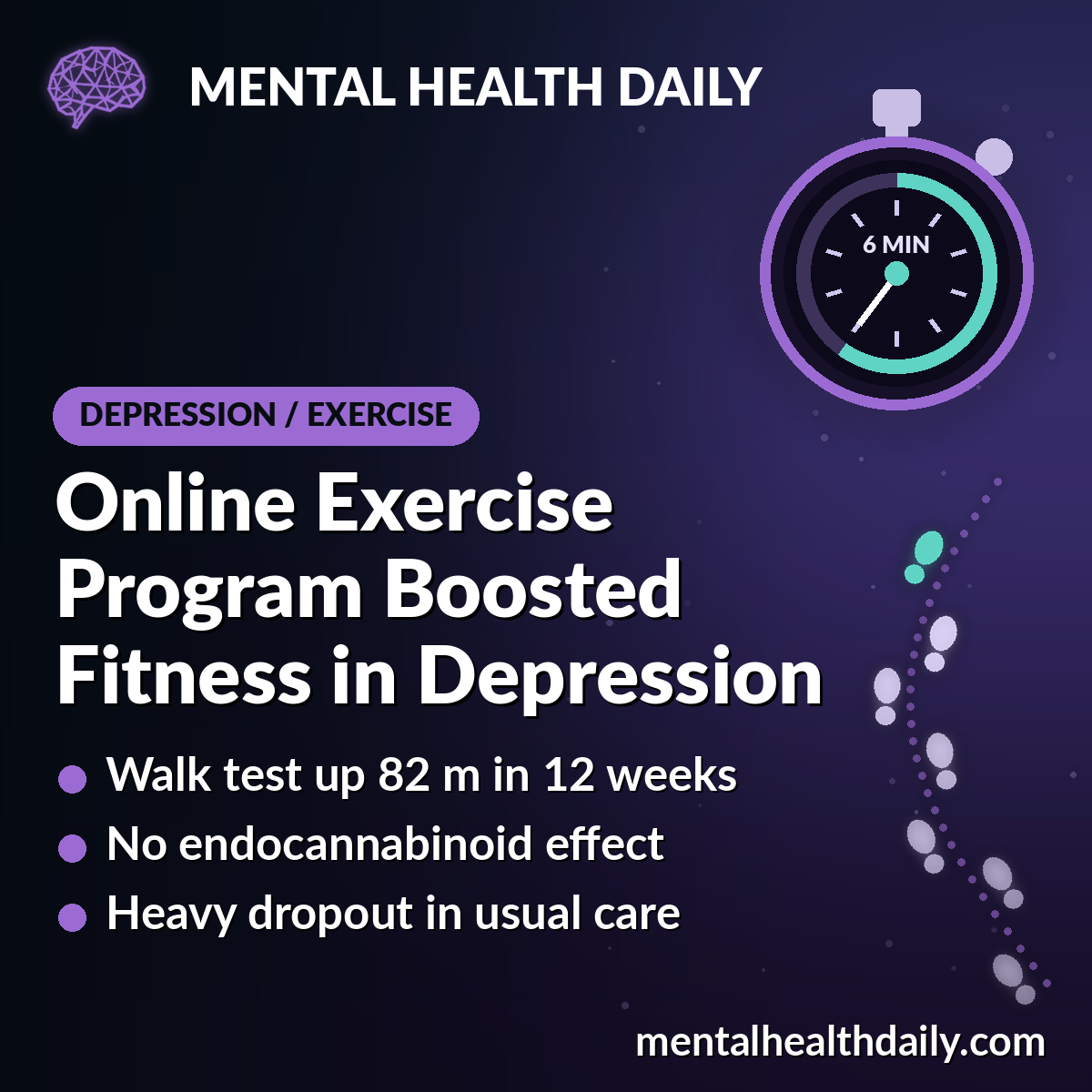
A 12-week online program that combined home exercise with internet-based cognitive behavioral therapy (iCBT) made adults with mild-to-moderate depression noticeably fitter. In a Spanish randomized trial of 80 people, the program group walked 81.6 meters farther on a 6-minute walking test after 12 weeks than at the start, while the usual-care group barely changed.1
The trial’s other main question came up empty. Blood levels of 2-AG, one of the body’s own cannabis-like signaling molecules called endocannabinoids, fell by about the same amount in both groups, so the program showed no specific effect on it.
Research Highlights
- Fitness improved: walking distance rose 81.6 meters in the exercise-plus-iCBT group by 12 weeks, while usual care barely changed (group difference p = 0.001).1
- No endocannabinoid effect: neither 2-AG (p = 0.844) nor anandamide (p = 0.306), the 2 main endocannabinoids, changed differently between groups.1
- Both groups’ 2-AG dropped: by 1.62 ng/mL with the program and 1.44 ng/mL with usual care, a shift the authors attribute to time rather than treatment.1
- Uneven dropout: 72.5% of the program group but only 37.5% of the usual-care group completed all assessments.1
- No mood data here: this paper reports fitness and blood markers only; the trial’s depression results are reported separately.14
What the SONRIE Trial Tested
SONRIE enrolled adults aged 25 to 65 who had a psychiatrist’s diagnosis of mild-to-moderate depression and were being treated at a public mental health service in Puerto Real, Spain. The analyzed participants averaged about 49 years old, 87% were women, and most were taking antidepressants. The 80 participants were randomly split into 2 arms of 40:1
- Exercise plus iCBT: 3 exercise sessions a week for 12 weeks, one led live online by an exercise specialist and 2 done at home from recorded videos. Each session mixed balance work, strength moves such as squats, lunges and push-ups, and dance and step routines, at a “somewhat hard” effort. Alongside this, participants worked through 18 video-guided iCBT modules based on the Unified Protocol, a CBT program for a range of emotional disorders, covering negative thoughts, emotions, breathing techniques and scheduling rewarding activities.
- Usual care: ordinary treatment at the mental health service, with no structured exercise or iCBT and no contact from the research team beyond the 3 assessments. This group was offered the program after the trial.
Participants were tested at the start, at 12 weeks, and again 8 weeks after the program ended. Fitness was measured mainly with the 6-minute walking test, which records how far someone can walk as fast as possible in 6 minutes on a flat course; it is a standard measure of cardiorespiratory (heart and lung) fitness. The team also measured 9 endocannabinoids and related molecules in fasting blood samples.
Why Look at Endocannabinoids?
The endocannabinoid system is a signaling network that acts on the same receptors as cannabis compounds and helps regulate mood, stress, pain and inflammation. Its 2 best-known messengers are anandamide (AEA) and 2-arachidonoylglycerol (2-AG). Both were primary outcomes in this analysis, alongside the walking test.1
There is a reason to expect a link with exercise. In a 2019 study of 17 women with major depression, a single 20-minute session of moderate-intensity cycling raised blood anandamide, and people whose anandamide rose more reported bigger short-term improvements in mood.3 SONRIE asked a different question: whether 12 weeks of training shifts resting endocannabinoid levels, measured in the morning after an overnight fast.
Walking Distance Rose by About 80 Meters
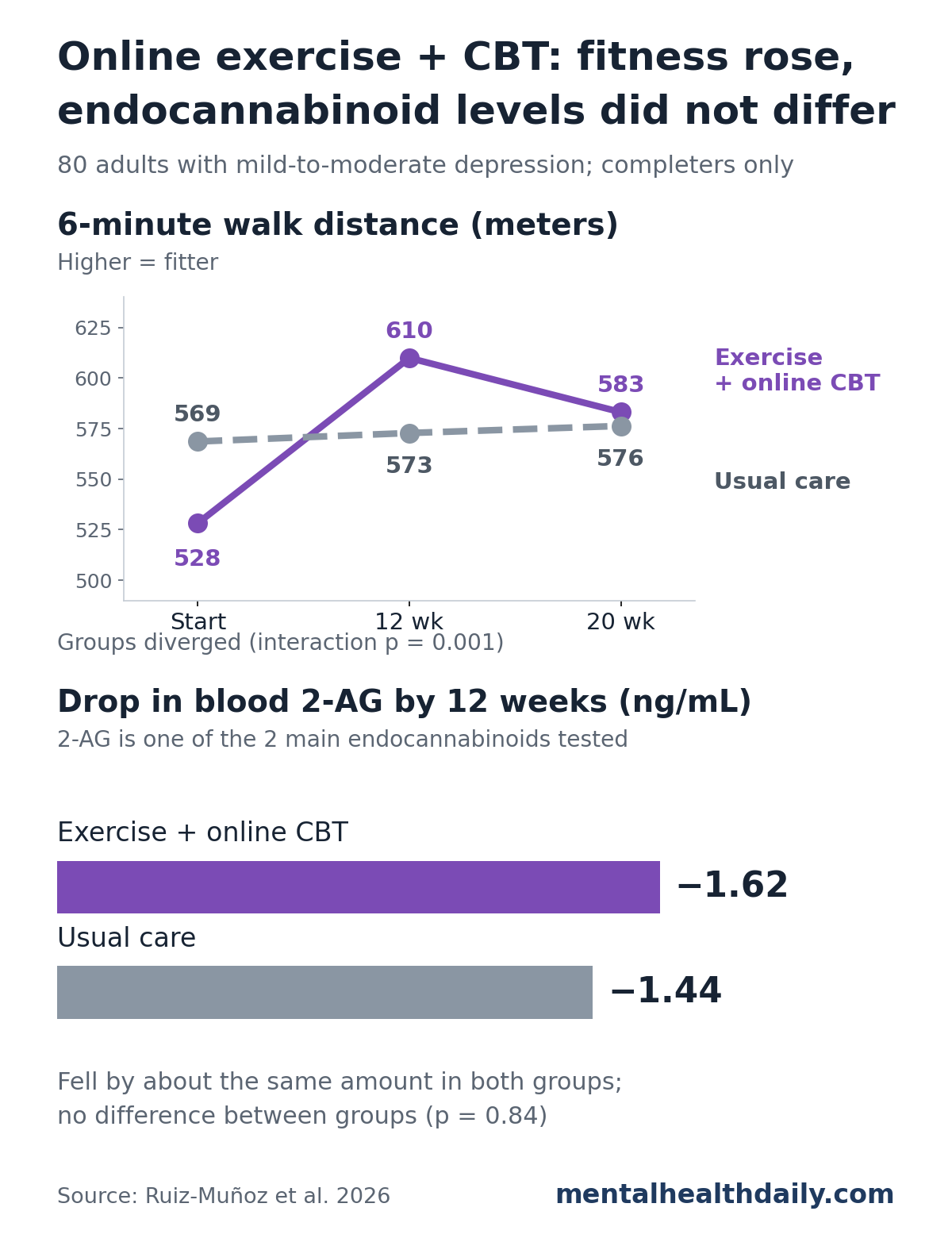
The program group started at an average of 528 meters, reached 610 meters at 12 weeks, and was still at 583 meters 8 weeks after the program stopped. The usual-care group went from 569 to 573 meters and then 576 meters, with no significant change at any point.1
- Size: the program group gained 81.6 meters, while usual care gained about 4 meters
- Statistics: the groups’ paths differed significantly (p = 0.001), and the result held after correcting for the 3 primary tests
- After the program: the program group kept 54.8 meters of its gain at the 8-week follow-up, about two-thirds of it
The strength tests told a quieter story. Grip strength, chair stands, and a standing jump did not change differently between groups. An arm-curl test came close (p = 0.065), mostly because the usual-care group declined at follow-up rather than because the program group improved.1
One detail matters for reading the walking result: the program group started about 40 meters behind the usual-care group. Part of its gain may be catch-up, although the program group ended well ahead of where the usual-care group finished.
2-AG Fell in Both Groups
None of the 9 endocannabinoid measures changed differently between the groups, and the mixed-model analysis that included everyone with any data reached the same conclusion.1
- 2-AG: fell from start to 12 weeks in both groups (program −1.62 ng/mL, 95% CI −2.48 to −0.76; usual care −1.44 ng/mL, 95% CI −2.34 to −0.53), then partly rebounded
- Anandamide: stayed roughly stable in both groups
- Related molecules: 2 closely related molecules (2-LG and 2-OG) also fell in both groups; the other 5 showed no group differences
Because the drops were matched, they say nothing about the program itself. The authors list several possible causes: regression to the mean (levels may have been unusually high at recruitment because of stress or diet), seasonal and behavior changes during a trial that overlapped with COVID-19 restrictions, and the effects of repeated fasting blood draws.1
The null result is consistent with longer-term training studies in healthy adults that found no change or decreases in resting endocannabinoids, while single exercise sessions tend to raise them briefly.13 Blood levels also may not reflect what happens in the brain, and the trial was only large enough to detect very big differences, so a modest biomarker effect cannot be ruled out.
How This Fits With Exercise for Depression
Exercise has solid support as a depression treatment on its own terms. A 2016 meta-analysis of 25 randomized trials found a large effect of exercise on depressive symptoms, with the strongest results for moderate-intensity aerobic exercise supervised by professionals.2
SONRIE adds evidence that a mostly online, mostly home-based program can build real fitness in people with depression, for whom low energy and access barriers can make regular exercise hard to sustain. Participants attended a median of 28 of 36 exercise sessions, and the only side effect logged was short-lived muscle soreness in 6 people during the first 2 weeks. Side effects were recorded informally rather than with a structured checklist.1
This paper does not show whether participants felt less depressed. The parent trial’s primary outcome was the Beck Depression Inventory, and those results are reported separately.14 Because the program combined exercise and iCBT, it also cannot say which part did what.
Limitations
- Uneven dropout: only 15 of 40 usual-care participants completed all biomarker and fitness assessments, compared with 29 of 40 in the program group, partly due to COVID-19 restrictions and missed blood samples. The authors call the fitness gain an upper-bound estimate.
- Small samples: the walking analysis included 26 program and 13 usual-care completers, enough to detect only very large effects.
- Usual-care comparison: the control group received no attention-matched activity, and participants knew their group, although the people doing the testing did not.
- Narrow sample: 87% women, almost all Spanish, all with mild-to-moderate depression.
- Reporting inconsistencies: one table value for 2-AG does not match the text or figure, and the paper describes the 81.6-meter gain both as the program group’s change and as the difference between groups (by the table averages, the difference is closer to 77 meters). Neither issue changes the main findings.
For people with depression, the practical takeaway is modest and clear: a structured online exercise program with CBT support improved fitness over 12 weeks. Anyone starting an exercise plan while being treated for depression can raise it with their care team; in this trial the program was added to standard treatment, not used in place of it.
References
- Ruiz-Muñoz M, Jiménez-Pavón D, Garrido-Palomino I, Escudier-Vázquez JM, Valmisa Gómez de Lara EJ, España-Romero V. Effects of an internet-based combined exercise and cognitive-behavioral therapy intervention on endocannabinoid system biomarkers and physical fitness in adults with mild-to-moderate depression: a SONRIE randomized controlled trial. European Archives of Psychiatry and Clinical Neuroscience. 2026;276:3701–3714. doi:10.1007/s00406-026-02330-x
- Schuch FB, Vancampfort D, Richards J, Rosenbaum S, Ward PB, Stubbs B. Exercise as a treatment for depression: a meta-analysis adjusting for publication bias. Journal of Psychiatric Research. 2016;77:42–51. doi:10.1016/j.jpsychires.2016.02.023
- Meyer JD, Crombie KM, Cook DB, Hillard CJ, Koltyn KF. Serum endocannabinoid and mood changes after exercise in major depressive disorder. Medicine & Science in Sports & Exercise. 2019;51(9):1909–1917. doi:10.1249/MSS.0000000000002006
- Escudier-Vázquez JM, Ruiz-Muñoz M, Garrido-Palomino I, et al. Internet-based psycho-physical exercise intervention program in mild-to-moderate depression: the study protocol of the SONRIE randomized controlled trial. International Journal of Environmental Research and Public Health. 2025;22(4):540. doi:10.3390/ijerph22040540