
Older adults with an intellectual disability can join ordinary local clubs and stay there when someone smooths the way in. In a 2026 randomized feasibility trial of a mentoring program called MATILDA, all 25 people who started were matched to a mainstream community group, and 17 of them (68%) were still going a year later.1 The trial was built to test whether the program and a larger trial could work, so it says little yet about whether MATILDA eases anxiety or loneliness.
Research Highlights
- Most people stayed in their groups: of 25 people who started MATILDA, 18 (72%) were still attending their community group at 6 months and 17 (68%) at 12 months.1
- Everyone found a group: all 25 were matched to a group such as a walking group, Men’s Shed, or singing group, and 23 had at least one named mentor.1
- Recruitment was middling: 57 of 95 people approached joined the trial (60%), which falls in the “amber” band of the trial’s own protocol.14
- Anxiety scores fell more with MATILDA, untested: the average Glasgow Anxiety Scale score dropped from 20.7 to 16 with MATILDA and from 19.6 to 18.2 in the control group over 12 months, with no statistical test.1
- Loneliness and quality of life barely differed: loneliness scores fell to the same average in both groups.1
Why Community Groups for Older Adults With Intellectual Disability
People with an intellectual disability are living longer, but they tend to show signs of aging earlier, often from around age 45. Many spend their social lives inside disability services, with few friends outside them, and loneliness is common.1 A 2018 systematic review brought together the evidence on how often people with intellectual and developmental disabilities feel lonely and what has been tried to help.5
The usual fix has been befriending, where a volunteer meets one person regularly. The trouble is that the friendship can end when the volunteer leaves. MATILDA (Managing Activities Together to Involve older adults with a Learning Disability in their Local Areas) tries something more durable: it places the person inside an existing mainstream club, where a whole group of people can become part of their life.1
How the MATILDA Program Worked
MATILDA is a UK adaptation of Australia’s “Transition to Retirement” program. It ran for 6 months, on top of usual care:1
- Matching: a paid volunteer coordinator got to know each person’s interests, health, finances, living situation, and transport, then found a nearby club that fit
- Mentors: one or two regular club members agreed to act as mentors after a 2- to 3-hour training session
- Gradual handover: the coordinator went along to the group for 3 to 12 weeks, then stepped back over 5 to 26 weeks, depending on the person
The control group received usual care plus three group outings with other older adults with an intellectual disability, such as a meal, a museum trip, or the cinema.1
The 57 participants were aged 45 to 81 (average 56.7), had a mild or moderate intellectual disability, lived in the community, and could give their own consent. Just over half lived in supported living. They were recruited in Northern Ireland (33) and London (24), and 28 were randomly assigned to MATILDA and 29 to the control group. Two people in the MATILDA group died and one withdrew before the program began, leaving 25 who started.1
Most People Were Still Attending Their Groups After a Year
All 25 were placed in a group: art and crafts, walking groups, church bowls, an evening social club, a Lego club, Men’s Sheds, coffee mornings, and a singing group among them. Twenty-three were paired with at least one named mentor. In the other two cases, the club preferred not to single out one mentor, and the whole group offered support instead. Both of those men were still attending weekly at 12 months.1
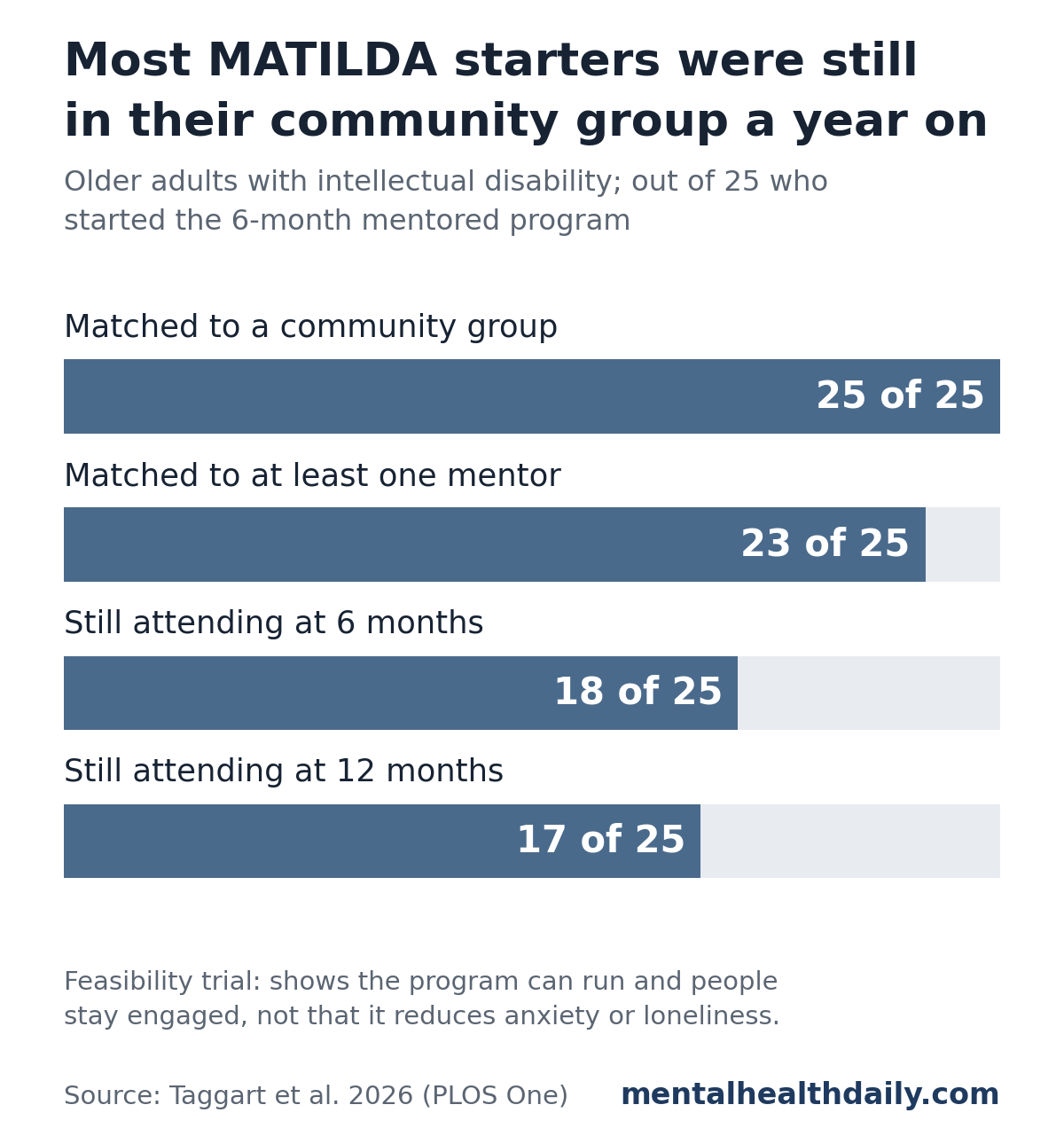
Attendance records showed 18 of 25 (72%) still going at 6 months and 17 of 25 (68%) at 12 months, six months after the program formally ended. The sites differed: in Northern Ireland, 12 of 13 were still attending at both points, while in London it was 6 of 12 at 6 months and 5 of 12 at 12 months.1
Several people went further. According to the coordinators’ records and focus groups, 12 of 17 regular attenders also took up other social activities with their groups, such as garden center trips, luncheon clubs, bingo, and the theater, and some picked up new skills like knitting, indoor bowls, and woodwork. One mentor described a participant who now comes along “under his own steam and is an active part of the club.”1
The result is consistent with the Australian program MATILDA was based on. In that study, which compared 29 mentored participants with a matched (not randomized) comparison group, 25 of the 29 (86%) attended their community group weekly for at least 6 months.2 It also contrasts with a UK pilot randomized trial of one-to-one volunteer befriending for adults with an intellectual disability and depressive symptoms, which aimed for at least 35 participants but recruited 16, and matched only 6 with a volunteer.3
What Got in the Way
Matching people to groups was the slowest step. The team planned on 2 to 4 weeks, but it took up to 12 weeks, mostly because suitable clubs had to be found, checked, and briefed.1
- Finding willing clubs in London: of 82 older people’s groups contacted, 51 were unsuitable, many because they had merged or closed after the COVID-19 pandemic. Of the 31 eligible, 13 declined. In Northern Ireland, 28 of 30 groups agreed.
- Worries about “risk”: some clubs saw the program as a burden, were short-staffed or full, or feared a change to group dynamics. The authors note that some overestimated the risk of including someone with an intellectual disability, and needed reassurance about liability and insurance.
- Poor fits: 4 people asked to switch groups because theirs felt “too old,” “boring,” or “not very posh,” or clashed with day center or college. Three were rematched.
- Support staff and transport: 3 people stopped attending because staff at their supported living service could no longer take them. One participant paid £20 in taxi fares to get to the group and back.
Anxiety and Loneliness Results Are Early Numbers
The trial also collected anxiety, loneliness, well-being, and quality of life scores, but only to check whether the questionnaires worked. They were summarized as averages, with no statistical tests.1
- Anxiety: on the Glasgow Anxiety Scale for people with an intellectual disability (scored 0 to 54, where 13 or more suggests anxiety), average scores went from 20.7 to 18.1 to 16 over 12 months with MATILDA, and from 19.6 to 17.1 to 18.2 in the control group. Spread within each group was wide, with standard deviations of about 8 to 11 points.
- Loneliness: the “aloneness” score fell in both groups to the same average of 2.3 at 12 months.
- Well-being and quality of life: scores changed little and looked similar across groups. One quality-of-life area, the environment domain, dipped in the MATILDA group at 12 months (from 4.1 to 3.4), which the paper does not discuss.
The authors say plainly that these numbers “should not be interpreted as evidence of intervention efficacy.”1 The abstract’s description of MATILDA as promoting quality of life and well-being goes further than the table supports.
Participants themselves handled the questionnaires well: 52 of 57 (91%) gave follow-up data at 6 months, using easy-read versions. Mentors did not. Only 2 mentors completed baseline questionnaires, 8 at 6 months, and 4 at 12 months, even after the forms were shortened.1
Did the Trial Meet Its Own Bar for a Full Trial?
The authors conclude that MATILDA met its progression criteria and a full trial can go ahead.1 The paper does not score each criterion, but the published protocol sets out a traffic-light system (red, amber, green) for five of them.4 Checked against the reported numbers:
- Engagement of at least 60% of the MATILDA group: green, with 18 of the 28 randomized participants (64.3%) still attending at 6 months; the reported 72% uses the 25 who started
- Retention of participants at follow-up: green, at 91% at 6 months
- Recruitment of people approached: amber, at 60% (57 of 95), below the 70% green line
- Mentor matching, measures, and retention: the protocol sought at least 2 mentors for at least 60% of the intervention arm, but the trial reported only matching to at least 1 mentor. Few mentors returned questionnaires, and mentor retention was not reported
A full trial looks reasonable for the participant side of the program, with mentor data collection needing a rethink. The protocol also notes that moving to a definitive trial would depend on signs of efficacy as well as the green criteria.4
Limitations
- Small and not powered: 57 people, with 25 starting the program, at two UK sites. The study was not designed to detect differences in anxiety or loneliness.
- No blinding: participants, mentors, and the researchers who collected outcome data all knew who was in which group.
- Uneven comparison: the control group had three outings, while the MATILDA group had 6 months of regular contact and support.
- Who took part: 86% were White, all had a mild or moderate intellectual disability, and all could consent for themselves, so results may not apply to people with more severe disabilities.
- Reporting slips: the flow diagram shows the planned numbers (64, split 32 and 32) rather than the actual 57; one loneliness baseline appears as 3.2 in the text and 3.8 in the table; and 12-month losses are described as both three and four people.
Three participants died suddenly during the study, two before starting the program and one in the control group. The authors judged these deaths unrelated to the intervention.1
What It Means
MATILDA shows that with a skilled coordinator and willing clubs, older adults with an intellectual disability can become regular members of mainstream community groups, and most keep going after formal support ends. Whether that membership lowers anxiety or loneliness is the question a larger randomized trial now has to answer. For families and services, the practical lessons are already clear: allow more time for matching, plan transport, and make sure support staff are on board.
References
- Taggart L, Campbell A, Doherty I, et al. Implementing the MATILDA intervention to enhance community participation for older adults with intellectual disability: a feasibility randomised controlled trial and RE-AIM guided process evaluation. PLOS One. 2026;21(9):e0341940. doi:10.1371/journal.pone.0341940
- Stancliffe RJ, Bigby C, Balandin S, Wilson NJ, Craig D. Transition to retirement and participation in mainstream community groups using active mentoring: a feasibility and outcomes evaluation with a matched comparison group. Journal of Intellectual Disability Research. 2015;59(8):703–718. doi:10.1111/jir.12174
- Ali A, McKenzie E, Hassiotis A, et al. A pilot randomised controlled trial of befriending by volunteers in people with intellectual disability and depressive symptoms. Journal of Intellectual Disability Research. 2021;65(11):1010–1019. doi:10.1111/jir.12886
- Taggart L, Hassiotis A, Ryan A, et al. A feasibility RCT protocol of the MATILDA intervention to support older adults with intellectual disability to improve their health and social networks. Pilot and Feasibility Studies. 2026;12(1):42. doi:10.1186/s40814-026-01780-3
- Alexandra P, Angela H, Ali A. Loneliness in people with intellectual and developmental disorders across the lifespan: a systematic review of prevalence and interventions. Journal of Applied Research in Intellectual Disabilities. 2018;31(5):643–658. doi:10.1111/jar.12432