
Almost every older adult treated for depression at a large Chinese psychiatric hospital had at least one prescription that the US Beers criteria flag as potentially inappropriate after age 65. China’s own criteria flagged about two in three.1
Research Highlights
- 92.7% vs. 65.1%: of 3,155 outpatients aged 65 and older with depression, 2,925 had at least 1 flagged drug under the 2023 Beers criteria and 2,055 under the 2017 Chinese criteria.1
- Same top drug on both lists: quetiapine was the most common flag under both checklists, followed by benzodiazepines such as clonazepam and estazolam and the sleep drug zolpidem.1
- Antidepressants drove much of the gap: Beers flagged 14 different antidepressants, including common SSRIs and SNRIs, while the Chinese criteria flagged 3.1
- Who got flagged most: women, people taking more medications, and people with sleep disorders had higher odds of a flag under both checklists.1
- Flags, not measured harm: the study counted prescriptions that matched a checklist; it did not track falls, side effects, or how patients did afterward.1
If you or a family member takes any of these drugs: do not stop or change a medication on your own. Several of them, including antidepressants and benzodiazepines, can cause withdrawal or relapse if stopped suddenly. Bring the list to the prescriber or a pharmacist and ask for a medication review.
What “Potentially Inappropriate Medication” Means for Older Adults
A potentially inappropriate medication (PIM) is a drug whose risks for an older person may outweigh its benefits, especially when a safer option exists. Aging changes how the body clears drugs, and older adults are more likely to fall, get confused, or take several interacting medicines at once.
Clinicians use explicit checklists to spot these drugs quickly. Jiang et al. applied 2 of them side by side:
- 2023 AGS Beers criteria: the American Geriatrics Society’s list for adults 65 and older, used in outpatient, hospital, and long-term care settings worldwide.2 Besides drugs to avoid, it has a “use with caution” category, and all SSRIs and SNRIs (the most common first-line antidepressants) sit in it because of links to low blood sodium, falls, fractures, and bleeding.1
- 2017 Chinese criteria: a China-specific list developed by Chinese geriatric medicine societies. It has no separate caution category and does not flag most SSRIs, but it does flag some drugs Beers does not, such as the blood thinner clopidogrel.1
Neither checklist is a prescription rule. A flag means the drug deserves a closer look for that person, and the researchers state plainly that a Beers flag on an antidepressant calls for monitoring, not stopping guideline-recommended treatment.1
92.7% Flagged Under Beers vs. 65.1% Under the Chinese Criteria
The researchers pulled every eligible outpatient record from Tongde Hospital of Zhejiang Province, a provincial psychiatric center in Hangzhou, between October 2024 and September 2025.1
- Patients: 3,155 adults aged 65+ with a documented depression diagnosis and at least 1 prescription
- Average age: 74.2 years; 21.7% were 80 or older
- Sex: 67.5% women
- Medication load: median of 2 drugs; 13.2% took 5 or more
- Common other conditions: sleep disorders (35.7%) and anxiety disorders (32.3%)
Two clinical pharmacists checked every flagged prescription by hand to weed out false positives.1
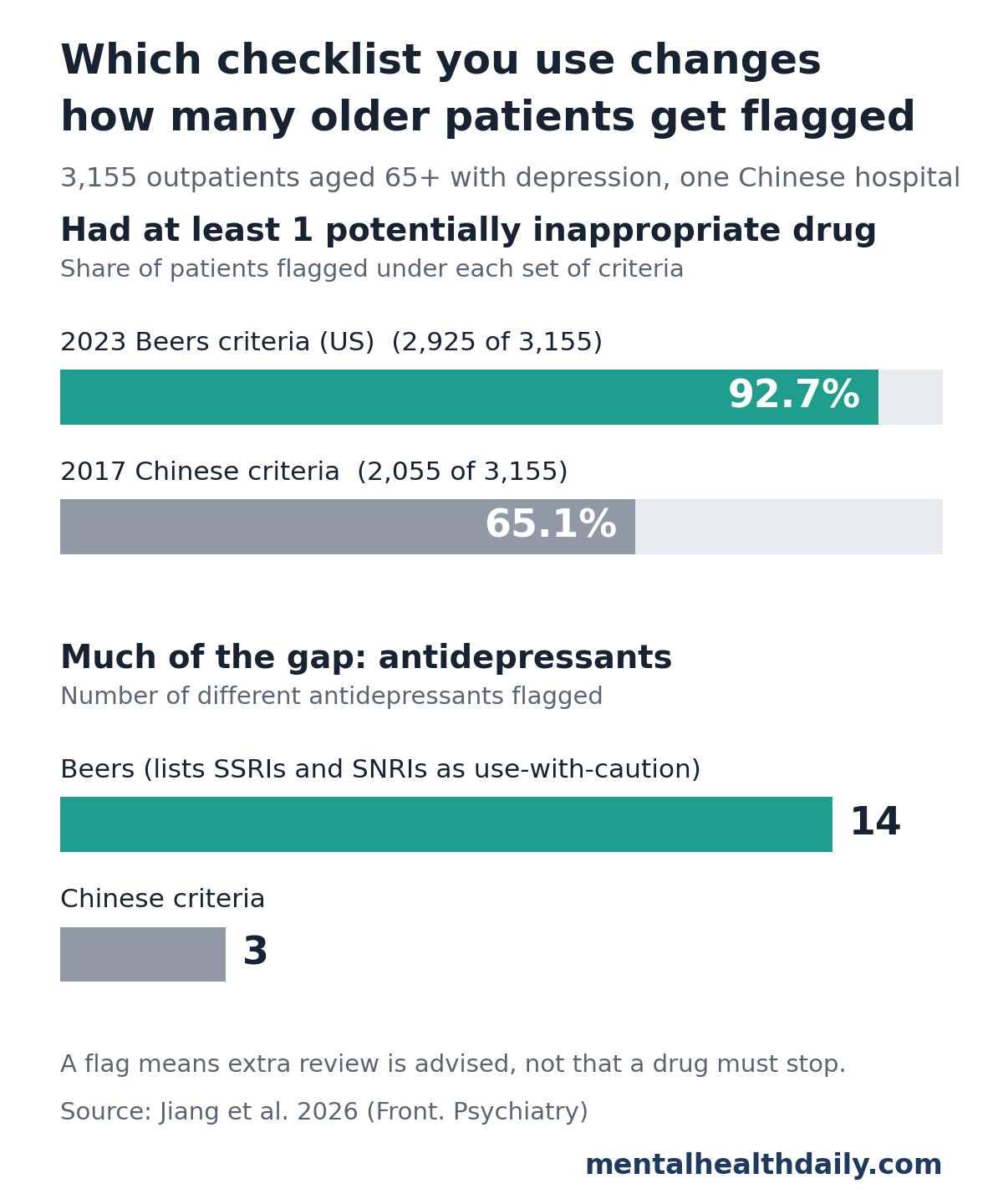
The 27.6-point gap mostly reflects how the 2 lists are built. Beers counts SSRIs such as escitalopram and sertraline and SNRIs such as venlafaxine, which are standard depression treatments, so a patient taking one of these common antidepressants picks up a Beers flag.1
Beers also produced more flags per person. Under Beers, 170 patients (5.4%) had 4 or more flagged drugs, compared with 13 (0.4%) under the Chinese criteria.1
Quetiapine, Benzodiazepines and Sleep Drugs Topped Both Lists
Quetiapine accounted for 11.4% of all Beers flags and about 22% of all Chinese-criteria flags. The most common flagged drugs were:1
- Beers: quetiapine, escitalopram, sertraline, zolpidem, clonazepam, venlafaxine, mirtazapine, estazolam, paroxetine, olanzapine
- Chinese criteria: quetiapine, zolpidem, clonazepam, estazolam, olanzapine, lorazepam, clopidogrel, alprazolam, fluoxetine, fluvoxamine
Quetiapine is an antipsychotic. In older adults with depression it is used as an add-on when an antidepressant has not worked, and in low doses as an off-label sleep aid. Both checklists flag antipsychotics because trials, mostly in people with dementia, linked them to stroke, cognitive decline, and higher death rates.1
Benzodiazepines (clonazepam, estazolam, lorazepam, alprazolam) and the related sleep drug zolpidem calm the brain by boosting the inhibitory chemical GABA. Both checklists warn against them in older adults because of falls, fractures, and memory and thinking problems.1
These sleep-related drugs line up with the patients’ problems: more than a third had a diagnosed sleep disorder, and sleep problems are common in later-life depression.1
Women, More Medications and Sleep Problems Were Linked to More Flags
An adjusted odds ratio (aOR) compares the odds of having a flagged drug between groups after accounting for age, sex, number of drugs, and other conditions. A value above 1 means higher odds.1
- Sleep disorders: aOR 1.79 under Beers and 3.67 under the Chinese criteria, the strongest link in the Chinese model
- More prescribed medications: aOR 2.43 (Beers) and 2.51 (Chinese); more drugs simply give more chances for one to be on a list
- Female sex: aOR 1.57 (Beers) and 1.44 (Chinese)
The researchers point out that older women have higher rates of anxiety, insomnia, and depression, which are common reasons to prescribe benzodiazepines and antipsychotics.1
Heart disease and stroke: coronary heart disease was linked to lower odds under both checklists (aOR 0.29 Beers, 0.57 Chinese). Ischemic stroke went in opposite directions: lower odds under Beers (aOR 0.27) and higher under the Chinese criteria (aOR 1.70).1
The researchers traced the stroke split to clopidogrel. Many stroke survivors take clopidogrel, which only the Chinese list flags. When they added SSRI and SNRI flags to the Chinese criteria and removed clopidogrel, the stroke association pointed the same way under both.1
Other Studies Also Found High PIM Rates in Late-Life Depression
Earlier studies also found high rates, with the exact figure depending on the setting and the checklist:
- China, 90 hospitals: Tian et al. applied the Chinese criteria to 40,516 outpatient prescriptions for older adults with depression across 7 cities and found 50.4% contained a PIM. Their top flags were also benzodiazepines (alprazolam, clonazepam, lorazepam, estazolam) and olanzapine.3
- Spain, 12,272 patients: Infante-Ventura et al. followed adults over 65 taking antidepressants for depression and found PIM rates of 73% to 89%, depending on the criteria. The more PIMs people had, the higher their risk of not sticking with antidepressant treatment.4
The Hangzhou rate under the Chinese criteria (65.1%) sits above the multicenter figure, though Tian et al. counted prescriptions rather than patients. The researchers also note that their specialist psychiatric center sees more complex cases, treated with more psychiatric drugs, than the broader mix of hospitals in the multicenter study.1
Limits of This Single-Hospital Records Study
A cross-sectional records review can show how common flagged prescriptions were and who had them. It cannot show whether those drugs caused harm or whether switching would have helped.
- No outcomes: there was no follow-up, so falls, side effects, hospital stays, and depression response were not measured.
- Missing kidney data: the Beers category for drugs that need dose changes with reduced kidney function was left out, so the true Beers rate may be higher.
- No severity or frailty data: depression severity, frailty, and memory problems were not recorded, and sicker patients may need more medications.
- No indication details: the records could not show why each drug was prescribed or whether alternatives had already failed.
- One specialist center: results may not apply to primary care or to other countries.
- Checklists differ by design: Beers includes caution-level drugs that the Chinese list does not, so the two rates measure different things.
One small inconsistency: the paper reports 1,013 patients with 2 Beers-flagged drugs as 31.20%, while that count works out to 32.1% of 3,155. The headline rates are unaffected.1
What This Means for Older Adults Taking Depression Medication
- A flag is a reason for review. SSRIs and SNRIs remain standard depression treatments, and the researchers note that for moderate to severe depression their benefits can outweigh the risks.1
- Sleep medications deserve a closer look. Benzodiazepines, zolpidem, and low-dose quetiapine for sleep were among the most common flags, and insomnia has non-drug treatments such as CBT for insomnia.
- More medications, more checks. The researchers recommend prioritizing medication reviews for people on several drugs, women, and anyone with a sleep disorder.1
- Talk before changing anything. Stopping antidepressants or benzodiazepines abruptly can cause withdrawal symptoms or a return of depression. Any change should be planned with the prescriber.
References
- Jiang H, Zhou X, Feng P, et al. Potentially inappropriate medications in older outpatients with depression: a cross-sectional study comparing the Beers criteria and the Chinese criteria. Frontiers in Psychiatry. 2026;17:1915277. doi:10.3389/fpsyt.2026.1915277
- American Geriatrics Society Beers Criteria Update Expert Panel. American Geriatrics Society 2023 updated AGS Beers Criteria for potentially inappropriate medication use in older adults. Journal of the American Geriatrics Society. 2023;71(7):2052–2081. doi:10.1111/jgs.18372
- Tian F, Chen Z, Zhang Y, et al. Prevalence and factors with potentially inappropriate prescribing among older outpatients with depression: a multicenter study across China. Journal of Global Health. 2025;15:04216. doi:10.7189/jogh.15.04216
- Infante-Ventura D, Rodríguez-Díaz B, Luis AA, et al. Potentially inappropriate medications and treatment adherence in older adults with depressive disorder: a population-based cohort study. International Psychogeriatrics. 2026:100189. doi:10.1016/j.inpsyc.2026.100189 (PubMed)