

When adults aged 50 and older were asked to worry about their own real concerns inside a brain scanner, women showed more activity than men in visual and emotional brain areas. Once they were asked to reframe those worries, the sex difference disappeared.1
Research Highlights
- Who was studied: 131 adults aged 50 and older (81 women, 50 men) at the University of Pittsburgh, recruited across the full range from mild to severe worry. The report is a medRxiv preprint posted in September 2026, not yet peer reviewed.1
- Women’s brains responded more to worry: stronger activity showed up in visual and imagery areas and in deeper emotion and memory hubs, including the amygdala and hippocampus.1
- No difference during reframing: men and women showed similar brain activity while reappraising their worries, and they lowered their worry ratings by similar amounts.1
- Men suppressed more: men reported more habitual emotional suppression (16.0 vs. 12.8 points) and lower worry ratings in the scanner, although overall worry and anxiety scores were similar.1
- Reframing was linked to less worry: people who habitually reappraised had lower everyday worry scores, for both sexes.1
Why Researchers Studied Worry in Older Women and Men
Women report more worry than men at every stage of life, and generalized anxiety disorder (GAD), whose core symptom is persistent, hard-to-control worry, is more common in older women. In later life, severe worry has also been linked to heart disease, stroke and dementia risk.1
Most earlier brain-imaging studies of sex differences in emotion and anxiety involved younger people. The Pittsburgh team wanted to see whether older women and men handle worry differently in the brain.1
How the Worry Task Worked
Before the scan, each person wrote at least 16 personal worry statements and, with an interviewer, at least 8 matching reappraisal statements. A worry might be “Worry about your husband’s health,” and its reappraisal “Your husband has an excellent medical team.”1
Inside a functional MRI (fMRI) scanner, which tracks blood flow as a stand-in for brain activity, participants spent 20 minutes reading 3 kinds of statements:
- Worry statements (16 blocks), drawn from their own lists
- Reappraisal statements (8 blocks), each shown right after its paired worry
- Neutral facts (10 blocks), such as “There are 26 letters in the alphabet”
Each statement stayed on screen for 25 seconds, followed by 10 seconds of resting on a fixation cross. Participants rated their worry from 1 to 5 during every block.1
Women Showed More Activity in Visual and Emotional Brain Areas
The team compared men and women in two ways. Worry vs. neutral statements isolates what is special about worrying, beyond simply reading. On that comparison, women had more activity in 4 regions:1
- Left middle occipital gyrus and right cuneus: parts of the visual cortex
- Left precuneus: an area involved in mental imagery, memory and thinking about oneself
- Cerebellum, on both sides
Worry vs. resting on the cross captures the whole worry response. Here women had more activity in deeper structures: the putamen and pallidum (on both sides), plus the left hippocampus, amygdala, two parts of the thalamus and the superior temporal gyrus.1
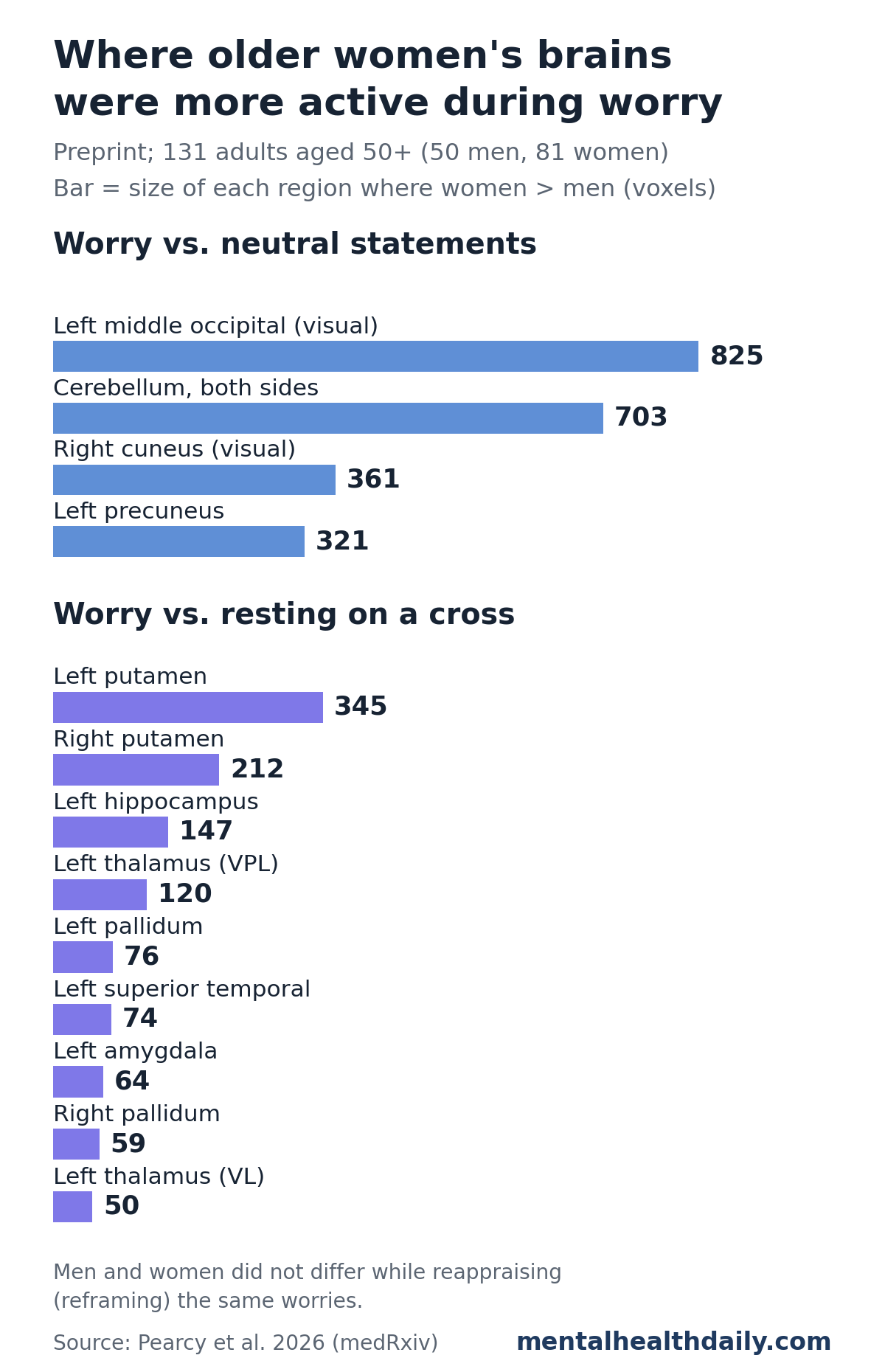
The authors read the visual findings as a sign that women lean more on mental imagery when they worry. The deeper structures handle threat, emotional memory and relaying signals, and the team links them to the sticky, hard-to-shake quality of severe worry.1
Reframing Worries Looked the Same in Both Sexes
None of the comparisons involving reappraisal showed a sex difference. Women and men also lowered their worry ratings by similar amounts when they moved from a worry to its reappraisal (p = 0.68).1
The authors conclude that the sex difference lies in how worry gets started, while the ability to calm it looked the same.1
Men Suppressed Emotions More, but Worried About as Much
On questionnaires, men and women had similar scores for everyday worry, anxiety and rumination (dwelling on problems). The clear exception was expressive suppression, hiding or holding back emotions, which men reported using more (16.0 vs. 12.8 points).1
- Lower worry in the scanner: men rated their worry lower during the worry blocks.
- Mostly among mild worriers: both differences came mainly from people with lower everyday worry scores and did not appear among high worriers.
- Reframers worried less: people who habitually reframed their emotions had lower everyday worry scores (p < 0.001, adjusted for age and sex), while habitual suppression was not linked to worry.
One finding runs against intuition. More activity in the putamen and right pallidum during worry was linked to lower everyday worry scores, and activity in the right pallidum and parts of the thalamus went with more suppression.1
Exploratory Clues About Reappraisal and the Amygdala
In extra analyses the authors label exploratory, habitual reappraisal related to the brain differently in each sex:1
- Men: more reappraisal was linked to lower amygdala activity during worry.
- Women: more reappraisal was linked to greater activity in the left precuneus and left visual cortex.
The male pattern is consistent with a 2008 fMRI study in younger adults. When men and women reappraised upsetting pictures, they felt similarly better, but men showed bigger drops in amygdala activity and smaller increases in prefrontal activity.2
What This Could Mean for Treating Late-Life Anxiety
Reappraisal is a core skill in cognitive behavioral therapy (CBT). A 2024 Cochrane review of 21 trials in adults 55 and older found low-certainty evidence that CBT reduces anxiety, worry and depression more than minimal care right after treatment, with little to no difference in anxiety 3 to 6 months later.3 As the Pittsburgh authors note, whether sex changes how well CBT works is still an open question.1
The Pittsburgh team suggests that therapy using visual imagery might suit older women with anxiety. That is a hypothesis for future trials. This study did not test any treatment.1
Limitations
- Preprint. The paper has not been peer reviewed, and its banner says it should not guide clinical practice.
- One snapshot in time. The design cannot tell whether the differences are built-in traits, a response to this task, or the result of decades of different worry habits.
- Modest size. The authors call 131 people a modest sample, and the sex-specific reappraisal findings rest on smaller subgroups.
- Narrow sample. All participants came from one site, and about 81% were White.
- Other differences between groups. Women scored higher than men on several memory and language tests, which were not included as adjustments in the brain-region models.
References
- Pearcy LB, Costa AP, Karim HT, Tudorascu DL, Andreescu C. Sex differences in neural activity during worry induction and reappraisal in late life. medRxiv (preprint, not peer reviewed). Posted September 16, 2026. doi:10.64898/2026.09.10.26362647
- McRae K, Ochsner KN, Mauss IB, Gabrieli JJD, Gross JJ. Gender differences in emotion regulation: an fMRI study of cognitive reappraisal. Group Processes & Intergroup Relations. 2008;11(2):143–162. doi:10.1177/1368430207088035
- Hendriks G-J, Janssen N, Robertson L, et al. Cognitive behavioural therapy and third-wave approaches for anxiety and related disorders in older people. Cochrane Database of Systematic Reviews. 2024;7:CD007674. doi:10.1002/14651858.CD007674.pub3