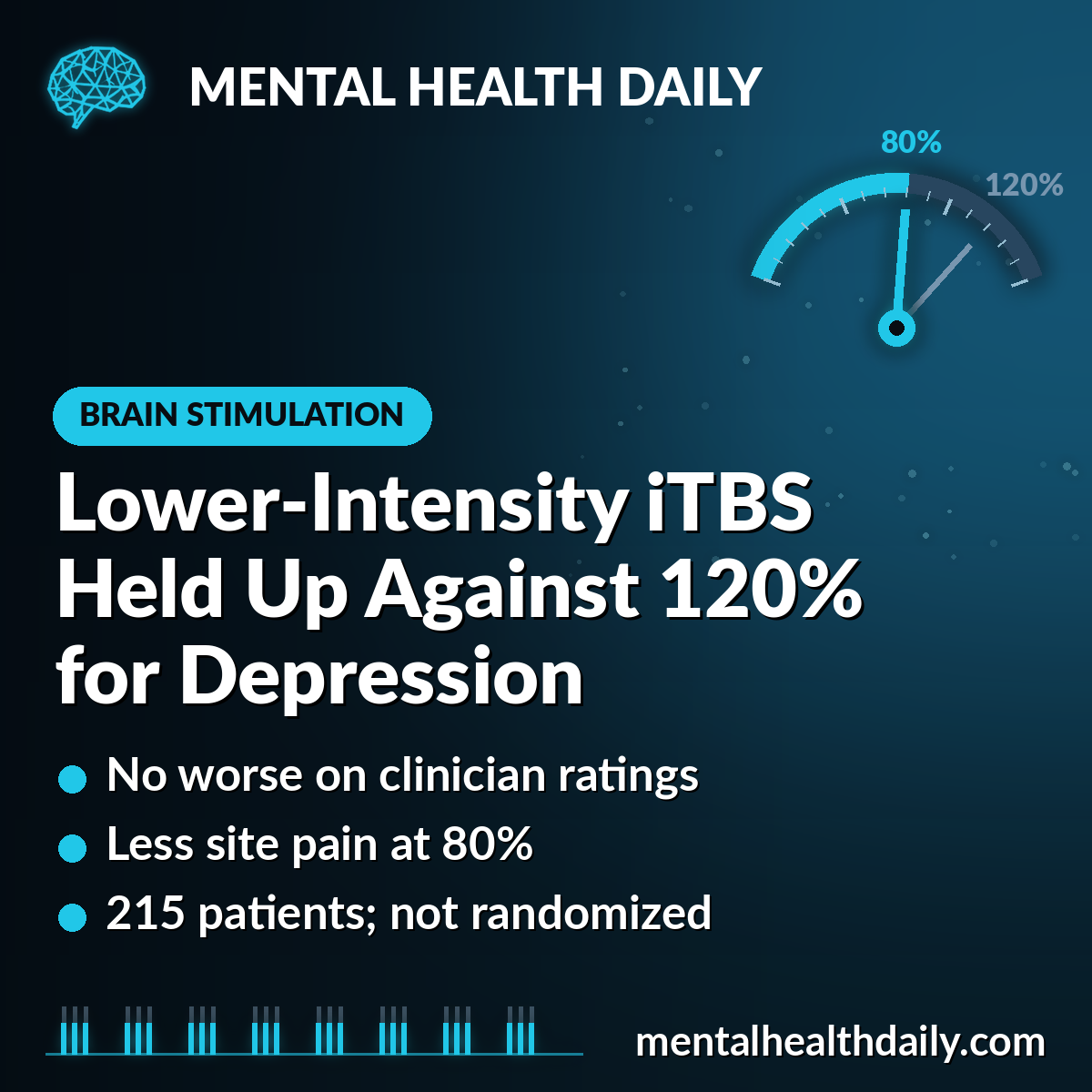
Turning theta burst stimulation down from 120% to 80% of the motor threshold did not make it less effective on a clinician-rated depression scale. In records from 215 patients at a German university clinic, the lower-intensity group finished treatment 0.90 points lower on the Hamilton scale after adjusting for starting severity (95% CI −2.61 to 0.82), well inside the preset margin for “no worse.”1
The comparison was not randomized. The clinic switched intensities at the start of 2025, so the two groups were treated in different years, and the higher-intensity group also got more pulses on average. That makes this a useful real-world check on a question with surprisingly little direct testing, though it does not settle the best dose.
Research Highlights
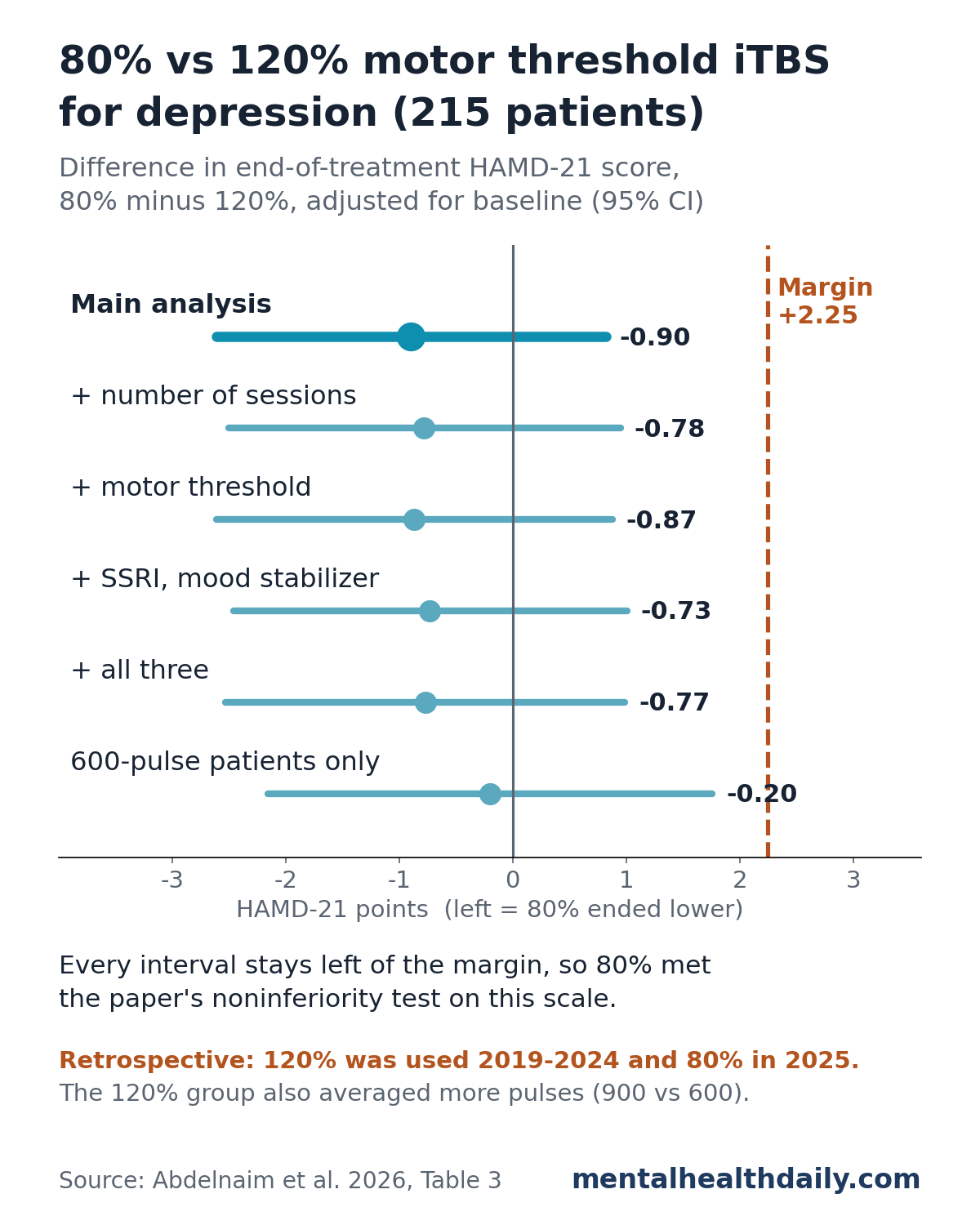
- 80% met the noninferiority test: adjusted end-of-treatment HAMD-21 scores were 12.7 at 80% vs 13.6 at 120%, a difference of −0.90 points (95% CI −2.61 to 0.82) against a 2.25-point margin.1
- Held up in every sensitivity check: adding sessions, motor threshold, or medication to the model, or keeping only 600-pulse patients, left every upper confidence bound between 0.88 and 1.76 points.1
- Similar response and remission: HAMD-21 response was 38% at 80% vs 31% at 120%, and remission 24% vs 26%; neither gap was significant.1
- Self-ratings leaned the other way: on the patient-rated MDI, the 120% group ended 2.28 points lower after adjustment (95% CI −0.47 to 5.03), not a significant difference.1
- Less site pain at 80%: 5 patients at 120% had painful stimulation that forced a lower setting, vs none at 80%. Overall side effects were 21% vs 28%, not a significant difference.1
What 80% and 120% of Motor Threshold Mean
Intermittent theta burst stimulation (iTBS) is a fast form of transcranial magnetic stimulation (TMS). A coil on the scalp delivers bursts of 3 magnetic pulses, 5 bursts a second, in 2-second trains separated by 8-second pauses. A standard 600-pulse session takes just over 3 minutes, compared with about 37 minutes for classic 10 Hz TMS.12
Clinics set the strength of those pulses for each patient using the resting motor threshold (RMT): the lowest stimulator output that, applied over the motor cortex, makes a relaxed finger muscle twitch measurably in about half of attempts. Treatment is then given at a percentage of that number over the depression target, the left dorsolateral prefrontal cortex. At 120% RMT, the pulses are stronger than the twitch threshold; at 80%, they are weaker.
Both settings are in common use. The landmark THREE-D trial used 120%, while international TBS safety guidance lists 80% to 100%.12 Higher settings tend to hurt more at the stimulation site, so if lower intensity works just as well, patients have a reason to prefer it.
How the Regensburg Clinic Compared the Two Intensities
Mohamed Abdelnaim and colleagues at the University of Regensburg went back through the records of every patient with unipolar or bipolar depression who completed a course of left-sided iTBS between April 2019 and November 2025 with depression ratings before and after treatment.1
- 120% group (108 patients): treated 2019 to 2024, when the clinic’s protocol moved from 600 to 1,200 to 1,800 pulses per session, including a 1-week accelerated schedule of 5 sessions a day in 2024. Average 900 pulses per session.
- 80% group (107 patients): treated in 2025, all at 600 pulses per session, over 1 week (accelerated) or 4 weeks.
- Who: inpatients and outpatients referred after an insufficient response to earlier treatment; about 90% had unipolar depression. Average age was 47 in the 80% group and 45 in the 120% group.
- Outcomes: the clinician-rated 21-item Hamilton Depression Rating Scale (HAMD-21) and the self-rated Major Depression Inventory (MDI), both measured at the start and end of treatment.
Allocation depended only on when someone was treated. The groups were never treated side by side, and there was no sham condition.
80% Intensity Passed the Noninferiority Test on the Hamilton Scale
Both groups improved a lot. HAMD-21 scores fell from 21.1 to 13.1 at 80% and from 19.8 to 13.3 at 120%, and the MDI dropped by 11 to 13 points in each group. A standard time-by-group analysis found no significant difference between intensities on either scale.1
Finding no significant difference does not show two treatments are equally good, so the authors also ran a noninferiority test. It asks whether the new option is no worse than the reference by more than a set amount, called the margin. Here the margin was 2.25 HAMD points, the same one THREE-D used to show iTBS was not worse than 10 Hz TMS.12 If the upper end of the confidence interval for the 80%-minus-120% difference sits below 2.25, lower intensity passes.
It passed comfortably. The main estimate favored 80% by 0.90 points, and the worst plausible case was 0.82 points in favor of 120%. That result held after adjusting for number of sessions, motor threshold, and antidepressant or mood stabilizer use, and in the subset treated with the same 600 pulses per session.1
The self-rated scale was less tidy. On the MDI, patients in the 120% group ended at 20.6 vs 23.5 in the 80% group (p = .055), and the adjusted gap was 2.28 points in favor of 120% (95% CI −0.47 to 5.03). MDI remission was 31% at 120% vs 23% at 80%, again not significant. No margin exists for the MDI, so the authors treated it as supporting evidence only, but it is the one place where the numbers tilted toward the higher setting.1
Tolerability: Fewer Painful Sessions at 80%
Side effects were mostly mild. At least one side effect was reported by 22 of 107 patients at 80% (21%) and 30 of 108 at 120% (28%), a difference that was not statistically significant (p = .217). Headache was the most common complaint in both groups (18 vs 16 patients).1
One complaint split cleanly: 5 patients at 120% (4.6%) found the stimulation site painful enough that staff had to lower the intensity, while no one at 80% did. That is a small count, but it is consistent with THREE-D, where people rated iTBS at 120% slightly more painful than 10 Hz TMS (3.8 vs 3.4 out of 10).12
Why the Era and Pulse Differences Matter
The authors are direct about the main weakness: intensity changed at a single point in time, so it cannot be fully separated from everything else that changed with it.1
- Different years: staff experience, referral patterns, and routine care all shift over 6 years.
- Different doses: the 120% group averaged 900 pulses per session vs 600, and fewer of them had the accelerated schedule (5 vs 22 patients). The 600-pulse sensitivity check removes the pulse gap but not the time gap.
- Different medication mix: more of the 120% group took SSRIs (42 vs 24) and mood stabilizers (19 vs 9). Adjusting for these did not change the result.
- Borrowed margin: 2.25 points came from THREE-D, which used the 17-item Hamilton scale and was powered in advance for that test. Here it was applied to records already collected.
- No sham, no follow-up: the study cannot separate stimulation from placebo effects or from other treatment, and it says nothing about how long improvement lasted.
- Completers only: patients without both before and after ratings were left out.
The same Regensburg group previously compared 600, 1,200, and 1,800 pulses per session in 215 patients and found no significant difference in HAMD-21 or MDI improvement between them.5 That study covered patients treated from 2021 to 2024, during the 120% years, and it makes the pulse gap a smaller concern than the gap in treatment years.
How It Fits With Randomized Evidence on TBS Intensity
The closest randomized test points the same way. An Australian trial of 300 patients with treatment-resistant depression compared accelerated bilateral TBS at 80% or 120% of motor threshold with standard 10 Hz TMS. Response and remission did not differ across the 3 arms, and response at the two TBS intensities was not significantly different (p = 0.319).3 The new study’s authors add that 4 people (3.9%) left that trial’s 120% arm because they could not tolerate the stimulation, vs none at 80%.1
A 2024 network meta-analysis of 23 randomized TBS trials (960 people) found left-sided iTBS beat sham on response, symptom improvement, and remission. It tested percent motor threshold among its possible moderators, and the Regensburg authors report that none of the moderators, intensity included, was linked to response.14
Put together, the result is consistent with the randomized data: across the usual 80% to 120% range, intensity does not look like the main driver of benefit. One likely reason, which the authors discuss, is that motor threshold is measured over the motor cortex, while the prefrontal target usually sits deeper and at a distance that varies from person to person, so the dose actually reaching it can differ from what the percentage suggests.1
What This Means for People Considering iTBS
- Lower intensity is a reasonable option to discuss. This study and the randomized 80% vs 120% trial found similar results, and in both the lower setting was easier to tolerate.
- It is not a new standard yet. The authors call for prospective trials that vary intensity while holding pulses and schedule constant. Until then, dose remains a clinical judgment.
- Pain is a fair thing to raise. If stimulation is hard to tolerate, asking whether a lower setting is appropriate is supported by this evidence.
- Keep the scale in mind. Clinicians’ ratings favored 80% slightly; patients’ own ratings favored 120% slightly. Neither difference was significant.
References
- Abdelnaim MA, Reissmann A, Kerkel K, et al. Theta burst stimulation with 80 and 120% resting motor threshold do not differ in their antidepressant efficacy: a retrospective analysis. European Archives of Psychiatry and Clinical Neuroscience. 2026. doi:10.1007/s00406-026-02384-x
- Blumberger DM, Vila-Rodriguez F, Thorpe KE, et al. Effectiveness of theta burst versus high-frequency repetitive transcranial magnetic stimulation in patients with depression (THREE-D): a randomised non-inferiority trial. Lancet. 2018;391:1683–1692. doi:10.1016/S0140-6736(18)30295-2
- Chen L, Thomas EHX, Kaewpijit P, et al. Accelerated theta burst stimulation for the treatment of depression: a randomised controlled trial. Brain Stimulation. 2021;14(5):1095–1105. doi:10.1016/j.brs.2021.07.018
- Kishi T, et al. Theta burst stimulation for depression: a systematic review and network and pairwise meta-analysis. Molecular Psychiatry. 2024;29(12):3893–3899. doi:10.1038/s41380-024-02630-5
- Kerkel K, et al. Is more better? Comparing 600, 1200 and 1800 pulses/session (p/s) of intermittent theta-burst stimulation (iTBS) for the treatment of depression. Journal of Psychiatric Research. 2025;184:256–261. doi:10.1016/j.jpsychires.2025.03.006