
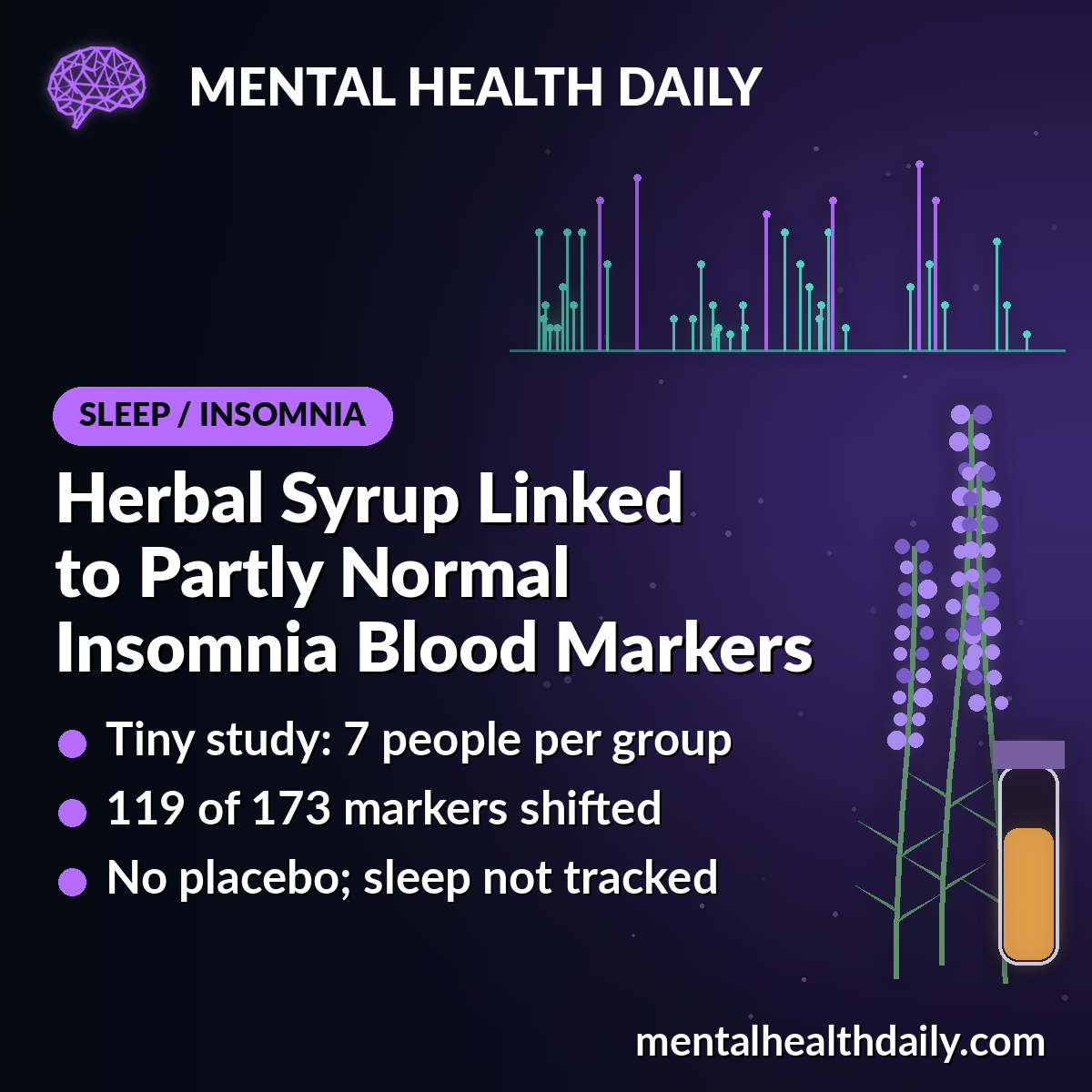
A 21-person study in China found that people with insomnia who had taken YWKS, a multi-herb syrup containing lavender, had blood chemistry partly closer to healthy controls than untreated patients did. The study had no placebo group and did not report whether anyone slept better.1
Research Highlights
- Insomnia showed a broad blood signature: 173 of 352 measured plasma metabolites differed between untreated sleep disorder patients and healthy controls (121 higher, 52 lower).1
- Treated patients looked partly closer to normal: in the group that took YWKS for 14 days, 119 of those 173 metabolites (68.8%) had shifted back toward healthy levels, and 54 (31.2%) had not.1
- Biggest shift was in a purine marker: hypoxanthine was sharply higher in untreated patients and showed the largest drop of any metabolite in the treated group, although a gout drug detected in patients’ blood complicates that result.1
- A fat-burning marker stayed high: stearoylcarnitine, a sign of strained fatty acid processing in mitochondria, was even higher in treated patients than in untreated ones.1
- Very early evidence: 7 people per group, no placebo, no randomization described, and no sleep scores reported.1 CBT for insomnia remains the recommended first-line treatment.2
What YWKS Syrup Is
Yinao Wusiti Kudusi Syrup (YWKS) is an in-house preparation made by a Uygur medicine hospital in Urumqi, Xinjiang, and approved by the regional drug regulator for use within that hospital. The researchers describe it as a traditional Chinese medicine blend used clinically for insomnia and related sleep problems.1
Its ingredients include:
- Lavender, which the researchers single out as a key ingredient for its calming effects; its main aromatic compounds are linalool and linalyl acetate
- Other plants: maidenhair fern, red peony root, Anchusa italica, licorice root, fennel, celery seed, hollyhock, henbane, Ficus concinna and Cordia dichotoma
- Sweeteners: seedless raisins and sucrose
Patients in the treatment group took 30 mL by mouth twice a day for 14 days.1 The syrup is made for that hospital’s own patients, so it is not a product most readers can buy.
How the YWKS Metabolomics Study Was Designed
Untargeted metabolomics measures as many small molecules in a blood sample as the equipment can detect (sugars, fats, amino acids, hormone byproducts, drug residues) without choosing them in advance. Researchers then look for molecules whose levels differ between groups. Here they used liquid chromatography with tandem mass spectrometry (LC-MS/MS), which separates molecules and identifies them by mass.1
- Groups: 7 healthy controls, 7 untreated patients with a sleep disorder diagnosed by ICSD-3 criteria (the paper focuses on chronic insomnia), and 7 patients who had taken YWKS
- Comparison: the methods describe 3 independent groups with separate samples, rather than the same patients measured before and after the syrup
- Measured: 1,797 molecular features, narrowed to 352 reliably measured metabolites
- Not reported in the paper: sleep questionnaire scores, sleep diaries, sleep lab recordings, or side effects
One section of the discussion describes the work as comparing responses “before and after” YWKS “in the same cohort,” which conflicts with the methods. The paper does not describe randomization or a placebo syrup.1
Insomnia Patients Differed From Controls on 173 Blood Metabolites
Compared with healthy controls, untreated patients had 173 metabolites at clearly different levels: 121 higher and 52 lower. Notable shifts included:1
- Hypoxanthine (higher): a product of purine breakdown, the pathway that recycles DNA building blocks and produces uric acid; its further breakdown generates oxidative stress
- Stearoylcarnitine (higher): a carrier form of a long-chain fat; when it builds up in blood, mitochondria may be struggling to burn fat for energy
- 5-hydroxyindole (higher): linked to the breakdown of serotonin, a brain and gut chemical that is also the raw material for melatonin
- Hormone byproducts (higher): estriol, a form of estrogen, and allotetrahydrocorticosterone, a stress-hormone byproduct; the researchers read the pair as a sign of an overactive stress-hormone system
- Arachidonic acid–containing membrane fats (lower): 2 glycerophospholipids that can release arachidonic acid, a building block for inflammatory signals
Glycerophospholipid metabolism, the pathway that builds and remodels cell-membrane fats, stood out in every group comparison. An earlier study of 24 insomnia disorder patients and 22 healthy controls likewise found broad serum metabolite differences (97 lower and 74 higher).13
Treated Patients’ Blood Profiles Were Partly Closer to Normal
The researchers sorted each of the 173 disease-linked metabolites by how it looked in the YWKS group. In treated patients, 119 (68.8%) had moved back toward healthy levels, and 54 (31.2%) remained out of range.1
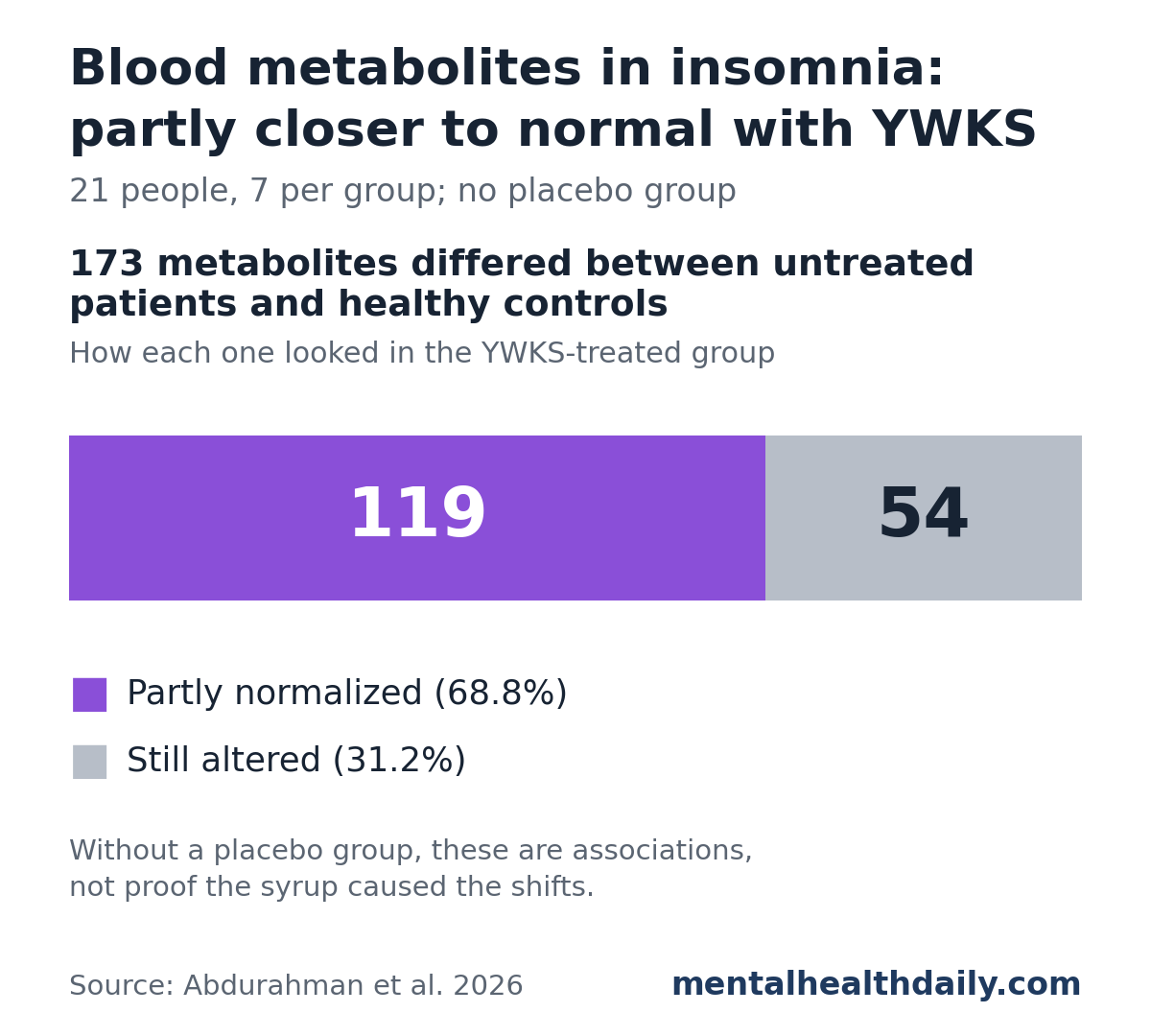
Treated patients still differed from healthy controls on 192 metabolites, more than the 173 for untreated patients. The researchers counted 133 metabolites that changed in the YWKS group without being part of the disease signature, which could reflect the syrup’s own ingredients or other medicines.1
Largest shifts toward normal:
- Hypoxanthine showed the biggest reversal of any metabolite
- Angiotensin I/II fragments, part of the hormone system that controls blood pressure, were higher in untreated patients and lower in treated ones
- Allotetrahydrocorticosterone and the membrane fat PC(16:0/20:4) moved back toward control levels
- 5-hydroxyindole moved only partway
No shift toward normal: stearoylcarnitine and nervonic acid stayed high. Stearoylcarnitine was higher in the treated group than in the untreated group, and the researchers flagged it as the clearest “treatment gap.”1
Other Medicines Muddy the Hypoxanthine Result
Several prescription drugs turned up in the blood samples. The antihistamine mebhydrolin and the gut-motility drugs cisapride and metoclopramide were the most connected points in the researchers’ metabolite correlation network. The team flagged known drug compounds and left them out of the pathway analysis.1
Allopurinol is a gout drug that blocks xanthine oxidase, the enzyme that breaks hypoxanthine down. Allopurinol and hypoxanthine rose together in untreated patients and fell together in treated ones. The researchers note that allopurinol levels may reflect medication use, so part of the headline hypoxanthine result may come from who was taking allopurinol rather than from insomnia or the syrup.1
Evidence Strength: An Exploratory Pilot With No Placebo
The researchers call this an exploratory pilot study and describe their results as correlational. In practice, the design can show which blood molecules differed among 3 small groups. It cannot show that YWKS caused those differences or improved sleep.1
- Tiny groups, many tests. 7 people per group with 352 metabolites compared raises the chance of false positives and unstable estimates.
- No placebo or randomization. Treated and untreated patients may have differed in age, diet, illness severity, or other medicines; the baseline details are only in a supplement.
- No sleep outcomes. The paper reports no sleep scores, so the metabolite shifts cannot be connected to better sleep.
- Drug residues. Other medicines were detected in blood and are hard to separate from disease signals, as the researchers acknowledge.
- Internal inconsistencies. The paper describes independent groups in its methods but a same-cohort comparison in its discussion, and it reports the treated-group up/down counts in opposite orders in 2 places.
The researchers suggest pairing YWKS with mitochondria-targeted supplements such as coenzyme Q10 or L-carnitine. Those were not tested here, and the persistent stearoylcarnitine signal is not evidence that anyone with insomnia should take them.1
How YWKS Fits With Proven Insomnia Treatment
Herbal remedies have a weak track record for insomnia. A meta-analysis of 14 randomized trials involving 1,602 participants found that valerian, chamomile, kava and wuling did not beat placebo on any of 13 sleep measures.4 That review did not include YWKS, and the 2026 paper cites no placebo-controlled sleep trial of the syrup itself.
The 2023 European Insomnia Guideline recommends cognitive behavioral therapy for insomnia (CBT-I) as the first-line treatment for chronic insomnia in adults, delivered in person or digitally. CBT-I retrains sleep habits and the worried thinking that keeps people awake, using tools such as a consistent sleep window and getting out of bed when unable to sleep. Certain medications are reserved for short-term use.2
- What the study adds: a list of blood molecules, especially purine, serotonin, fatty acid and membrane-fat markers, that future insomnia studies can check in larger groups
- What it does not show: that YWKS improves sleep, or that changing these blood markers helps insomnia
- Next step: a randomized, placebo-controlled trial with sleep outcomes, before-and-after blood samples from the same people, and records of other medicines
References
- Abdurahman A, Yasheng A, Abulajiang A, et al. Untargeted plasma metabolomics reveals systemic metabolic dysregulation and treatment-associated metabolic modulation following YWKS treatment in sleep disorder patients. Frontiers in Pharmacology. 2026;17:1905102. doi:10.3389/fphar.2026.1905102
- Riemann D, Espie CA, Altena E, et al. The European Insomnia Guideline: an update on the diagnosis and treatment of insomnia 2023. Journal of Sleep Research. 2023;32(6):e14035. doi:10.1111/jsr.14035
- Zhou J, Wu X, Li Z, et al. Alterations in gut microbiota are correlated with serum metabolites in patients with insomnia disorder. Frontiers in Cellular and Infection Microbiology. 2022;12:722662. doi:10.3389/fcimb.2022.722662
- Leach MJ, Page AT. Herbal medicine for insomnia: a systematic review and meta-analysis. Sleep Medicine Reviews. 2015;24:1–12. doi:10.1016/j.smrv.2014.12.003