
Teens who coped with hard feelings mainly by ruminating had far more anxiety, depression and self-injury than teens who looked for something positive, a 2026 survey of 759 Swedish students found. A group that used almost no coping strategies at all did nearly as well as the best group.1
Research Highlights
- 5 coping profiles: a statistical grouping of 759 students in grades 7 to 9 sorted them into 5 patterns of emotion regulation, published in Child and Adolescent Psychiatry and Mental Health.1
- Worst mental health in the rumination-heavy groups: 48.9% of the smallest group, which combined rumination, aggressive outlets and creative expression, scored in the clinical range for anxiety, vs. 6.5% of the positive-reorientation group.1
- Using few strategies was not a problem here: the minimal-strategy group, mostly boys, had just 3.3% in the clinical range for anxiety and 5.8% for depression.1
- More strategies did not mean better health: the group using the widest mix of strategies landed in the middle.1
- One-time snapshot: the survey shows which patterns go together, not which strategies cause better or worse mental health.1
How Researchers Sorted Teens Into Emotion Regulation Profiles
Emotion regulation is the set of things people do, deliberately or out of habit, to change how strongly or how long they feel an emotion. Most teens use several strategies at once, so studying one strategy at a time can miss how they combine.
Nilsson et al. surveyed students from 7 regular schools in a municipality in southern Sweden in 2023. About 1,000 were invited and 808 took part; after removing incomplete or outlying answers, 759 remained (average age 13.9, 48.6% girls).1
Students rated how often they used 6 strategies “when I experience difficult emotions,” on a 0 (never) to 4 (very often/always) scale. The questionnaire (AERSQ-E) was built for adolescents by the same Lund University group; an earlier version was developed in a 10-year Swedish youth cohort of 991 people.14
- Rumination/negative thinking: going over distress again and again, often turning it on oneself (“I think that I am bad or worthless”)
- Positive reorientation: looking for something good in what happened or shifting toward a more hopeful angle
- Social support: seeking comfort from others
- Aggressive outlet: letting feelings out through aggression, such as wanting to break something
- Creative expression: expressing feelings by making something
- Distraction: thinking about something else
Latent profile analysis then did the sorting. It is a statistical method that looks for hidden subgroups of people whose answers follow a similar pattern, and assigns each person to the group they most likely belong to. The researchers tested 1 to 6 groups and chose 5 as the best balance of fit and simplicity.1
The 5 Coping Profiles and Their Mental Health
The researchers named each group for the strategies that stood out. Listed from best to worst mental health:1
- Positive reorientation-focused (296 teens, 39%): high positive reorientation and distraction, very little rumination. About two-thirds boys.
- Minimal strategy (125 teens, 16.5%): low use of every strategy. 77% boys.
- Multiple strategy (97 teens, 12.8%): broad use of many strategies, especially creative expression, with above-average positive reorientation, support seeking and distraction.
- Rumination-focused (190 teens, 25%): rumination about 1 standard deviation above average, some aggressive outlet, little positive reorientation.
- Creative rumination-aggression (51 teens, 6.7%): the highest aggressive outlet, rumination and creative expression, with little positive reorientation or distraction. 87.8% girls.
The groups differed on every outcome measured — life satisfaction, anxiety, depression and non-suicidal self-injury — with large effect sizes (all p < 0.001). Those differences held after adjusting for gender and after a check that accounted for uncertainty in who belonged to which group.1
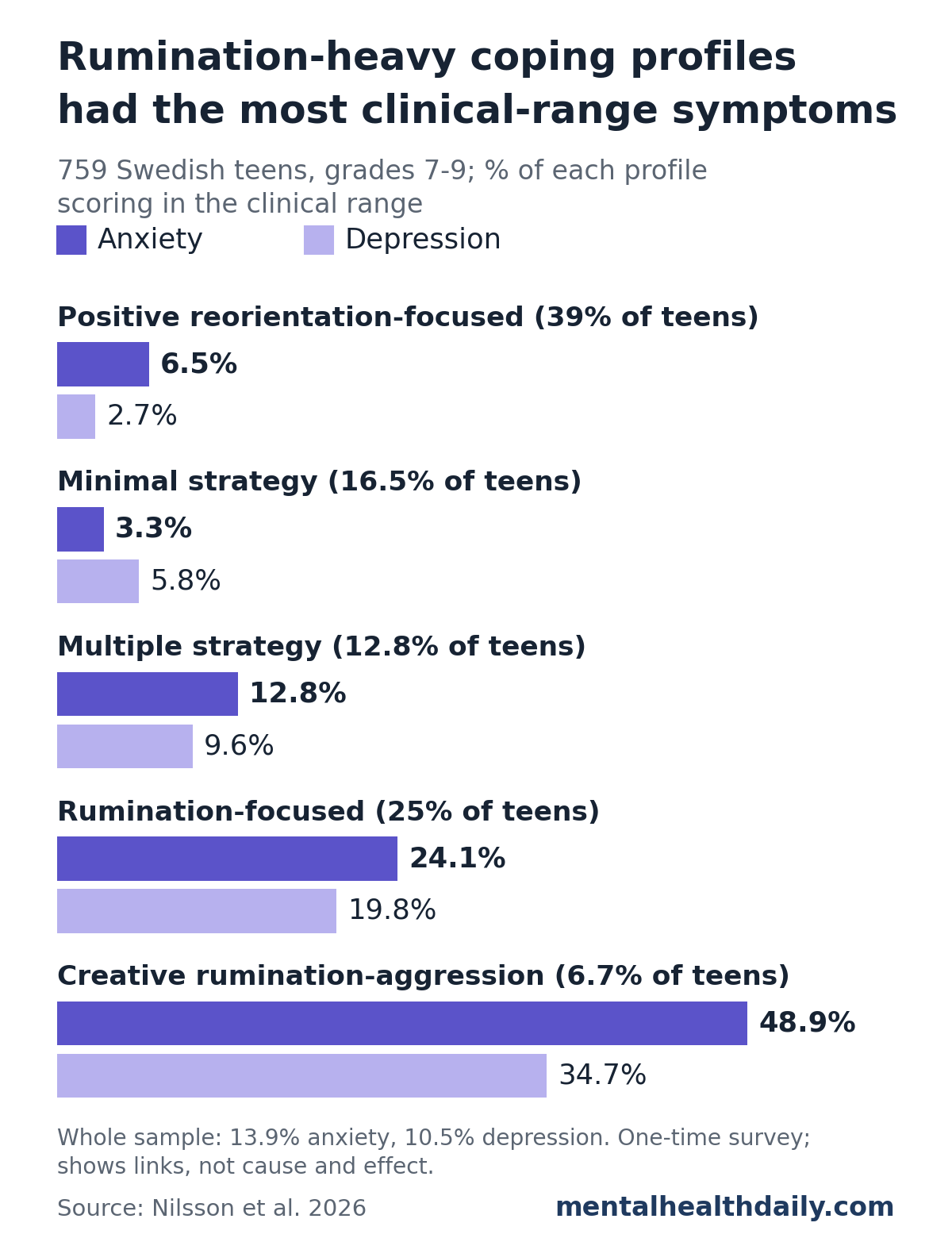
Clinical range here means a score on the anxiety and depression questionnaire (RCADS-25) that is well above Swedish norms. It flags high symptoms; it is not a diagnosis. In the whole sample, 13.9% scored in that range for anxiety and 10.5% for depression.1
Life satisfaction followed the same order. Average scores ran from 18.25 in the positive-reorientation group down to 11.26 in the rumination-focused group and 8.67 in the creative rumination-aggression group.1
Self-Injury Was Most Common in the Rumination-Aggression Group
Non-suicidal self-injury (NSSI) means hurting oneself on purpose without intending to die. The survey counted it as repetitive when a teen reported 5 or more episodes in the past 6 months.1
- Positive reorientation-focused: 9.6% repetitive NSSI
- Minimal strategy: 17.9%
- Multiple strategy: 35.2%
- Rumination-focused: 49.7%
- Creative rumination-aggression: 75.5%
The researchers point to a common explanation for self-injury: it can become a way to escape overwhelming feelings when other strategies are not working. Their survey did not test that directly.1
If you or a teen you know is self-harming or thinking about suicide, reach out for help. In the US, call or text 988 (Suicide & Crisis Lifeline); elsewhere, contact local emergency services or a crisis line.
Rumination Had the Strongest Link to Teen Anxiety and Depression
Rumination was the strategy most closely linked to poor mental health. Across girls and boys, it correlated with anxiety, depression and NSSI at roughly r = 0.37 to 0.65, and with lower life satisfaction at roughly r = −0.43 to −0.60.1
The result is consistent with a 2017 meta-analysis of 35 youth studies. Rumination and avoidance had the strongest links to more depressive and anxiety symptoms, while acceptance had the strongest link to fewer symptoms.2
The worst-off groups also lacked some strategies. Both rumination-heavy profiles also used little positive reorientation and distraction. The researchers suggest that fewer ways to step back from a negative thought loop may let rumination run on, though the survey cannot show that sequence.1
Why Using Few Coping Strategies Did Not Mean Worse Mental Health
More strategies did not rank higher here. The multiple-strategy group used the widest mix yet landed in the middle, while the minimal-strategy group was nearly as healthy as the positive-reorientation group.1
That contrasts with an earlier adolescent profile study. Lougheed and Hollenstein found that teens with a limited repertoire of strategies reported more anxiety and depressive symptoms than those using a broader mix.3
The researchers offer 3 possible explanations for the minimal-strategy result:1
- Less to regulate: these teens may face fewer stressors or feel emotions less intensely, so they need fewer strategies.
- Automatic coping: some regulation happens without much awareness and may not show up on a questionnaire.
- Study differences: the questionnaires, ages and samples differ across studies.
The survey did not measure stress exposure or emotional intensity, so it cannot tell these apart. Only follow-up over time can show whether this group stays well or runs into trouble later.1
Creative Expression Showed Up in Both Healthy and Struggling Teens
Creative expression was high in 2 very different groups. In the multiple-strategy group, it came with positive reorientation, support seeking and distraction, and mental health was middling. In the creative rumination-aggression group, it came with heavy rumination and aggression, and mental health was the worst in the study.1
The researchers read this as a sign that one strategy’s link to mental health may depend on the company it keeps. Writing, music or art might help a teen make sense of distress in one pattern, and turn into another form of dwelling on it in another. They call these ideas speculative, since the survey did not examine how creative expression worked for each teen.1
Limits of This Swedish Teen Emotion Regulation Survey
- One point in time: the survey cannot show whether rumination leads to anxiety and depression, whether distress leads to more rumination, or both.
- Five or six groups: a 6-profile solution also fit well. It split the smallest group into a creative-and-ruminating group and an aggressive-outlet-focused group, with broadly similar mental health.
- Labels are statistical groupings: membership is probabilistic and specific to this sample, not a diagnostic type a teen “has.”
- Self-report only: no stress, emotional intensity or flexibility measures, and no clinical interviews.
- One municipality: students aged about 13 to 15 from one southern Swedish area; the pattern needs replication in other places, ages and clinical groups.
What the Coping Profiles Suggest for Parents and Schools
The profiles point to a practical target: teens who ruminate heavily and rarely shift toward something positive or distracting had the most concurrent distress. The researchers suggest that, if longitudinal studies confirm the pattern, school programs could aim to reduce rumination and build strategies like positive reorientation.1
- Watch the pattern, not the count: a teen who uses few strategies is not automatically struggling, and one who uses many is not automatically fine.
- Repetitive negative thinking plus anger outbursts deserves attention: in this sample, that combination came with the most anxiety, depression and self-injury.
- Creative outlets are not a fix by themselves: they appeared in both the middle and the worst-off groups.
References
- Nilsson M, Segercrantz Walther E, Willkomm L, Bjärehed J, Daukantaitė D. Mapping emotion regulation profiles in adolescence and examining their associations with mental health outcomes. Child and Adolescent Psychiatry and Mental Health. 2026;20:134. doi:10.1186/s13034-026-01180-8
- Schäfer JÖ, Naumann E, Holmes EA, Tuschen-Caffier B, Samson AC. Emotion regulation strategies in depressive and anxiety symptoms in youth: a meta-analytic review. Journal of Youth and Adolescence. 2017;46(2):261–276. doi:10.1007/s10964-016-0585-0
- Lougheed JP, Hollenstein T. A limited repertoire of emotion regulation strategies is associated with internalizing problems in adolescence. Social Development. 2012;21(4):704–721. doi:10.1111/j.1467-9507.2012.00663.x
- Zhou Y, Daukantaitė D, Lundh LG, Wångby-Lundh M, Ryde A. Adolescents’ Emotion Regulation Strategies Questionnaire: initial validation and prospective associations with nonsuicidal self-injury and other mental health problems in adolescence and young adulthood in a Swedish youth cohort. Frontiers in Psychiatry. 2020;11:462. doi:10.3389/fpsyt.2020.00462