
Fibromyalgia treatment should start with education, exercise, and psychological therapy such as cognitive behavioral therapy (CBT), with medication added when symptoms persist, according to a 2026 narrative review of diagnosis and treatment evidence.1
Research Highlights
- What it is: a narrative review by Doan and colleagues in the Journal of Pain Research (published September 16, 2026) summarizing guidelines, meta-analyses, and trials on fibromyalgia.1
- Common: a meta-analysis across 38 countries put general-population prevalence at about 1.4%.1
- Still diagnosed by symptoms: there is no reliable blood test or scan, and the 2016 American College of Rheumatology (ACR) criteria performed best in head-to-head comparisons.1
- Non-drug care comes first: guidelines recommend education, exercise (aerobic exercise has the strongest evidence), and psychological therapies as first-line treatment.12
- Four FDA-approved drugs: pregabalin, duloxetine, milnacipran, and, since August 2025, an under-the-tongue form of cyclobenzaprine. Benefits are modest.1
Fibromyalgia Is a Pain-Processing Problem in the Brain and Spinal Cord
Fibromyalgia causes widespread muscle and joint pain along with fatigue, unrefreshing sleep, and trouble thinking and remembering. Depression, irritable bowel syndrome, migraine, and jaw disorders often come along with it.1
The leading explanation is central sensitization: nerve cells in the brain and spinal cord become overly responsive, so normal or weak signals register as pain. The review describes weaker pain-dampening signals from the brain (which rely partly on serotonin and norepinephrine), stronger excitatory signaling, and inflammation-related activity in support cells called glia.1
Brain imaging studies show changes in pain-related regions such as the insula and anterior cingulate cortex.1 Pain researchers now call this kind of pain nociplastic: pain that comes from altered pain processing rather than from tissue damage or nerve injury.3
That label matters for treatment. A 2021 Lancet review described nociplastic pain as typically coming with fatigue, sleep, memory, and mood problems, and as responding less well to anti-inflammatory drugs, opioids, surgery, or injections.3
Other Systems the Review Links to Fibromyalgia
- Stress systems: an overactive “fight or flight” nervous system and altered cortisol responses to stress. The review links this autonomic imbalance to anxiety, depression, and poor sleep in a cycle that can worsen pain.
- Immune signals: higher levels of some inflammatory proteins in meta-analyses, and a 2021 experiment in which antibodies from people with fibromyalgia made mice more pain-sensitive.
- Gut and nerves: early evidence on gut bacteria and on small nerve fiber damage in some patients.
The authors present these as possible contributors. None has become a diagnostic test.1
How Fibromyalgia Diagnosis Criteria Changed
The first ACR criteria, from 1990, required widespread pain plus tenderness at 11 or more of 18 specific “tender points” pressed during an exam. They were written to classify patients for research, not to diagnose them in the clinic.1
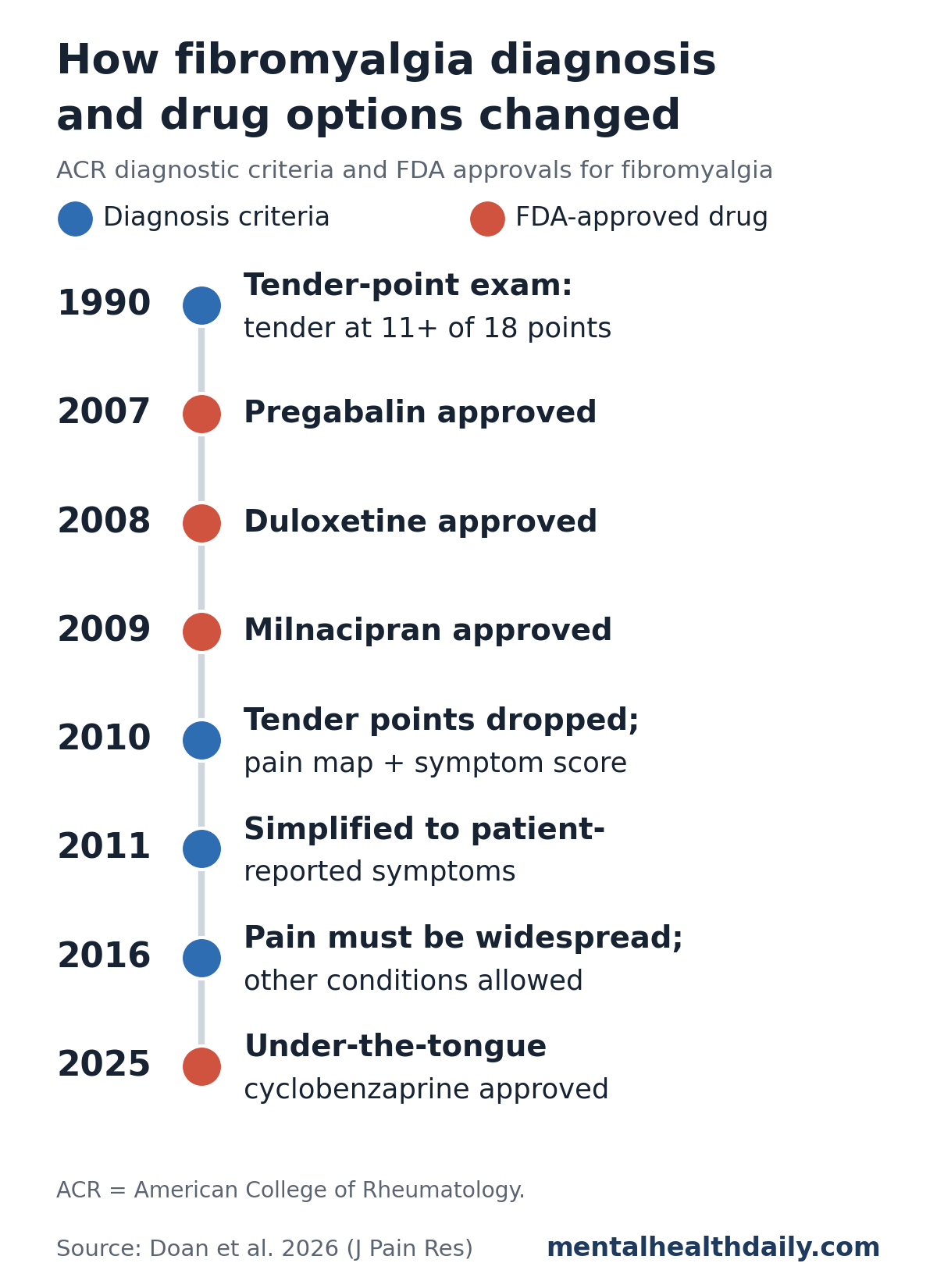
- 2010: the tender-point exam was dropped. Doctors instead count painful areas over the past week on a 19-area body map (the Widespread Pain Index) and score fatigue, waking unrefreshed, and thinking problems (the Symptom Severity Scale).
- 2011: the criteria were simplified by replacing the doctor’s rating of how many other symptoms a patient had with 3 patient-reported symptoms: headache, lower abdominal pain or cramps, and depression.
- 2016: pain must be generalized, meaning present in at least 4 of 5 body regions. Fibromyalgia can now be diagnosed even when another condition is present, so it is no longer a diagnosis of exclusion. The criteria authors added the widespread-pain rule because the earlier version misclassified some people with pain limited to one region.14
Mood and thinking are built into the modern criteria. Depression is one of the scored symptoms, and fatigue, unrefreshing sleep, and thinking problems are each rated from 0 to 3 alongside the pain map.1
Studies comparing criteria sets found broad agreement. In a 2021 Korean comparison, the 2016 ACR criteria had the best overall accuracy, while two simpler alternatives (the AAPT and modified FAS criteria) were easier to apply but less accurate.1
Conditions Doctors Rule Out
Because there is still no biomarker, diagnosis depends on a careful history, an exam, and a few basic blood tests (blood counts, inflammation markers, muscle enzyme, thyroid and parathyroid hormone). Conditions that can look like fibromyalgia include:1
- Underactive thyroid and low vitamin D
- Muscle diseases (weakness climbing stairs or rising from a chair is a clue)
- Infections such as Lyme disease, HIV, and hepatitis C
- Inflammatory rheumatic disease, neurological disorders, mental illness, cancer, and medication side effects
The review also notes heavy overlap between fibromyalgia and long COVID, enough that some researchers have proposed calling it “fibromyalgia-like post-COVID syndrome.”1
Exercise and CBT Come First
The review describes care as multidisciplinary, often involving doctors, physical therapists, psychologists, sleep specialists, and social workers. Guidelines treat non-drug options as first-line.1
That order matches the European League Against Rheumatism (EULAR) recommendations, which reviewed 107 systematic reviews and meta-analyses. Exercise was the only treatment to earn a “strong for” recommendation. Psychological therapy, medication, and multimodal rehabilitation were rated “weak for” and tailored to each patient’s main problems, and most treatments had modest effects.2
Exercise
Aerobic exercise has the strongest evidence of any exercise type, and resistance training is also recommended. Proposed reasons it helps include strengthening the brain’s pain-dampening pathways, regulating the stress-hormone system, and easing anxiety and depression.1
Pulling together several meta-analyses, the authors suggest a reasonable starting point for most patients is 30 to 60 minutes of moderate aerobic exercise 2 to 3 times a week, built up gradually and generally kept under 180 minutes a week in total. Because pain and fatigue limit tolerance, they say the plan should be adjusted over time. Yoga, tai chi, qigong, Pilates, and pool exercise are also covered.1
Psychological Therapy
The review points to catastrophizing (expecting the worst about pain), passive coping, anxiety, and depression as factors that add to distress and may weaken the brain’s pain-dampening system. Several guidelines recommend CBT as part of combined treatment.1
Imaging studies suggest CBT changes cortical brain regions involved in pain, along with reducing catastrophizing and improving sleep. Acceptance and commitment therapy (ACT), which helps people make room for pain and distressing thoughts while acting on their values, is another option:1
- In a randomized trial of 67 patients, online ACT added to usual care reduced the overall impact of fibromyalgia more than usual care alone, and also improved depression, pain, and fear of movement.
- Greater acceptance of pain helped explain the improvement.
What Fibromyalgia Medications Can Do
Medication is mainly for people whose symptoms persist despite non-drug care. Antidepressants and anticonvulsants carry the highest guideline ratings among drugs, and in fibromyalgia antidepressants are prescribed mainly for pain.1
- Duloxetine and milnacipran (serotonin-norepinephrine reuptake inhibitors, or SNRIs; approved 2008 and 2009): a Cochrane review found only small pain reductions compared with placebo, without much change in fatigue, sleep, or quality of life, and more people stopped because of side effects. A 2022 network meta-analysis found duloxetine at 120 mg had its largest effects on pain and depression.
- Pregabalin (approved 2007): a Cochrane review found that only a minority of people with moderate to severe pain got meaningful relief over 12 to 26 weeks. A network meta-analysis found it moderately improved sleep.
- Sublingual cyclobenzaprine (approved August 2025, the first new FDA-approved fibromyalgia drug in 15 years): 2 of 3 phase 3 trials found less pain than placebo, and all 3 found improvements in overall disease impact and sleep. Mouth numbness and taste changes were the most common side effects.
- Amitriptyline (off-label, low dose): studies conflict. One network meta-analysis found better sleep, fatigue, and quality of life but only slight pain relief and no significant effect on depression.
Opioids: tramadol may be considered for moderate to severe pain that has not responded to other treatment, but strong opioids are not recommended by some guidelines. In a 2024 study, people who stopped opioids reported no less improvement than those who kept taking them, and their coping got better.1
Newer and Add-On Treatments Have Weaker Evidence
The review covers many other options and is clear about how thin most of the evidence is:1
- Brain stimulation: meta-analyses show repetitive transcranial magnetic stimulation (rTMS) reduces pain and improves quality of life, with limited effect on depression. EULAR and Italian guidelines do not recommend rTMS or transcranial direct current stimulation (tDCS).
- Acupuncture: an umbrella review found modest gains in pain and fatigue, with limited overall evidence.
- Supplements: vitamin D (in people with low levels) and magnesium showed promise in randomized trials; evidence for others is preliminary.
- Short-term or specialized drugs: ketamine infusions gave pain relief lasting hours, and sodium oxybate improved pain and sleep in trials but is not FDA-approved for fibromyalgia and carries misuse risk.
Limitations
- Narrative review. The authors chose and summarized studies without a systematic search, quality grading, or pooled effect sizes, so the review shows where guidelines and major meta-analyses stand rather than ranking treatments.
- Mixed strength of evidence on CBT. The review says several guidelines strongly recommend CBT, but EULAR rated psychological therapies “weak for,” with exercise the only strong recommendation.2
- Mechanisms are still under study. Many proposed causes rest on small studies or animal experiments, and none yields a diagnostic test.
- Modest drug benefits. Cochrane reviews found small pain reductions with the SNRIs and meaningful relief for only a minority on pregabalin, and side effects lead some people to stop.
The authors call for objective biomarkers and for treatments aimed at specific mechanisms. Until then, guidelines favor combining several modest treatments, tailored to each person’s main symptoms.12
References
- Doan HN, Moon JS, Park WT, Baek J, Chang MC. Evolving concepts in the diagnosis and management of fibromyalgia: a moving target. Journal of Pain Research. 2026;19:615824. doi:10.2147/JPR.S615824
- Macfarlane GJ, Kronisch C, Dean LE, et al. EULAR revised recommendations for the management of fibromyalgia. Annals of the Rheumatic Diseases. 2017;76(2):318–328. doi:10.1136/annrheumdis-2016-209724 (PubMed)
- Fitzcharles MA, Cohen SP, Clauw DJ, Littlejohn G, Usui C, Häuser W. Nociplastic pain: towards an understanding of prevalent pain conditions. The Lancet. 2021;397(10289):2098–2110. doi:10.1016/S0140-6736(21)00392-5 (PubMed)
- Wolfe F, Clauw DJ, Fitzcharles MA, et al. 2016 revisions to the 2010/2011 fibromyalgia diagnostic criteria. Seminars in Arthritis and Rheumatism. 2016;46(3):319–329. doi:10.1016/j.semarthrit.2016.08.012