
Middle-aged and older German workers whose weekly hours went up during the COVID-19 pandemic were more likely to have clinically relevant depression and anxiety symptoms, a 2026 study of 6,813 adults found.1 Across the whole group, though, average symptoms barely moved.
Research Highlights
- More hours, more depression: among employed participants, an increase in weekly working hours was linked to 2.49 times the odds of clinically relevant depressive symptoms (95% CI 1.56–4.00) and 1.86 times the odds of clinically relevant anxiety (95% CI 1.07–3.24).1
- Averages stayed flat: mean depression scores were 4.22 at the last pre-pandemic visit and 4.06 to 4.14 during the pandemic, on a 0–27 scale.1
- More people crossed the depression threshold: the share scoring 10 or higher rose from 7.6% at the last pre-pandemic visit to 9.2% by mid-2021.1
- Past mental health mattered most: pre-pandemic symptom scores were by far the strongest predictors of pandemic symptoms.1
- Most work factors were weak: home office, income changes, and job type showed small or negligible links once earlier symptoms were accounted for.1
How the Gutenberg Health Study Tracked Mental Health Before and During COVID-19
The Gutenberg Health Study is a long-running population study in the Mainz region of Germany. It began in 2007 with a random, stratified sample of residents aged 35 to 74, who were seen at a study center in 2007–2012 and again in 2012–2017.1
When the pandemic hit, all participants were invited into the Gutenberg COVID-19 Study, with 2 more visits: October 2020 to April 2021, and March to June 2021. Those windows covered Germany’s second and third waves, with lockdowns, curfews, and the early vaccine rollout.1
- Sample: 6,813 adults who took part in both studies; 48.8% women; average age 63.5 (range 45 to 88).
- Work: about half were employed. Since the pandemic began, 10.7% of those asked reported more weekly hours and 10.1% reported fewer.
- Depression measure: the PHQ-9, a 9-question screening questionnaire scored 0 to 27; 10 or higher is the usual cutoff for clinically relevant symptoms.
- Anxiety measure: the GAD-2, a 2-question anxiety screener scored 0 to 6, with 3 or higher as the cutoff.
To see who fared worse during the pandemic, the researchers compared groups while adjusting for each person’s own score at the 2012–2017 visit. This accounted for pre-existing symptom differences when comparing groups during the pandemic.
Average Depression and Anxiety Scores Barely Changed During the Pandemic
Mean PHQ-9 scores across the 4 visits were 3.92, 4.22, 4.06, and 4.14. Mean GAD-2 anxiety scores were 0.85, 0.95, 0.77, and 0.73, a slight drift downward.1
Changes within the same people were just as small. The average person’s depression score changed by −0.07 points from the last pre-pandemic visit to the pandemic visits, and most people showed little or no change. Roughly equal numbers got better and worse.
The depression threshold was the exception. The share with a PHQ-9 of 10 or more climbed across the visits:1
- 2007–2012: 7.0%
- 2012–2017: 7.6%
- Late 2020 to spring 2021: 8.1%
- Spring to summer 2021: 9.2%
No similar rise showed up for anxiety, where the share above the cutoff fell from 6.5% to 5.5%. A flat average can hide a growing group at the top end.
Longer Working Hours Were the Most Consistent Work-Related Link to Depression and Anxiety
People whose weekly hours went up after the pandemic started had an average PHQ-9 of 4.59 at the 2012–2017 visit and 5.35 during the pandemic. Those whose hours did not go up went from 4.35 to 4.25.1
Anxiety followed a similar pattern. Scores in the extra-hours group held steady (1.08 to 1.06) while everyone else’s fell (0.98 to 0.77).
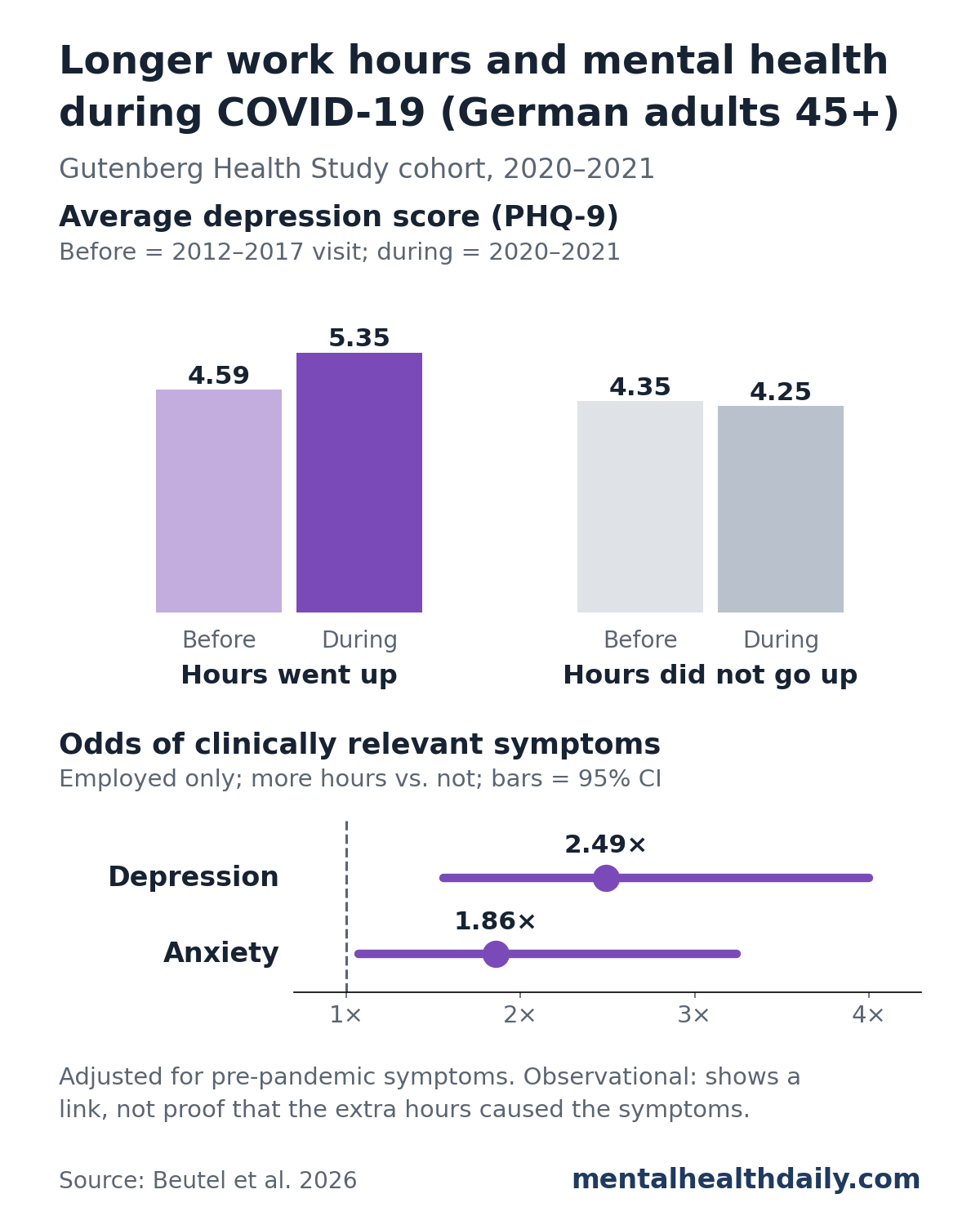
A second analysis looked only at employed participants (about 1,700 people with complete data). It asked what predicted crossing the clinical cutoffs during the pandemic, adjusting for sex, age, relationship status, job type, income change, home office, reduced hours, and pre-pandemic symptoms.1
- Clinically relevant depression: more working hours, OR 2.49; having no partner, OR 2.12 (95% CI 1.33–3.38); each extra point of pre-pandemic PHQ-9, OR 1.33.
- Clinically relevant anxiety: more working hours, OR 1.86; each extra point of pre-pandemic GAD-2, OR 2.24.
An odds ratio (OR) compares the odds of an outcome between two groups; 2.49 means the odds were about two and a half times higher.
Effect sizes were still small. In the group comparisons, the working-hours difference came to about d = 0.20 for depression and 0.17 for anxiety (Cohen’s d is a standardized difference; 0.2 is conventionally called small). The difference between men and women was about the same, d = 0.21. Pre-pandemic scores alone explained 28% of the variation in depression and 22% in anxiety, far more than any work factor.1
Why More Hours Might Weigh on Mental Health
The study did not record why hours went up, whether the change was voluntary, or what the work involved. The researchers offer a few possible explanations, which they call tentative:1
- Less recovery time: more hours leave less room for rest.
- Heavier demands: extra hours may signal higher workloads or role conflicts.
- Harder-hit jobs: longer hours may have been more common in jobs under heavy pandemic strain.
Because the design is observational, other explanations are possible. Distress and longer hours could share a cause, such as a job that became much more demanding, or stress elsewhere in life could have pushed some people to work more.
Other Work and Life Factors Linked to Pandemic Depression
Several other factors showed small differences after accounting for earlier symptoms:1
- Part-time workers had higher depression and anxiety scores than every other employment group. Part-time work was far more common among women (26.3% vs 5.4% of men), and the researchers suggest caregiving load may explain some of this.
- Employed people had more depressive symptoms than retirees, and people in lower-level jobs had more than the self-employed.
- Women held steady on depression (4.72 to 4.73) while men dropped slightly (3.76 to 3.55).
- People in their 40s and 50s had higher scores than those in their 60s and 70s.
- Living alone or without a partner was linked to higher depression scores.
Working from home showed only a negligible link with depression and did not predict clinical symptoms. Income changes had very small effects and were not a significant predictor in the anxiety model.
How This Compares With Other Before-and-During COVID Studies
A flat average with some people doing worse fits the wider evidence. A meta-analysis of 65 longitudinal cohorts found a small overall rise in symptoms in 2020, largest in March and April and fading later in the year.2
In adults 60 and older, a meta-analysis of 108 studies with 102,136 participants found a small increase in mental distress and a small drop in anxiety symptoms, with larger increases in distress among women.3 That lines up closely with the Gutenberg results.
U.S. data pointed to job loss and reduced hours instead. In the COVID-19 Coping Study of Americans 55 and older, job loss was linked to the most depressive symptoms and loneliness, followed by furlough and reduced hours or income; working from home was linked to more anxiety.4 The German researchers suggest that fewer hours may signal financial strain while more hours may signal overload, so changes in either direction may matter for mental health.
Limitations of the Gutenberg Working-Hours Analysis
- Observational design: working hours were not assigned, so the study shows a link, not a cause.
- Old baseline: the pre-pandemic comparison visit took place in 2012–2017, years before COVID-19.
- Advantaged sample: participants were relatively well educated with above-average income, and the results may not apply to younger or lower-paid workers.
- Missing work details: job control, workplace support, and reasons for the extra hours were not measured.
- Screening scales: the PHQ-9 and GAD-2 are self-report questionnaires, not diagnoses, and the short GAD-2 may miss small changes in anxiety.
- Many comparisons: the analyses were exploratory, with no correction for multiple testing.
What the Findings Mean for Workers in Midlife and Later
Past mental health was the best guide to who struggled during the pandemic. The researchers recommend that prevention efforts look at earlier symptoms and social circumstances, such as living alone, not only at job factors.1
Among work factors, a jump in weekly hours stood out. The researchers suggest workplaces could watch for heavy or rising workloads and make support easier to reach, as part of a broader plan rather than the main response to a public health crisis.1
References
- Beutel T, Hettich-Damm N, Petersen J, et al. Vocational factors and mental health during the COVID-19 pandemic in middle-aged and older adults: longitudinal evidence from a population-based cohort. Frontiers in Public Health. 2026;14:1803297. doi:10.3389/fpubh.2026.1803297
- Robinson E, Sutin AR, Daly M, Jones A. A systematic review and meta-analysis of longitudinal cohort studies comparing mental health before versus during the COVID-19 pandemic in 2020. Journal of Affective Disorders. 2022;296:567–576. doi:10.1016/j.jad.2021.09.098
- Schäfer SK, Lindner S, Kunzler AM, Meerpohl JJ, Lieb K. The mental health impact of the COVID-19 pandemic on older adults: a systematic review and meta-analysis. Age and Ageing. 2023;52(9):afad170. doi:10.1093/ageing/afad170
- Abrams LR, Finlay JM, Kobayashi LC. Job transitions and mental health outcomes among U.S. adults aged 55 and older during the COVID-19 pandemic. The Journals of Gerontology: Series B. 2022;77(7):e106–e116. doi:10.1093/geronb/gbab060