
In a survey of 246 Saudi women on drug treatment after breast cancer surgery, more than half screened positive for depression and about half for anxiety. Women on chemotherapy reported far more symptoms than those not on it.1
Research Highlights
- High symptom burden: 54.1% scored in the clinically significant range for depression and 49.6% for anxiety on standard screening questionnaires.1
- Chemotherapy linked to the most distress: after adjustment for other factors, chemotherapy was linked to depression scores 9.55 points higher and anxiety scores 9.39 points higher.1
- More chemotherapy cycles, more depression: each additional cycle was linked to a 1.34-point higher depression score.1
- Hormone therapy was not linked to depression or anxiety once other factors were accounted for, though it was linked to slightly lower quality of life.1
- One survey, one moment: the cross-sectional design cannot show that any treatment caused these symptoms.
Who Was Studied: Saudi Women on Adjuvant Breast Cancer Treatment
Abdallah et al. surveyed 246 women at 3 hospitals in Saudi Arabia between November 2024 and March 2025. Their average age was 53.5, and none had cancer that had spread to distant organs. The study was published in Cancer Medicine in 2026.1
Adjuvant therapy is treatment given after surgery to lower the chance that breast cancer comes back. Every woman in the study was on at least one of these drug types:
- Chemotherapy (48.4%): drugs that kill fast-dividing cells, given in cycles every 1 to 4 weeks. Common regimens here combined doxorubicin, cyclophosphamide and a taxane, sometimes with trastuzumab. The median woman on chemotherapy was at cycle 3.
- Endocrine (hormone) therapy: daily pills that block estrogen’s fuel supply to hormone-sensitive tumors. Letrozole (45.5%), an aromatase inhibitor that stops the body from making estrogen, and tamoxifen (22.8%), which blocks estrogen receptors on cancer cells, were the most common. Some women also took goserelin (7.3%), an injection that shuts down estrogen production by the ovaries.
- Biological therapy: antibody drugs aimed at a specific target. Trastuzumab (20.3%) blocks the HER2 growth signal; pembrolizumab (11.0%) is an immunotherapy that helps immune cells attack cancer.
Most tumors (65%) were hormone receptor–positive, the type treated with endocrine therapy. The rest were HER2-positive, triple-negative, or both HER2- and hormone receptor–positive.1
About Half Screened Positive for Depression and for Anxiety
Women filled out 3 questionnaires once, during a routine follow-up visit:
- PHQ-9 (Patient Health Questionnaire-9): a 9-item depression screen scored 0 to 27. A score of 10 or more flags clinically significant depression.
- GAD-7 (Generalized Anxiety Disorder-7): a 7-item anxiety screen scored 0 to 21, with the same 10-point cutoff.
- EORTC QLQ-C30: a 30-item cancer quality-of-life questionnaire, scored here from 0 (worst) to 100 (best).
The average depression score was 12.87, in the moderate range, and 54.1% scored 10 or higher. Just over a quarter (27.2%) were in the severe range.1
Anxiety looked similar: an average GAD-7 score of 9.55, with 49.6% at or above the cutoff and 28.5% reporting severe anxiety. Average quality of life was 58.8 out of 100.1
On the PHQ-9 item about thoughts of self-harm, 45.5% reported having them on at least several days. A single questionnaire item is not a suicide-risk assessment, but a rate this high calls for careful follow-up. If you are having thoughts of harming yourself, contact your care team or a crisis line now; in the US, call or text 988.1
These screen-positive rates sit in the range seen elsewhere. A 2020 meta-analysis of 36 studies with 16,298 breast cancer patients put the pooled prevalence of anxiety at 41.9%.2
Chemotherapy Was Linked to Depression Scores Nearly 10 Points Higher
The gap between women on and off chemotherapy was large. Average depression scores were 19.98 with chemotherapy vs 6.2 without; average anxiety scores were 14.81 vs 4.62. Quality of life averaged 34.0 with chemotherapy vs 82.2 without.1
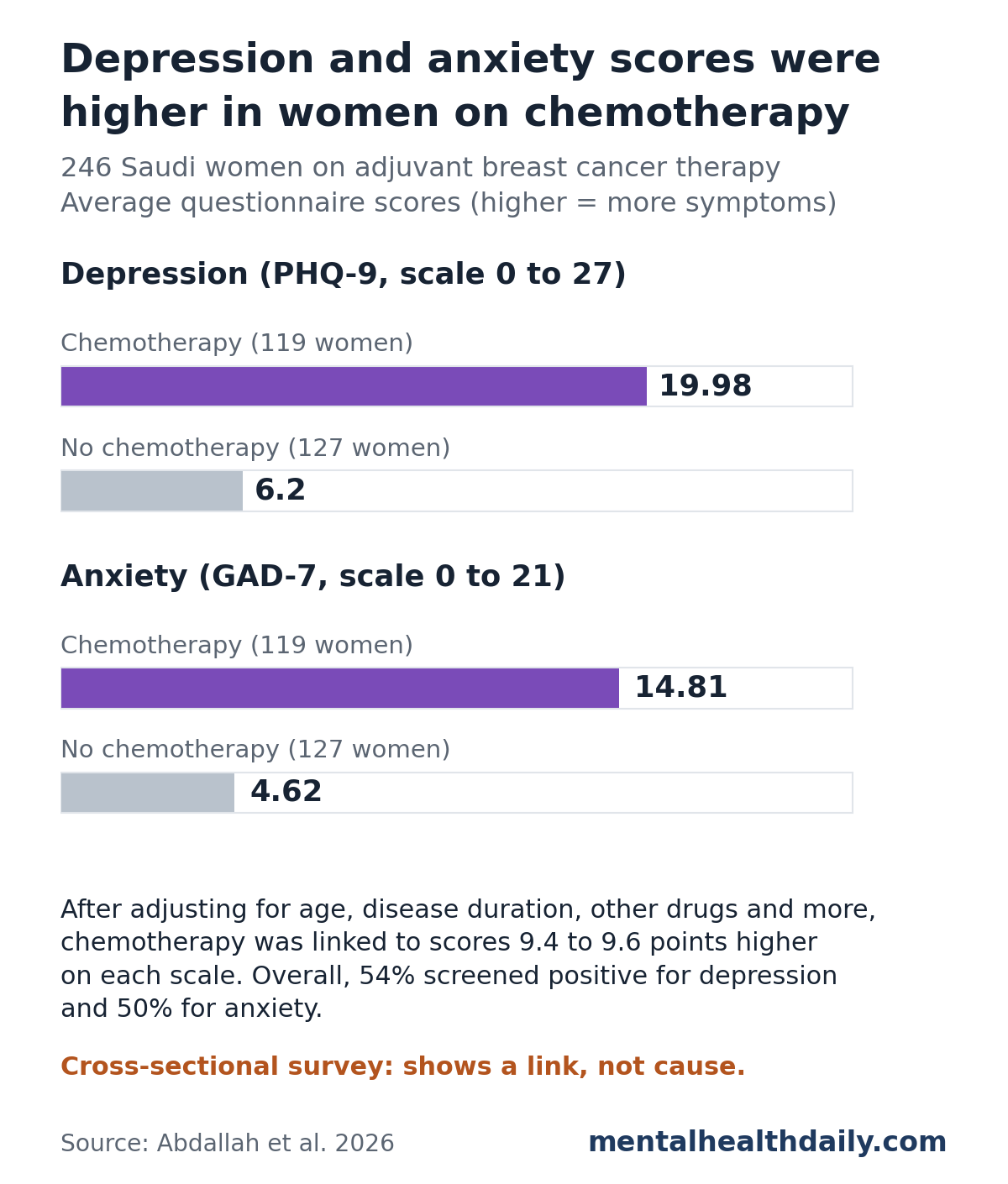
Adjusted results: the researchers ran regression models that accounted for age, place of residence, diabetes, high blood pressure, disease duration, number of cycles, and the other drug types. Chemotherapy stayed the strongest factor:1
- Depression: 9.55 points higher on the PHQ-9 with chemotherapy, plus 1.34 points per additional cycle.
- Anxiety: 9.39 points higher on the GAD-7 with chemotherapy. The number of cycles fell just short of significance (p = 0.056).
- Quality of life: 42.6 points lower with chemotherapy and 2.4 points lower per cycle.
This pattern fits a prospective US study of 256 women with early breast cancer. During chemotherapy, 26% reported at least moderately severe depression and 41% at least moderately severe anxiety, nearly double the rates before chemotherapy began.3
Hormone Therapy Was Not Linked to Depression or Anxiety After Adjustment
In simple comparisons, women on endocrine therapy reported much less depression and anxiety than women not on it, and women on biological drugs reported much more. Neither difference held up in the adjusted models.1
A likely reason is overlap between treatments. Endocrine therapy alone is typically used for early, hormone-sensitive cancer, while trastuzumab and pembrolizumab are typically given alongside chemotherapy for HER2-positive or triple-negative cancer. Once chemotherapy was in the model, the other drug types added little.
Quality of life was the exception: endocrine therapy was linked to a QLQ-C30 score 3.07 points lower after adjustment, a small difference next to chemotherapy’s 42.6 points. The researchers point to hot flashes, mood swings, and fatigue, which are known side effects of hormone therapy.1
Note on the abstract: the paper’s abstract says endocrine therapy contributes to psychological distress and that cycle number was linked to anxiety. The adjusted tables do not support either claim; endocrine therapy was linked only to lower quality of life.
Younger Women and Recent Diagnoses Reported More Distress
In simple correlations, younger age and a shorter time since diagnosis were both linked to higher depression and anxiety scores and lower quality of life. After adjustment, a longer time since diagnosis remained linked to slightly lower depression and anxiety scores, but age did not. The median time since diagnosis was 9 months.1
Widowed women reported the least depression and anxiety and the best quality of life, while divorced women had the lowest quality of life. The researchers point out that widowed women in the sample tended to be older, so age may explain much of this.1
Limitations of This Saudi Breast Cancer Survey
- Cross-sectional design: everyone was surveyed once, so the study shows which treatments were linked to symptoms, not whether treatment caused them.
- Sicker patients get chemotherapy: chemotherapy is usually reserved for more aggressive or node-positive cancer, and cancer stage was not in the regression models. Some of the chemotherapy gap may reflect the disease rather than the drugs.
- Unusually clean split: chemotherapy and non-chemotherapy groups barely overlapped on depression scores (averages of 20 vs 6, with most scores within 3 to 4 points of each average), which is rare for questionnaire data and is not discussed in the paper.
- Screens, not diagnoses: the PHQ-9 and GAD-7 flag likely depression and anxiety; a clinician did not confirm them.
- Timing varied: surveys were not given at a set point in the chemotherapy cycle.
- Limited reach: 3 hospitals, no metastatic cancer, and no data on radiotherapy or weight.
What This Means for Patients on Breast Cancer Treatment
Depression and anxiety are common during adjuvant breast cancer treatment, especially during chemotherapy and in the first months after diagnosis. Both are treatable, and many cancer centers screen for them routinely.
Do not stop or change chemotherapy, tamoxifen, letrozole, or any other cancer treatment because of these findings. If you notice low mood, constant worry, or poor sleep during treatment, tell your oncology team; they can adjust supportive care or refer you for counseling or psychiatric help.
References
- Abdallah MS, Gardouh AR, Abuaeaaq ZK, Badawoud AM. Prevalence and determinants of depression, anxiety, and quality of life in patients with breast cancer in Saudi Arabia: a focus on adjuvant pharmacotherapy. Cancer Medicine. 2026;15:e72288. doi:10.1002/cam4.72288
- Hashemi SM, Rafiemanesh H, Aghamohammadi T, et al. Prevalence of anxiety among breast cancer patients: a systematic review and meta-analysis. Breast Cancer. 2020;27:166–178. doi:10.1007/s12282-019-01031-9
- Nakamura ZM, Deal AM, Nyrop KA, et al. Serial assessment of depression and anxiety by patients and providers in women receiving chemotherapy for early breast cancer. The Oncologist. 2021;26(2):147–156. doi:10.1002/onco.13528