
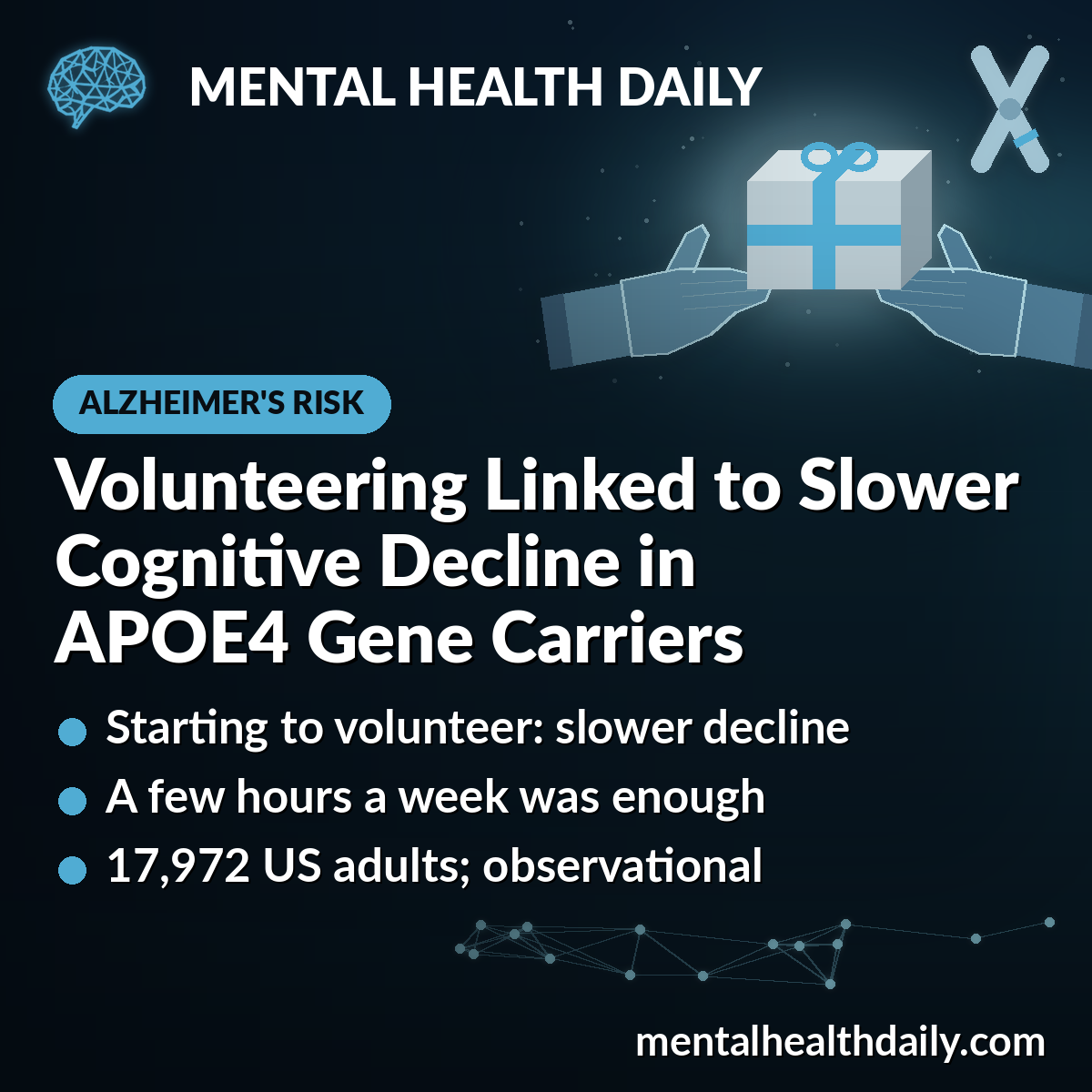
Starting to volunteer was linked to slower cognitive decline in older Americans who carry APOE ε4, the best-known gene variant for Alzheimer’s risk, in a study that followed 17,972 adults for up to 22 years. Stopping volunteering was linked to faster decline.1
Research Highlights
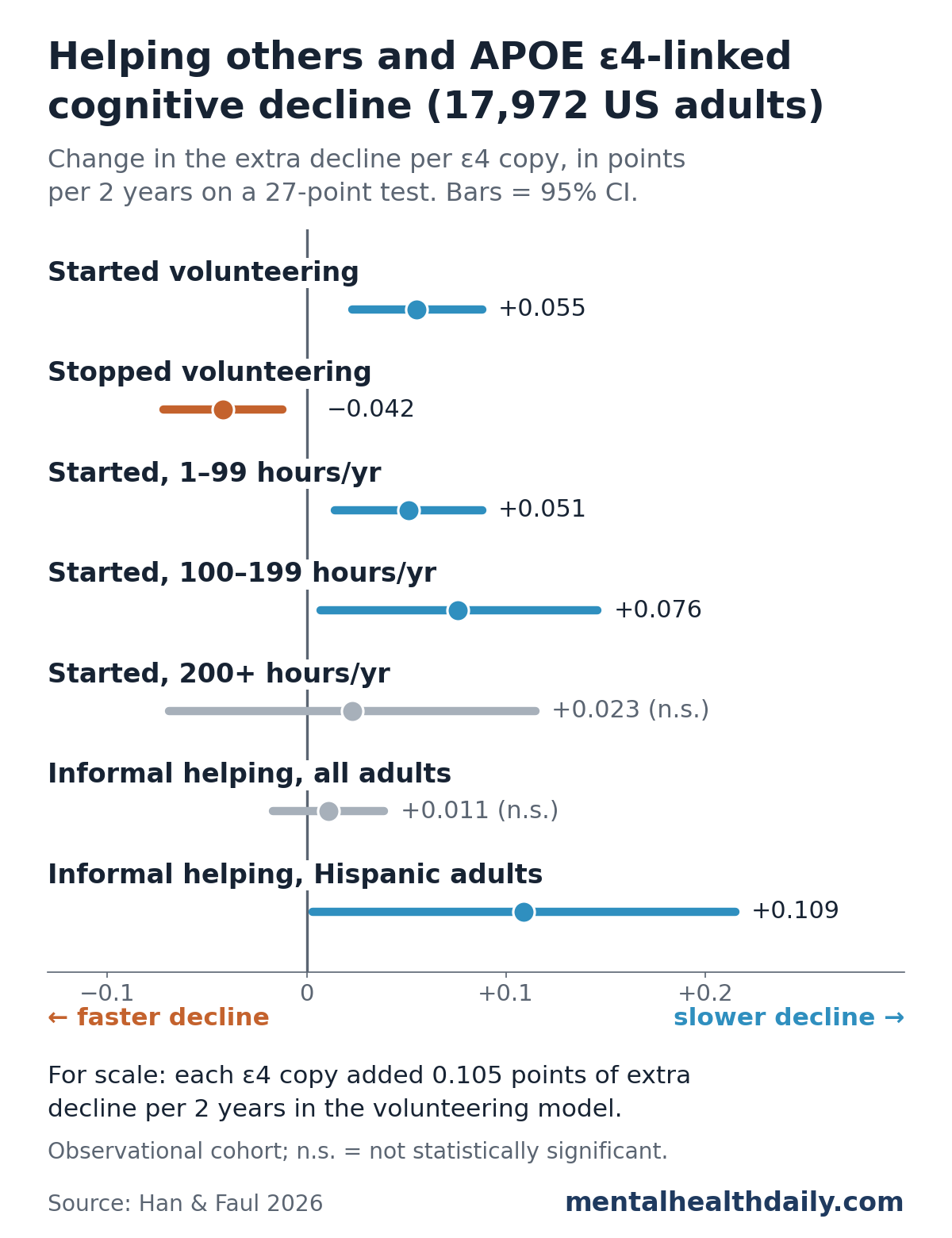
- Starting to volunteer was linked to slower ε4-related decline: the extra decline per ε4 copy shrank by 0.055 points per 2 years on a 27-point cognitive test (95% CI 0.023 to 0.088).1
- Stopping went the other way: quitting volunteering was linked to steeper ε4-related decline (−0.042 points per 2 years).1
- Modest hours were enough: the link held for up to about 4 hours a week, while 200 or more hours a year showed no clear benefit.1
- Informal helping counted for Hispanic adults: helping friends, neighbors or relatives was linked to slower ε4-related decline among Hispanic participants but not in the full sample.1
- Observational design: the Health and Retirement Study data show a consistent association, but people were not assigned to volunteer.1
What APOE ε4 Does to Cognitive Decline
APOE (apolipoprotein E) is a gene that makes a protein for carrying fats and cholesterol in the brain and blood. It comes in 3 common versions: ε2, ε3 and ε4. Carrying ε4 is the most consistently documented genetic risk factor for late-onset Alzheimer’s disease.1
Beyond amyloid and tau buildup, ε4 is linked to leaky blood vessels in the brain, more brain inflammation, and a stress response that does not shut off well. Each of those is a possible point where something else could push back.1
In this study, 72.5% of participants had no ε4 copy, 25.2% had one, and 2.3% had two. Cognition was measured with the mTICS (modified Telephone Interview for Cognitive Status), a 0-to-27 phone test of word recall, counting backward and subtracting 7s. Scores of 11 or lower are a common cutoff for cognitive impairment.1
Compared with non-carriers, people with one ε4 copy lost an extra 0.086 points every 2 years, and people with two copies lost an extra 0.240 points. Those gaps grow over decades of follow-up.1
How Researchers Tracked Volunteering and Helping in 17,972 Adults
Sae Hwang Han and Jessica Faul used the Health and Retirement Study (HRS), a US survey that has interviewed adults aged 51 and older every 2 years since 1992. They analyzed 12 waves from 1998 to 2020 for people who gave a saliva DNA sample between 2006 and 2012.1
- Sample: 17,972 adults with 139,777 interviews, an average of 7.8 waves each
- Who: 57.7% women; 69.2% non-Hispanic White, 18.1% non-Hispanic Black and 12.7% Hispanic
- Formal volunteering: any volunteer work for religious, educational, health-related or charitable groups in the past year (reported in 36.1% of interviews)
- Informal helping: unpaid help to friends, neighbors or relatives outside the home (53.6% of interviews)
- Hours: grouped as none, 1–99, 100–199, or 200 or more hours a year
Each person as their own control. The analysis compared each participant’s cognition before and after they started or stopped helping, rather than comparing volunteers with non-volunteers. That design removes the influence of stable traits such as education, personality or childhood background.1
The models also adjusted for changing life circumstances measured at the prior wave: marriage, work, wealth, daily-living limitations and depressive symptoms. They also included each person’s prior cognitive score, to reduce the chance that people whose thinking was already slipping, and who then quit volunteering, drove the result.1
Starting to Volunteer Was Linked to Slower APOE ε4 Decline
Starting a volunteer role was linked to a smaller ε4 penalty: 0.055 fewer points lost per 2 years for each ε4 copy (95% CI 0.023 to 0.088; P < 0.001). Quitting was linked to a larger penalty of 0.042 points (95% CI −0.072 to −0.012; P = 0.007).1
In the same model, each ε4 copy added 0.105 points of extra decline per 2 years. Starting to volunteer was linked to a slowdown roughly half that size.1
What that looks like over time. The researchers modeled a 60-year-old with two ε4 copies who starts volunteering and keeps at it. That person’s predicted score reached the impairment cutoff (mTICS of 11 or lower) about 2 years later than the same person without volunteering.1
The volunteering link was similar for White, Black and Hispanic adults. It held when the analysis was limited to people born before 1950, who reached at least their 70s during follow-up, and it held when the ε4 count was treated as 0, 1 or 2 copies or when ε2 carriers were removed.1
Modest Volunteering Hours Showed the Clearest Link
Going from no volunteering to 1–99 hours a year (under 2 hours a week) was linked to slower ε4-related decline (b = 0.051, P = 0.007). Going to 100–199 hours (roughly 2 to 4 hours a week) showed a similar link (b = 0.076, P = 0.032).1
Jumping straight to 200 or more hours a year showed no clear link (b = 0.023, 95% CI −0.069 to 0.115). Han and Faul point to earlier work suggesting heavy helping loads can create strain that cancels out the benefit.1 Dropping from low hours to none was linked to steeper ε4-related decline (b = −0.040, P = 0.028).
Informal Helping Was Linked to Slower Decline in Hispanic Adults
Across the full sample, informal helping showed no significant link with ε4-related decline (b = 0.011, 95% CI −0.017 to 0.039). Among the 2,287 Hispanic participants, starting to help friends, neighbors or relatives was linked to slower ε4-related decline (b = 0.109, 95% CI 0.003 to 0.215; P = 0.043).1
- Low hours carried the effect: starting at 1–99 hours a year, b = 0.128 (P = 0.031)
- Stronger in older Hispanic adults: among the 1,176 born in 1950 or earlier, b = 0.170 (P = 0.007)
- Wide intervals: the Hispanic group was the smallest of the 3, so these estimates are less precise
The researchers link this to how prosocial life is organized in many Latino communities: much helping happens through family and neighbors rather than formal organizations. When they lengthened the gap between a change in helping and the next cognitive test, informal helping reached significance in the full sample too (b = 0.041, P = 0.017), again driven mainly by Hispanic participants.1
Why Helping Others Might Slow APOE ε4 Decline
The researchers argue that helping works on the same body systems that ε4 disrupts, in the opposite direction.1 Earlier studies, many in the same HRS population, have linked helping others to:
- Calmer stress hormones: healthier HPA axis (the brain-to-adrenal stress system) regulation and lower cortisol reactivity
- Less inflammation: lower markers of body-wide inflammation
- Better vascular health: lower rates of new cardiovascular disease
Specific to ε4. Volunteering did not show the same buffering against a polygenic score for Alzheimer’s (a combined risk score built from many other gene variants, with the APOE region removed). The researchers read that as fitting an ε4-specific pathway rather than general genetic risk.1
An earlier HRS analysis from the same research group, involving 9,697 adults of European ancestry, found volunteering was linked to slower cognitive decline, with stronger links in people at higher polygenic risk for Alzheimer’s.2 The 2026 study extends that work to a multiethnic sample and to APOE ε4 itself.
Randomized evidence. In the Baltimore Experience Corps trial, 111 older adults were randomly assigned to an intergenerational volunteer program or to a control group. Over 2 years, men in the program showed 0.7% to 1.6% gains in cortical and hippocampal volume, while men in the control group declined; gains in women were smaller and not statistically significant.3 That trial did not look at APOE genotype.
Limitations of This Volunteering and APOE ε4 Study
The within-person design is stronger than a simple comparison of volunteers and non-volunteers, but it is still observational. Han and Faul list the main gaps themselves:1
- Changing circumstances: a life event that changes both volunteering and cognition at the same time, and does so differently by ε4 status, could still bias the result
- Reverse causation: slipping cognition may lead people to stop volunteering; the longer-gap analysis argues against this as the only explanation but does not rule it out
- Coarse measures: the survey recorded whether people helped and for how many hours, not what they did or how meaningful it felt
- Brief cognitive test: the mTICS is a phone screening tool, and no brain scans, biomarkers or dementia diagnoses were used
- Selected sample: only HRS participants who gave DNA in 2006–2012 were included, and results need replication in other cohorts and countries
The paper’s title says helping “attenuates” ε4-driven decline, which reads as cause and effect. The data support a consistent link; a randomized trial in ε4 carriers would be needed to show that volunteering itself slows decline.
What This Means for People Who Carry APOE ε4
- Genes are not the whole story: ε4-related decline varied with something people can change, and the link appeared at a few hours a week.
- Staying involved mattered: the pattern was strongest for starting and keeping a volunteer role, and quitting was linked to faster decline.
- More is not better: 200 or more hours a year showed no clear benefit.
- Informal help may count: helping family and neighbors showed a similar link among Hispanic adults.
Volunteering carries little risk, so the bar for trying it is low even while the cause-and-effect question stays open. Most people do not know their APOE status, and this study gives no reason to get tested just to decide whether to volunteer.
References
- Han SH, Faul JD. Prosocial helping behaviors attenuate accelerated cognitive decline driven by APOE ε4. Alzheimer’s & Dementia. 2026;22:e71877. doi:10.1002/alz.71877
- Han SH, Roberts JS, Mutchler JE, Burr JA. Volunteering, polygenic risk for Alzheimer’s disease, and cognitive functioning among older adults. Social Science & Medicine. 2020;253:112970. doi:10.1016/j.socscimed.2020.112970
- Carlson MC, Kuo JH, Chuang YF, et al. Impact of the Baltimore Experience Corps Trial on cortical and hippocampal volumes. Alzheimer’s & Dementia. 2015;11(11):1340–1348. doi:10.1016/j.jalz.2014.12.005