
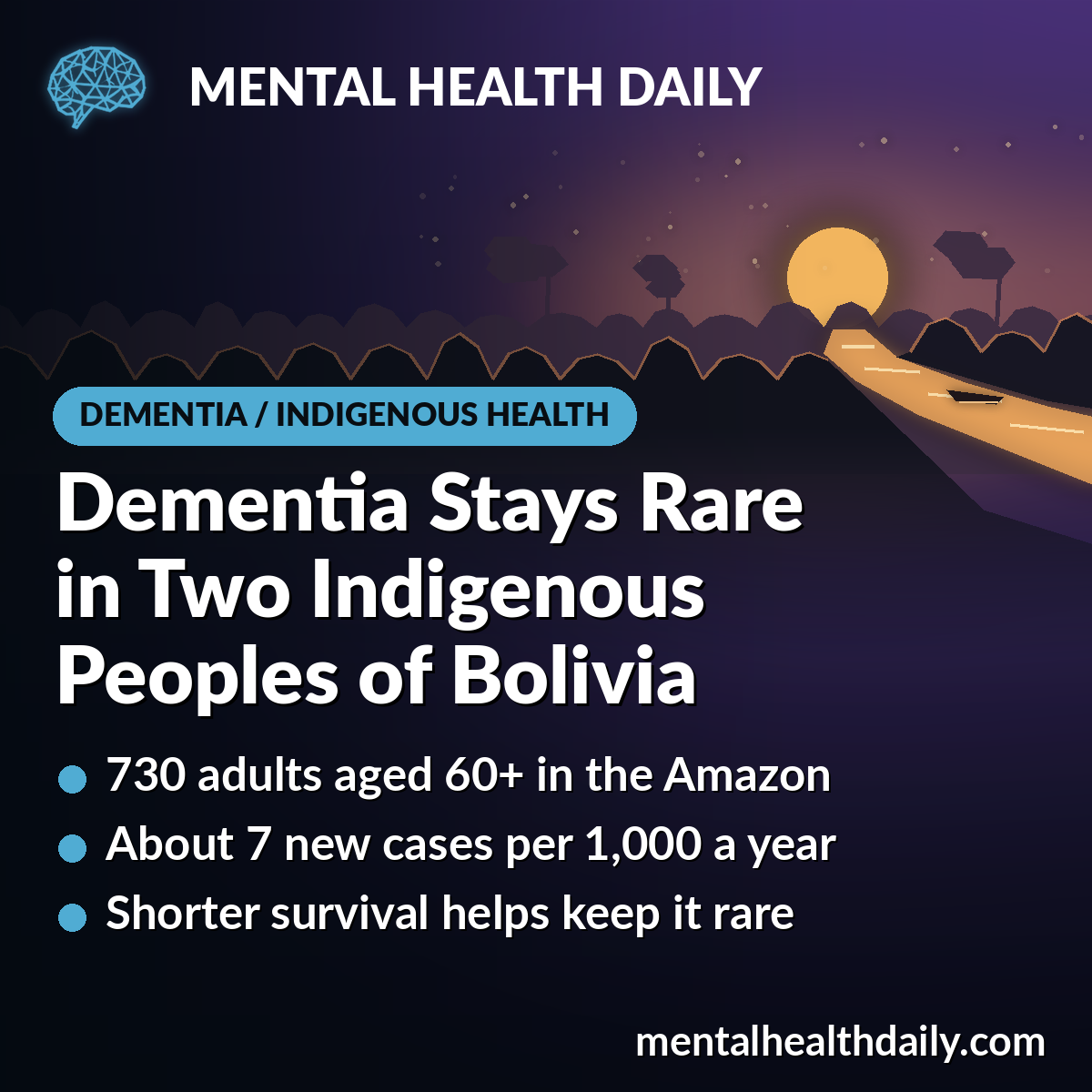
Dementia remains uncommon among older Tsimane and Moseten adults, two Indigenous peoples of the Bolivian Amazon. A 2026 follow-up study found that about 7 in every 1,000 people aged 60 and older developed dementia each year, and only about 2% were living with it at any one time.1
Research Highlights
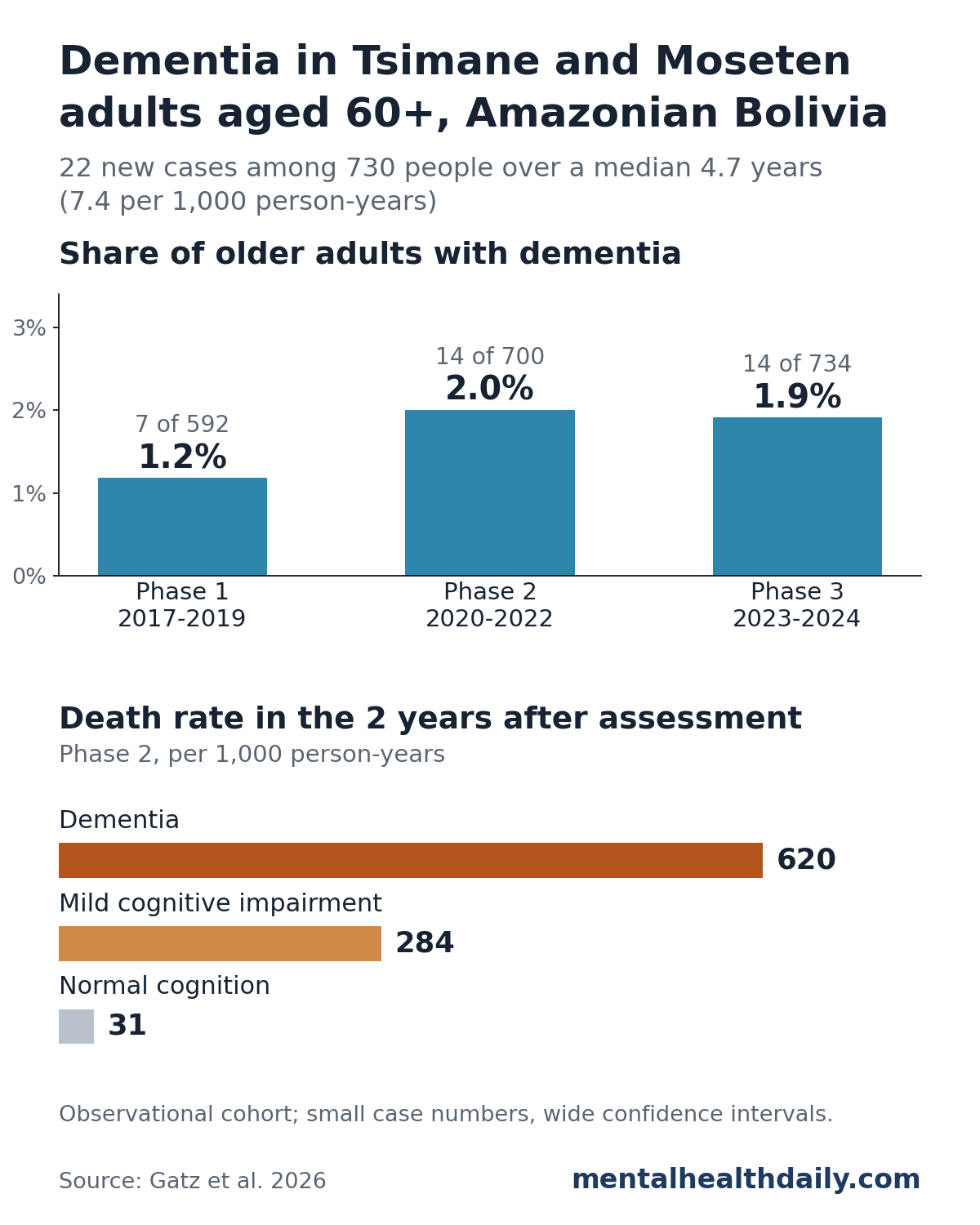
- New cases were few: 22 of 730 adults without dementia developed it over a median 4.7 years, a rate of 7.40 per 1,000 person-years (95% CI 4.87–11.24).1
- Prevalence stayed low: 2.00% of adults 60+ had dementia in the second assessment round and 1.91% in the third, close to the 1.18% seen at baseline.1
- Survival after diagnosis was short: people with dementia had about 6 times the death risk of cognitively normal peers (hazard ratio 6.14), and every person with dementia at baseline had died by the end of follow-up.1
- Age-specific risk looked familiar: before about age 80, yearly risk at each age was in the same range as in European and US studies, so shorter survival explains part of the low prevalence.1
- APOE ε4 stood out as a risk factor: 53% of genotyped cases carried it vs. 20% of people who stayed dementia-free.1
Who the Tsimane and Moseten Are and How the Study Worked
The Tsimane and Moseten live in villages in lowland Bolivia and still get much of their food from farming, fishing, hunting and foraging. They are physically active, eat a high-fiber, low-sugar diet, and have low rates of high blood pressure, obesity and diabetes. They also face heavy infection burdens, little medical care and frequent food insecurity.1
Gatz et al. worked through the Tsimane Health and Life History Project, which has partnered with these communities since 2002 (Tsimane) and 2015 (Moseten). Tsimane and Moseten governments and village leaders approved the protocols. The team invited everyone aged 60 or older in 89 Tsimane and 16 Moseten villages.1
- Three rounds: 2017–2019, 2020–2022 and 2023–2024, with 97% and 91% participation in the two follow-up rounds
- Adapted testing: most participants never went to school, so cognitive tests swapped reading and drawing items for tasks such as copying a design with matchsticks, and scores were compared with local norms by age, sex and literacy
- Diagnosis: the same Bolivian physician examined people in every round, interviewing Tsimane in their own language; two independent teams then applied standard DSM-5 criteria for dementia and mild cognitive impairment (MCI), meaning measurable decline that does not yet take away independence
- Deaths: when a participant died before the next visit, the team interviewed a relative, which they managed for 98 of 108 deaths
Dementia Incidence: 7.4 New Cases per 1,000 Person-Years
Incidence counts new cases over time; prevalence is the share of people who have the condition at a given moment. Incidence was nearly identical in the two peoples: 7.36 per 1,000 person-years in Tsimane and 7.49 in Moseten.1
Risk climbed steeply with age. Among Tsimane, the yearly rate rose from 1.48 per 1,000 at ages 65–69 to 20.28 at 75–79. Each age band held only a handful of cases, so these estimates have wide error bars.1
Rates were 8.71 per 1,000 in men and 6.09 in women, a difference that was not statistically significant. Of the 22 new cases, 14 had normal cognition at their first assessment and 8 already had MCI.1
Why Dementia Prevalence Stays Low: Shorter Survival After Diagnosis
Prevalence depends on two things: how many people develop a condition and how long they live with it. Among the Tsimane and Moseten, both play a part: incidence is modestly low, and people with dementia die much sooner.1
- Overall death risk: after adjusting for age, sex and population, the hazard of death was 6.14 times higher with dementia and 2.70 times higher with MCI than with normal cognition
- Two-year death rates: in the second round, 620 per 1,000 person-years with dementia vs. 31 with normal cognition
- By the end of follow-up: 100% of people with dementia at baseline had died, compared with 40% of those with MCI and 21% of those with normal cognition
The researchers estimate that survival with dementia is 2 to 3 times shorter than in the United States. Across all groups, death notes most often pointed to treatable infections such as tuberculosis, kidney failure and accidents, and stroke was mentioned in 30% of dementia deaths.1
In these communities everyone helps find food, so a person who can no longer farm or fish becomes harder for a family to support. The researchers suggest that poorer nutrition, untreated illness and other problems such as failing eyesight shorten survival further.1
How Tsimane Dementia Rates Compare With the US, Europe and Other Indigenous Groups
Overall incidence was modestly lower than most published European and US studies. Part of that gap reflects age structure: these populations have relatively few people in their 80s, the ages when dementia risk is highest.1
Age by age, the rates were in the same range as high-income cohorts, especially before 80. A pooled analysis of 7 US and European cohorts found rates rising from about 4 per 1,000 person-years at ages 65–69 to 65 at ages 85–89, with incidence falling 13% per decade since the late 1980s.2 MHD has covered one proposed reason for that decline in Falling Dementia Rates Linked to Generational Memory Gains.
Prevalence is a different story. The researchers estimate European and US prevalence at 3 to 4 times higher, consistent with their first round, which found some of the lowest dementia prevalence reported anywhere.13
Other Indigenous populations: Tsimane and Moseten incidence was 2 to nearly 3 times lower than the few published Indigenous estimates, which mostly come from Aboriginal Australians.1 In one cohort of 155 Aboriginal Australians aged 60 and older, mostly living in urban areas, the age-standardized rate was about 36 per 1,000 person-years.4 Gatz et al. note that high rates tend to appear where Indigenous communities have been forcibly settled or have adopted Western diets, with more hypertension and stroke.1
Risk Factors: APOE ε4 and Artery Calcium, Not Blood Pressure or Inflammation
The researchers tested a set of possible risk factors, adjusting each for age, sex and population. With only 22 cases, they describe these analyses as exploratory.1
- APOE ε4: this gene variant is the best-known inherited risk factor for Alzheimer’s disease. Carriers had about 5 times the hazard of dementia (HR 4.93, 95% CI 1.98–12.32), and the result held after correcting for multiple tests
- Thoracic aortic calcium: calcium buildup in the chest aorta, measured on CT scans, is a marker of hardened arteries and stroke risk. Scores above 500 appeared in 73% of cases vs. 35% of non-cases (HR 3.29)
- No clear signal: blood pressure, cholesterol and fasting glucose measured before baseline did not predict dementia, and inflammatory markers were also unrelated, contrary to the researchers’ prediction
Few people in these communities have high blood pressure, high blood sugar or obesity, so there was little variation for these factors to explain. A subsistence lifestyle may protect against dementia, but this study cannot test that directly.1
Blood Biomarkers Point to Vascular Damage More Than Typical Alzheimer’s
The team measured plasma markers of amyloid and phosphorylated tau, the two proteins that define Alzheimer’s disease biologically, plus neurofilament light chain (NfL), a protein released when nerve fibers are damaged. Only 11 dementia cases had a matching blood sample.1
Neither amyloid nor tau markers distinguished people with dementia from cognitively normal peers. Higher NfL was linked to dementia (odds ratio 2.81 per standard deviation), a sign of general nerve damage that does not point to one cause.1
Only 5 of the 22 new cases had a memory-led, Alzheimer’s-like pattern. Together with artery calcification seen on earlier brain scans, the researchers’ impression, which they call speculative, is that vascular brain injury drives more of the dementia here than classic Alzheimer’s does.1
Limitations of This Tsimane and Moseten Dementia Study
This is a careful population-based cohort with high participation, but it is observational and small. The main limits:
- Few cases: 22 dementia cases make age-specific and risk-factor estimates imprecise
- Hard diagnoses: illiteracy, widespread uncorrected vision and hearing loss, and limited imaging make dementia and especially MCI harder to classify
- Possible missed cases: post-death interviews were less often obtained for people with MCI, so some dementia may have gone uncounted, though the researchers judge the effect on incidence to be modest
- Uncertain ages and timing: many participants do not know their birth date, and only age at diagnosis, not age at onset, is known
- No midlife data: risk factors were measured in later life, after selective survival had already shaped who remained
- Cross-study comparisons: comparisons with Europe, the US and other Indigenous groups rely on published studies using different methods
The researchers expect rates may change as cell phone coverage, motorized canoes and motorcycles bring more market foods and less physical work, and as better medical care extends survival.1
References
- Gatz M, Mack WJ, Eid Rodriguez D, et al. Incidence of dementia and mild cognitive impairment in two Indigenous Bolivian cohorts. Alzheimer’s & Dementia. 2026;22:e71750. doi:10.1002/alz.71750
- Wolters FJ, Chibnik LB, Waziry R, et al. Twenty-seven-year time trends in dementia incidence in Europe and the United States: the Alzheimer Cohorts Consortium. Neurology. 2020;95(5):e519–e531. doi:10.1212/WNL.0000000000010022
- Gatz M, Mack WJ, Chui HC, et al. Prevalence of dementia and mild cognitive impairment in indigenous Bolivian forager-horticulturalists. Alzheimer’s & Dementia. 2023;19(1):44–55. doi:10.1002/alz.12626
- Lavrencic LM, Delbaere K, Broe GA, et al. Dementia incidence, APOE genotype, and risk factors for cognitive decline in Aboriginal Australians: a longitudinal cohort study. Neurology. 2022;98(11):e1124–e1136. doi:10.1212/WNL.0000000000013295