
Schisandrin B, a key compound in schisandra berries, eased anxiety-like behavior in rats on a standard maze test, with results similar to diazepam (Valium), according to a 2026 animal study.1
Research Highlights
- More time in exposed maze arms: in 48 male rats with fear-conditioned anxiety, 10 days of schisandrin B at 10 or 20 mg/kg increased time spent in the open arms of an elevated plus maze compared with untreated anxious rats (p < 0.05 and p < 0.01). The lowest dose, 5 mg/kg, did not.1
- No change in the open field: no dose of schisandrin B, and not diazepam either, significantly changed movement or center time in an open arena.1
- Calmer brain chemistry: at 10 mg/kg, schisandrin B lowered hippocampal glutamate (p < 0.001) and the glutamate-to-GABA ratio (p < 0.05), and reduced blood levels of 3 stress hormones (each p < 0.001).1
- Partial gut repair: fecal pH fell and one gut-wall sealing protein, claudin-1, recovered; colon length and 2 other sealing proteins did not change significantly.1
- Animal evidence only: small groups of male rats, a short-term fear model and no safety testing. Schisandra supplements are sold, but this study did not test them or any treatment in people.1
What Schisandrin B Is and Why It Was Tested for Anxiety
Schisandra (Schisandra chinensis) is a climbing vine whose red berries have long been used in traditional Chinese medicine for anxiety, insomnia and unease.2 In Soviet medicine of the 1960s it was classed as an adaptogen, a plant thought to raise resistance to stress.3
Today schisandra berry powders, extracts and teas are sold widely as supplements for stress and energy.
Schisandrin B is the most abundant member of a family of plant compounds called lignans in schisandra fruit. It is fat-soluble and small enough to cross from the blood into the brain.1
Anxiety disorders are among the most common mental disorders worldwide.4 Benzodiazepines such as diazepam work quickly, but they can cause sedation, tolerance and dependence, which is why researchers keep looking for other options.1
How Tian et al. Tested Schisandrin B in Anxious Rats
Jia-Yu Tian et al., at Heilongjiang University of Chinese Medicine in Harbin, China, used fear conditioning to create anxiety-like behavior. Rats heard a tone paired with a mild foot shock, repeated every minute over 15-minute sessions, across 4 days.1
Researchers randomly assigned 48 male Sprague-Dawley rats to 6 groups of 8:1
- Control: tone only, no shock
- Model: fear conditioning, no treatment
- Diazepam: fear conditioning plus 5.2 mg/kg diazepam, a standard anti-anxiety drug used as the comparison
- Schisandrin B low, medium and high: fear conditioning plus 5, 10 or 20 mg/kg schisandrin B
Each treatment was given by mouth once a day for 10 days after the conditioning period. Behavior was tested 24 hours after the last dose.1
Two tests measured anxiety-like behavior:
- Elevated plus maze: a raised, plus-shaped platform with 2 walled arms and 2 open arms. Anxious rats avoid the exposed open arms, so more time there is read as less anxiety.
- Open field test: a large open box. Anxious rats hug the walls and avoid the center.
Schisandrin B Increased Open-Arm Time in the Maze but Not Open-Field Behavior
Untreated anxious rats spent far less time in the maze’s open arms than control rats (p < 0.001). Schisandrin B reversed part of that drop:1
- 5 mg/kg: no significant change
- 10 mg/kg: more open-arm time (p < 0.05)
- 20 mg/kg: more open-arm time (p < 0.01)
- Diazepam: more open-arm time (p < 0.001)
The share of maze time spent in the open arms showed the same pattern. The 10 and 20 mg/kg doses did not differ from each other, so the researchers used 10 mg/kg for all the biology that followed.1
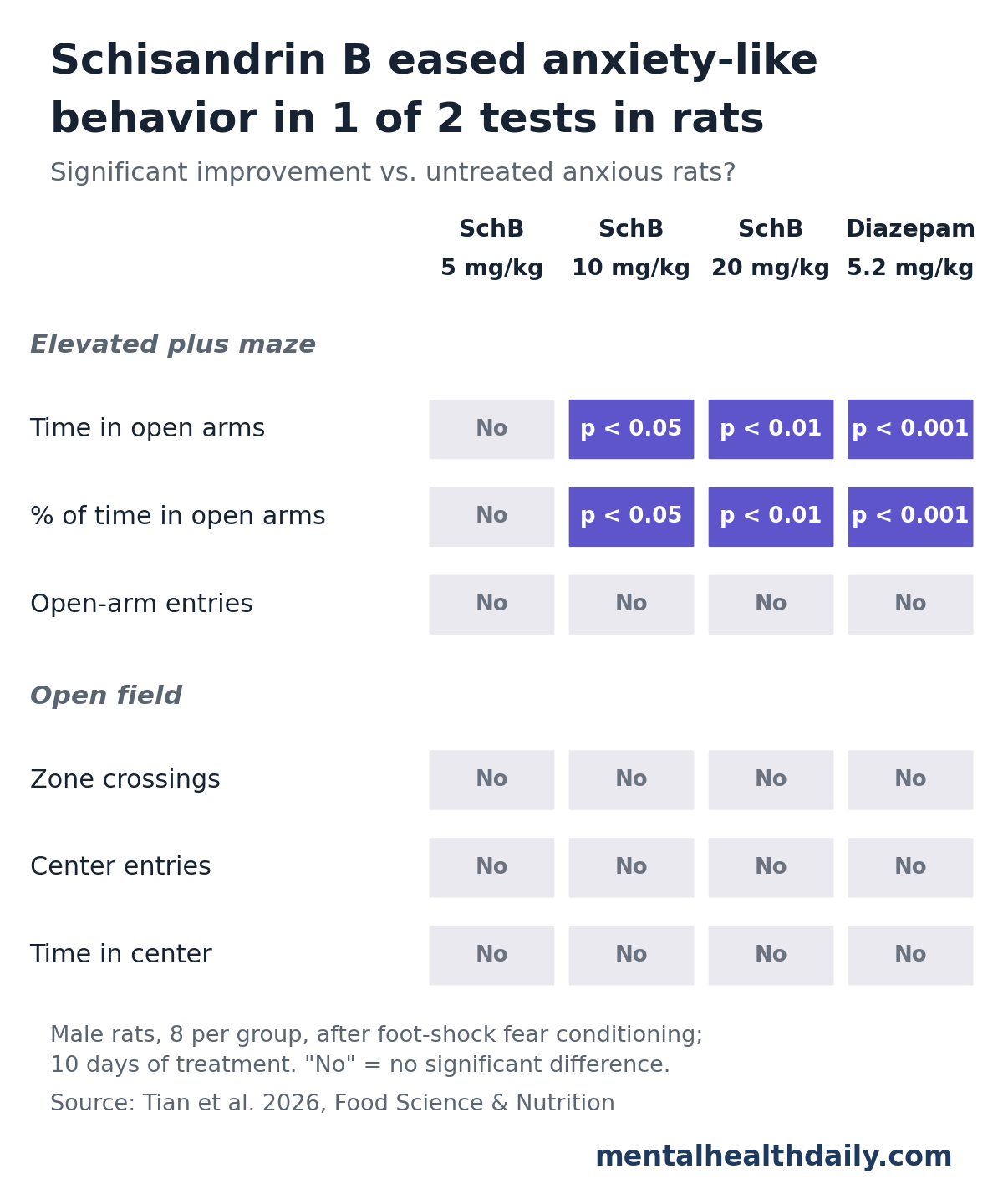
Open-arm entries: the paper’s text says treatment improved this measure too, but its figure shows no significant difference for any treated group.1
Open field: anxious rats spent less time in the center than controls (p < 0.05). Neither schisandrin B nor diazepam changed center time, center entries or zone crossings significantly.1
The open-field equipment did not record total distance or speed. The researchers acknowledged that they could not fully rule out changes in general movement, although maze open-arm time depends less on motor activity.1
Schisandrin B Lowered Glutamate and Stress Hormones in Anxious Rats
Glutamate is the brain’s main “go” signal and GABA its main “brake.” Too much glutamate activity relative to GABA in the hippocampus, a memory and emotion hub, has been linked to anxiety.1
In anxious rats, GABA fell and the glutamate-to-GABA ratio rose. Schisandrin B at 10 mg/kg lowered hippocampal glutamate (p < 0.001) and brought the ratio back down (p < 0.05); its small rise in GABA was not significant.1
Glutamate receptors: fear conditioning raised levels of NMDA and AMPA receptor subunits, the docking sites that let glutamate excite neurons. Schisandrin B reduced most of them at both the gene-activity and protein level; one subunit, GluN2A, did not fall significantly at the protein level.1
Synapses: SYP and PSD-95, 2 proteins that hold synapses together on either side of the connection, dropped in anxious rats and rose again with schisandrin B (p < 0.001 and p < 0.05). Electron microscope images showed less swelling and synapse damage.1
Stress hormones: the HPA axis is the hormone chain linking the brain’s hypothalamus, the pituitary gland and the adrenal glands. Anxious rats had higher blood CRH, ACTH and corticosterone, and schisandrin B lowered all 3 (each p < 0.001), as diazepam did.1
Schisandrin B Partly Restored the Gut Barrier in Rats
The gut lining is sealed by tight junction proteins, which stitch neighboring cells together so bacterial products stay inside the gut. Stress can loosen these seals, and a leaky gut is thought to feed inflammation that reaches the brain.1
Results in the colon were mixed:1
- Fecal pH: rose in anxious rats and fell with schisandrin B (p < 0.001).
- Claudin-1: this sealing protein dropped in anxious rats and recovered with schisandrin B (p < 0.01).
- Occludin and ZO-1: trended upward with schisandrin B, but not significantly.
- Colon length: shortened in anxious rats, with no significant recovery.
- Tissue images: stained colon sections showed better-preserved lining and less inflammatory cell buildup.
Gut bacteria also shifted. Schisandrin B-treated rats had more Lachnospiraceae NK4A136 group bacteria, while Lactobacillus and Prevotella were more abundant in untreated anxious rats than in the other groups.1
An earlier rat study found similar results with whole schisandra fruit: raw and wine-processed schisandra reduced anxiety-like behavior and reversed some stress-related gut bacteria changes.2
Limitations of This Schisandrin B Rat Study
This is an early-stage animal experiment. It shows that schisandrin B improved anxiety-like behavior on one maze test in male rats; it does not show that schisandrin B or schisandra supplements treat anxiety in people.
- Male rats only: the researchers noted that anxiety differs by sex and no females were studied.
- Small groups: 8 rats per group for behavior; the number of animals behind each lab measure was not reported.
- One of 2 behavior tests: the benefit appeared in the maze but not in the open field.
- Short-term fear model: a few days of foot-shock conditioning and 10 days of treatment do not mirror a long-lasting human anxiety disorder.
- Mechanism by association: the brain and gut changes were measured alongside behavior, at one dose, without experiments that blocked a pathway to show cause.
- No safety testing: the researchers did not check liver, kidney or other organ toxicity.
- Thin reporting: results appear only as figures without exact group means or p-values, and parts of the text overstate the figures, such as the gut-barrier proteins.
Supplements: schisandra supplements are sold for stress, but this study tested a purified compound in rats, not any commercial product, and rat doses do not translate directly to people. Whether schisandrin B helps anxiety in humans is untested.
References
- Tian JY, Wang RZ, Wang HK, Ye XN, Li RX, Wang ZH, Huang LL, Wang YY. Mechanistic study of schisandrin B in alleviating anxiety-like behaviors in rats via enhancement of hippocampal synaptic plasticity and restoration of the intestinal barrier. Food Science & Nutrition. 2026;14:e72315. doi:10.1002/fsn3.72315
- Song Y, Shan B, Zeng S, et al. Raw and wine processed Schisandra chinensis attenuate anxiety like behavior via modulating gut microbiota and lipid metabolism pathway. Journal of Ethnopharmacology. 2021;266:113426. doi:10.1016/j.jep.2020.113426
- Panossian A, Wikman G. Pharmacology of Schisandra chinensis Bail.: an overview of Russian research and uses in medicine. Journal of Ethnopharmacology. 2008;118(2):183–212. doi:10.1016/j.jep.2008.04.020
- Penninx BW, Pine DS, Holmes EA, Reif A. Anxiety disorders. Lancet. 2021;397(10277):914–927. doi:10.1016/S0140-6736(21)00359-7