
Older adults in central Spain who reported depressive symptoms were more likely to have Alzheimer’s disease recorded as their cause of death over the next two decades, a 2026 study of 3,085 people found. The link was strongest in women.1
Research Highlights
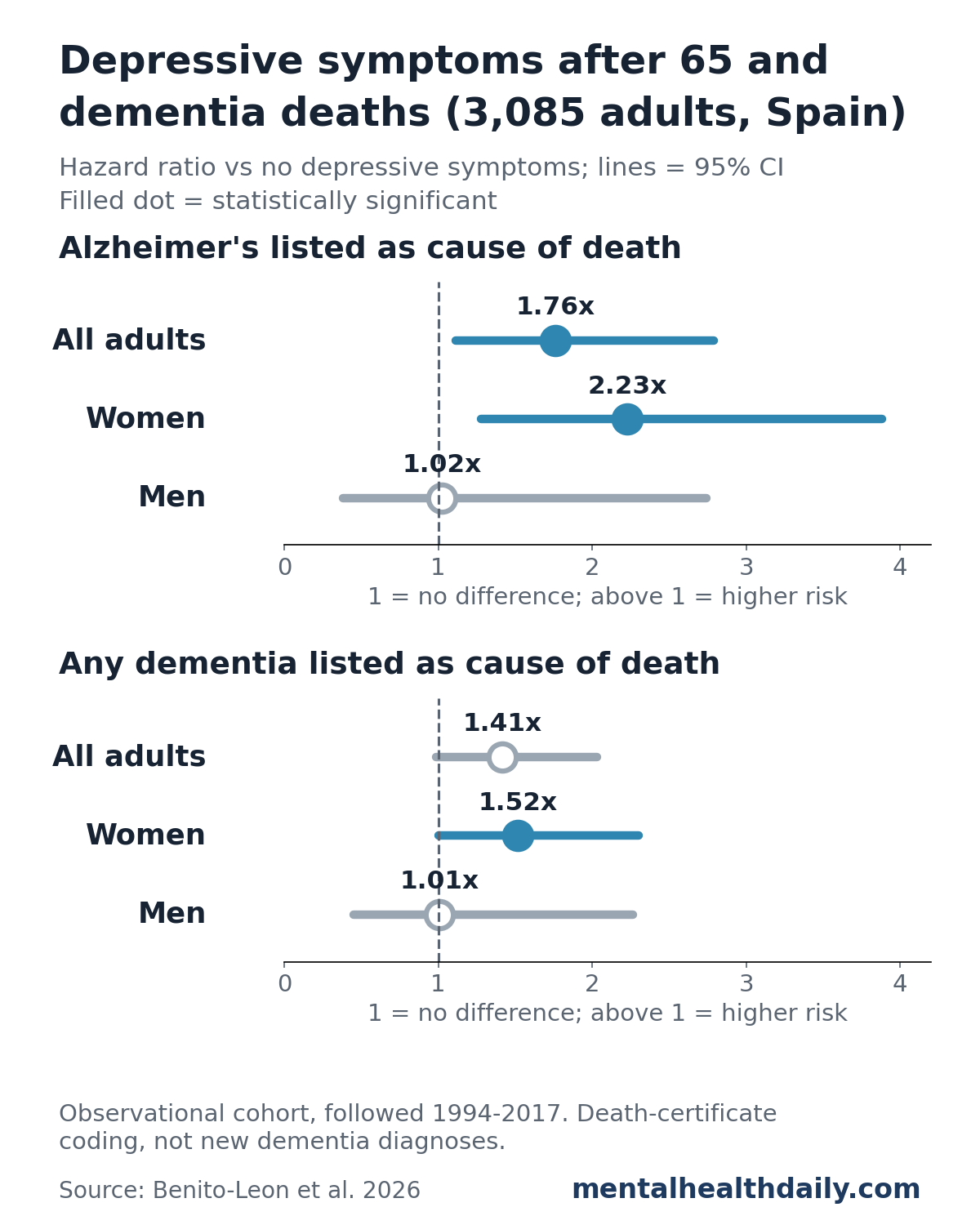
- Higher Alzheimer’s death risk: people with depressive symptoms at age 65 or older had a 1.76-times higher risk of dying with Alzheimer’s listed as the underlying cause of death (95% CI 1.11–2.79).1
- Strongest in women: among women, the figure was 2.23 times (95% CI 1.28–3.88); among men, there was no clear link.1
- Any dementia death: depressive symptoms were linked to higher dementia-coded death in women (1.52 times), but the estimate for all adults (1.41 times) did not reach statistical significance.1
- Long follow-up: participants were dementia-free when enrolled in 1994–1995 and were tracked through national death records to the end of 2017.1
- Lower risk is not protection: smoking and obesity were linked to fewer dementia-coded deaths, a pattern the researchers attribute mainly to people dying of other causes first.1
How the NEDICES Study Tracked Dementia Deaths in Older Adults
The data came from NEDICES (Neurological Disorders in Central Spain), a population-based study of adults aged 65 and older in three areas: a middle- to high-income Madrid district, a lower-income neighborhood in Getafe, and the rural county of Arévalo.1
Benito-León et al. kept only people who did not have dementia at entry and who had complete answers on 13 modifiable risk factors. That left 3,085 adults, with an average age of 73.4 years; 53.8% were women.1
- Depressive symptoms: measured with one yes/no question, “Do you suffer from depression?” A 50-person validation check within the cohort found 86% agreement (sensitivity 90.5%, specificity 82.8%). It flags significant symptoms, not a formal diagnosis of major depression.
- Other factors: diabetes, high blood pressure, high cholesterol, current smoking, current drinking, inactivity, living alone, hearing and vision problems, short or long sleep, obesity, and urban vs. rural residence.
- Outcome: dementia or Alzheimer’s recorded as the underlying cause of death (the disease that started the chain of events leading to death) on the death certificate.
Over up to 23 years, 182 participants (5.9%) died with dementia as the underlying cause, including 105 with Alzheimer’s. Far more, 2,423 (78.6%), died of something else, and 480 were still alive at the end of 2017.1
Competing-risk models handled that imbalance. A person who dies of a heart attack at 75 can never die of dementia at 88, so the Fine–Gray method the researchers used counts those other deaths as a “competing” outcome rather than ignoring them.
Its result, the subdistribution hazard ratio, compares how often each group ended up with a dementia-coded death in the real world.1
Women With Depressive Symptoms Had About Twice the Alzheimer’s Death Risk
Depressive symptoms were common at entry: 30.4% of women and 16.0% of men answered yes. Each estimate below was adjusted for age, the other 12 risk factors, and (for all adults) sex.1
- Alzheimer’s-coded death, all adults: 1.76 times higher (95% CI 1.11–2.79)
- Alzheimer’s-coded death, women: 2.23 times higher (95% CI 1.28–3.88)
- Any dementia-coded death, women: 1.52 times higher (95% CI 1.00–2.30), right at the edge of significance
- Any dementia-coded death, all adults: 1.41 times higher (95% CI 0.99–2.03), not statistically significant
- Men: close to no difference for either outcome (1.02 for Alzheimer’s, 1.01 for any dementia), with wide uncertainty
Depression already sits on the list of 14 modifiable dementia risk factors in the 2024 Lancet Commission report, which estimated that nearly half of dementia cases could in theory be prevented or delayed.2 A 2013 meta-analysis of 23 community cohorts found late-life depression was linked to a 1.65-times higher risk of developing Alzheimer’s.3
The Spanish result is consistent with that incidence research and carries it one step further: from getting dementia to dying of it.
The researchers suggest several possible pathways, including faster cognitive decline, lower brain reserve, poorer general health, less use of preventive care, and vascular or inflammatory changes. The study did not test any of them.1
Why Smoking and Obesity Looked “Protective” Against Dementia Death
Several known dementia risk factors pointed the other way. Current smokers had a 0.61-times risk of dementia-coded death, obese participants 0.57 times, and men with high blood pressure just 0.30 times. Vision problems were linked to lower Alzheimer’s-coded death (0.61 times).1
The researchers caution against reading any of these as protection and point to three explanations:
- Dying of something else first. Smokers, for example, die earlier of heart and lung disease, so fewer survive long enough for dementia to become the recorded cause. Earlier work showed that ignoring this competing risk compares nonsmokers only with the healthiest smokers.14
- Reverse causation. Weight and blood pressure often fall in the years before dementia is diagnosed, so low readings in late life can be an early symptom rather than a cause.
- Death-certificate habits. In people with heavy heart or vascular disease, doctors may list those conditions as the cause of death even when dementia was present.
Obesity and high blood pressure are established dementia risk factors when measured in midlife, and the researchers say midlife risk-factor control remains the most plausible way to lower dementia rates.1
Depression Accounted for the Largest Share of Alzheimer’s Deaths in Women
A population attributable fraction (PAF) estimates what share of deaths in a group is statistically linked to a risk factor, based on how common the factor is and how strong the link is. The calculation assumes the link is causal, which an observational study cannot show.1
- Depressive symptoms, women, Alzheimer’s-coded death: 27.2% (95% CI 7.8–46.7)
- Depressive symptoms, all adults, Alzheimer’s-coded death: 15.4% (95% CI 2.6–29.9)
- All risk-raising factors combined: 10.8% of dementia-coded deaths and 18.2% of Alzheimer’s-coded deaths overall, rising to 41.1% of Alzheimer’s-coded deaths in women
The combined figure for dementia deaths was much smaller than the roughly 45% estimate for preventable dementia cases. The researchers expected that: they measured risk factors only in late life, their outcome came after both getting dementia and surviving with it, and death certificates often leave dementia off.1
Limitations of This Spanish Dementia Mortality Study
This is an observational cohort, so it shows associations, not cause and effect. Several features limit how far the depression result can go:
- One question, asked once: depressive symptoms came from a single yes/no item at entry, with no tracking of later mood or treatment.
- Late-life timing: depression after 65 can be an early sign of the brain changes that lead to dementia, so some of the link may run in reverse.
- Death certificates, not diagnoses: the study measured whether dementia was recorded as the cause of death, not who developed dementia. Dementia is often missing from death certificates.
- Sensitive to modeling: when education replaced urban vs. rural residence in the models, the depression link in women weakened (1.52 times for Alzheimer’s-coded death, 1.18 for any dementia) and was no longer statistically significant.
- Missing data: 1,805 people were dropped for incomplete answers. Those analyzed were younger and less often female than those excluded, which could shift the estimates for women.
- Few events in men: the Alzheimer’s analysis in men had wide confidence intervals, so a modest link could have been missed.
What the Findings Mean for Depression in Older Women
Of 13 late-life factors, depressive symptoms were the one most consistently linked to having dementia or Alzheimer’s recorded as the cause of death, especially among women. The researchers conclude that the findings support better recognition and management of depressive symptoms in older adults, particularly women, and call for confirmation in other cohorts.1
Depression in later life is treatable in its own right. The study did not test whether treating it changes dementia outcomes, but persistent low mood after 65 is worth raising with a doctor regardless.
References
- Benito-León J, Serrano JI, del Castillo MD, et al. Population-based cohort study of modifiable risk factors for dementia and Alzheimer disease mortality in Spain. Communications Health. 2026;1(1):26. doi:10.1038/s44528-026-00022-5
- Livingston G, Huntley J, Liu KY, et al. Dementia prevention, intervention, and care: 2024 report of the Lancet standing Commission. The Lancet. 2024;404(10452):572–628. doi:10.1016/S0140-6736(24)01296-0
- Diniz BS, Butters MA, Albert SM, Dew MA, Reynolds CF. Late-life depression and risk of vascular dementia and Alzheimer’s disease: systematic review and meta-analysis of community-based cohort studies. British Journal of Psychiatry. 2013;202(5):329–335. doi:10.1192/bjp.bp.112.118307
- Chang CC, Zhao Y, Lee CW, Ganguli M. Smoking, death, and Alzheimer disease: a case of competing risks. Alzheimer Disease & Associated Disorders. 2012;26(4):300–306. doi:10.1097/WAD.0b013e3182420b6e