
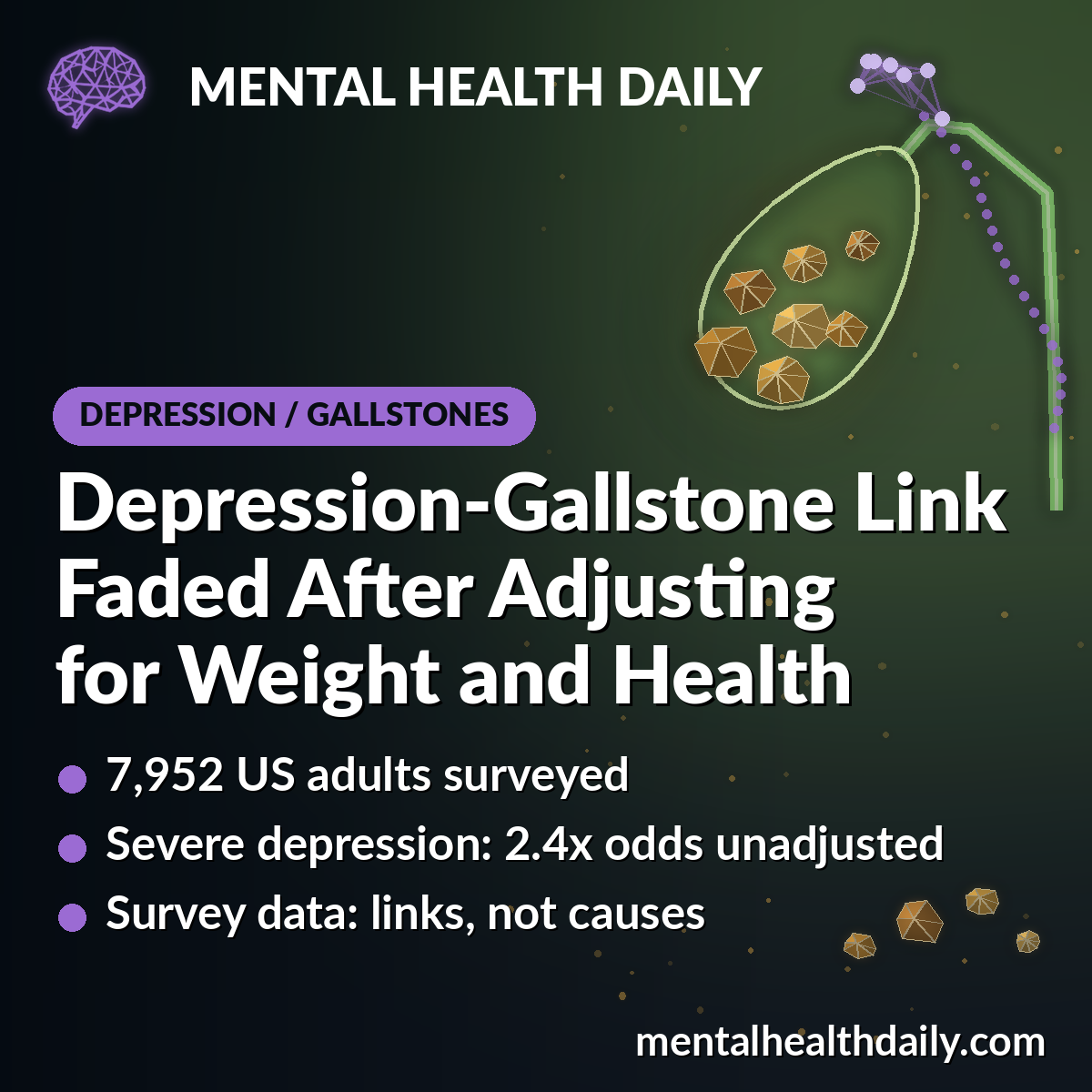
US adults who screened positive for depression were more likely to report a gallstone diagnosis, and the odds were highest among people with the most severe symptoms. Much of that link faded once weight, smoking and other health conditions were taken into account.1
Research Highlights
- Depression was linked to higher gallstone odds: among 7,952 adults in the 2017–2023 National Health and Nutrition Examination Survey (NHANES), people with depression had 61% higher odds of a gallstone diagnosis (OR = 1.61, 95% CI 1.13–2.29).1
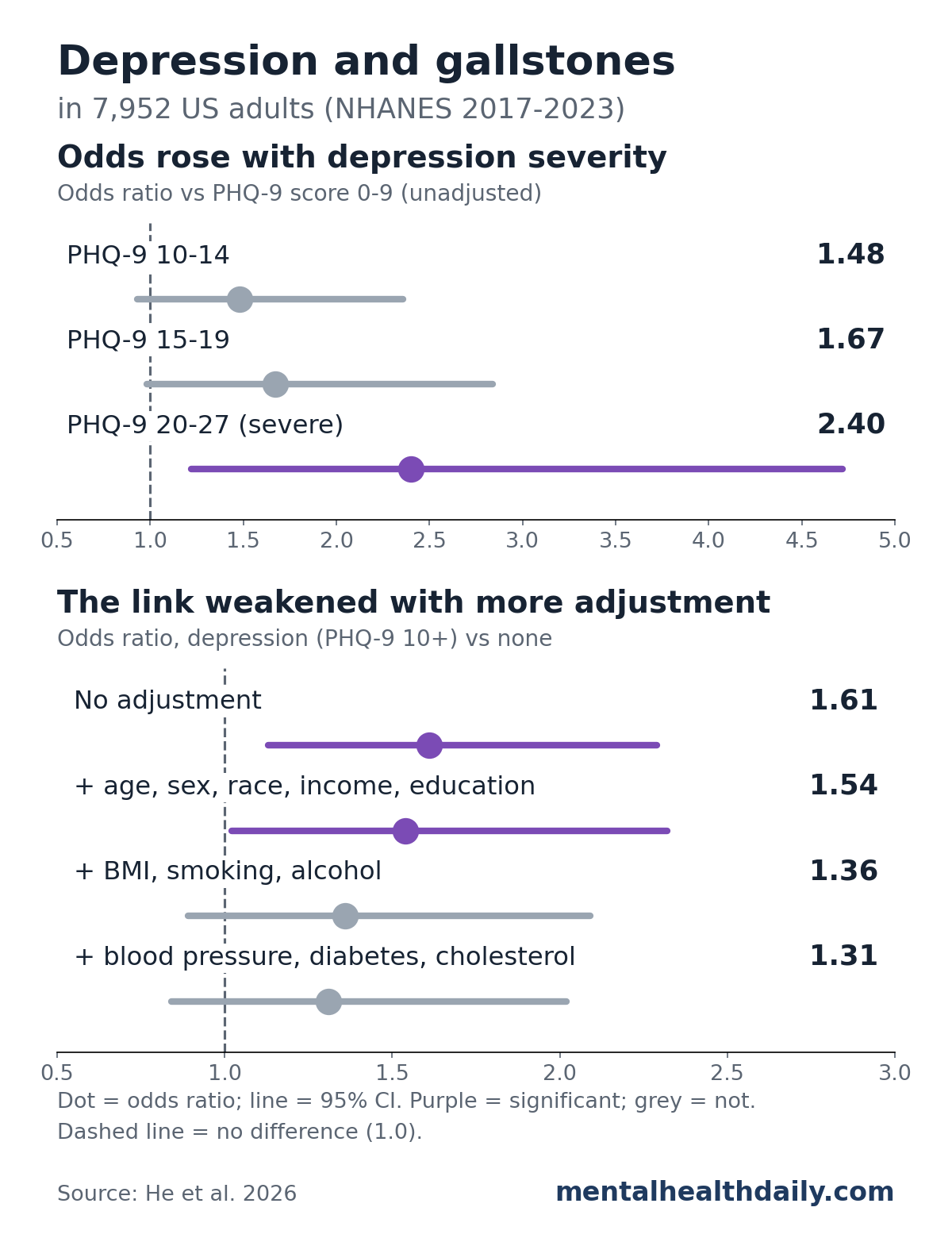
- Severe symptoms carried the highest odds: people scoring 20–27 on the PHQ-9 depression questionnaire had 2.4 times the odds of people scoring 0–9 (OR = 2.40, 95% CI 1.22–4.72).1
- The link weakened after full adjustment: with weight, smoking, alcohol, high blood pressure, diabetes and high cholesterol accounted for, the odds ratio fell to 1.31 and was no longer statistically significant.1
- Smoking and body weight each explained about 6%: a statistical mediation analysis attributed 6.3% of the link to smoking and about 6% to body mass index (BMI).1
- Depression became more common: the share of US adults with depression rose from about 5.5% in 2005–2006 to about 12.5% in 2021–2023, with a sharp jump after 2020.1
How the NHANES Study Measured Depression and Gallstones
He et al., a biliary surgery group at West China Hospital, analyzed NHANES, a long-running US government survey that combines interviews, physical exams and lab tests in a sample weighted to represent the US adult population. Their report appeared in Depression and Anxiety in 2026.1
- Depression: a score of 10 or more on the PHQ-9, a 9-item questionnaire that rates how often depression symptoms occurred over the past 2 weeks (total range 0 to 27). It is a screening tool, not a clinical diagnosis.
- Gallstones: answering yes to “Has a doctor or other health professional ever told you that you had gallstones?” NHANES only began asking this in 2017, which is why the gallstone analysis covers 2017–2023.
- Sample: 7,952 adults, weighted to represent about 146 million noninstitutionalized US adults; 9.1% screened positive for depression and 8.6% reported gallstones.
Gallstones are hard deposits, most often made of cholesterol, that form in the gallbladder, the small sac under the liver that stores bile for digesting fat. Many cause no symptoms, but stones that block bile flow can cause intense upper-abdominal pain, and they are the main reason people have their gallbladder removed.
Results are reported as odds ratios (ORs), which compare the odds of having had a gallstone diagnosis in one group with the odds in another. An OR of 1.0 means no difference; 1.61 means 61% higher odds.
Depression Was Linked to 61% Higher Odds of Gallstones
Among adults who reported gallstones, 13% screened positive for depression, compared with 8.7% of adults without gallstones. Without any adjustment, depression was linked to 1.61 times the odds of a gallstone diagnosis.1
Gallstone odds also climbed step by step with PHQ-9 score:
- PHQ-9 10–14 (moderate): OR 1.48 (95% CI 0.93–2.36), not statistically significant
- PHQ-9 15–19 (moderately severe): OR 1.67 (0.98–2.84), just short of significance
- PHQ-9 20–27 (severe): OR 2.40 (1.22–4.72)
- Each additional PHQ-9 point: OR 1.05 (1.03–1.06)
A pattern where higher exposure goes with higher odds is called a dose–response relationship. These severity estimates were unadjusted, though, and the researchers reported that the trend lost statistical significance once other factors were added to the models.1
Weight, Smoking and Health Conditions Explained Much of the Link
The researchers added potential confounders (other factors that could drive both depression and gallstones) in 3 steps:
- Age, sex, race, education and income: OR 1.54 (95% CI 1.02–2.32), still significant
- Plus BMI, smoking and alcohol: OR 1.36 (0.89–2.09), not significant
- Plus high blood pressure, diabetes and high cholesterol: OR 1.31 (0.84–2.02), not significant
The estimate stayed above 1.0 in every model, so the data still lean toward a link. In the final model, though, the confidence interval ran from 16% lower odds to about double the odds, which leaves the adjusted result uncertain. The researchers listed limited statistical power, overadjustment and leftover confounding as possible explanations.1
Who had gallstones: compared with adults without gallstones, those with gallstones were:1
- Older: median age 55 vs. 44
- More often women: 74% vs. 48%
- Heavier: median BMI 32 vs. 28
- More likely to have smoked: 51% vs. 41%
- More likely to have high blood pressure or diabetes: 46% vs. 28% and 16% vs. 8.5%
Several of these factors are also common in people with depression, which helps explain why adjustment shrank the link.
Smoking and BMI Accounted for Only a Small Share
Mediation analysis is a statistical method that estimates how much of a link between 2 factors runs through a third factor. Here, it tested whether depression’s link to gallstones passed through smoking (at least 100 lifetime cigarettes) or higher BMI.1
- Smoking: 6.3% of the total link
- BMI: about 6% of the total link
Both shares are small, which leaves most of the association unexplained by these 2 factors. Because all measures were taken at the same time, the researchers called this mediation analysis exploratory: it cannot show that depression leads to smoking or weight gain, which then leads to gallstones.1
Possible Pathways Between Depression and Gallstones
The study team proposed several ways depression could raise gallstone risk. None was measured directly in this analysis:1
- Lifestyle: changes in appetite, less physical activity and less healthy eating, leading to weight gain and unhealthy blood fats
- Stress hormones: overactivity of the HPA axis (hypothalamic–pituitary–adrenal axis, the body’s main stress-hormone system) raises cortisol, which may slow gallbladder emptying and change bile composition
- Inflammation: low-grade chronic inflammation, common in depression, may promote cholesterol crystals in bile and inflammation in gallbladder tissue
The reverse direction is also plausible. Painful gallstone attacks can disrupt sleep, eating and daily life, which could raise depression scores.
Earlier Studies Found a Similar Depression–Gallstone Link
A 2024 study by Wang et al. analyzed 7,707 NHANES participants and found higher gallstone odds with mild (OR 1.58) and moderate (OR 2.07) depression.2
In the same paper, a Mendelian randomization analysis, which uses inherited gene variants as a stand-in for depression risk to reduce confounding, linked genetically predicted depression to higher gallstone risk (OR 2.06).2
A 2023 study by Li et al. combined a cohort analysis with Mendelian randomization. Probable depression was linked to a higher 5-year risk of gallstone disease (relative risk 1.33). Waist circumference accounted for 25.8% of the genetic link, far more than the roughly 6% BMI share in the 2026 NHANES analysis, though the methods differ.3
Limitations of This NHANES Gallstone Analysis
- Snapshot design: depression and gallstones were measured at the same time, so the study cannot tell which came first.
- Self-reported gallstones: people with silent, undiagnosed stones were counted as gallstone-free, and some reports may be wrong.
- Screening-based depression: a PHQ-9 score of 10 or more flags likely depression but is not a clinical diagnosis.
- Missing factors: detailed diet, genetics and medication use were not accounted for.
- Lost significance: the main association did not hold up statistically after adjustment for weight, smoking, alcohol and other health conditions.
What the Depression–Gallstone Findings Mean in Practice
The researchers suggested that doctors keep gallstones in mind for people with depression, especially women and people with obesity or metabolic problems. This study alone cannot support routine gallstone screening, since the adjusted link was uncertain and the timing of the 2 conditions is unknown.
The clearest overlap runs through shared risk factors such as excess weight, smoking and diabetes. Steady upper-right or upper-middle abdominal pain, especially after fatty meals, is worth checking with a doctor whether or not someone has depression.
The study also documented a rise in depression among US adults: roughly 1 in 8 screened positive in 2021–2023, more than twice the share in 2005–2006, and rates were higher in women than in men in every survey cycle.1
References
- He E, Wang Y, Nie G, et al. Trends in depression and its association with gallstones: evidence from NHANES with exploration of mediating pathways. Depression and Anxiety. 2026;2026:1800832. doi:10.1155/da/1800832
- Wang B, Xiong Y, Li R, Zhang S. Depression increases the risk of gallstone: a cross-sectional study and Mendelian randomization analysis. Journal of Affective Disorders. 2024;362:606–614. doi:10.1016/j.jad.2024.07.119
- Li J, Zhang J, Kong B, et al. Abdominal obesity mediates the causal relationship between depression and the risk of gallstone disease: retrospective cohort study and Mendelian randomization analyses. Journal of Psychosomatic Research. 2023;174:111474. doi:10.1016/j.jpsychores.2023.111474