
In a survey of 210 psychiatric patients in Croatia, none of the 4 “Dark Tetrad” personality traits had a direct link with suicidal thoughts. Sadistic traits were linked to more severe suicidal thoughts only by way of higher stress.1
Research Highlights
- Stress carried the link: higher sadism scores went with higher stress, and higher stress went with more severe suicidal thoughts. This indirect path was statistically significant (B = 0.147; 95% CI 0.037–0.291).1
- No direct trait link: once depression, anxiety and stress were in the model, none of the 4 traits had a significant direct link with suicidal thoughts.1
- Depression had the strongest link: depression tracked suicidal thoughts most closely (r = 0.56), ahead of stress (0.51) and anxiety (0.47). Each trait’s link was 0.23 or lower.1
- Held up in checks: the stress path remained after adjusting for age, sex, hospital stay and diagnosis, and after dropping the smallest diagnostic groups.1
- One survey at one time point: the design cannot show that the traits cause stress or that stress causes suicidal thoughts.1
If you are struggling or thinking about suicide, help is available right now. In the US, call or text 988 to reach the 988 Suicide & Crisis Lifeline. Elsewhere, contact your local emergency number or crisis service.
What the 4 Dark Tetrad Personality Traits Measure
The Dark Tetrad is a research name for 4 personality traits that tend to strain relationships with other people. Everyone sits somewhere on each trait, and a higher score is not a diagnosis.
- Machiavellianism: a strategic, cynical style of dealing with people, including a willingness to manipulate.
- Narcissism: a sense of grandiosity and entitlement, with a strong need for admiration.
- Psychopathy: callousness, lower empathy and impulsivity.
- Sadism: a tendency to take pleasure in other people’s suffering. Studied in ordinary people rather than in criminal cases, it is often called everyday sadism.
Most research on these traits has looked at outward behavior such as aggression or online trolling. Far less has looked at how they relate to a person’s own distress, and few studies have tested all 4 traits together in adults receiving psychiatric care.1
How the Croatian Study Measured Personality, Stress and Suicidal Thoughts
Marin Mamić et al. invited consecutive patients at General County Hospital Požega between July 2025 and May 2026. Of 256 eligible patients, 210 completed usable questionnaires.1
- Patients: mean age 42.7, 51.9% women, 41.9% hospitalized. All had to be stable enough to give consent and fill out the forms.
- Diagnoses: neurotic, stress-related and somatoform disorders, a group that includes anxiety disorders (105), alcohol use disorders (50), depressive disorders (30), bipolar disorder (15) and psychotic disorders (10).
- Personality: the Short Dark Tetrad (SD4), a 28-item questionnaire with 7 items per trait.
- Distress: the DASS-21, which scores depression, anxiety and stress over the past week. Its stress scale covers tension, irritability and trouble relaxing.
- Suicidal thoughts: the Suicidal Ideation Attributes Scale (SIDAS), 5 questions on the past month, including how often the thoughts came, how distressing they were and how much they got in the way of daily life. Scores run from 0 to 50.
Suicidal thoughts were common in this group: 118 patients (56.2%) reported at least some in the past month, and 92 (43.8%) scored 0. The median score was 10.1
The researchers then used a statistical mediation model. This kind of analysis asks whether a trait’s link with suicidal thoughts runs through another measure, here depression, anxiety or stress. With data from a single survey, it describes how the scores fit together, not what causes what.
Depression and Stress Had the Strongest Links to Suicidal Thoughts
Before any modeling, simple correlations showed distress symptoms lined up with suicidal thoughts far more closely than personality did. A correlation (r) runs from 0 for no link to 1 for a perfect match:1
- Depression: r = 0.56
- Stress: r = 0.51
- Anxiety: r = 0.47
- Psychopathy and sadism: r = 0.23 each
- Machiavellianism: r = 0.20
- Narcissism: r = 0.14, not statistically significant
When depression, anxiety and stress were entered together, depression and stress each kept an independent link with suicidal thoughts. Anxiety did not, likely because it overlaps heavily with the other two.1
Sadistic Traits Were Linked to Suicidal Thoughts Only Through Stress
Of the 4 traits, sadism had the clearest link with distress. It correlated more strongly with stress (r = 0.40) than with suicidal thoughts themselves (r = 0.23).1
In the full model, the pattern looked like a chain:1
- Sadism to stress: patients with higher sadism scores reported more stress (standardized estimate 0.29).
- Stress to suicidal thoughts: patients with more stress reported more severe suicidal thoughts (0.23), even with depression and anxiety in the model.
- No direct step: sadism had no direct link with suicidal thoughts once stress was accounted for (−0.01, not significant).
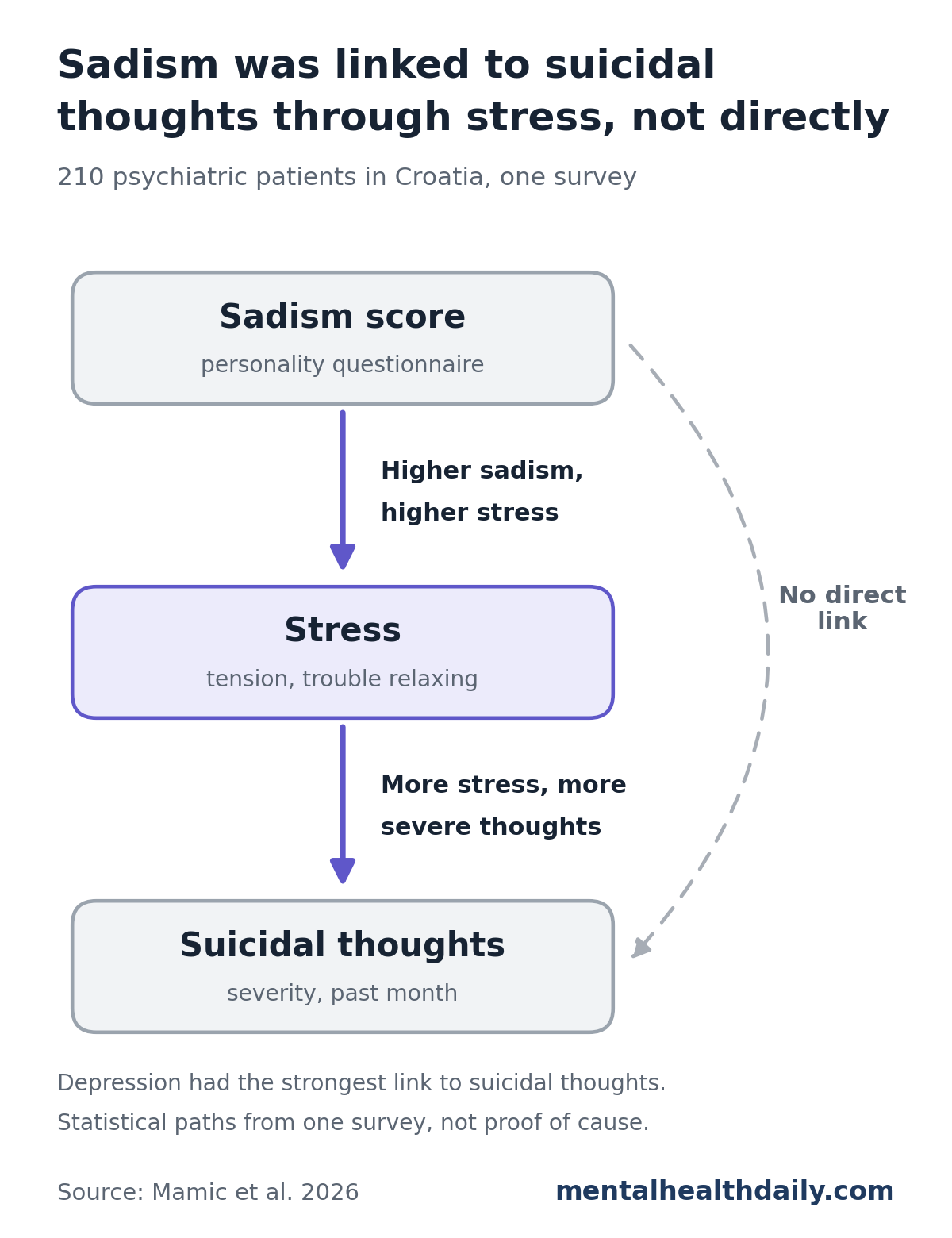
The indirect path through stress was the only one of 12 indirect paths tested that reached statistical significance. Paths through depression and anxiety, and every path for Machiavellianism, narcissism and psychopathy, were not significant.1
Robustness checks: the sadism-to-stress-to-suicidal-thoughts path stayed significant in 2 further analyses, though its lower confidence limit moved close to zero each time:1
- Adjusted for age, sex, hospital stay and diagnosis: B = 0.126 (95% CI 0.016–0.266)
- Without the bipolar and psychotic groups (185 patients): B = 0.115 (95% CI 0.006–0.259)
The effect was small. Sadism’s overall link with suicidal thoughts, adding direct and indirect paths together, was not statistically significant.1
Hospitalized patients scored higher: patients who were hospitalized scored about 5.7 points higher on the SIDAS than outpatients after adjustment. That may reflect more severe illness among inpatients rather than an effect of the hospital itself, the researchers note.1
Depression Linked to Having Suicidal Thoughts, Stress to Their Severity
Because so many patients scored 0, the team split the question in 2: who had any suicidal thoughts, and how severe they were among the 118 who did.1
- Having any suicidal thoughts: linked to higher depression scores and to being hospitalized. None of the 4 traits was linked.
- How severe they were: linked to higher stress and higher sadism scores, but not to depression or anxiety.
The researchers treat the sadism-severity finding with caution, since it came from a smaller subgroup and did not show up as a direct link in the full sample.1
A two-wave study of Chinese adolescents found a similar indirect pattern for related traits: the shared core of narcissism, Machiavellianism and psychopathy, along with Machiavellianism on its own, was linked to suicidal thoughts through feeling socially alienated.2
Personality Scores Are Not a Suicide Screening Tool
Mamić et al. state plainly that Dark Tetrad scores should not be used to label patients as suicidal or not, and that the results do not justify stigmatizing people who score high on these traits.1
That caution fits the wider evidence. A meta-analysis of 365 studies spanning 50 years found that individual risk factors predicted suicidal thoughts and behaviors only slightly better than chance.3
Where the findings point instead: personality traits change slowly, but stress, coping and emotion regulation can be worked on. The researchers suggest clinicians look at whether ongoing conflict with others, hostility, poor coping or sustained stress is part of what a patient is dealing with.1
Whether stress-management, emotion-regulation or interpersonal coping programs would ease suicidal thoughts in patients with high scores on these traits has not been tested. The researchers name this as a question for future trials.1
Limitations of This Single-Hospital Survey
This was a cross-sectional study, meaning everything was measured once. It can show which scores go together, but not which came first.1
- Direction unknown: suicidal thoughts or distress could raise reported stress, rather than the reverse.
- Self-report only: people may underreport traits that are seen as socially undesirable.
- Mismatched time frames: the DASS-21 covered the past week and the SIDAS the past month.
- Small, mixed groups: one hospital, broad diagnostic groups, and only 10 and 15 patients with psychotic and bipolar disorders.
- Most acute patients excluded: people too unwell to complete questionnaires were not included.
- Missing risk factors: no data on past suicide attempts, self-harm, hopelessness, social support, trauma, impulsivity or medications.
Longer studies that measure traits, stress and suicidal thoughts several times would be needed to show whether stress actually connects these traits to suicidal thoughts over time.
References
- Mamić M, Farčić N, Barać I, Mudri Ž, Barišić M, Kljaić Bukvić B, Mamić I, Puharić Z, Vukoja I. Dark Tetrad traits and suicidal ideation in psychiatric patients: the role of depression, anxiety, and stress. Behavioral Sciences. 2026;16:1606. doi:10.3390/bs16091606
- Wang C, Guo J, Zhou X, Shen Y, You J. The Dark Triad traits and suicidal ideation in Chinese adolescents: mediation by social alienation. Journal of Research in Personality. 2023;102:104332. doi:10.1016/j.jrp.2022.104332
- Franklin JC, Ribeiro JD, Fox KR, et al. Risk factors for suicidal thoughts and behaviors: a meta-analysis of 50 years of research. Psychological Bulletin. 2017;143(2):187–232. doi:10.1037/bul0000084