
Stroke patients with depression did about as well on escitalopram whether their CYP2C19 gene made them slow or normal metabolizers of the drug. A 2026 study of 148 escitalopram-treated patients in China found no significant gap in symptom drop, response, or remission after 8 weeks.1
Research Highlights
- Similar symptom drop: depression scores fell by a median of 10 points in slower CYP2C19 metabolizers and 11 points in normal or rapid metabolizers (P = 0.434).1
- Similar response and remission: 61.0% vs. 69.7% responded and 48.8% vs. 51.5% reached remission, with neither gap statistically significant.1
- Stroke disability predicted more than genes: each step up on a stroke disability scale roughly halved the odds of responding to escitalopram.1
- Venlafaxine could not be tested: 111 of 113 venlafaxine patients had the same CYP2D6 metabolizer type, leaving nothing to compare.1
- Observational design: doctors chose each patient’s drug, the study was not randomized, and only 18 patients were true CYP2C19 poor metabolizers.1
What the Post-Stroke Depression Gene Study Tested
Post-stroke depression is depression that starts after a stroke. It is the most common psychiatric complication of stroke, and it can slow physical recovery. Antidepressants help many patients, but responses vary widely from person to person.1
One proposed reason is genetic differences in liver enzymes. CYP2C19 and CYP2D6 are cytochrome P450 enzymes (a family of liver enzymes that break down many medications). Common gene variants make these enzymes work faster or slower, which changes how much drug stays in the blood.
Based on their gene variants, people are grouped as metabolizer types:
- Poor metabolizers: two non-working copies of the gene, so the drug clears slowly and blood levels run high
- Intermediate metabolizers: reduced enzyme activity
- Normal metabolizers: typical activity
- Rapid or ultrarapid metabolizers: extra activity, so blood levels run lower
Escitalopram (Lexapro), an SSRI antidepressant, is broken down mainly by CYP2C19. Venlafaxine (Effexor), an SNRI antidepressant, is broken down mainly by CYP2D6. The researchers picked these two drugs so each gene could be tested against the drug it handles.1
Study snapshot:
- Setting: neurology department of Tongji Hospital in Wuhan, China, January to July 2021
- Patients: 313 enrolled, 261 analyzed; adults aged 18 to 75 admitted within 14 days of a stroke, with at least moderate depression (HAMD-17 score of 14 or higher) and no prior antidepressant treatment
- Drugs: escitalopram 10 mg a day (148 patients) or venlafaxine built up to 150 mg a day (113 patients) for 8 weeks, chosen by the treating doctor
- Main outcome: drop in the 17-item Hamilton Depression Rating Scale (HAMD-17), a clinician-rated depression score, from baseline to week 8
- Genotyping: blood was stored at baseline and tested only after all treatment and ratings were done
Patients with aphasia (language loss), significant cognitive problems, psychotic symptoms, or severe depression with suicide risk were excluded.1
CYP2C19 Metabolizer Type Did Not Change Escitalopram Results
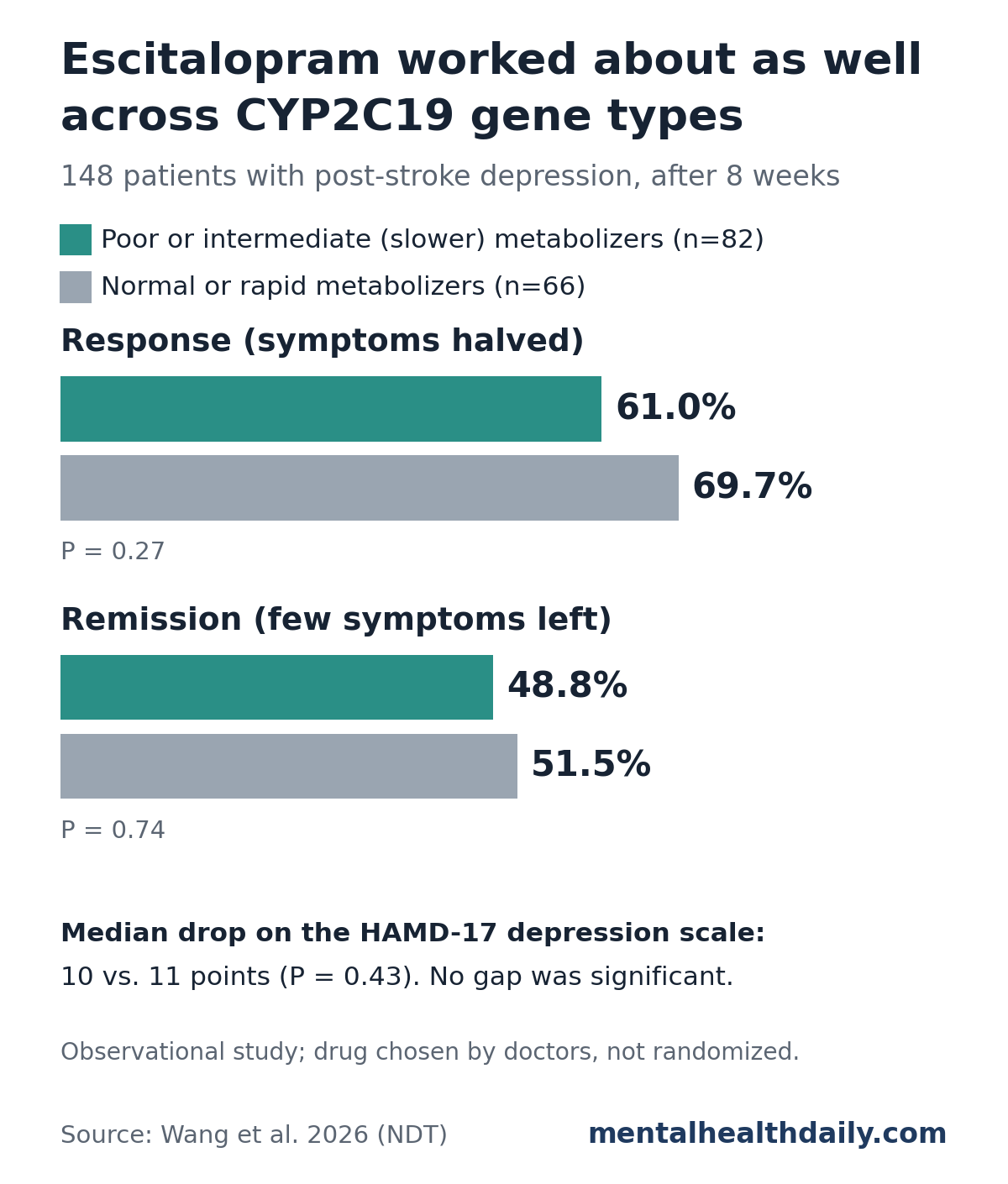
Among the 148 escitalopram patients, 18 were poor metabolizers, 64 intermediate, 63 normal, and 3 rapid. Because the extreme groups were small, the researchers pooled them into 82 slower metabolizers (poor or intermediate) and 66 normal or rapid metabolizers.1
The two groups started at the same depression level (median HAMD-17 of 18 vs. 17) and ended in the same place:
- Symptom drop: median 10 points in slower metabolizers vs. 11 points in normal or rapid metabolizers (P = 0.434; estimated difference −1.0 point, 95% CI −3.0 to 1.0)
- Response (at least a 50% drop in score): 50 of 82 (61.0%) vs. 46 of 66 (69.7%), P = 0.269
- Remission (HAMD-17 of 7 or lower): 40 of 82 (48.8%) vs. 34 of 66 (51.5%), P = 0.741
The pattern held at earlier check-ins. At week 4, 41.5% of slower metabolizers and 33.3% of normal or rapid metabolizers had responded, a difference that ran the other way and was also not significant.1
An adjusted model that accounted for age, sex, lifestyle, other illnesses, stroke type, and baseline symptom and disability scores again found no link between CYP2C19 group and symptom drop (P = 0.439).1
Stroke Disability and Starting Depression Severity Predicted Escitalopram Response
Clinical features did a better job than genes. In the escitalopram group, two baseline measures stood out in the adjusted analysis:1
- Disability after stroke: each 1-point increase on the modified Rankin Scale (a 0-to-6 disability score where higher is worse) was linked to lower odds of response (adjusted OR 0.49) and remission (adjusted OR 0.54)
- Starting depression severity: each extra HAMD-17 point at baseline was linked to higher odds of response (adjusted OR 1.29)
The researchers note that the severity finding matches earlier antidepressant studies, where people who start with more symptoms tend to show larger improvements.
In the venlafaxine group, a higher Barthel Index (a score of independence in daily activities such as eating, dressing, and walking) was linked to higher odds of response and remission. A higher baseline PHQ-9 self-rated depression score was linked to lower odds of remission.1
Why CYP2D6 and Venlafaxine Could Not Be Tested
Of 113 venlafaxine patients, 111 were CYP2D6 normal metabolizers and 2 were intermediate. There were no poor or ultrarapid metabolizers, so the researchers had no comparison group and did not run the analysis.1
Two things explain the lopsided split:
- Population genetics. CYP2D6 poor and ultrarapid metabolizers are rare in Han Chinese people. The researchers cite a separate Chinese study of 2,467 patients that found none.
- A limited gene panel. The test checked only 4 CYP2D6 variants (*1, *2, *4, *10), which cover about 80% of variants in this population. Rarer variants such as *5 and *41 were missed, so some patients may have been misclassified.
CYP2C19 Rarely Predicts Antidepressant Response in Larger Depression Studies
The null result is consistent with larger studies in major depression. In the European GENDEP study, CYP2C19 gene type was linked to escitalopram blood levels in 223 patients, but neither the gene type nor the blood level predicted who got better.2
A 2024 meta-analysis pooled data on 5,843 depressed patients from 13 studies of European and East Asian ancestry. CYP2C19 poor metabolizers had somewhat higher remission rates than normal metabolizers (OR 1.46), but the result did not survive correction for multiple testing. No metabolizer type was linked to the percentage of symptom improvement.3
Test-guided prescribing shows a small benefit at best. In the PRIME Care trial of 1,944 US veterans, giving doctors pharmacogenomic results steered prescriptions away from drugs with predicted gene interactions. Remission rates over 24 weeks were modestly higher (risk difference 2.8%) but not significantly higher at week 24.4 MentalHealthDaily has also covered pharmacogenomic testing and SSRI remission in major depression.
The new study adds stroke patients to that picture. Until now, data on gene type and antidepressant outcomes in post-stroke depression had been scarce.1
Limitations of This Post-Stroke Escitalopram Study
This was a single-center observational study, which can show whether gene type and outcome moved together but cannot rule out a modest effect. Specific limits:
- Few extreme metabolizers. Only 18 poor and 3 rapid CYP2C19 metabolizers were enrolled, and none were ultrarapid. Pooling them with intermediate and normal metabolizers could hide an effect that shows up only at the extremes.
- No randomization. Doctors chose escitalopram or venlafaxine, and there was no placebo group.
- Fixed, modest dose. Everyone took 10 mg of escitalopram, and blood levels and side effects were not compared by gene type, so the study could not show whether genes affect side effects or the best dose.
- Narrow population. Participants were hospitalized Han Chinese adults with moderate-to-severe depression in the weeks after a stroke. People with aphasia or major cognitive problems were excluded.
- Remote follow-up. Most follow-up ratings were done by phone or video call.
- Reporting inconsistency. The abstract lists 64 normal or rapid metabolizers, while the results text and main table list 66; the numbers here use 66.
What This Means for Gene Testing After a Stroke
- Most stroke patients improved on escitalopram. About half reached remission in 8 weeks regardless of CYP2C19 group.
- CYP2C19 testing did not help predict who would improve. Disability and starting depression severity were more informative in this group.
- Poor metabolizers remain an open question. With only 18 in the study, there were too few to tell whether they respond differently.
- Venlafaxine and CYP2D6 still need study, ideally with a fuller gene panel and a more varied population.
The researchers concluded that gene testing may not yet be useful enough for choosing antidepressants and favored cheaper, practical approaches over costly testing alone. Anyone with new or worsening depression after a stroke should raise it with their care team, since treatment helps many patients.
References
- Wang Y, Sun W, Pan C, Zhu Z, Li G, Zhao X, Zhu S. Association between CYP450 polymorphisms and treatment outcomes of escitalopram and venlafaxine in patients with post stroke depression. Neuropsychiatric Disease and Treatment. 2026;22:610626. doi:10.2147/NDT.S610626
- Hodgson K, Tansey K, Dernovšek MZ, et al. Genetic differences in cytochrome P450 enzymes and antidepressant treatment response. Journal of Psychopharmacology. 2014;28(2):133–141. doi:10.1177/0269881113512041
- Li D, Pain O, Fabbri C, et al. Metabolic activity of CYP2C19 and CYP2D6 on antidepressant response from 13 clinical studies using genotype imputation: a meta-analysis. Translational Psychiatry. 2024;14:296. doi:10.1038/s41398-024-02981-1
- Oslin DW, Lynch KG, Shih MC, et al. Effect of pharmacogenomic testing for drug-gene interactions on medication selection and remission of symptoms in major depressive disorder: the PRIME Care randomized clinical trial. JAMA. 2022;328(2):151–161. doi:10.1001/jama.2022.9805